
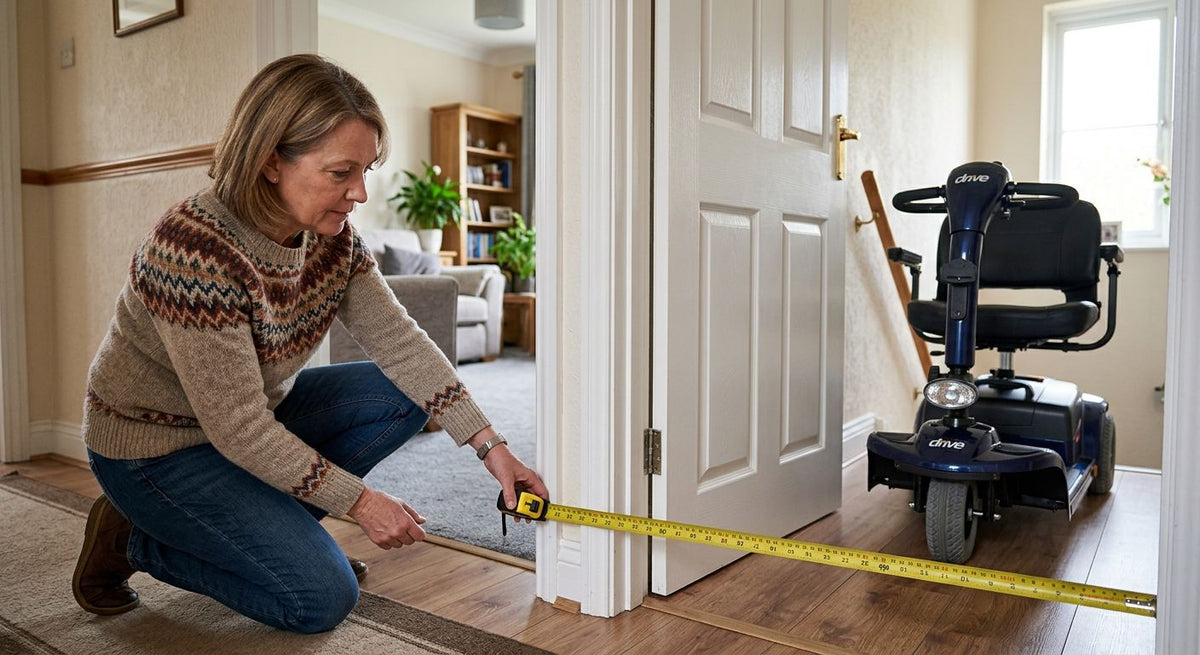
A standard interior door with a 32-inch nominal size clears about 27 to 29 inches once you account for the frame, hinges, and stop molding — and most mobility scooters need at least 28 to 32 inches of clear width to pass through without scraping a fender or door casing. Measure the clear opening, not the door slab size, and check it against your scooter's actual width plus a 2-inch buffer before you assume it fits.
- Measure clear doorway width frame-to-frame, not the door slab — most homes clear only 27-29 inches on a 32-inch nominal door.
- Mobility scooters run 24-29 inches wide; add a 2-inch buffer on each side before calling a doorway passable.
- Turning scooters need 42-60 inches of clear floor space to pivot, not just a wide doorway.
- Door swing direction and hinge offset can shrink usable width by 1-3 inches even when the frame measures fine.
- Threshold height over 0.5 inches stalls most scooters — plan a bevel or ramp before move-in day.
Why this matters
A scooter that fits through a showroom aisle can still get stuck in a bathroom doorframe. The gap between "door looks wide enough" and "scooter actually clears it" is where most home accessibility projects stall in 2026 — usually discovered after the scooter is already delivered.
Getting this measurement wrong costs more than an afternoon. Widening a doorway means removing trim, sometimes reframing, and in older homes it can mean load-bearing surprises. Measuring correctly the first time — scooter width, clear opening, swing path, and threshold height — avoids a second trip to the hardware store and a scooter parked in the garage.
Before you start
- Your scooter's exact width spec. Check the manufacturer's manual or the frame sticker — don't eyeball it. Three-wheel scooters typically run 22-26 inches wide; four-wheel and heavy-duty models often reach 27-29 inches.
- A tape measure and a helper. Doorway measurements are easiest with two people — one holding the tape at the narrowest point, one reading it.
- The gotcha: doorway width is measured stop-to-stop (the two vertical door stops the door closes against), not jamb-to-jamb. Skipping the stop molding in your measurement overstates clearance by half an inch to a full inch on each side — enough to turn a tight-but-passable doorway into a stuck one.
Measure the doorway's clear width
- Open the door fully against the wall or to its maximum swing.
- Measure from the inside face of one door stop to the inside face of the opposite door stop, at the narrowest point — usually at hinge height where the hinge barrel protrudes slightly into the opening.
- Take three measurements: top, middle, and bottom of the frame. Older homes settle, and frames are rarely perfectly square.
- Record the smallest of the three numbers — that's your true clear width.
Expected result: you have one number, in inches, that represents the tightest point a scooter must pass through. Compare it directly against your scooter's width spec plus 2 inches of buffer.
Measure your scooter's actual footprint
- Measure the scooter at its widest point — this is almost always across the rear wheels or the armrests, not the seat.
- Measure the scooter's turning radius or check the spec sheet for it directly.
- Note the overall length, since tight hallway turns matter as much as doorway width when a scooter has to pivot to enter a room.
Expected result: a width figure and a turning radius figure. A scooter measuring 26 inches wide needs a minimum 28-inch clear doorway; anything tighter forces the rider to angle through, which is workable occasionally but not for daily use.
Check door swing and hinge clearance
- Note which way the door swings — into the room or out into the hallway.
- If the door swings into a small room (a bathroom, typically), measure the remaining floor space with the door fully open. A scooter needs 42 to 60 inches of clear floor to complete a turn once inside.
- Consider whether the door can be rehung to swing the other way, or replaced with a pocket door or offset (swing-clear) hinges, which can add 1.5 to 2 inches of usable width without touching the framing.
Expected result: you know whether the bottleneck is the doorway itself or the room behind it. Swing-clear hinges alone solve a surprising number of "too narrow" doorways without any demolition.
Account for thresholds and transitions
- Measure the height of any threshold strip, sill, or transition between rooms.
- Anything over 0.5 inches typically requires a bevel or a low-profile transition ramp — most scooters stall or jolt hard on a square-edged threshold above that height.
- Check exterior doors separately; those thresholds run higher than interior ones and almost always need a ramp for scooter access. Homeowners planning a full charging and storage setup near an entry door should also review setting up a home charging station for a mobility scooter, since doorway clearance and charging placement usually get planned together.
Expected result: a list of every threshold in the scooter's daily path, flagged pass or needs-ramp.
Measuring for a power wheelchair instead
If the household is choosing between a scooter and a power wheelchair, the doorway math shifts. Power wheelchairs average 24-27 inches wide — often narrower than heavy-duty four-wheel scooters — but their turning radius can run tighter or wider depending on the drive-wheel configuration (front-wheel drive chairs pivot in less space than mid-wheel models). If the same doorway needs to serve both a scooter parked in a garage and a wheelchair used indoors, measure for the wider of the two devices and use that as your baseline.
Troubleshooting
The doorway measures 30 inches but the scooter still scrapes. Check hinge height — hinge barrels and door closers sometimes protrude further into the opening than the door stop itself. Remeasure at the hinge line specifically.
The scooter fits the doorway but can't turn into the room. This is a floor-space problem, not a doorway problem. Widening the door won't help; you need 42-60 inches of clear turning radius on the far side.
Two doorways measure the same but one feels tighter. Door swing direction and molding profile both affect the felt width. A door swinging away from the scooter's path always feels wider than one swinging toward it, even at identical clear-width measurements.
The threshold is fine but the scooter still jolts. Check for a second, less obvious transition — carpet-to-tile seams and old vinyl edging often add an unmeasured quarter-inch bump that a tape measure on the door frame won't catch.
What to do next
Once doorway clearance is confirmed, the next planning steps are usually storage and transport. If the scooter needs to leave the house regularly, review transporting a mobility scooter in your car for ramp and lift sizing — the same width-and-clearance logic applies to vehicle ramps as it does to doorways. Households also adding a lift chair or stairlift to the same accessibility plan should read planning a lift chair and stairlift installation together before finalizing doorway or hallway widths, since stairlift rail clearance can compete with scooter turning space in tight hallways.
Plan your scooter's home setup
Doorway clearance and charging placement work best planned together.
FAQ
How wide does a doorway need to be for a mobility scooter?
A doorway needs at least 28 to 32 inches of clear width for most mobility scooters, measured stop-to-stop rather than jamb-to-jamb. Heavy-duty four-wheel scooters running 27-29 inches wide need the upper end of that range plus a 2-inch buffer.
What's the difference between clear width and door slab width?
Clear width is the actual open gap between door stops when the door is fully open; door slab width is the size printed on the door itself, which is always larger. A 32-inch nominal door typically has only 27-29 inches of true clear width once hinges and stop molding are accounted for.
Is measure doorway for mobility scooter different for wheelchairs?
The core steps are the same — clear width, turning radius, threshold height — but power wheelchairs average 24-27 inches wide, often narrower than heavy four-wheel scooters. Measure for whichever device is wider if both will use the same doorway.
How much floor space does a scooter need to turn through a doorway?
Most scooters need 42 to 60 inches of clear floor space on the far side of a doorway to complete a turn. A wide doorway doesn't help if the room behind it is too small for the scooter to pivot.
Can swing-clear hinges fix a too-narrow doorway?
Swing-clear (offset) hinges can add 1.5 to 2 inches of usable clear width by swinging the door fully out of the opening instead of partially into it. This is often enough to turn a marginal doorway into a passable one without any framing work.
What threshold height is too high for a mobility scooter?
Thresholds over 0.5 inches typically stall or jolt a mobility scooter and need a beveled transition or ramp. Exterior door thresholds run higher than interior ones and almost always require a ramp.
Do I need a contractor to widen a doorway for a scooter?
Simple trim removal or hinge swaps can often be done without a contractor, but any doorway requiring reframing — especially on load-bearing walls — should be handled by a licensed contractor. Measure first; many doorways only need hinge or threshold changes, not demolition.
One last thing
The most common doorway failure in 2026 accessibility retrofits isn't the doorway at all — it's the hallway turn just before it. A scooter can clear a 30-inch doorway easily and still get stuck trying to line up for the approach in a hallway narrower than its turning radius. Measure the full path, not just the frame, before ordering anything.