
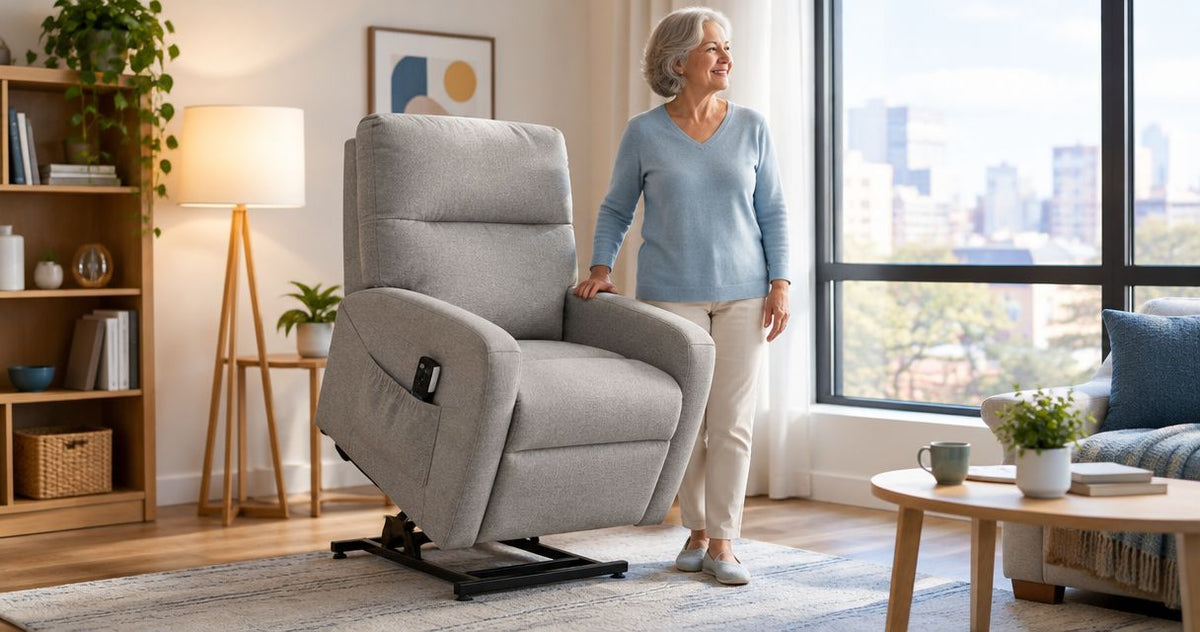
Best overall: a compact wall-hugger power lift chair. Best for shorter users: a petite power lift chair. Best for independent backrest and footrest adjustment: a dual-motor lift chair. The best lift chairs for small apartments fit both your body and the chair’s full movement area—not just the empty corner beside your sofa.
By Editorial Team
A power lift chair raises and tilts its seat to assist the transition toward standing; a regular power recliner does not necessarily provide that function. This Aeva Vital guide ranks chair configurations rather than individual models, so you can identify the right design before comparing product specifications. Start with the distinction between lift assistance and wall-hugger recliners for small spaces: a space-saving reclining mechanism does not, by itself, confirm powered lift assistance.
- For 2026, prioritize a compact wall-hugger power lift chair when rear clearance is your main constraint.
- The best lift chairs for small apartments need verified reclined dimensions, seat measurements, and delivery access.
- Choose petite sizing for body fit, not simply because your living room is small.
- Choose independent backrest and footrest controls only when you need separate positioning.
Why this matters
A lift chair occupies different amounts of space when upright, reclined, and raised. A chair that looks compact in a photograph can still block your apartment’s main walkway when the footrest extends.
Buy for the largest operating footprint, not the smallest advertised footprint. For your 2026 shortlist, treat body fit, movement clearance, and the delivery route as pass-or-fail requirements before considering upholstery or convenience features.
What makes the best lift chairs for small apartments?
Use these criteria to compare every candidate:
- Operating footprint: Obtain overall width, upright depth, fully reclined depth, and the manufacturer’s required wall clearance.
- Seat fit: Compare seat height, usable width, and depth with the person who will use the chair.
- Lift function: Confirm that the exact model provides powered seat lift, not reclining alone.
- Controls: Check whether the backrest and footrest move together or independently, and whether the handset is easy to operate.
- Delivery access: Compare packaged dimensions or approved disassembled dimensions with doors, hallways, elevators, and turns.
- Support information: Read the exact model’s weight limit, power requirements, care instructions, and service terms.
No single feature wins every category. A petite chair can also have a wall-hugger mechanism, while a dual-motor chair can have a compact exterior. These rankings identify your first selection priority; they are not mutually exclusive product categories.
Lift chair configurations at a glance
| Rank and configuration | Best for | Standout feature | Key limitation |
|---|---|---|---|
| 1. Compact wall-hugger power lift chair | Limited space behind the chair | Forward-moving reclining mechanism reduces required rear clearance | Still needs front clearance and a verified lift function |
| 2. Petite power lift chair | Shorter users who need a better seat fit | Smaller seat proportions | Smaller sizing is not suitable for every user |
| 3. Dual-motor power lift chair | Separate backrest and footrest positioning | Independent adjustment when specified | Motor count does not establish a compact footprint |
| 4. Basic single-motor power lift chair | Users who prefer linked reclining movement | Simpler combined positioning | Less control over individual reclining components |
1. Compact wall-hugger: best for limited rear clearance
A wall-hugger reclining mechanism moves the seating assembly forward as the backrest reclines. That design reduces the space needed behind the chair compared with a mechanism that reclines backward without the same forward travel. Select a model that explicitly includes powered lift assistance.
For apartment shopping in 2026, this is the first configuration to investigate when a wall limits placement. It does not eliminate the need to measure the footrest’s reach.
Compact wall-hugger pros:
- Reduces the rear-clearance requirement through its reclining geometry.
- Lets you prioritize placement near a wall.
- Combines reclining and standing assistance when both functions are specified.
Compact wall-hugger cons:
- Forward travel still occupies usable floor space.
- The wall-hugger label provides no universal clearance measurement.
Best for: A room where space behind the chair is the main constraint, but front clearance remains available.
Verdict: Buy this configuration when the exact operating dimensions preserve your walkway.
2. Petite power lift chair: best for shorter users
A petite lift chair uses smaller seating proportions intended for smaller users. Evaluate the actual seat measurements rather than relying on the size label: manufacturers do not use a single universal definition of petite.
Your feet should have appropriate support in the seated position, and the seat should not force you to slide forward to reach the floor. If the chair supports a medical or post-surgical need, have an occupational therapist or other qualified clinician assess fit and transfer technique.
Petite power lift chair pros:
- Gives shorter users a smaller-seat option to evaluate.
- Helps distinguish usable seat dimensions from bulky exterior styling.
- Allows body fit to guide the purchase rather than room size alone.
Petite power lift chair cons:
- Reduced seat dimensions do not suit taller or broader users.
- A petite seat does not establish low wall-clearance requirements.
Best for: A shorter user whose current chair feels too tall or too deep.
Verdict: Buy for confirmed body fit; skip petite sizing as a room-saving shortcut.
3. Dual-motor power lift chair: best for separate positioning
A dual-motor reclining arrangement can provide separate backrest and footrest movement. Confirm that functionality in the exact model’s manual, because motor count alone does not describe every available movement.
Choose this configuration when you want to change the back angle without necessarily moving the footrest at the same time. In a small apartment, its dimensions still have to pass the same clearance checks as any simpler chair.
Dual-motor power lift chair pros:
- Provides independent positioning when that function is specified.
- Lets you evaluate back support and leg position separately.
- Offers a useful alternative to a linked reclining sequence.
Dual-motor power lift chair cons:
- Additional controls require more familiarity.
- Independent movement does not prove better fit or a smaller footprint.
Best for: A user who specifically needs separate backrest and footrest adjustment.
Verdict: Buy for a demonstrated positioning need, not for motor count alone.
4. Single-motor power lift chair: best for simpler operation
A basic single-motor lift recliner typically links reclining movements through its mechanism. Check the operating sequence before choosing it: the relationship between footrest extension and backrest recline determines whether the available positions suit you.
For a 2026 apartment purchase, this configuration deserves consideration when you prefer straightforward controls over separate adjustments. Do not assume that fewer controls mean a narrower chair or a shorter reclined length.
Single-motor power lift chair pros:
- Offers a simpler linked movement sequence to evaluate.
- Suits users who do not need independent positioning.
- Keeps the buying decision focused on essential lift and recline functions.
Single-motor power lift chair cons:
- Restricts separate backrest and footrest adjustment.
- The linked sequence will not suit every preferred sitting position.
Best for: A user who prefers simple operation and is comfortable with the demonstrated reclining sequence.
Verdict: Buy after trying the controls; skip if independent positioning is essential.
Measure the apartment before choosing the chair
Record 3 operating positions: upright, fully reclined, and fully raised. Ask the seller for the dimensions or clearance drawing covering each position, then mark the occupied area on your floor with removable tape.
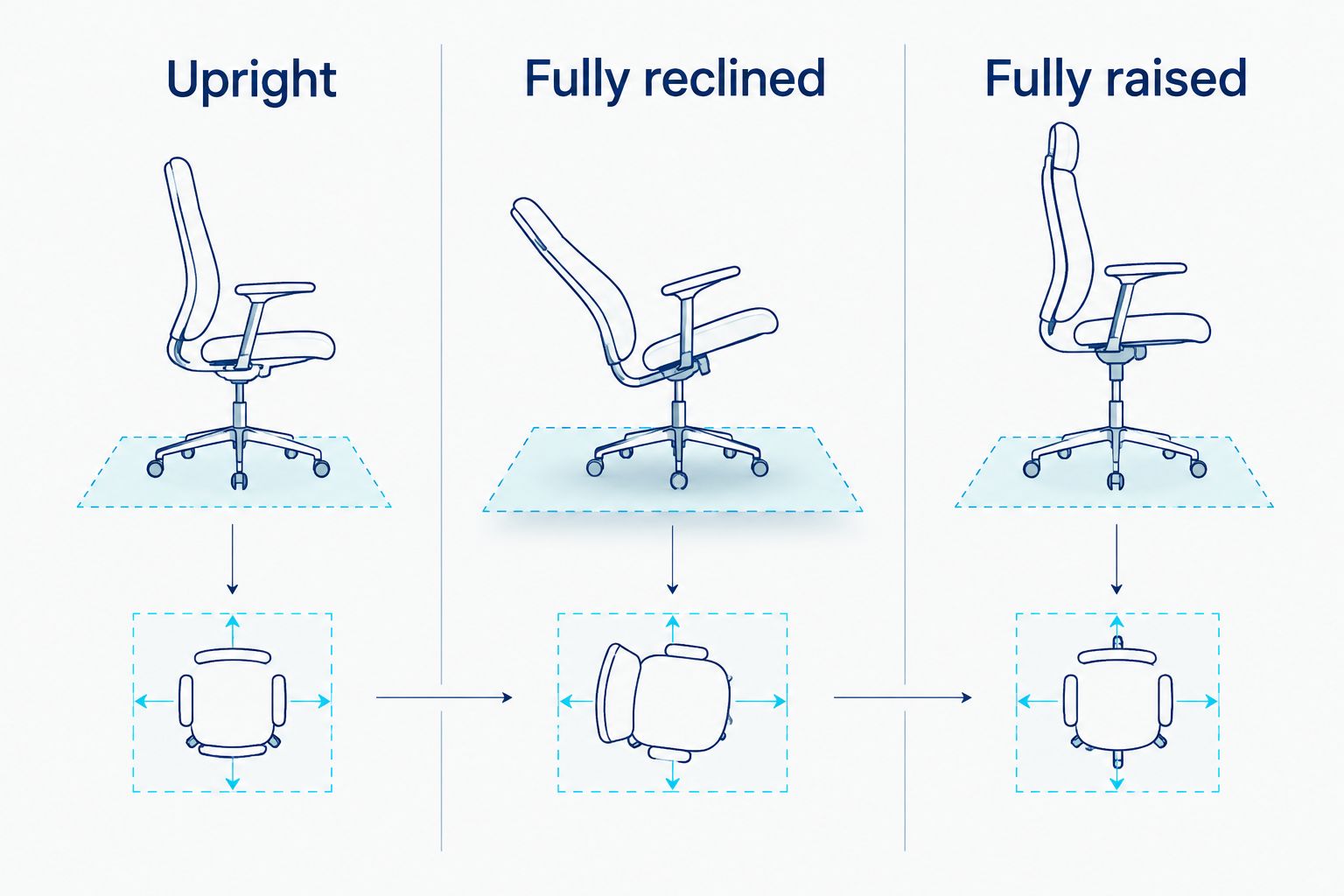
Measure 2 seat dimensions separately from the chair’s overall width: usable seat width and seat depth. Then record seat height as well. Thick arms can make an externally wide chair surprisingly restrictive inside.
Check the following before approving the layout:
- Front access: Leave room for the footrest and for approaching the chair.
- Standing area: Keep the area ahead of the raised seat free of tables and rugs that obstruct movement.
- Side access: Preserve the space needed for your normal transfer technique or caregiver assistance.
- Power route: Keep cords out of walkways and moving mechanisms; follow the manufacturer’s connection instructions.
- Doors and storage: Test nearby door swings, drawers, and cabinet access against the taped outline.
Do not borrow another model’s clearance figure. Even chairs with similar upholstery and arm shapes can use different mechanisms.
Check delivery access and construction
Measure 3 delivery checkpoints: the building entrance, the narrowest interior opening, and the tightest turn. Include the elevator and apartment doorway where applicable. Clear opening width matters more than the nominal door size.
Ask whether the backrest is designed to detach and request the resulting component dimensions. A removable back can change delivery access, but it does not mean that every other component separates or that assembly is included.
Construction details need the same discipline. A listed upholstery material tells you what covers the chair; it does not establish stain resistance, cleaning compatibility, or seam durability. Read the care label before selecting fabric for frequent use.
Likewise, a published weight capacity is a model-specific limit, not proof of seat comfort or transfer suitability. Keep those questions separate when comparing specifications.
Aeva Vital product check: reclining is not powered lifting
The Aeva Vital catalog includes the Upholstered Folding Rocking Chair with Adjustable Footrest. Its listed description identifies a high backrest, thick sponge cushioning, and adjustable recline and footrest features. Those details describe seating features; they do not establish a powered seat-lift mechanism.
Do not substitute a rocking chair, folding recliner, or zero-gravity seat for a specified power lift chair when standing assistance is the requirement. Aeva Vital’s lift chair selection rule is simple: verify powered lifting before comparing comfort extras.
For any candidate, request the exact model manual and dimensional drawing. Treat heat, massage, charging ports, and storage pockets as secondary features after fit, access, and lift operation pass inspection.
How the configurations are ranked
This 2026 ranking puts the apartment’s limiting condition first: rear clearance, user proportions, positioning needs, or control simplicity. It is a configuration-based buying guide, not a claim that particular models underwent comparative testing.
Wall-hugger designs take the default slot because they directly address rear clearance. Petite sizing, independent adjustment, and linked operation each win a different use case. No configuration receives an exemption from the measurement checklist.
Which lift chair should you choose?
Start with a compact wall-hugger power lift chair, then confirm seat fit and the full operating footprint. If seat height or depth is the bigger problem, prioritize petite sizing instead. If separate positioning is essential, require independent backrest and footrest controls.
Before buying, ask the seller to confirm the exact model, dimensions, lift operation, delivery configuration, and written return terms. Keep those answers with your order record rather than relying on a category-page description.
Related guides
- Routing lift chair power cords safely in small apartments
- Can a lift chair fit through a standard doorway?
- How do you clean a fabric lift chair?
FAQ
What are the best lift chairs for small apartments?
Start with compact wall-hugger power lift chairs when rear clearance is your main constraint. Confirm powered lifting, seat fit, fully reclined dimensions, and delivery access before choosing a model.
Is a petite lift chair always better for a small apartment?
No. Petite sizing addresses user proportions, not every room-clearance requirement. Compare actual seat dimensions and the complete operating footprint.
Does a wall-hugger recliner help you stand up?
Only a model with a specified powered lift function provides that type of assistance. Wall-hugger describes reclining geometry, not seat lifting.
How close can a lift chair sit to the wall?
Use the exact model’s required wall clearance. There is no single clearance measurement that applies to every lift chair or wall-hugger mechanism.
Is a dual-motor lift chair better than a single-motor chair?
A dual-motor arrangement is better suited to separate backrest and footrest positioning when that functionality is specified. A linked single-motor arrangement suits users who prefer its simpler movement sequence.
Can a lift chair fit through a narrow apartment doorway?
Fit depends on the clear opening and the chair’s packaged or approved disassembled dimensions. Measure the entire delivery route, including tight turns and elevators.
Can I replace a lift chair with a rocking recliner?
Not when powered standing assistance is the requirement. Rocking, reclining, and adjustable footrests do not establish a powered seat-lift function.
What should I check before ordering a lift chair online?
Confirm the model’s dimensions, seat fit, lift function, operating clearances, delivery configuration, and written return terms. Ask for the manual and dimensional drawing before ordering.
One last thing
The empty space in front of a lift chair is part of its usable footprint, not leftover floor area. Before ordering in 2026, walk through your taped layout with the chair represented in its fully reclined position; if the route fails, change the layout or the chair.