
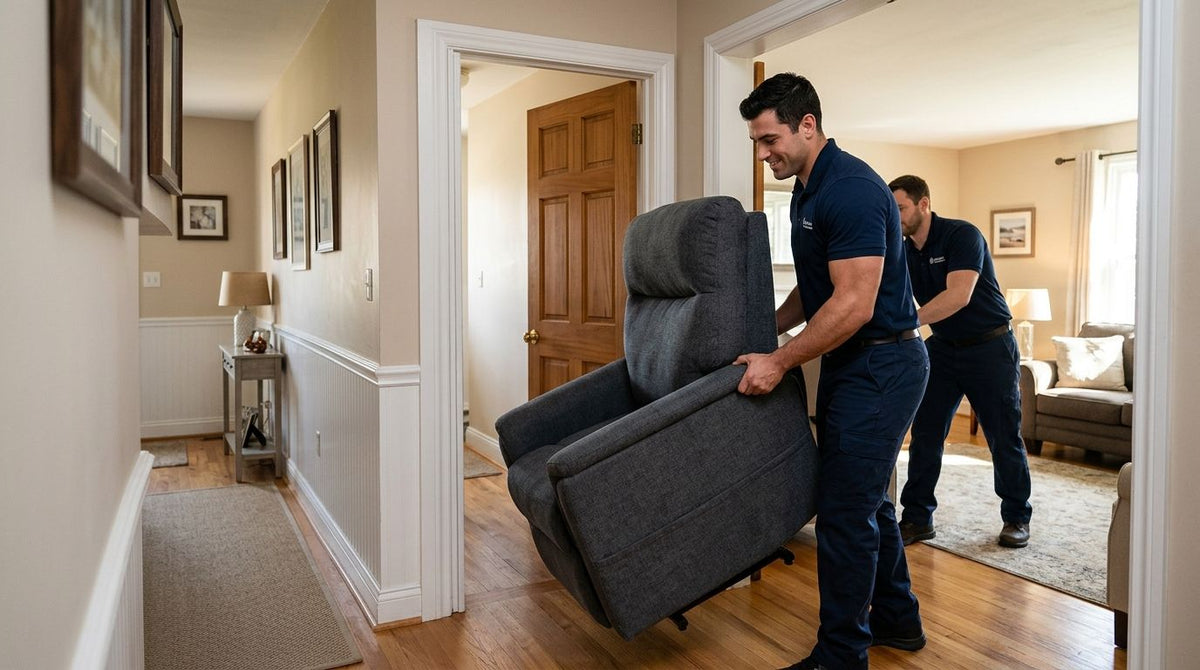
Most lift chairs fit through a standard doorway, but not always in the position they arrive in — a chair measuring 30 to 36 inches wide upright can be tighter than the 27 to 34 inches of clear passage a typical 30-, 32-, or 36-inch interior door actually provides in 2026. The real obstacle usually isn't the doorway itself; it's turning the chair through a hallway corner or maneuvering it into a room with a tight approach angle.
- Standard 36-inch doors give roughly 34 inches of clear passage — enough for most lift chairs on their side.
- A 30-inch door clears about 27 inches, which stalls many lift chairs moved upright.
- ADA-compliant 32-inch clear width doorways still require tilting or removing the back on wider recliners.
- Measure the chair's widest point (usually the arms) before you measure the doorway.
- Aeva Vital's guide on measuring doorways for mobility scooter access applies the same tape-measure method to lift chairs.
Why This Matters
A lift chair that doesn't clear the doorway isn't a minor inconvenience — it's a delivery that gets refused, a chair stuck in a hallway, or a return shipment nobody budgeted for. Anyone furnishing a home for post-surgical recovery, assisted living, or aging in place needs to know the fit before the chair shows up on the truck, not after.
The guide on measuring doorways for mobility scooter access covers the same tape-measure method used for lift chairs, since both rely on clear width rather than the number stamped on the door frame.
Can a Lift Chair Fit Through a Standard Doorway?
Yes, in most cases — but the fit depends on which of three common door widths you're working with and whether the chair travels upright or on its side.
| Door type (nominal) | Approx. clear width | Fits most lift chairs upright? |
|---|---|---|
| 30-inch interior door | ~27 inches | No — tilt or remove the back |
| 32-inch interior door | ~29 inches | Rarely — depends on arm width |
| 36-inch door (ADA-compliant) | ~34 inches | Usually yes |
The gap between nominal door size and actual clear width comes from the door slab, hinges, and stop molding eating into the opening. A door labeled "36 inches" rarely delivers a full 36 inches of clearance once it's hung.
30-Inch Door: About 27 Inches Clear
A 30-inch door is the tightest common size in older homes and most bathrooms. Skip moving a lift chair through upright — tilt it 45 degrees on its wheels or dolly, lead with the back corner, and expect to remove any protruding side pockets or cup-holder consoles first.
32-Inch Door: About 29 Inches Clear
This is the width most codes reference when people say "ADA doorway," though true ADA compliance requires 32 inches of clear width, which usually means a 34- or 36-inch nominal door once hardware is accounted for. A 32-inch door still stalls wider recliners — measure the chair's arm-to-arm width before assuming it clears.
36-Inch Door: About 34 Inches Clear
This is the size that reliably passes most lift chairs upright, including bariatric and wide-body models. If a home is being retrofitted for a lift chair alongside other mobility equipment, widening entry doors to 36 inches solves the problem for chairs, wheelchairs, and scooters at once — the same threshold covered in the assisted living lift chair guide.
Why Doorway Fit Varies
- Chair width at the arms — lift chairs range 30 to 36 inches wide upright, and the arms (not the seat) are almost always the widest point.
- Door hardware and trim — hinges and stop molding shave 2 to 3 inches off the nominal door width before you get a real clear-passage number.
- Hallway turning radius — a chair that clears the door can still stall if the hallway is too narrow to pivot it 90 degrees into the room.
- Removable backrest design — many lift chairs ship with a bolt-on back panel that drops the overall width by several inches once detached.
- Recliner footrest and side consoles — power lift recliners with side pockets or USB consoles add width that isn't reflected in the base spec sheet.
- Moving equipment used — a furniture dolly or appliance strap changes the angle you can carry the chair at, which affects how much clearance you actually need.
Plan your lift chair setup right
Check fit, wiring, and placement before delivery day.
How Do You Measure a Doorway for a Lift Chair?
Measure the clear width between the door stops, not the door slab itself, since the slab number overstates the usable opening by 2 to 3 inches. Then measure the lift chair at its widest point — typically the arms — and confirm at least 1 to 2 inches of margin on each side for a clean pass.
Can You Remove the Back of a Lift Chair to Fit It Through a Door?
Yes, most lift chairs have a back panel that unbolts or unpins from the base, and removing it typically narrows the chair by several inches for the doorway pass. Reattach the back once the chair is in position — most models use two to four bolts that don't require special tools.
Do Narrow Lift Chairs Exist for Small Apartments or Older Homes?
Yes, narrower or petite lift chair frames exist and generally run toward the lower end of the 30-to-36-inch width range, closer to what a 30- or 32-inch door can pass without tilting. If a home has 30-inch interior doors throughout, checking a chair's spec sheet for arm-to-arm width in 2026 before ordering avoids a doorway surprise on delivery day.
Fit problems compound when a lift chair shares a hallway with other recovery equipment. The lift chair and hospital bed rail setup guide and the lift chair and stairlift installation guide both walk through sequencing deliveries so nothing gets wedged in a narrow hallway.
Budget matters here too — a chair that requires professional disassembly to fit through a door adds a cost most buyers don't plan for, which the lift chair cost breakdown for 2026 accounts for separately from the sticker price.
FAQ
Can a lift chair fit through a standard doorway?
Most lift chairs fit through a standard 36-inch door, which clears roughly 34 inches, but a 30-inch door at about 27 inches clear usually requires tilting the chair or removing the back panel.
What is the widest part of a lift chair?
The arms are almost always the widest point on a lift chair, typically pushing total width to 30 to 36 inches depending on the model.
Do movers need to remove doors to deliver a lift chair?
Removing the door isn't usually necessary if the chair is tilted on its side, but taking the door off its hinges adds 2 to 3 inches of extra clearance on tight 30-inch openings.
Is a 32-inch doorway wide enough for a wheelchair and a lift chair?
A 32-inch nominal door clears about 29 inches, which meets minimum wheelchair passage guidelines but still stalls wider lift chairs moved upright.
How much clearance should I leave when measuring a doorway for a lift chair?
Leave at least 1 to 2 inches of margin between the chair's widest point and the doorway's clear width to avoid scraping trim or hardware.
Can I return a lift chair if it doesn't fit through my door?
Return policies vary by retailer, so confirm the doorway clearance against the chair's arm-to-arm width before ordering rather than relying on a return as the fallback plan.
One Last Thing
The number printed on a door frame is almost never the number that matters — a "36-inch door" and its actual 34-inch clear passage are two different measurements, and that 2-inch gap is exactly where lift chair deliveries go wrong in 2026. Measure clear width with the door open 90 degrees, not the slab size on the box.