

Best overall: a correctly fitted dual-motor power lift chair. Best for straightforward operation: a single-motor lift chair; best for shorter users: a petite lift chair. The best lift chairs for arthritis in 2026 match your seated dimensions, support a controlled standing transfer, and have controls you can operate comfortably.
By Editorial Team
- The best lift chairs for arthritis prioritize seat fit and controlled standing assistance over heat or massage.
- Dual-motor lift chairs suit users who need separate backrest and footrest adjustment.
- Petite and tall lift chairs address body fit; neither label replaces actual seat measurements.
- A power recliner is not a lift chair unless its mechanism raises the seat for standing.
Why this matters
A power lift chair raises and tilts its seat to assist the transition toward standing. A standard power recliner adjusts your resting position but does not necessarily provide that lifting function.
For arthritis, the buying question is practical: can you sit, reposition, and get up without struggling with the furniture? A lift chair is an assistive seating choice, not a treatment for arthritis or a guarantee of independent transfers.
Aeva Vital’s best lift chairs guide covers the broader category. This 2026 guide narrows the decision to joint-sensitive seating, usable controls, and chair fit.
What makes the best lift chairs for arthritis?
Judge every candidate against these criteria before comparing extras:
- Seat fit: Your feet rest on the floor when upright, and the cushion supports your thighs without pressing behind your knees.
- Lift motion: The chair moves you toward a standing position you can control, rather than leaving you perched or sliding.
- Position adjustment: Backrest and footrest movement match the positions you actually use.
- Hand controls: Buttons remain reachable and operable with your usual grip and finger movement.
- Room compatibility: The chair clears walls, furniture, walking aids, and your route out of the seat.
- Support and service: Published capacity, operating instructions, and repair arrangements are clear before purchase.
Fit comes before motor count. More adjustments cannot correct a seat that leaves your feet dangling or places the armrests beyond comfortable reach.
Lift-chair configurations at a glance
These are configuration recommendations, not rankings of individual products. Features overlap: a petite chair can also have independent motors and a space-saving mechanism.
| Rank and configuration | Best for | Standout feature | Key limitation |
|---|---|---|---|
| 1. Dual-motor lift chair | Independent resting adjustments | Separate backrest and footrest control | More controls to learn; fit still determines suitability |
| 2. Single-motor lift chair | Straightforward operation | Linked reclining movement | Less freedom to combine back and leg positions |
| 3. Petite lift chair | Shorter users | Smaller-scale seating dimensions | A petite label does not specify actual fit |
| 4. Tall lift chair | Taller users | Longer seating proportions | Extra depth can hinder transfers if oversized |
| 5. Wall-hugger lift chair | Restricted room depth | Space-saving reclining mechanism | Required wall clearance remains model-specific |
1. Dual-motor lift chair: best for independent positioning
A dual-motor lift chair typically lets you adjust the backrest and footrest separately. Confirm the control layout and movement sequence in the operating manual; motor terminology alone does not describe every function.
This configuration suits you when one linked reclining movement cannot produce your preferred resting position. For example, you might want your legs supported while keeping your back relatively upright.
Dual-motor lift chair pros:
- Separate adjustments offer more combinations of back and leg position.
- You can change one supported area without necessarily moving the other.
- Independent positioning makes it easier to compare specific resting preferences during a trial.
Dual-motor lift chair cons:
- Additional buttons can complicate operation for users with limited hand movement or vision.
- Independent reclining does not prove the lift motion suits your transfer.
- The mechanism does not compensate for an unsuitable cushion or seat depth.
Best for: Users who need independent backrest and footrest adjustment and can operate the handset comfortably.
Verdict: Buy after checking fit and completing a supervised transfer trial when needed.
2. Single-motor lift chair: best for straightforward operation
A single-motor lift chair generally links backrest and footrest movement through a defined sequence. It offers fewer positioning choices than independently controlled mechanisms.
That limitation is acceptable when the movement sequence matches how you sit. Test the entire sequence rather than judging the chair only at its fully reclined endpoint.
Single-motor lift chair pros:
- Linked movement reduces the number of positioning decisions.
- A straightforward handset can suit users who dislike multiple adjustment buttons.
- The same movement sequence is repeatable during everyday use.
Single-motor lift chair cons:
- Back and leg positions cannot generally be selected independently.
- A comfortable fully reclined position does not guarantee comfortable intermediate positions.
- Fewer functions do not automatically mean buttons are easier to press.
Best for: Users whose preferred resting position matches the chair’s linked movement.
For your 2026 shortlist, treat ease of operation as something to demonstrate, not infer from the number of motors.
Verdict: Buy if the linked positions and controls suit you; skip if independent adjustment is essential.
3. Petite lift chair: best for shorter users
A petite lift chair uses smaller-scale seating proportions. The useful specifications are seat height, usable seat depth, armrest spacing, and the position of the back support—not the word “petite.”
Sit back against the backrest with the chair upright. If your feet cannot rest securely on the floor, do not assume the lifting mechanism will resolve the mismatch.
Petite lift chair pros:
- Shorter seat depth can suit shorter thighs.
- A lower seat height can improve floor contact for shorter users.
- Closer armrest spacing can make supported sitting more practical when it matches your body.
Petite lift chair cons:
- Smaller overall dimensions do not establish the usable seat dimensions.
- Narrower seating can restrict movement or feel cramped.
- Capacity and reclining clearance still require separate checks.
Best for: Shorter users who cannot sit fully supported in a standard-size chair.
Verdict: Buy on measured fit, not the size label.
4. Tall lift chair: best for taller users
A tall lift chair offers proportions intended for a taller body. Check the backrest, cushion depth, and extended footrest together; a high back alone does not establish full-body support.
Your upper back should meet the intended support areas without forcing you to slide forward. During reclining, check where the footrest contacts your legs and whether the position feels stable.
Tall lift chair pros:
- A longer backrest can better match a taller torso.
- Longer seating proportions can suit longer thighs.
- An appropriately sized footrest can provide more suitable leg support.
Tall lift chair cons:
- Excessive seat depth can make reaching the backrest difficult.
- A larger footprint can obstruct transfer space.
- “Tall” does not establish a higher weight capacity.
Best for: Taller users who find standard backrests or footrests too short.
Verdict: Buy only when the upright seat and reclined support both fit.
5. Wall-hugger lift chair: best for restricted room depth
A wall-hugger mechanism moves the chair through a space-saving reclining path. Verify that the particular chair also includes powered lift assistance; wall-hugger describes the reclining arrangement, not a standing-assistance function.
The required distance from the wall belongs in the model’s installation instructions. Do not substitute a generic clearance figure.
Wall-hugger lift chair pros:
- The reclining mechanism addresses limited space behind the chair.
- It offers another layout option in a compact room.
- It can combine space-saving recline with lift assistance when both functions are specified.
Wall-hugger lift chair cons:
- Space behind the chair is only part of its operating footprint.
- The footrest and raised seat still need clear movement paths.
- Furniture placement cannot take priority over a safe exit route.
Best for: Users with limited room depth who can still preserve transfer and walking space.
Verdict: Hold until you have checked the full operating footprint.
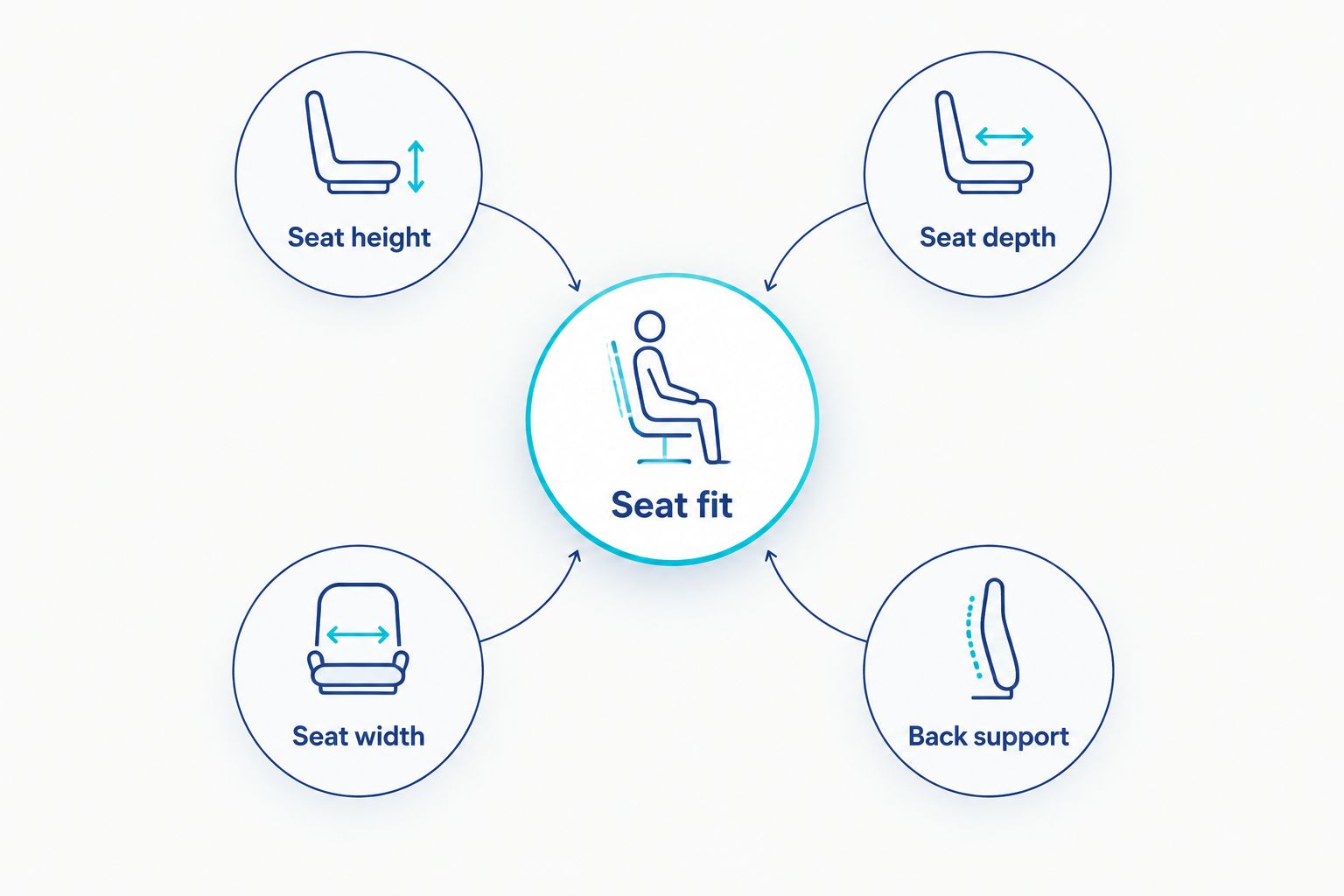
Measure the person before measuring the room
For a 2026 purchase, record body-fit measurements and room measurements separately. Use inches consistently, and distinguish usable seating dimensions from exterior width and depth.
- Seat height: Compare the chair’s upright seat height with a chair in which your feet rest securely.
- Seat depth: Check the distance from the backrest to the cushion’s front edge against your supported sitting position.
- Seat width: Allow comfortable sitting without placing the armrests beyond useful reach.
- Back support: Check where the chair supports your lower back, shoulders, and head.
- Transfer space: Preserve the area needed for your feet, walking aid, and any assisting person.
These measurements work together. A wide chair can still have excessive seat depth, and a compact exterior can still conceal unsuitable seating proportions.
What specifications prove—and what they do not
A published weight capacity identifies a manufacturer-stated operating limit. It does not establish seat comfort, stability during your particular transfer, or compatibility with your body dimensions.
Motor count describes part of the adjustment system. Upholstery type describes the covering. Neither proves arthritis pain relief, and a “zero-gravity” label does not establish that the chair lifts you toward standing.
Aeva Vital’s lift-chair selection advice puts those distinctions first: compare what a specification actually describes, not the benefit you hope it implies. Ask for the operating manual and dimensional drawing before making a model-specific decision.
Heat, massage, and arthritis claims
Treat heat and massage as optional comfort functions, not the foundation of your decision. Check where heat is applied, how it is controlled, and the manufacturer’s precautions; ask your clinician about suitability if you have reduced sensation or another relevant condition.
Equipment selection and medical treatment answer different questions. Claims about joint supplements for arthritis knee pain concern symptom management; they do not establish whether a lift chair supports a controlled transfer.
Do not trade correct seat fit for additional comfort settings. A chair should meet your basic sitting and standing needs before extras enter the comparison.
Test the transfer and plan for interruptions
A useful showroom trial includes sitting down, finding a supported position, operating the handset, returning upright, and using the lift function. Wear your usual footwear and bring the walking aid you normally use.
Ask an occupational therapist or physical therapist for a seating assessment if you have difficulty balancing or need hands-on assistance. Powered seat movement does not establish that standing alone is safe.
For your 2026 setup, keep cords outside walking paths and follow the manufacturer’s electrical instructions. Keep hands, feet, pets, and loose items clear of moving mechanisms.
Ask specifically what happens during an outage. A battery feature might serve a limited emergency function rather than ordinary repeated use; the manual must define its operation. Aeva Vital’s guide to power lift recliners during a power outage addresses that separate selection question.
How these configurations are ranked
The order prioritizes independent positioning, straightforward operation, body fit, and room compatibility. It is a buying framework, not a claim of hands-on testing or measured medical outcomes.
Dual-motor seating is the default recommendation for positioning flexibility. Petite or tall sizing takes priority whenever standard proportions do not fit; wall-hugger construction matters only after body fit and transfer space are satisfactory.
Which lift chair should you choose?
Start with a correctly fitted dual-motor lift chair if you need independent back and leg adjustment. Choose a single-motor configuration when its linked movement already suits you and its controls are easier for you to use.
In 2026, the decisive comparison remains the same: upright fit, handset operation, and a controlled transfer. Eliminate any chair that fails one of those checks, regardless of its feature list.
FAQ
What are the best lift chairs for arthritis?
The best lift chairs for arthritis fit your body, provide usable controls, and support a controlled transition toward standing. A dual-motor configuration is a strong starting point when you need separate backrest and footrest adjustment.
Is a dual-motor lift chair better than a single-motor chair?
A dual-motor lift chair is better for independent positioning, not automatically better for every user. A single-motor chair is suitable when its linked movement and handset meet your needs.
Can a lift chair treat arthritis or stop joint pain?
A lift chair is assistive furniture, not an arthritis treatment. Its purpose is to adjust seating and assist movement toward standing; it does not establish a medical outcome.
How do I know whether a lift chair fits me?
Check upright foot contact, usable seat depth, armrest reach, and back support. Then test the reclining and lifting sequence, with professional assistance when your mobility or balance requires it.
Are heat and massage essential in a lift chair for arthritis?
No, heat and massage are optional comfort features. Correct seat fit, usable controls, and suitable lift motion come first; follow the manufacturer's precautions for any heating function.
Does a zero-gravity recliner help you stand up?
A zero-gravity label does not prove a chair has powered lift assistance. Confirm that the specifications explicitly describe a seat-lifting mechanism.
Can I use a lift chair without caregiver help?
Independent use depends on your balance, strength, ability to operate the controls, and transfer needs. An occupational therapist or physical therapist can assess whether the chair and your technique support safe use.
Will a lift chair work if the power goes out?
Operation during an outage depends on the model's backup system. Read the manual to confirm whether backup power is included and which movements it supports.
Related guides
One last thing
Test the handset while sitting back normally—not while leaning forward to reach it. A button you can press at a showroom counter is not necessarily a button you can comfortably operate from the chair.