
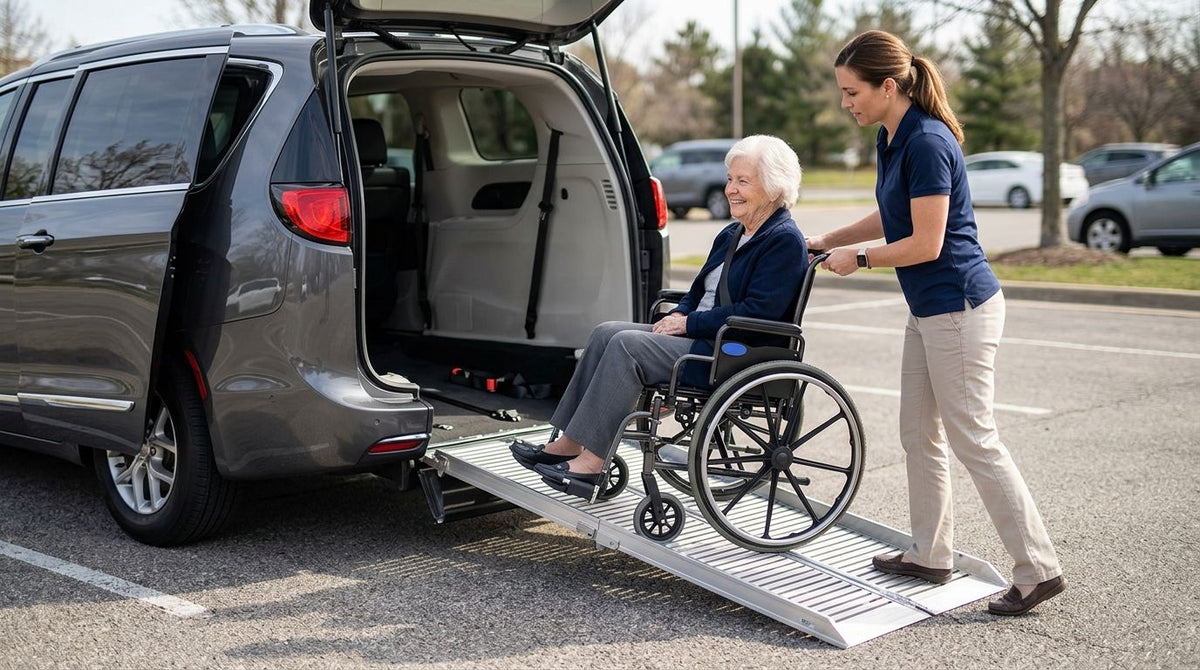
Loading a wheelchair into a vehicle by hand — lifting the frame, wrestling the footrests through the door, hoping your back holds up — turns a five-minute errand into a physical risk every time. Set up a vehicle wheelchair ramp correctly once, and every trip after that becomes a straight roll-in, roll-out with no lifting at all.
This guide covers how to transport a wheelchair with a vehicle ramp: picking the right ramp length and slope, anchoring it to the vehicle, and securing the wheelchair and rider for the drive. It applies to manual folding chairs, power wheelchairs, and portable ramps used with vans, SUVs, and trucks.
- Transport wheelchair with vehicle ramp setups need a slope no steeper than 1:12 (12 inches of ramp per inch of rise) for safe manual pushing.
- Portable ramps require a minimum 30-inch width to clear standard wheelchair wheelbases without edge strikes.
- Four-point tie-down straps at the frame, not the wheels, are the only reliable way to secure a wheelchair in transit.
- Weight capacity on folding ramps commonly tops out near 800 lbs combined chair and rider weight — check the rating before loading.
- Test the ramp unloaded first; a ramp that flexes or slides under foot traffic will fail under a loaded chair.
Why this matters
A wheelchair ramp that's too short or too steep isn't a minor inconvenience — it's how tip-overs happen. The 1:12 slope ratio (one inch of ramp rise for every twelve inches of length) is the standard reference point used across accessibility guidelines in 2026, and it's the number that determines whether a ramp is safe for unassisted rolling or requires a second person spotting.
Getting the setup wrong once usually means buying the wrong ramp twice. Matching ramp length, vehicle floor height, and wheelchair type before you buy anything saves the return shipping and the wasted trip.
The same planning logic applies if you're moving a mobility scooter in and out of your car — ramp angle and anchor points work the same way for scooters as they do for wheelchairs, though scooters run heavier and need a higher weight rating.
Before you start
- Measure your vehicle's load height — the vertical distance from the ground to the cargo floor or door threshold. This number, divided by 12, gives your minimum ramp length in feet under the 1:12 rule.
- Confirm the wheelchair's total weight (chair plus rider) against the ramp's rated capacity. Most folding portable ramps are rated between 600 and 800 lbs; exceeding that flexes the ramp surface mid-load.
- The gotcha: vehicle floors are rarely flat where the ramp lands. A ramp that measures fine on paper can still rock or gap at the vehicle lip if the threshold has a lip, a rubber seal, or a step-down. Dry-fit the ramp against the actual vehicle opening before you commit to a length, not just against a tape measure.
Set up your ramp and vehicle connection
- Fully extend or unfold the ramp on level ground next to the vehicle. Check the locking latch or hinge pin clicks into place — a ramp that isn't locked flat will fold under weight.
- Position the ramp's top edge flush against the vehicle's door sill or cargo lip. Look for a lip flip or transition plate on the ramp and flip it down so there's no gap between ramp and vehicle floor.
- Check the slope. Stand at the base and sight along the ramp — anything steeper than roughly 4.8 degrees (the 1:12 ratio) means the ramp is too short for the vehicle's load height.
- If the vehicle has anchor points or a ramp bracket built into the floor, hook the ramp's safety strap or retention pin into it now, before any weight goes on the ramp.
Expected result: the ramp sits flat, doesn't shift when you push on the near end with your foot, and the transition from ramp to vehicle floor has no lip a front caster could catch on.
Configure the wheelchair for loading
- Lock the wheelchair's wheel locks or set the power wheelchair to its lowest drive speed setting before approaching the ramp.
- Fold or remove anything that widens the chair beyond the ramp's rated width — armrests that flip up, or footrests that swing out, are the two most common snag points.
- Approach the ramp straight on, centered between the side rails, not at an angle. Angled entry is the single biggest cause of a wheel catching the ramp edge.
- Roll up in one continuous push. Pausing halfway on an incline steeper than 1:12 makes it harder to regain momentum without rolling backward.
Expected result: the wheelchair sits fully inside the vehicle with all four wheels (or the two rear wheels and casters) clear of the ramp and door frame.
Secure the wheelchair for transit
- Attach four-point tie-down straps to the wheelchair's frame — never the wheels or footrests, which aren't structural.
- Route front straps forward at roughly a 45-degree angle to the floor anchor points, and rear straps backward at the same angle. This cross pattern is what actually stops forward and lateral shift during braking.
- If the rider stays seated in the chair during transport, add a separate occupant restraint (lap and shoulder belt) anchored to the vehicle structure, not to the wheelchair frame.
- Tighten all four straps until the chair doesn't rock more than an inch in any direction when pushed by hand.
Expected result: the wheelchair is rigid against the vehicle floor with zero play at the tie-down points before the vehicle moves.
Variant: transporting an unoccupied wheelchair vs. a rider in transit
If the rider transfers to a vehicle seat and the wheelchair travels empty, you can skip the occupant restraint step entirely and rely on the four-point tie-down alone — this is the faster setup for daily errands.
If the rider remains seated in the wheelchair during the drive (common with power wheelchairs that don't fold), the occupant restraint step is not optional. Skipping it means the four-point straps hold the chair but do nothing to protect the person in a hard stop.
Troubleshooting
- Ramp flexes or bows under the wheelchair's weight. The chair plus rider likely exceeds the ramp's rated capacity — check the rating plate, don't estimate.
- Front casters catch at the ramp-to-vehicle transition. The lip flip isn't seated flush; re-extend the ramp and re-check the transition plate.
- Wheelchair rolls backward mid-incline. The slope exceeds 1:12 for this vehicle's load height — a longer ramp is the only real fix, not a stronger push.
- Tie-down straps loosen after a short drive. Straps were anchored to non-structural parts (footrests, armrests) instead of the frame; re-anchor at the frame crossbars.
- Ramp slides sideways when loading. Missing or unengaged anchor pin at the vehicle floor bracket; confirm the retention pin clicked before loading weight.
Customize your workflow
Once the ramp and tie-down routine is dialed in, the same setup logic extends to related mobility equipment in the home. If the household also runs a power lift recliner or stairlift, the planning steps for pairing a lift chair with a stairlift installation follow the same before-you-start discipline: measure first, confirm weight ratings, then install.
For rehab and recovery settings specifically, facilities managing multiple wheelchair users often standardize ramp and lift chair setups together — see the notes on lift chairs for post-surgical recovery centers for how that's typically handled at scale.
The one sentence to remember: a vehicle wheelchair ramp is only as safe as its slope, and a slope steeper than 1:12 turns a loading ramp into a hazard, not a convenience.
FAQ
What's the best slope for a wheelchair vehicle ramp?
A slope of 1:12 — one inch of rise for every 12 inches of ramp length — is the standard safe maximum for unassisted wheelchair use in 2026. Steeper ramps require a second person to assist and increase tip-back risk.
How long a ramp do I need for my vehicle?
Divide your vehicle's load height (in inches) by 1 and multiply by 12 to get the minimum ramp length under the 1:12 rule. A van with an 8-inch load height needs at least an 8-foot ramp.
Is a portable ramp better than a permanently mounted ramp?
Portable ramps work better for single-vehicle households that need to remove the ramp for storage; permanently mounted ramps suit vehicles used daily for wheelchair transport and don't require setup each trip.
How much weight can a wheelchair vehicle ramp hold?
Most folding portable ramps carry a combined weight rating of 600 to 800 lbs for chair plus rider. Power wheelchairs and heavier riders should check the manufacturer's rating plate before use.
Do I need to strap down a wheelchair during transport?
Yes. Four-point tie-down straps anchored to the wheelchair's frame are required to stop forward and lateral shift; wheel locks alone don't hold a chair in place during braking.
Can a power wheelchair use the same ramp as a manual wheelchair?
Yes, as long as the ramp's weight rating covers the power wheelchair's typically heavier combined weight. Power wheelchairs often run 100-plus lbs heavier than manual folding chairs.
What's the minimum ramp width for a wheelchair?
30 inches is the standard minimum width to clear most wheelchair wheelbases without the wheels catching the ramp's side rails.
One last thing
The most overlooked step isn't the ramp — it's the vehicle floor. A rubber door seal or a half-inch lip at the cargo threshold is enough to stop a front caster cold, even on a ramp with a perfect 1:12 slope. Dry-fit the ramp against the actual vehicle opening before the first real load, every time you switch vehicles.