
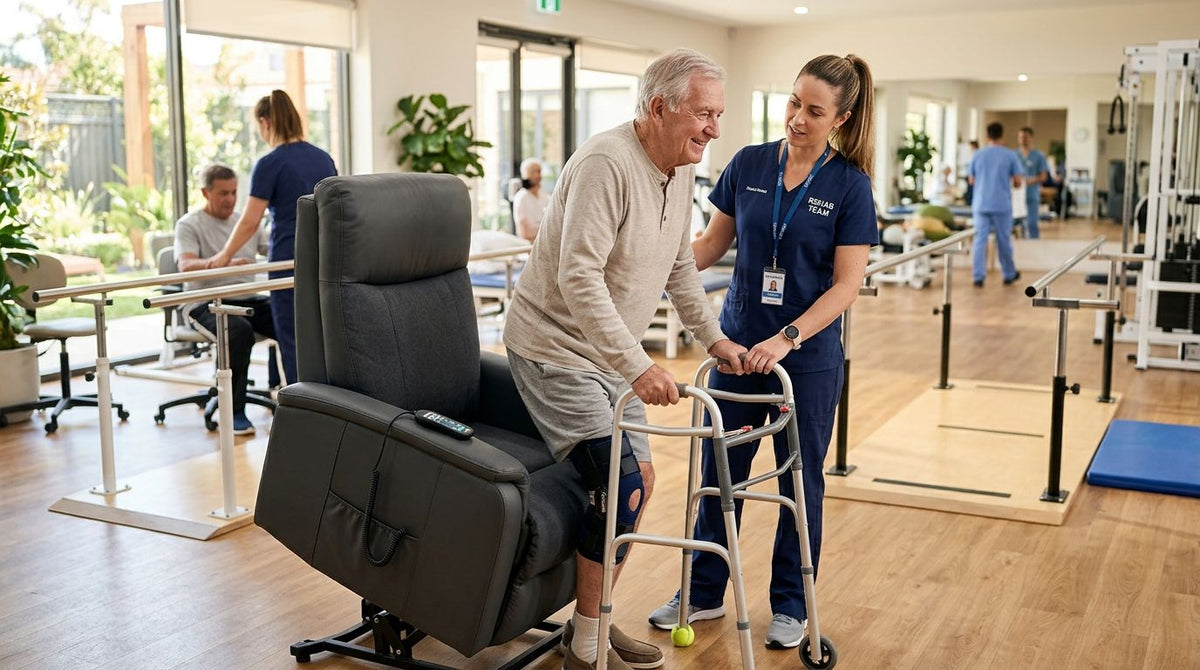
Lift chairs for rehab centers are powered seating systems that use an electric lift mechanism to raise a patient from seated to a near-standing angle, cutting the number of manual transfers staff perform each shift. A rehab or post-surgical recovery center needs a different spec sheet than a home buyer: higher weight capacity, wipeable upholstery, and a duty cycle built for multiple patients a day instead of one person a few times a week.
- Bariatric lift chairs rated near 500-700 lbs cover the heaviest post-surgical patients most recovery centers admit.
- Three-position dual-motor chairs handle standard rehab stays; infinite-position models suit extended edema and circulation cases.
- Vinyl or polyurethane upholstery beats fabric in infection-control settings because staff can wipe it down between patients.
- Battery backup keeps the lift function working through a power flicker — most home lift chair buyers never ask about this.
- Lift chairs for rehab centers succeed or fail on weight capacity and motor reliability, not on color or fabric.
Why lift chairs matter for rehab and post-surgical recovery centers
A patient recovering from a hip or knee replacement can't push up from a low recliner without help, and manual sit-to-stand assists are one of the more common sources of staff back injury in long-term care and rehab settings. A powered lift chair moves that patient to a stand-assist angle without a two-person lift.
Recovery centers also run chairs through far more daily cycles than a household ever would. A chair spec'd for home use with a light-duty motor and fabric cover wears out fast under institutional turnover, and fabric upholstery is harder to disinfect between patients than vinyl or polyurethane. If your facility is building out full recovery bays, the chair is one piece of a larger setup that usually includes an adjustable bed for post-op positioning alongside the seating.
How to choose lift chairs for rehab centers
Match lift chair capacity to your patient population
Weight capacity is the first filter, not the last. A mixed post-surgical population needs more than one capacity class on the floor.
- Standard-duty chairs: roughly 300-375 lbs capacity, fine for general rehab stays
- Heavy-duty chairs: roughly 400-450 lbs, useful when bariatric patients aren't the norm but do show up
- Bariatric-rated chairs: roughly 500-700 lbs, reinforced frame and wider seat depth
- Seat width and depth ranges, not just weight rating, since a heavy patient may still need more hip room
- Reinforced base plates and wider feet to prevent tipping at full recline
Choose the lift mechanism and motor configuration
Motor count and position count determine how much control staff and patients have over positioning during recovery.
- Single-motor, two-position chairs: recline and lift only, no independent leg-rest control
- Dual-motor, three-position chairs: independent back and footrest control, the standard pick for most post-surgical bays
- Infinite-position or zero-gravity chairs: continuous adjustment through a full recline, better for edema and circulation management
- Battery backup so the lift still works during a power outage
- Large-button or one-touch remotes for patients with limited hand dexterity
- Quiet motor operation in shared multi-bed recovery rooms
Specify infection-control-rated upholstery and frame materials
Fabric that looks fine in a showroom becomes a liability in a clinical setting.
- Wipeable vinyl or polyurethane over fabric for between-patient disinfection
- Seam-sealed cushions so fluid can't pool underneath the cover
- Removable, washable covers as a backup to wipe-down cleaning
- Steel internal frames over wood for daily-use durability
- Antimicrobial-treated foam where the vendor offers it
Set seat height and lift-assist angle to match your therapy protocols
Seat height changes how easily a patient can transfer, and it should match the procedures your center sees most.
- Standard seat height: roughly 19-21 inches
- Raised seat height: roughly 22-24 inches, easier for hip and knee replacement patients
- Full stand-assist lift angle near 45 degrees, not a partial recline that stalls halfway
- Adjustable headrest and lumbar support for post-op positioning
- Footrest extension for patients managing swelling or edema
Confirm facility power, space, and clearance requirements
A chair that fits the brochure photo doesn't always fit the bay.
- Dedicated outlet access at each chair position, or battery backup as a fallback
- Wall clearance for full recline — most lift chairs need several inches behind the chair back to fully extend
- Aisle width sufficient for wheelchair-to-chair transfers
- Floor load rating checked against bariatric chair weight when combined with patient weight
Build out the full recovery bay around the chair
The lift chair is one component of a recovery bay, and the rest of the setup affects how well patients actually recover. Facilities furnishing post-surgical rooms in 2026 are pairing lift chairs with supportive sleep surfaces and add-on recovery equipment rather than buying the chair as a standalone purchase.
- An adjustable bed alongside the chair for patients who need to alternate between seated and reclined positioning
- A supportive mattress rated for heavier patients if your center admits bariatric cases regularly
- Cold therapy for post-op inflammation management in shared therapy spaces
- Infrared heat therapy to support circulation before mobility sessions
- A tray or reading accessory for patients on extended bed rest between chair sessions
Verify procurement, warranty, and clinical documentation
Institutional buying moves slower than a consumer purchase, and the paperwork matters as much as the chair.
- Ask the vendor for institutional-use warranty terms, not the consumer warranty
- Request infection-control compliance documentation before signing
- Get PT or clinical staff sign-off on seat height and lift angle before the order goes in
- Check whether the seat-lift mechanism (not the full chair) qualifies for Medicare Part B reimbursement under a Certificate of Medical Necessity — this covers the motorized mechanism only, not the chair itself
A lift chair that can't reach a full stand-assist angle is just an expensive recliner.
“A lift chair that can't reach a full stand-assist angle is just an expensive recliner.”
Comparing lift chair options for rehab centers
| Option | Best for | Key limitation |
|---|---|---|
| Two-position lift chair | Short-stay bays with limited space | No independent footrest control, can't reach full recline |
| Three-position dual-motor chair | Standard post-surgical recovery | Moderate footprint, no zero-gravity recline |
| Infinite-position (zero-gravity) chair | Extended stays needing edema or circulation management | Larger footprint, higher price point |
| Bariatric lift chair | Patients above standard weight capacity | Heavier unit, needs wider aisle and reinforced flooring |
Common mistakes rehab centers make when buying lift chairs
- Buying only one capacity class. A single 350 lb-rated chair model across the whole floor forces staff to reassign patients or double up on manual transfers when a heavier patient is admitted.
- Choosing fabric upholstery for cost. Fabric costs less upfront and more in labor once staff can't disinfect it fast enough between patients.
- Skipping the clearance check. A chair that needs 10+ inches of wall clearance to fully recline doesn't fit against a shared-room wall, and nobody catches it until delivery day.
- Ignoring battery backup. A lift chair with no backup power strands a patient mid-recline during even a brief outage.
- Treating Medicare coverage as covering the whole chair. The reimbursement applies to the seat-lift mechanism only under a Certificate of Medical Necessity, not the full unit — centers that assume otherwise get an unpleasant billing surprise.
FAQ
What is a lift chair for rehab centers?
It's a powered chair with an electric lift mechanism that raises a seated patient to a near-standing angle, reducing the need for staff-assisted manual transfers during recovery.
Is a two-position or three-position lift chair better for post-surgical recovery?
Three-position dual-motor chairs are the standard pick because they give independent back and footrest control, which matters for post-surgical positioning. Two-position chairs work fine for short stays with lower acuity patients.
Can lift chairs handle bariatric patients?
Yes, bariatric-rated lift chairs typically handle roughly 500-700 lbs with a reinforced frame and wider seat. Standard-duty chairs top out closer to 300-375 lbs, so check the rating before assigning a heavier patient.
Does Medicare cover lift chairs for rehab centers?
Medicare Part B can cover the motorized seat-lift mechanism itself under a Certificate of Medical Necessity, not the entire chair or its upholstery. Confirm documentation requirements with the vendor before procurement.
What upholstery is best for infection control in lift chairs?
Vinyl or polyurethane upholstery is easier to disinfect between patients than fabric because it wipes clean and resists fluid absorption. Seam-sealed cushions add another layer of protection against pooling.
How is a lift chair different from a recliner?
A recliner only tilts back; a lift chair uses a powered mechanism to physically raise the seat and patient toward a standing position. That lift function is the entire point in a rehab setting.
What weight capacity should a rehab center's lift chairs have?
Most centers stock a mix: standard-duty chairs near 300-375 lbs for general patients and bariatric-rated chairs near 500-700 lbs for heavier admissions. A single capacity class across the floor creates transfer bottlenecks.
How long does a lift chair last in an institutional setting?
Commercial-grade lift chairs are built for a higher daily-use cycle than home models, so check the vendor's stated duty-cycle rating rather than assuming a home-use lifespan applies.
One last thing
The detail most procurement teams skip is aisle width, not motor type. A bariatric-rated chair that clears every spec on paper still fails if the aisle can't fit a wheelchair-to-chair transfer next to it, and that's a measurement tape problem, not a catalog problem.