

Instead of moving your cold plunge’s power cord between household outlets, have a licensed electrician confirm the required supply and GFCI protection, then connect the equipment according to its installation manual. This 2026 cold plunge tub GFCI outlet guide separates the electrical work a professional must handle from the inspection, connection, and startup checks you can perform safely.
By Editorial Team
A dedicated outlet and a dedicated circuit are not the same thing. Before connecting a powered cold plunge, confirm the equipment’s voltage, circuit requirements, grounding, and installation location—not just whether its plug fits. If you are selecting equipment first, start with the cold plunge tub with a built-in chiller guide.
- Aeva Vital’s cold plunge tub GFCI outlet guide is best for homeowners planning an electrically powered ice-bath installation.
- GFCI protection addresses ground faults; a dedicated circuit addresses shared electrical loads. Neither replaces proper grounding.
- Use the equipment manual and nameplate to specify the supply, not tank capacity or plug appearance.
- Have a licensed electrician confirm outlet placement, circuit sizing, and any required bonding before startup.
Why this matters
A cold plunge combines water with electrical equipment when a chiller, circulation pump, or other powered accessory is attached. A ground-fault circuit interrupter, or GFCI, detects an imbalance between outgoing and returning current and interrupts power. It does not make damaged equipment, improper wiring, or an unsuitable installation safe.
A circuit breaker protects the branch circuit against overcurrent. Equipment grounding provides a fault-current path, while bonding connects specified conductive parts to reduce differences in electrical potential. These functions are related but not interchangeable.
For a 2026 installation, your electrician must use the locally adopted electrical code and the equipment instructions. A cold plunge’s regulatory classification affects requirements; do not assume that every portable ice bath follows the same rules as a permanently installed spa.
Before you start
- Collect the documentation: Have the tub, chiller, and pump manuals; electrical nameplate information; and instructions for any supplied protective device. Confirm whether the equipment is cord-connected or requires professional hardwiring.
- Arrange access and materials: Give a licensed electrician access to the proposed location and electrical panel. Mark the tub footprint, drainage route, cord route, and equipment position before an outlet is installed.
- Check the hidden gotcha: An outlet that serves only your plunge can still share its circuit with other receptacles. Have the electrician verify the entire branch circuit; a panel label alone does not establish that it is dedicated.
If documentation is incomplete or the electrical requirements conflict, stop before connection. Obtain the correct instructions from the equipment manufacturer rather than substituting a generic chiller setup.
At a glance: electrical protection options
The table compares protection arrangements, not permission to use a particular installation. Your electrician must confirm which arrangement satisfies the equipment instructions and local requirements.
| Arrangement | Best for | What it provides | Limitation |
|---|---|---|---|
| GFCI receptacle | Accessible, permitted cord-connected installations | Ground-fault protection at the receptacle and appropriately connected downstream outlets | Its location and enclosure still need to suit the environment |
| GFCI circuit breaker | Installations requiring branch-circuit ground-fault protection | Ground-fault protection from the electrical panel | Requires compatible panel equipment and professional installation |
| Dedicated branch circuit | Equipment requiring a supply without unrelated loads | Separates the equipment’s circuit from other household loads | Does not provide GFCI protection unless that protection is included |
GFCI protection and a dedicated circuit solve different problems. Neither establishes that the receptacle is grounded, the cord is undamaged, or the equipment is suitable for outdoor use.
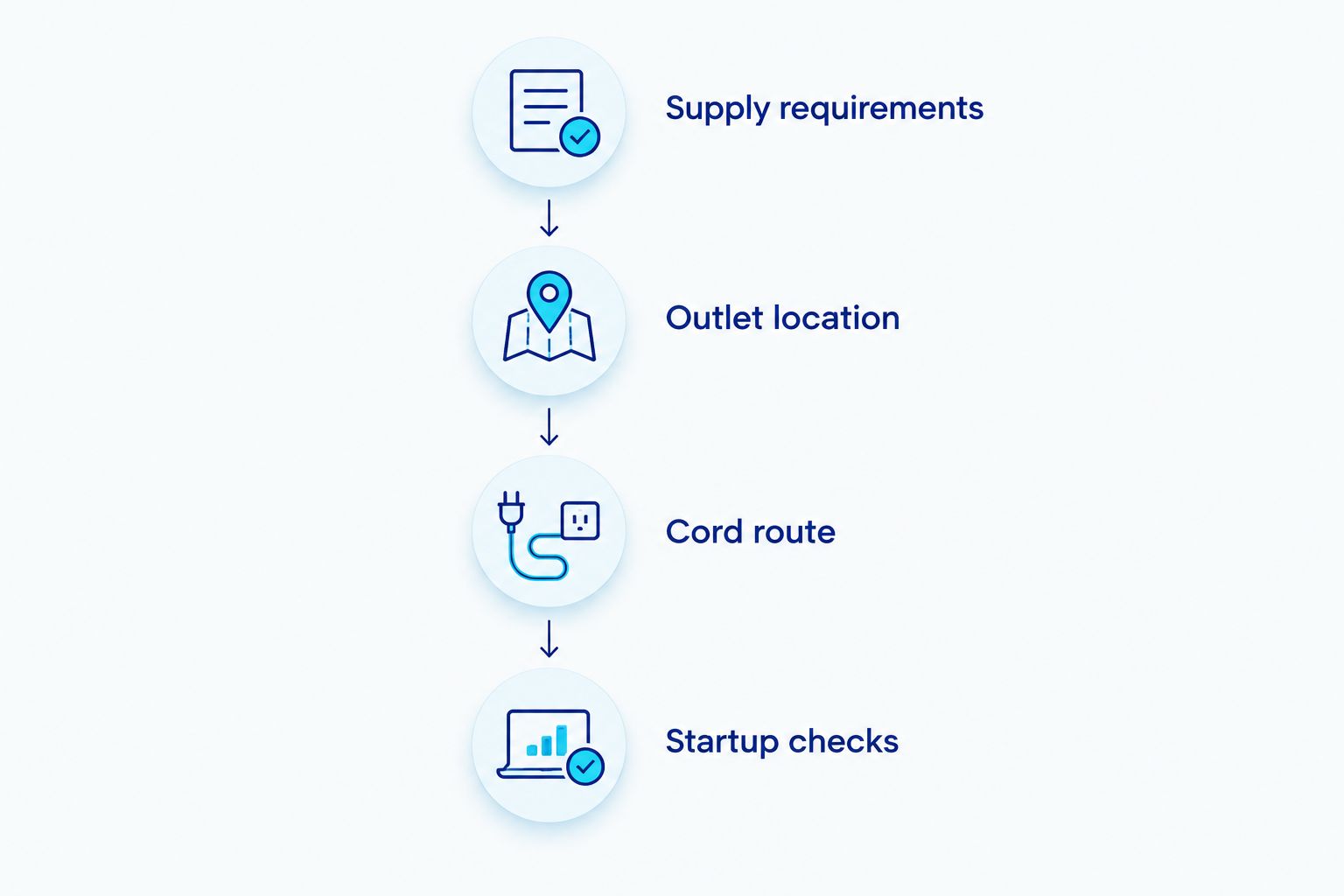
Supply requirements
- Read each electrical nameplate. Record the rated voltage, current, frequency, and manufacturer’s circuit instructions. Include separately powered accessories rather than treating the tub and chiller as a single electrical load automatically.
- Match the supply to the equipment. Equipment rated for 120 volts is not interchangeable with equipment rated for 240 volts. A plug adapter does not convert voltage or establish electrical compatibility.
- Ask the electrician to determine circuit sizing. Motor starting characteristics, operating loads, installation instructions, and applicable code requirements affect the decision. Do not choose a breaker from tank volume or a general online recommendation.
- Confirm the connection method. Use the specified receptacle for approved cord-connected equipment. Leave hardwiring, receptacle replacement, breaker installation, and panel work to a licensed electrician.
- Confirm the required protection. Have the electrician identify where GFCI protection is provided and whether bonding or additional disconnecting provisions apply to the installation.
Expected result: You have a documented supply specification and an electrician-confirmed connection method before placing the equipment in service.
Do not infer a universal circuit rating from a product category. A small tank can use a separately powered chiller, while a larger unpowered tub has no electrical connection by itself. Water volume and electrical demand describe different parts of the system.
Outlet location and cord route
- Position the tub and powered equipment on paper first. Include the manufacturer’s service access and ventilation requirements. Keep the electrical connection outside foreseeable splash, overflow, and drainage paths.
- Have the electrician establish permitted outlet placement. Required separation from water depends on equipment classification and applicable rules. Do not treat the reach of the supplied cord as permission to place an outlet beside the tub.
- Confirm environmental suitability. For an outdoor or wet-location installation, have the electrician specify the required receptacle, enclosure, cover, and wiring method. A weather-resistant receptacle alone does not make the whole installation waterproof.
- Route the original cord without strain. Keep it away from sharp edges, pinch points, standing water, and walking paths. Position equipment so the cord reaches the approved outlet without an extension cord or power strip.
- Keep protective controls accessible. Locate the applicable GFCI TEST and RESET controls, including protection at the panel if present. Do not obstruct access with the tub or storage.
Expected result: The equipment fits the approved location, the cord reaches without modification, and you can access the protective device safely.
An outdoor setup in 2026 needs more than a protective cover added to an indoor arrangement. Confirm that the tub, chiller, connections, and electrical installation are each suitable for the intended environment. Do not assume that an outdoor tub title establishes outdoor suitability for an attached accessory.
Connection and startup checks
- Keep the equipment switched off. Follow the manual’s connection sequence. Inspect the plug and accessible cord for damage without opening electrical housings or removing outlet covers.
- Prepare the water system as instructed. Complete required filling, hose connections, valve positioning, and pump preparation before startup. Never energize a pump that requires water while it is dry.
- Test the GFCI using its instructions. With nobody in the tub, use TEST and confirm that the protected supply disconnects as specified. Use RESET only after the test and only when the device is safe to restore.
- Connect with dry hands in a dry connection area. Insert the original plug fully into the approved receptacle. Do not remove a grounding pin, use a grounding adapter, or connect through an unapproved intermediate device.
- Start the system according to its manual. Observe circulation and inspect accessible water connections for leaks. Check for electrical faults, unusual odors, or damage without touching wet electrical equipment.
- Record the setup. Keep the circuit identification, GFCI location, manuals, and commissioning notes together. Make clear which device must be tested according to its manufacturer’s schedule.
Expected result: The protective device passes its specified test, the equipment starts according to its instructions, and no leak or electrical fault is present.
A successful startup is not permission to disregard operating instructions. Follow the manufacturer’s directions about whether powered equipment remains connected or operates during bathing. If you feel tingling in or around the water, stop use immediately; do not touch electrical equipment while wet, and have the system professionally inspected.
Reconnection after moving or servicing the plunge
A location change is a new electrical suitability check, not simply a longer cord route. Use this adjacent workflow when moving the tub, replacing a chiller, or returning equipment to service after maintenance.
- Compare the replacement equipment’s nameplate and instructions with the existing supply.
- Have the electrician reassess outlet placement, environmental protection, and circuit requirements when the installation changes.
- Inspect the cord and complete the manufacturer’s required water-system preparation.
- Repeat the specified GFCI test and startup checks before use.
Expected result: The changed setup meets its own requirements rather than relying on the original installation’s assumptions.
For a 2026 equipment replacement, preserve the new manual alongside the original installation records. A connector that looks familiar does not prove that the new equipment has the same electrical requirements.
Aeva Vital cold plunge tubs: capacity is not an electrical specification
The Aeva Vital cold plunge tub titles below identify water capacity and physical product categories. They do not establish a chiller’s voltage, circuit rating, grounding arrangement, or connection method.
| Product | Best for | Stated capacity | Useful distinction | Electrical limitation |
|---|---|---|---|---|
| Portable Inflatable Ice Bath Tub | Buyers considering a portable inflatable ice bath | 76.6 gallons | The title identifies an inflatable construction category | Capacity does not establish powered-accessory compatibility |
| 79 Gallon Cold Plunge Tub | Buyers considering an outdoor ice bath with an included thermo lid | 79 gallons | The title identifies an outdoor ice bath and included lid | The tub’s outdoor designation does not establish a chiller’s electrical suitability |
Choose the water vessel and electrical system as separate decisions. These Aeva Vital cold plunge tub capacities help distinguish the vessels, but neither figure specifies operating current or proves that an accessory can connect directly.
For either tub, confirm the actual water connections and manufacturer-approved accessory arrangement before adding powered equipment. Do not drill openings, modify plugs, or assume that a generic hose fitting establishes compatibility.


Troubleshooting
- The GFCI trips when equipment starts. Stop using the system and follow the manufacturer’s fault procedure. A trip can involve equipment leakage or wiring faults; do not bypass protection or move the plug to an unprotected outlet. Have an electrician and, where appropriate, the equipment service provider investigate.
- The GFCI will not reset. A device can refuse to reset when power is absent or a fault remains. Leave the equipment off and have the cause checked; repeated reset attempts do not repair the installation.
- The circuit breaker trips but the GFCI does not. Overcurrent and ground-fault protection respond to different conditions. Have the electrician check the circuit load and equipment requirements. Never increase breaker size without evaluating the wiring and installation.
- The plug, receptacle, or cord becomes unusually hot, discolored, or smells burned. Stop use. If the connection is wet, hot, or damaged, do not handle it; have power safely isolated and the equipment inspected before reconnection.
- Water reaches the electrical connection. Keep people away and stop use. Do not touch wet plugs or controls. Have the supply safely isolated, correct the leak or drainage problem, and obtain an inspection before restoring power.
Customize your workflow
Build electrical checks into maintenance and location changes rather than treating installation as a one-time task. Keep the area clear, inspect accessible cords, and test protective devices on the schedule their instructions specify.
For an Aeva Vital home wellness setup, add remote controls only after confirming that the equipment supports the proposed arrangement. A smart plug does not replace GFCI protection, and its presence does not establish suitability for a motor-driven appliance or a wet environment.
Related guides
- How to connect a cold plunge chiller to your Wi-Fi
- Cold plunge tubs ranked by tank capacity
- Infrared sauna to cold plunge workflow
FAQ
Does a cold plunge tub need a GFCI outlet?
Powered cold plunge equipment needs the ground-fault protection required by its instructions and applicable local code. A licensed electrician must confirm the installation requirements; protection can be provided at a receptacle or by an appropriate GFCI breaker.
Does a dedicated outlet mean I have a dedicated circuit?
No. A receptacle used only by your cold plunge can still share a branch circuit with other outlets. Have an electrician verify the circuit rather than relying on its label.
Can I plug a cold plunge chiller into an extension cord?
Do not use an extension cord as a workaround for outlet placement. Position the equipment within reach of its approved supply or have an electrician provide the correct connection, following the equipment instructions.
Is a GFCI breaker better than a GFCI outlet for a cold plunge?
Neither is universally better. The correct arrangement depends on the equipment, panel compatibility, accessibility, environment, and applicable installation requirements.
Why does my cold plunge trip the GFCI?
A GFCI trip indicates a current imbalance or a problem requiring investigation, not permission to bypass protection. Stop using the equipment and have the electrical installation and equipment checked.
Can I leave the chiller running while I am in the cold plunge?
Follow the specific equipment manufacturer’s bathing and operating instructions. Do not assume that a successful GFCI test authorizes powered operation while someone is in the water.
Does cold plunge tank capacity tell me which circuit to install?
No. Tank capacity describes water volume, while electrical requirements come from the powered equipment’s nameplate and instructions. Have an electrician evaluate the actual connected equipment.
One last thing
For your 2026 installation, label the actual GFCI protection location—not just the outlet. If protection is at the panel or another receptacle, that detail prevents confusion when someone needs to test the device or report a fault.