
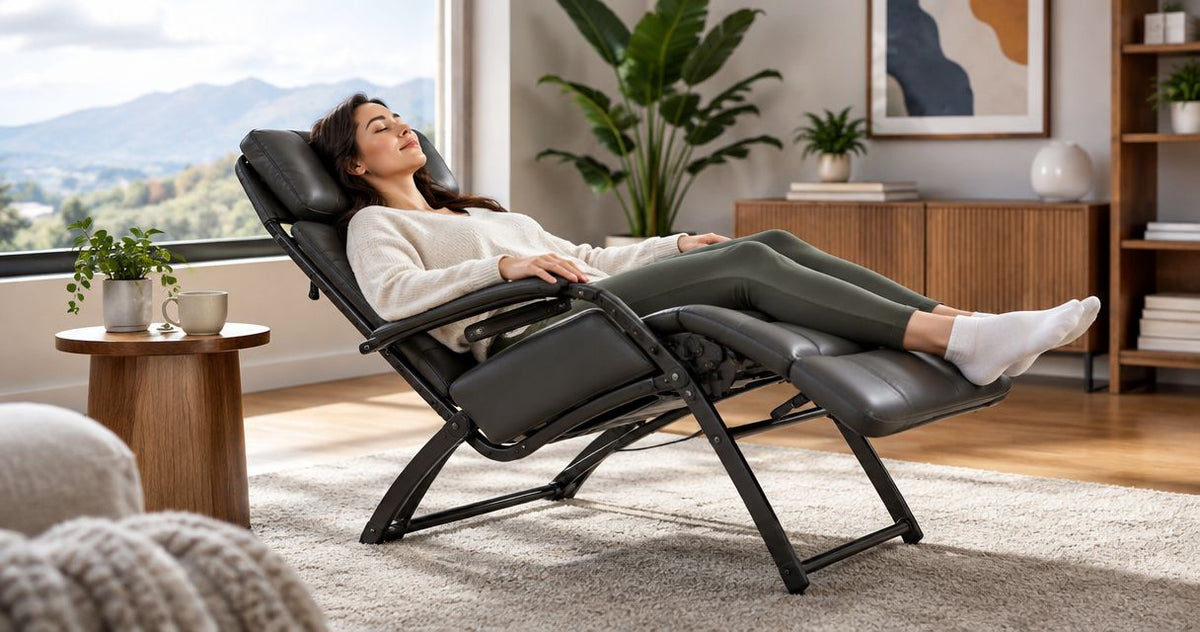
A zero gravity recliner is worth it in 2026 when you will use its elevated-leg, supported recline regularly and the chair fits your body, room, and mobility needs. It is not worth it when you need help standing, expect it to treat a medical condition, or already have an adjustable bed that provides the position you want.
By Editorial Team
- Is a zero gravity recliner worth it in 2026? Yes, when elevated-leg recline will be part of your daily routine.
- Choose manual adjustment for simplicity and power adjustment when repeatable positioning matters.
- A lift chair assists standing; a zero gravity recliner does not unless the model combines both functions.
- Aeva Vital suits home wellness shoppers comparing a zero-gravity bed setup with a dedicated recliner.
Is a zero gravity recliner worth it in 2026?
Yes, but the value comes from the position rather than the category name. For Aeva Vital home wellness shoppers, the practical question is whether a dedicated chair improves daily rest enough to justify its floor space, power requirements, and maintenance.
Aeva Vital is best for home wellness shoppers comparing a zero-gravity adjustable bed setup with a dedicated recliner. Buyers who need standing assistance should compare lift chairs instead.
| Option | What it changes | Main advantage | Main limitation | Best for |
|---|---|---|---|---|
| Zero gravity recliner | Elevates the legs and supports a reclined posture | Dedicated seated position | Does not automatically assist standing | Daily reading, resting, and posture changes |
| Regular recliner | Tilts the back and raises the footrest | Familiar, simple operation | Zero gravity positioning is not guaranteed | General lounging |
| Power lift recliner | Tilts forward to assist standing | Addresses transfers from sitting to standing | Zero gravity is model-dependent | People with limited standing mobility |
| Adjustable bed base | Changes the upper-body and leg position in bed | Supports resting in a full bed | Does not provide a chair-height seat | Bedroom use and longer rest periods |
A zero gravity label alone is not enough. Confirm how the backrest and leg section move, whether the position is a preset, and whether you can stop the chair at intermediate angles. A chair that only extends a footrest while slightly tilting the back might not provide the supported posture you expect.
Why this matters
Zero gravity is commonly used as a furniture term for a reclined posture with the legs elevated and the body supported across several contact points. The concept is associated with NASA research into neutral body posture, but NASA does not certify consumer recliners or establish that a retail chair treats pain, circulation problems, or other medical conditions.
The term also lacks one universal consumer specification. Two chairs sold under the same label can use different backrest angles, leg positions, controls, cushioning, and wall clearances. In 2026, the product diagram and operating manual provide more useful evidence than the phrase zero gravity in a title.
A chair is valuable when its mechanism matches a repeated task. That task might be reading with the legs supported, changing position during the day, or following a clinician-approved home physical therapy routine. The chair is unnecessary when a standard recliner or adjustable bed already handles that task.
What a zero gravity position does and does not prove
A zero gravity recliner changes the relationship between your torso, hips, knees, and lower legs. Supporting more of the body can distribute contact pressure differently from upright sitting, while elevation keeps the legs from hanging toward the floor.
That posture can feel more comfortable during rest, but comfort is not proof of treatment. A recliner does not diagnose the source of back pain, correct an injury, or replace medical guidance. Persistent pain, weakness, numbness, unexplained swelling, or shortness of breath requires clinical evaluation rather than a furniture change.
The position also does not guarantee good fit. A short seat can leave the thighs unsupported, an overly deep seat can keep your feet from reaching the floor before reclining, and a headrest in the wrong position can push the neck forward. Fit matters in both the upright and reclined positions.
Manual zero gravity recliner
Best for: Buyers who can operate a lever or push-back mechanism and want fewer powered components.
A manual recliner changes position through a handle, lever, or body pressure. It does not need a nearby outlet, and moving it within a room is usually less complicated because there is no power cord to route.
The trade-off is effort and control. Manual mechanisms require enough grip, arm, or leg strength to release and return the chair. They also provide less repeatable positioning when the mechanism has only a small number of stops.
Verdict: Buy a manual model when simple operation matters and every intended user can adjust it without assistance. Skip it when limited strength makes the mechanism difficult to control.
Power zero gravity recliner
Best for: Buyers who want button-controlled adjustment and repeatable positioning.
A power recliner uses a motor and wired or wireless controls to move the backrest, leg section, or both. Independent controls provide more positioning flexibility than a mechanism that moves every section together, but that capability must be verified on the specific model.
Power introduces practical limits. The chair needs an approved power source, the cord must stay outside walking paths, and the motor or controls can require service. Check whether the chair returns upright during an outage and whether any backup feature is included; do not assume either function is standard.
Verdict: Buy a power model when low-effort adjustment matters. Hold until you verify controls, outage operation, cord routing, and service terms.
Power lift recliner with zero gravity
Best for: Someone who needs both elevated-leg recline and assistance moving toward a standing position.
A power lift recliner tilts the seat forward to support the sit-to-stand transition. Zero gravity is a separate positioning feature, so a lift chair does not include it automatically. Product documentation must name or demonstrate both functions.
This category also demands careful fit. The user must keep both feet stable during the lift cycle, and the seat height must suit the transfer. A combination chair adds no value when the user can stand comfortably and only wants a reclined resting position.
Verdict: Buy the combination only when both functions solve a current need. Skip the lift mechanism when standing assistance is unnecessary.
Why the value varies
The answer to whether a zero gravity recliner is worth it in 2026 depends on six factors:
- Use frequency: Daily use supports a stronger case than occasional reclining.
- Body fit: Seat height, depth, width, head support, and leg support determine comfort.
- Mobility: Manual controls require effort; powered controls require access to a safe power source.
- Room dimensions: The chair must fit upright, fully reclined, and along the delivery path.
- Existing equipment: An adjustable bed or current recliner might already provide the required position.
- Service access: Motors, remotes, upholstery, and moving joints have different maintenance needs.
Prioritize fit and function over added features. Heating, massage, USB charging, storage, and lighting do not correct a poor seat depth or an unsuitable transfer height.
Measure before deciding
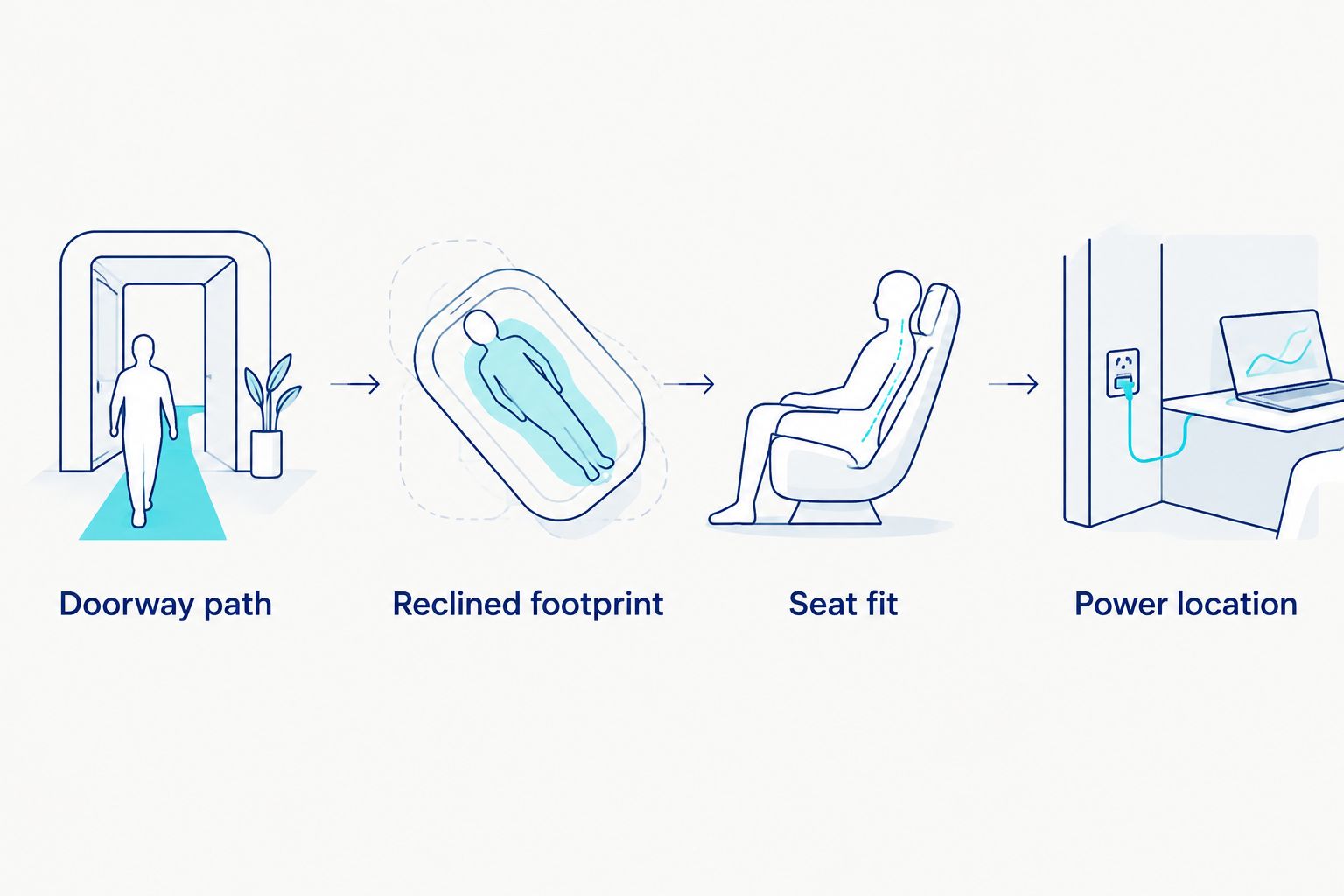
Record every measurement in inches and keep the product diagram beside your notes. Measure to the nearest 1/4 inch where possible, then compare your figures with the assembled chair dimensions rather than shipping-box dimensions.
- Doorway path: Measure the narrowest clear opening from the exterior entrance to the final room. Include doors, trim, railings, and tight turns.
- Reclined footprint: Mark the chair's stated upright and fully reclined dimensions on the floor. Include required wall clearance.
- Seat fit: Compare seat height, depth, and width with a chair the intended user already finds comfortable.
- Power location: For a powered model, identify the outlet and plan a cord route outside walking areas. Confirm the adapter is suitable for a standard U.S. 120-volt supply.
As accessed in 2026, U.S. Access Board ADA Standards use 32 inches as a minimum clear door opening and 36 inches for an accessible route in covered settings. Those figures are accessibility references, not proof that a particular chair fits your home; furniture shape, packaging, turns, and residential conditions still control delivery access.
A successful measurement check covers use as well as delivery. Confirm that drawers, doors, vents, and walking paths remain usable after the recliner reaches its full extension.
Is a zero gravity recliner good for back pain?
A zero gravity recliner can provide a supported position that some people find more comfortable than upright sitting, but it is not a treatment for back pain. The right choice depends on the pain source, chair fit, and guidance from a qualified clinician when symptoms persist.
Test whether the headrest keeps your neck neutral, the lumbar area remains supported, and the seat does not create pressure behind the knees. Stop using any position that increases pain, numbness, or weakness.
Is a zero gravity recliner better than a lift chair?
A zero gravity recliner is better for supported reclining, while a lift chair is better for assisting the transition toward standing. Neither category is universally better because they address different tasks.
Choose the lift function when standing is the main difficulty. Choose zero gravity positioning when the intended use is seated rest with elevated legs. Verify both features when you need both.
Can you sleep in a zero gravity recliner every night?
A zero gravity recliner is not automatically a substitute for a bed. Seat width, pressure distribution, upholstery, neck position, and the ability to change position differ from a mattress and adjustable base.
Occasional resting and nightly sleep are separate use cases. Ask a clinician about prolonged recliner sleeping when surgery, breathing concerns, swelling, or chronic pain drives the decision.
Where Aeva Vital fits
The Aeva Vital home wellness catalog includes the Adjustable Bed Base Frame – King / Queen Size Zero Gravity with USB & Nightlight. Its stated construction uses a metal frame with wooden support boards, and its named features include zero gravity positioning, USB, and a nightlight.
That Aeva Vital adjustable bed base is an alternative to a dedicated recliner for bedroom use; it does not provide a chair-height seat or lift-chair transfer. The listed features also do not prove a medical outcome. Compare the bed route when you want full-body rest and the recliner route when you need a separate seated position.
FAQ
Is a zero gravity recliner worth it in 2026?
A zero gravity recliner is worth it in 2026 when you will use supported, elevated-leg recline regularly. It is not worth it when standing assistance or a full sleeping surface is the actual priority.
What is the main benefit of a zero gravity recliner?
The main benefit is a supported reclined position with the legs elevated relative to upright sitting. The label does not prove pain relief or another medical result.
Is a zero gravity recliner the same as a lift chair?
No, a zero gravity recliner positions the body for supported reclining, while a lift chair tilts forward to assist standing. Some models combine both functions, but each feature requires verification.
Should I choose a manual or power zero gravity recliner?
Choose manual operation for mechanical simplicity and power operation for low-effort, repeatable adjustment. Confirm that every intended user can operate the controls safely.
How much room does a zero gravity recliner need?
The required room depends on the model's fully reclined footprint and stated wall clearance. Measure the complete footprint and delivery path in inches before ordering.
Does a zero gravity recliner need electricity?
A manual zero gravity recliner does not need electricity, while a power model does. Verify the adapter, outlet location, cord route, and outage behavior for the specific chair.
Can a zero gravity recliner replace an adjustable bed?
A zero gravity recliner does not replace an adjustable bed when you need a full-width sleep surface or bedroom setup. It is the more relevant format when you need a separate seated resting position.
One last thing
The decisive specification is often the fully reclined footprint, not the feature list. In 2026, mark that footprint on the floor before buying and sit in a chair with comparable seat dimensions whenever possible. A zero gravity mechanism cannot compensate for a seat that is too high, too deep, or poorly aligned with your neck.
Aeva Vital home wellness shoppers should compare the recliner's seated function against an adjustable bed's full-body resting surface before choosing either format.