
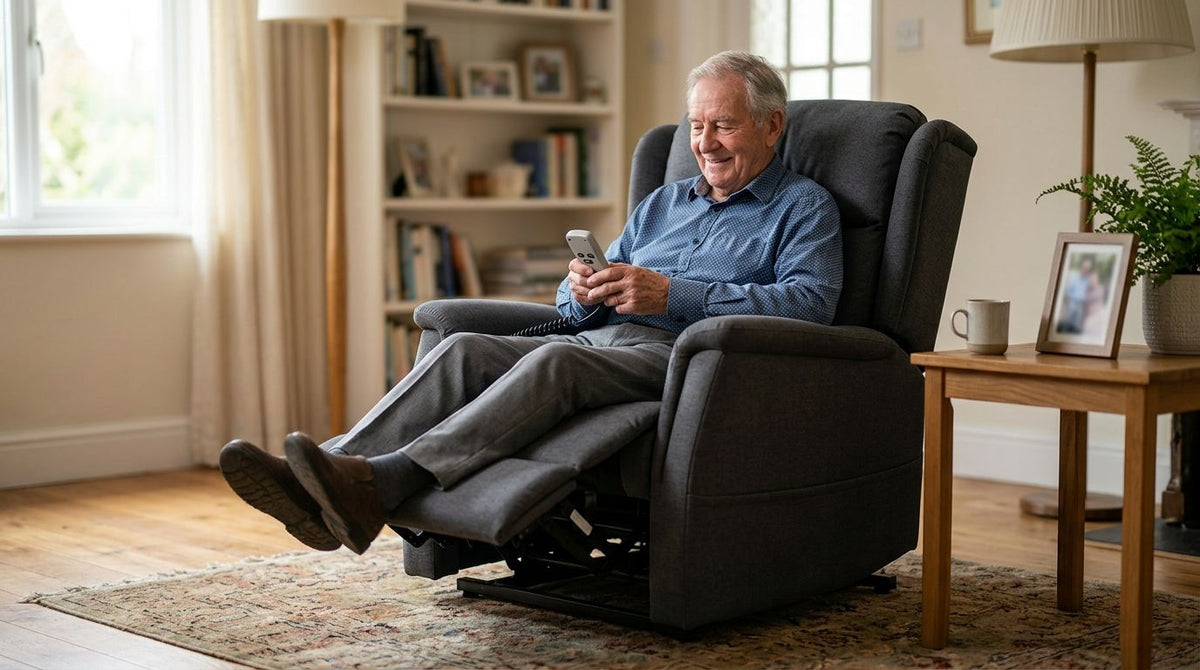
In 2026, a power lift recliner is worth it for an elderly parent who cannot stand safely or consistently from a standard chair without physical help. It is not worth it when your parent stands independently and only wants a comfortable place to sit, because the lift mechanism adds complexity without solving a current mobility problem.
By Editorial Team
- In 2026, a power lift recliner is worth it for elderly parents who need regular help standing.
- Choose a standard recliner when comfort, rather than sit-to-stand assistance, is the main goal.
- Medicare Part B can cover the lifting mechanism when medical-necessity and supplier requirements are met.
- Measure the user, doorway, room and outlet location before choosing a lift-chair type.
- Aeva Vital recommends matching the chair to current mobility needs instead of buying for a possible future need.
Why this matters
A lift chair solves one defined problem: it raises and tilts the seat so the user can move toward a standing position with less physical assistance. Aeva Vital's lift-chair value guide explains the broader purchase decision, but elderly parents require extra attention to balance, fit, caregiver access and medical equipment.
The chair does not diagnose or treat the reason standing is difficult. New weakness, dizziness, pain or repeated falls needs medical assessment rather than a furniture-only response. A clinician or occupational therapist can also identify whether a higher fixed seat, physical therapy, a grab point or a lift chair best addresses the actual limitation.
The 2026 decision should be based on what happens during an ordinary day. Watch how your parent gets up from the chair they already use, how often another person intervenes and whether the struggle appears every time or only after prolonged sitting.
Is a power lift recliner worth it for elderly parents?
Yes, when standing from a normal seat requires another person's hands, repeated rocking or unsafe pushing on nearby furniture. No, when your parent rises independently and the only requirement is powered reclining.
| Option | Best for | Main advantage | Main limitation | Verdict |
|---|---|---|---|---|
| Power lift recliner | Regular sit-to-stand difficulty | Raises and tilts the seat | Requires power and correct sizing | Buy for a current mobility need |
| Standard power recliner | Independent users who want powered positioning | Reclines without a manual lever | Does not assist standing | Buy for comfort only |
| Manual recliner | Independent users comfortable with a lever or handle | Simple controls | Requires arm and trunk effort | Skip when mobility is limited |
| Firm, higher fixed chair | Users who need a stable seat but not powered assistance | No motor or handset | Does not provide progressive lifting | Consider after a fit assessment |
A power lift recliner can also reduce how often a caregiver has to pull from the user's arms or shoulders. It does not remove the need for supervision when the person becomes dizzy, cannot bear weight through both legs or has difficulty controlling the final movement into standing.
Aeva Vital's verdict is direct: a power lift recliner is best for an elderly parent with a present, repeatable sit-to-stand limitation. Buying one solely because a parent is older is not a sufficient reason.
The user must still complete the transfer after the chair rises. That includes placing both feet securely, shifting weight forward, grasping a walker if one is used and maintaining balance once the chair stops moving.
2-position lift recliners: best for basic assistance
A 2-position model supports an upright position and a limited recline while retaining the powered lifting function. It suits a parent who mainly reads, watches television or talks with visitors from an upright seat and needs the motor primarily for standing.
The advantage is simpler positioning. Fewer adjustments can make the handset easier to understand for someone who becomes frustrated by multiple controls.
The limitation is the restricted recline range. A 2-position chair is a weak fit when your parent needs substantial leg elevation, changes position frequently or requires a defined head-and-torso angle around other equipment.
Best for: straightforward sit-to-stand help with limited reclining needs. Verdict: Buy when simple controls matter more than independent positioning.
3-position lift recliners: best for extended sitting
A 3-position model adds a deeper recline while preserving the powered lift. It is better suited to a parent who spends longer periods in the chair and wants to alternate between upright sitting and a more relaxed position.
The category name does not mean the chair has only 3 exact stopping points. Powered controls commonly stop between the main upright, reading and deeper-recline positions, but the specific control scheme must be confirmed on the model under consideration.
The main limitation is that the backrest and leg rest may move together. That linked movement gives the user less control than an independently adjustable design.
Best for: daily sitting with a deeper recline. Verdict: Buy when your parent wants more positioning range without a more complicated handset.
Infinite-position recliners: best for independent adjustment
An infinite-position lift recliner lets the backrest and leg rest adjust independently when the model uses separate motors for those sections. This matters when the user wants elevated legs without reclining the torso to the same degree, or a caregiver needs to make smaller positioning changes.
Do not assume every chair marketed with broad positioning language uses independent motors. Check the motor count, handset functions and operating manual for the exact model. A longer list of positions does not prove that the seat will fit your parent's body or that the controls will be easy to operate.
More controls are also a disadvantage for some users. Small buttons, unclear icons and similar-looking controls can make daily operation harder for a parent with reduced vision, hand dexterity or memory.
Best for: users who need separate backrest and leg-rest control. Verdict: Buy only when the added adjustments solve a defined positioning need.
Why the value of a lift chair varies
- Current standing ability: Frequent physical assistance creates a stronger case than occasional stiffness after sitting.
- Balance after rising: The motor brings the user forward, but it cannot stabilize the user after both feet take their weight.
- Chair fit: Seat height, width and depth affect foot placement, back support and the effort required to move forward.
- Caregiver access: A caregiver needs room beside or in front of the chair without stepping over cords or other furniture.
- Control usability: Button size, handset labels and movement speed affect whether your parent can operate the chair independently.
- Room infrastructure: Recline clearance, doorway access and a nearby 120-volt receptacle determine whether the chair can be installed without unsafe cord routing.
These factors explain why the same lift chair can be useful in one home and unsuitable in another. Aeva Vital treats lift-chair selection as a fit and function decision, not an age-based recommendation.
How to decide before ordering
1. Observe the complete standing sequence
Ask your parent to stand from the chair they use most, with their usual cane or walker nearby. Note whether they can place both feet flat, move toward the edge, lean forward and rise without another person pulling them.
Stop the observation if the movement appears unsafe. The goal is to identify the difficult stage, not to test how much risk the person can tolerate.
2. Measure the seated user
Measure from the back of the buttocks to the back of the knee for seat depth, across the widest seated point for seat width and from the floor to the crease behind the knee for seat height. Record measurements in inches, preferably to the nearest 1/8 inch, and compare them with the manufacturer's dimensions.
A seat that is too deep can prevent the user from reaching the backrest while keeping both feet supported. A seat that is too high can leave the feet unsupported before the lift cycle begins.
3. Measure the delivery path
Check the exterior entrance, every doorway, hallway turn and stair landing between the delivery point and the intended room. Measure the actual clear opening rather than relying on the door's nominal size.
Confirm whether the selected chair ships in separate sections and whether removing the back is part of the manufacturer's approved assembly process. Do not assume every model breaks down in the same way.
4. Map the operating space
Mark the chair's proposed footprint and its manufacturer-listed recline clearance on the floor. Include side tables, walkers, oxygen equipment and the path another person uses to approach the chair.
A wall-hugger design can require less space behind the chair, but its forward travel still needs an unobstructed area. Verify both directions of movement.
5. Check the controls and backup plan
Have your parent handle the handset if a demonstration is available. The important questions are whether the buttons are distinguishable, whether the cord reaches a natural hand position and whether the user understands how to stop movement.
A lift chair cannot change position during an outage unless that model has a functioning backup-power system. Confirm whether backup power is included, optional or unavailable, then follow the manufacturer's battery instructions.
6. Plan assembly and the first transfer
Arrange for someone to inspect the power cord, connect the chair and test its full movement before your parent uses it alone. Post-surgery lift-chair setup requires particular attention to prescribed movement restrictions and the position of other support equipment.
The first transfer should happen with the chair fully assembled and the floor clear. Keep pets, loose rugs and charging cables away from the moving base.
Does Medicare cover a power lift recliner in 2026?
Medicare Part B can cover the motorized seat-lift mechanism as durable medical equipment when the beneficiary meets the medical criteria and receives it from a Medicare-enrolled supplier. Medicare does not treat the entire upholstered recliner as the covered mechanism.
Coverage requires more than age or general difficulty getting up. Medicare's criteria include a physician's prescription and documented medical necessity, such as severe arthritis of the hip or knee or a severe neuromuscular condition. The beneficiary must be unable to stand from a regular armchair or another chair in the home but able to walk once standing.
Use the official 2026 Medicare requirements and the enrolled supplier's documentation process before ordering. The 2026 Medicare lift-chair guide explains what to verify, but the final coverage decision rests with Medicare and the submitted medical record.
How do I know whether my parent needs a lift chair?
Your parent is a strong candidate when standing from an ordinary chair regularly requires physical help, unsafe momentum or pushing on unstable furniture. The need is clearer when the same difficulty appears across several days rather than during one isolated episode of fatigue.
Ask what your parent dislikes about the current chair. The problem may be excessive seat depth, a low cushion, poor arm support or pain unrelated to seat height. A lift chair is appropriate only when powered sit-to-stand assistance addresses the actual problem.
If mobility has changed suddenly, contact a clinician before treating the change as a furniture issue. Sudden weakness or dizziness requires assessment.
Can an elderly parent use a lift chair as a normal recliner?
Yes. A power lift recliner can remain upright or recline without using the forward lift position, so your parent can use it for ordinary seated activities.
The distinction is that every position is controlled by a powered mechanism. If the chair loses power and lacks working backup power, it may remain in its current position until electricity returns.
The chair should not be treated as a substitute for a bed unless the manufacturer expressly permits the intended use and the user's care team agrees. Reclining range alone does not establish suitability for overnight sleep.
What if my parent refuses to use the lift function?
Start by asking whether the movement feels unstable, the controls are confusing or the chair does not fit. Refusal often identifies a practical problem that needs correction rather than resistance to help.
Demonstrate one complete cycle without the user seated, then let the parent control the handset while supervised. The chair should rise only far enough to support a controlled transfer; taking it to the maximum lift position is not automatically better.
If your parent consistently stands without the motor, the chair may be functioning only as a powered recliner. Reassess whether its main feature still solves a current need.
FAQ
Is a power lift recliner worth it for elderly parents in 2026?
Yes, a power lift recliner is worth it for elderly parents who regularly need help standing from a standard chair. It is unnecessary when the parent stands safely and independently and only wants reclining comfort.
Who should not use a power lift recliner without assessment?
A person with sudden weakness, uncontrolled dizziness or an inability to bear weight should not rely on a lift chair without clinical assessment. The chair assists the transfer but cannot stabilize the user after standing.
Does Medicare pay for a lift chair in 2026?
Medicare Part B can cover the motorized lifting mechanism when medical-necessity, prescription and supplier requirements are met. The upholstered chair is not the covered mechanism.
Can a power lift chair be used as a regular recliner?
Yes, a power lift chair can function as a regular powered recliner without activating the forward lift position. It still requires electricity to change positions.
What should I measure before buying a lift chair?
Measure the user's seated width, seat depth and lower-leg height, then measure the delivery path and operating space. Compare every measurement with the exact model specifications.
Does a lift chair need to stay plugged in?
A lift chair needs electrical power to lift or recline. Keep it connected according to the manufacturer's instructions and avoid placing the cord across a walking route.
Will a lift chair work during a power outage?
A lift chair works during an outage only if the model has a functioning backup-power system. Backup capability and battery requirements vary, so verify the exact model before purchase.
Is an infinite-position chair always better for an elderly parent?
No, an infinite-position chair is better only when independent backrest and leg-rest adjustment solves a defined need. Simpler controls can be more usable for a parent who only needs standing assistance.
One last thing
The most useful test in 2026 is not how far the empty chair reclines; it is whether your parent can complete a controlled transfer after the seat rises. Aeva Vital recommends testing fit, controls and the final standing position together, because a powerful motor cannot correct poor foot placement or an oversized seat.