
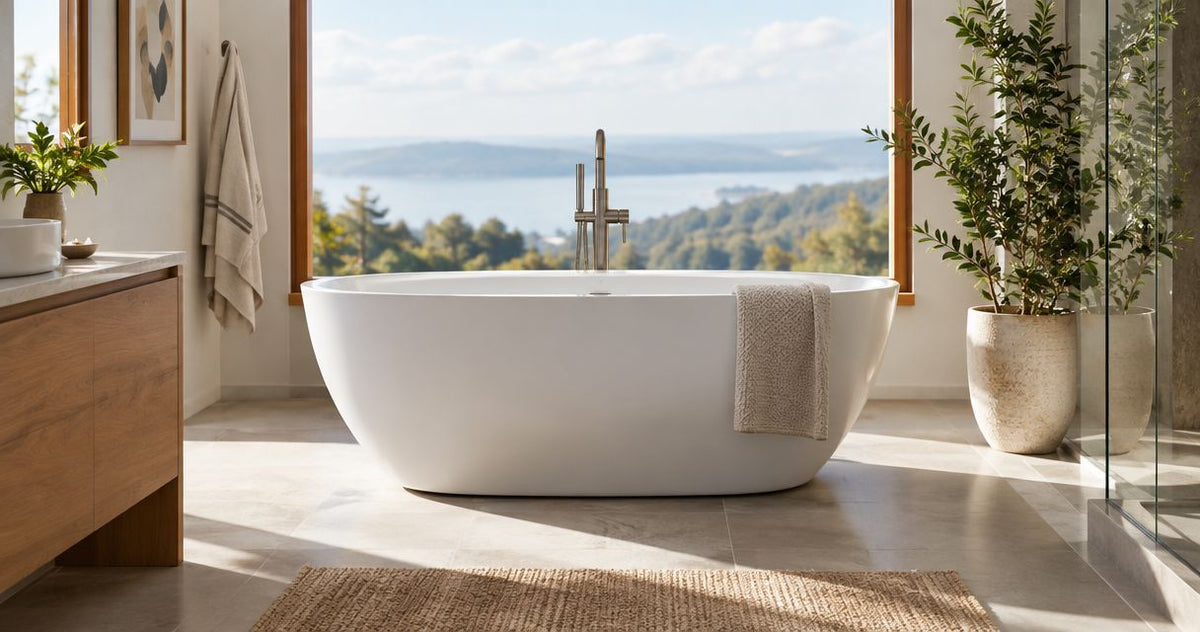
A freestanding soaking tub is worth it in 2026 if you regularly take baths, the basin fits your body, and your bathroom supports comfortable access and installation. Skip it if the tub crowds your shower, creates difficult cleaning gaps, or adds a step-over barrier you cannot use safely. The decision includes plumbing, floor support, hot-water supply, and maintenance—not just the tub itself.
By Editorial Team
- Is a freestanding soaking tub worth it? Yes, when comfortable bathing outweighs the space and maintenance trade-offs.
- Aeva Vital lists acrylic bathtubs in 55-inch, 59-inch, and 67-inch sizes; compare interior dimensions before choosing.
- Check drain access, faucet placement, floor support, and hot-water supply before ordering.
- Exterior length does not establish soaking depth, usable legroom, or ease of entry.
Is a freestanding soaking tub worth it in 2026?
A freestanding soaking tub earns its place through use, not appearance alone. Choose one when you want a dedicated bathing fixture and can preserve practical access around it. For the work behind the finished installation, review how long freestanding tub installation takes before setting your remodeling schedule.
| Bathroom option | Best for | Main advantage | Main limitation |
|---|---|---|---|
| Freestanding soaking tub | Regular bathers with a suitable layout | A separate bathing fixture with flexible placement where plumbing permits | Requires a plan for access, cleaning, faucets, and drainage |
| Alcove tub | Bathrooms arranged around an enclosed tub position | Fits within a defined wall enclosure | Placement follows the enclosure rather than an open layout |
| Shower without a separate tub | Households that prioritize showering | Leaves the room focused on its most-used bathing function | Removes the option of soaking in that bathroom |
These are layout choices, not quality rankings. A well-planned alcove tub is a better purchase than a freestanding tub that leaves you squeezing past the rim every morning.
Why this matters
A bathtub becomes part of your room's daily circulation even when nobody is bathing. You still need to reach the shower, open drawers, clean the floor, and move between fixtures without awkward detours.
A soaking tub is intended for immersion, while freestanding describes how the fixture sits independently of a built-in enclosure. Neither term establishes its usable depth, interior shape, or suitability for your body. Read the dimensional drawing rather than treating the category name as a comfort specification.
For a 2026 remodel, separate the purchase into two decisions: whether a dedicated tub suits your routine, and whether a particular model fits the room. Passing the first test does not automatically pass the second.
What makes a freestanding tub worth keeping?
Start with your actual bathing habits. If you already prefer showers and rarely use an existing bathtub, a different silhouette does not establish a practical reason to keep a dedicated bathing area.
For regular bathers, comfort is the stronger test. Compare the interior floor length, backrest slope, basin width, and overflow position. A long exterior shell can still contain a basin that does not match your preferred posture.
Also consider what happens before and after the soak. You need a place for a towel, somewhere reachable for bathing supplies, and a clear route out of the tub. An attractive position under a window is not automatically a convenient position for those tasks.
Choose the bathing experience first and the placement second. If the only workable placement makes entry awkward or leaves supplies out of reach, reconsider the layout before choosing a model.
Compare documented sizes, not assumptions about comfort
Aeva Vital's supplied product information identifies acrylic bathtubs with nominal lengths of 55 inches, 59 inches, and 67 inches. Those labels provide a starting point for comparing footprints; they do not replace complete installation drawings.
| Listed bathtub | Best for | Explicitly listed details | What to verify before choosing |
|---|---|---|---|
| 55-inch acrylic freestanding soaking bathtub | Buyers starting with the shortest listed length | Acrylic construction; chrome drain | Interior floor length, width, soaking depth, and installation clearance |
| 59-inch acrylic freestanding bathtub | Buyers comparing an intermediate listed length | Diamond pattern; gloss white; chrome drain | Basin geometry, overall width, and access around the exterior |
| 67-inch acrylic freestanding bathtub | Buyers whose layout accommodates the longest listed length | Gloss white; chrome drain; cUPC certified | Interior fit, filled load, certification documentation, and plumbing compatibility |
The difference between the shortest and longest listed lengths is 12 inches. That difference matters when marking the footprint, but it does not establish 12 inches of additional usable legroom. Rim thickness and basin geometry also occupy space.
The 59-inch listing describes an oval shape, but an oval outline alone does not establish how your shoulders, knees, and back will fit. Compare the interior drawing with your preferred bathing position rather than choosing by exterior styling.
Why the value of a freestanding soaking tub varies
The tub's value changes with the work it requires and how well it serves your household. Evaluate these factors together rather than letting one appealing specification decide the purchase.
- Bathing habits: A dedicated soaking fixture needs a genuine place in your routine. Occasional admiration is not the same as regular use.
- Room fit: The tub footprint must coexist with doors, drawers, the shower, and the path through the room. Include the faucet in that layout.
- Body fit: Interior length, width, backrest shape, and water depth determine the bathing position. Exterior length answers a different question.
- Plumbing access: Drain alignment, faucet connections, and service access affect the installation plan. Confirm these before closing floors or walls.
- Water and floor capacity: The hot-water system must suit the intended fill, and the floor must support the installed tub, water, and bather.
- Cleaning and entry: You need to reach exposed surfaces and enter and exit safely. A narrow gap that looks tidy on a drawing still needs a cleaning plan.
Check the footprint before selecting the finish
Use the manufacturer's full outside dimensions to mark the proposed footprint on your bathroom floor. Mark the faucet position separately. Then open nearby doors and drawers and walk the routes you use during an ordinary morning.
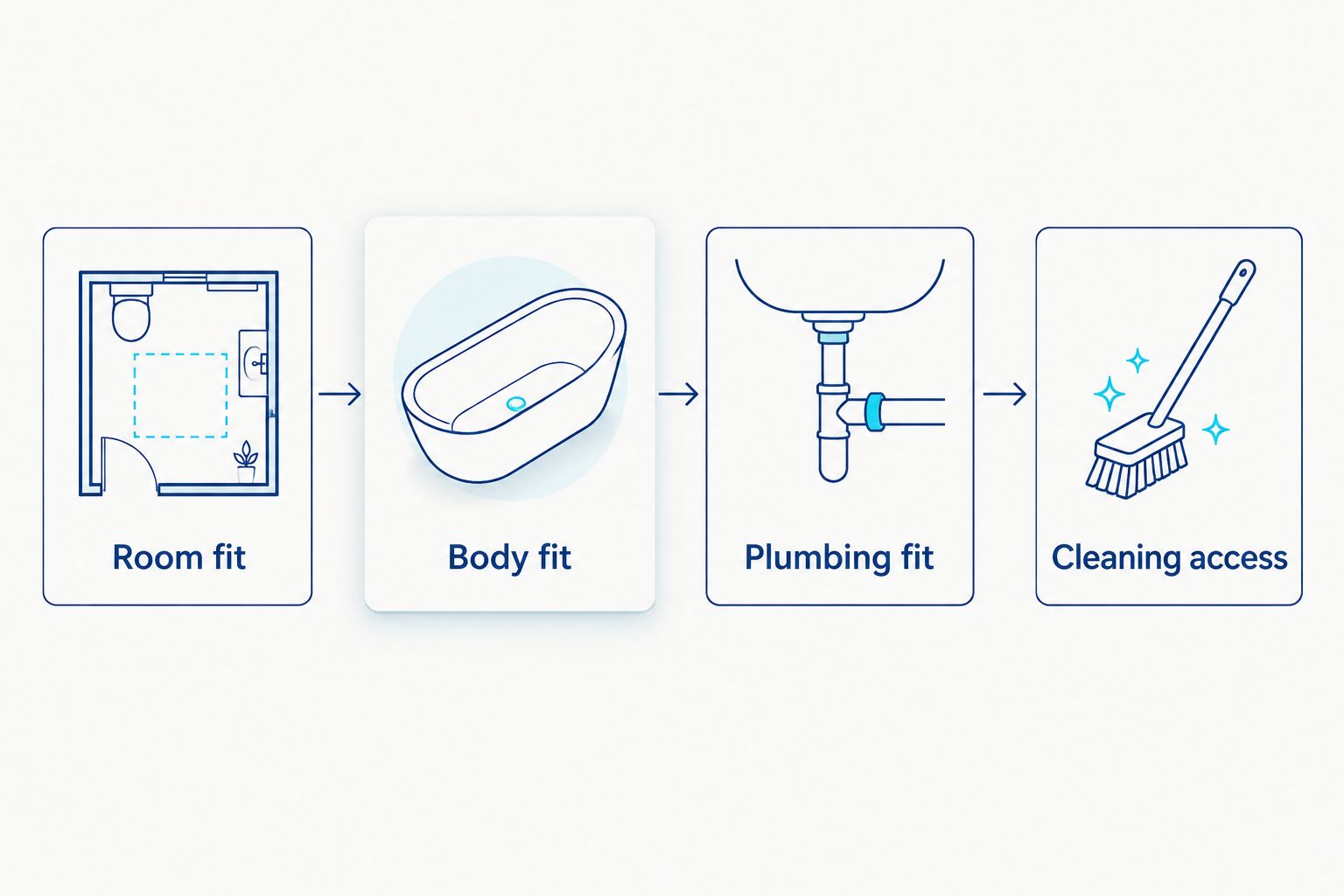
A useful layout check has four parts:
- Room fit: Confirm that the shell, faucet, and required clearances fit together without blocking other fixtures.
- Body fit: Review the basin drawing and, when possible, physically assess a comparable interior shape.
- Plumbing fit: Have the installer check drain position, water connections, and access for future service.
- Cleaning access: Confirm that you can reach the floor and exterior surfaces without moving the installed tub.
Do not choose a universal wall gap from a photograph. Follow the installation instructions and applicable local requirements, then check whether the remaining space is usable for your cleaning tools.
Confirm plumbing, hot water, and floor support
A freestanding tub still needs a compatible drain connection. Confirm where the drain lands relative to the existing plumbing and how the connection will be installed and serviced. A centered tub and an existing drain do not necessarily align.
Faucet placement deserves the same attention. Check that the selected fixture reaches the basin correctly and that its controls remain accessible. A chrome drain identifies a finish detail; it does not establish that a faucet is included or compatible.
Ask your plumber to assess the tub's documented fill requirements against your hot-water system. Tank capacity, incoming water temperature, delivery performance, and other household demand affect the result. Do not infer filling performance from the tub's exterior length.
For floor support, use the manufacturer's documented tub weight and water capacity together with the expected bather load. Have the appropriate professional assess the supporting structure when needed. An empty tub's weight is not the installed bathing load.
Make cleaning and safe entry part of the decision
Freestanding installation exposes surfaces that a built-in enclosure would cover. Before ordering, consider how you will clean behind the tub, around the base, and beside any floor-mounted faucet. Reaching the front is only part of the job.
Follow the tub manufacturer's cleaning instructions for the specific finish. Do not assume a household cleaner is suitable because it works on tile or another bathroom surface. Material names alone do not establish chemical compatibility.
Also assess the rim height and the movement required to sit down and stand up. A deep basin does not automatically provide easy access. If stepping over the side is difficult, prioritize an appropriate bathing arrangement and properly planned support rather than relying on the tub rim or faucet as a handhold.
Aeva Vital acrylic bathtub options for 2026
Aeva Vital freestanding bathtubs are best for buyers comparing documented acrylic sizes before selecting an installation layout. The useful starting facts are the listed lengths, material, drain finish, and model-specific details—not an assumed comfort or performance ranking.
The 55-inch option starts the comparison with the shortest listed length. Its limitation is that the length label alone does not establish interior fit. The 59-inch option adds a diamond-pattern exterior, but that styling detail does not prove better soaking comfort.
The 67-inch option lists cUPC certification. Check the documentation for that exact model and confirm acceptance with your installer or local authority; certification does not prove that the tub fits your body or that the room's plumbing is ready.
These Aeva Vital acrylic bathtub listings support a size comparison, not a claim about identical soaking depth, heat retention, or installation requirements. Resolve those details from the exact model documentation before ordering.


Is a larger freestanding tub always better?
A 67-inch tub is longer than the listed 55-inch and 59-inch options, but longer does not automatically mean more comfortable. Your bathing posture depends on the interior basin, including the backrest and the position of your feet.
Choose the size that fits both the person and the room. Do not trade away necessary access simply to select the longest shell.
Can a freestanding soaking tub work in a small bathroom?
A 55-inch listed length provides a shorter starting footprint than the other listed options, but length alone cannot establish small-bathroom suitability. You must also check width, faucet location, door movement, and the space needed to approach and clean the tub.
If those checks fail, reconsider the layout or fixture type. A smaller length label is not permission to ignore the rest of the room.
Should a 2026 remodel keep the tub or prioritize the shower?
Prioritize the fixture your household actually uses. If bathing is an established preference, protect space for a properly fitted tub; if showering dominates, do not compromise the shower merely to add a freestanding centerpiece.
Make that decision before choosing finishes. Changing the fixture arrangement affects more of the project than changing the tub's surface appearance.
Related guides
- Freestanding soaking tubs ranked by soaking depth
- Freestanding soaking tubs for remodelers
- Freestanding tubs for small bathrooms
FAQ
Is a freestanding soaking tub worth it if I rarely take baths?
A freestanding soaking tub is difficult to justify on practical use alone if you rarely bathe. Prioritize your everyday bathroom routine before dedicating space to a separate tub.
What's the difference between a soaking tub and a freestanding tub?
Soaking describes a tub's bathing purpose, while freestanding describes its installation form. Check the model's documented water depth and interior dimensions rather than assuming either term guarantees a particular fit.
Is a 55-inch freestanding tub big enough?
A 55-inch exterior length does not establish whether the basin fits your body. Compare interior floor length, width, backrest shape, and soaking depth before deciding.
Is a 67-inch tub more comfortable than a 59-inch tub?
A 67-inch tub is not automatically more comfortable than a 59-inch tub. Interior geometry and your preferred bathing posture determine whether the additional exterior length is useful.
Do freestanding tubs need special plumbing?
Freestanding tubs need drain and faucet arrangements compatible with the exact model and installation location. Have a plumber verify connection positions and service access before ordering.
Are freestanding tubs difficult to clean behind?
Freestanding tubs are difficult to clean behind when the layout leaves inaccessible gaps. Check your reach and cleaning-tool access while planning the footprint.
Does cUPC certification mean a bathtub will fit my bathroom?
cUPC certification does not establish bathroom fit or personal comfort. Confirm the exact model's documentation, installation requirements, and acceptance with your installer or local authority.
One last thing
Before committing to a freestanding soaking tub in 2026, mark its full footprint and faucet position on the floor, then use the bathroom normally. If the outline already makes daily movement awkward, change the plan before the tub arrives.