

To clean a cold plunge tub without adding chemicals, drain it, remove debris, wipe accessible surfaces with a manufacturer-approved soft cloth, rinse with potable water, and let it dry. For a no-added-sanitizer routine in 2026, use fresh water for each session rather than storing untreated water between uses. Physical cleaning removes dirt; it does not disinfect the tub, plumbing, or water.
By Editorial Team
- How to clean a cold plunge tub without chemicals: drain, wipe, rinse, and dry; these steps do not disinfect.
- Use fresh potable water for each session instead of repeatedly using stored, untreated water.
- Filters capture particles; a chiller and clear water do not prove microbiological safety.
- Aeva Vital offers portable and outdoor ice baths; compare cleaning access before choosing a tub.
How do you keep a cold plunge tub clean without chemicals?
Separate the job into removing contamination and controlling microorganisms. You can remove loose dirt mechanically, but a water-only routine does not provide a verified disinfection step. For retained water, use the tub manufacturer's specified water-treatment procedure; the guide to maintaining water quality in a cold plunge tub covers the broader maintenance task.
Follow this sequence for a drain-and-refill tub, provided its instructions permit the methods below:
- Check the manual. Identify approved cleaning tools, drainage instructions, and any required disinfection procedure before starting.
- Shut down connected equipment. Follow the manufacturer's shutdown sequence before draining or opening serviceable components. Never run a pump dry.
- Empty the tub completely. Remove floating debris and discharge the water through the intended drain route.
- Wipe accessible surfaces. Use a clean, soft cloth on the walls, floor, waterline, lid, and accessible fittings. Avoid abrasive pads.
- Rinse and remove residue. Rinse loosened dirt away with potable water, then drain again. Do not leave dirty rinse water behind.
- Dry before storage. Let accessible surfaces dry according to the instructions. Refill with fresh potable water immediately before the next session.
If residue remains, do not treat repeated water-only wiping as proof that the tub is ready. Use the manufacturer's approved cleaning and disinfection procedure before returning it to service.
Why this matters: clear water is not disinfected water
A cold plunge collects material from your skin, swimwear, feet, and surroundings. A lid blocks some incoming debris, but it does not remove what a person introduces during immersion. Low temperature is not a substitute for disinfection.
Judge appearance and sanitation separately. Water that looks clear can still contain microorganisms, while a visibly dirty surface needs cleaning regardless of the water temperature.
For your 2026 maintenance plan, distinguish these tasks:
- Cleaning: removing dirt, oils, and other material from surfaces.
- Filtration: capturing particles as water passes through a suitable filter.
- Disinfection: using a validated process to inactivate microorganisms.
- Water replacement: removing used water and introducing fresh water without necessarily cleaning the system.
These tasks complement each other. None becomes unnecessary just because the water feels cold.
Which no-added-chemical methods help, and where do they fall short?
“Without chemicals” usually means without adding a sanitizer to the bathwater. It does not mean that every alternative is suitable for every tub, or that retained water becomes safe without treatment. Compare methods by the job they actually perform.
| Method | Best for | What it does | Main limitation |
|---|---|---|---|
| Drain, wipe, rinse, and dry | Accessible drain-and-refill tubs | Removes used water and reachable surface dirt | Does not disinfect hidden plumbing or surfaces |
| Showering before entry | Reducing incoming contamination | Removes some sweat, dirt, and personal-care residue before immersion | Does not make the bather or bathwater sterile |
| Fitted cover | Keeping out outdoor debris | Limits leaves, insects, and other falling material | Does not treat existing contamination |
| Mechanical filtration | Removing suspended particles | Captures material within the filter's capabilities | Does not automatically disinfect water |
| Properly specified UV treatment | Compatible treatment systems | Inactivates susceptible microorganisms exposed to an adequate UV dose | Does not leave a disinfectant residual throughout the tub |
The strongest practical approach combines prevention, accessible cleaning, and the treatment required by the equipment manufacturer. Do not interpret a filter or UV component as permission to ignore the rest of the water-care instructions.
What changes when your tub has a chiller or plumbing?
A simple basin and a recirculating system have different cleaning demands. Draining the visible tub does not establish that hoses, pump housings, fittings, and other internal passages are empty or clean. Those areas need their own maintenance instructions.
Drain-and-refill tubs
An accessible basin lets you inspect and wipe more of the wetted surface. That makes physical cleaning straightforward, but seams, folds, valves, and lid undersides still need attention.
For a routine without added sanitizer, choose fresh water for each session rather than inventing a storage interval. This reduces reuse of untreated water; it does not eliminate the need for disinfection when required by the manufacturer or following contamination.
Recirculating tubs
A chiller controls temperature, not sanitation. A circulating pump moves water, and a filter captures particles according to its design. Neither function proves that microorganisms are controlled throughout the system.
Before adopting any no-added-sanitizer routine, confirm that the manufacturer explicitly supports it for the complete installation. If the instructions require a sanitizer, do not replace that requirement with extra filtration or colder water.
Why cold plunge cleaning needs vary
There is no universal water-change schedule that applies to every cold plunge. A calendar reminder cannot account for changes in use, contamination, or equipment condition. Base the maintenance routine on the manufacturer's instructions and the actual setup.
- Bather load: More users introduce more opportunities for contamination; shared use requires a different approach from a private session.
- Pre-entry hygiene: Sweat, cosmetics, lotions, and dirty feet add material that the maintenance process must remove.
- Outdoor exposure: Leaves, insects, soil, and rainwater create additional cleaning demands.
- Surface access: Seams, textured areas, valves, and inaccessible fittings make inspection and cleaning harder.
- Water retention: Storing and reusing water creates different treatment requirements from draining after a session.
- Equipment layout: Filters, hoses, pumps, and chillers add components with separate servicing needs.
In 2026, record the routine for your actual system rather than copying an interval from a different tub. Include what you inspected, what you cleaned, and any faults that remain unresolved.
How do you reduce contamination before entering?
Start with the person and the surrounding area. Shower before entry, rinse off soap, and use clean swimwear. Keep outdoor footwear away from the entry point so you do not carry soil into the water.
Keep clean equipment separate from dirty equipment. A cloth used on the floor should not become the cloth used inside the tub, and the dirty underside of a cover should not rest against a freshly cleaned surface.
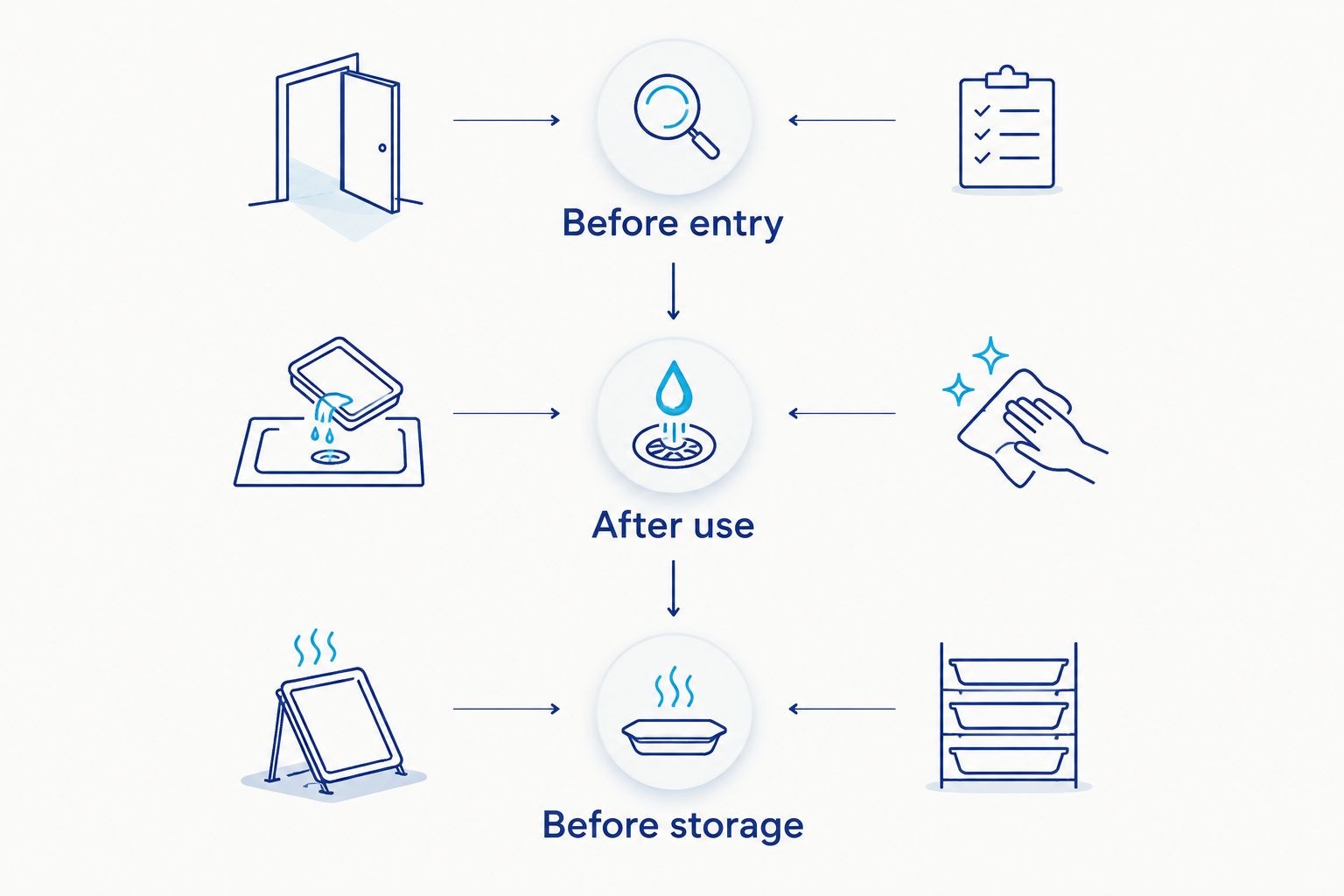
Use these checks around every session:
- Before entry: Check the water, accessible surfaces, cover, and equipment condition.
- After use: Follow the planned drain-and-clean procedure rather than leaving untreated water for another session.
- Before storage: Remove standing water where accessible and allow drying as directed.
Do not enter if you have diarrhea, an infected wound, or another condition that creates a contamination concern. If a contamination incident occurs, stop using the tub and follow the applicable cleaning and disinfection procedure; a quick rinse is not enough.
Can you use vinegar, baking soda, ozone, or UV instead?
Vinegar and baking soda are chemical substances, not chemical-free substitutes. Their household cleaning uses do not establish that they disinfect a cold plunge or suit its seals, liner, fittings, and equipment. Do not add them unless the manufacturer approves the specific use.
Ozone is also a chemical treatment. Its presence does not make a system “chemical-free,” and its operation needs equipment-specific instructions and appropriate exposure controls. Do not improvise an ozone installation.
UV treatment requires the right equipment, water conditions, flow, and maintenance. It acts on water exposed inside the treatment chamber, not automatically on every surface in the basin and plumbing. A UV label alone does not prove that a complete cold plunge can operate without a residual sanitizer.
Never mix cleaning products or combine treatments based on an online recipe. Follow the equipment instructions and each treatment product's label.
What should you compare in an Aeva Vital cold plunge tub?
Aeva Vital cold plunge tubs suit home buyers comparing portable and outdoor ice-bath formats. For cleaning, the important questions concern access, drainage, and the required treatment routine—not capacity alone.
The supplied product information identifies these specifications for comparison in 2026. A listed capacity does not establish a recommended fill level, cleaning interval, or sanitation capability.
| Product | Listed capacity | Stated format or feature | Best for comparing | Cleaning limitation |
|---|---|---|---|---|
| Portable Inflatable Ice Bath Tub | Cold Water Therapy for Athletes | 76.6 Gallon | 76.6 gallons | Portable, inflatable ice bath | Portable ice-bath formats | Capacity and portability do not establish cleaning access or disinfection requirements |
| 79 Gallon Cold Plunge Tub | All-Season Outdoor Ice Bath | Thermo Lid Included | 79 gallons | Outdoor ice bath with included thermo lid | Covered outdoor ice-bath formats | An included lid does not establish water-treatment performance |
The 76.6-gallon capacity identifies the portable inflatable tub's listed volume. The 79-gallon capacity identifies the outdoor tub's listed volume. Neither specification proves that you can retain untreated water safely between sessions.
Before selecting either Aeva Vital option, confirm how you reach the drain, clean the waterline, dry the interior, and care for any connected equipment. Do not infer included filtration, UV treatment, or a chemical-free operating mode from these product titles.


When should you stop using the water?
Stop using the tub if you notice slime, persistent cloudiness, unusual odor, visible contamination, or a treatment-system fault. These are reasons to investigate, not signals to add more ice and continue. Their absence does not prove safety.
Drain and clean according to the manufacturer's procedure, including required disinfection and equipment servicing. If a slippery film returns after wiping, investigate inaccessible components rather than repeatedly cleaning only the visible basin.
Do not refill a contaminated system and assume fresh water fixes the underlying problem. Resolve the cause before another session.
FAQ
How do I clean a cold plunge tub without chemicals?
Drain the tub, remove debris, wipe accessible surfaces with an approved soft cloth, rinse with potable water, and dry as directed. This removes dirt but does not disinfect the tub or plumbing.
Can I leave untreated water in my cold plunge between sessions?
Do not assume untreated retained water is safe for reuse. For a no-added-sanitizer routine, use fresh water for each session and follow the manufacturer's cleaning and disinfection requirements.
Does cold water kill bacteria in an ice bath?
Cold water is not a reliable disinfection method. A chiller controls temperature; it does not establish that the water or wetted surfaces are microbiologically safe.
Will a filter keep my cold plunge clean without sanitizer?
A filter removes particles within its design limits, but filtration alone does not establish disinfection. Follow the complete water-treatment instructions for the tub and connected equipment.
Can I use vinegar to sanitize my cold plunge?
Do not use vinegar as an improvised cold plunge sanitizer. Use only manufacturer-approved methods and follow the directions for the specific cleaning or treatment product.
Does a UV system make a cold plunge chemical-free?
A UV system does not automatically make a cold plunge suitable for operation without added sanitizer. Its effectiveness depends on the installed system, and it does not leave a disinfectant residual throughout the tub.
Does an Aeva Vital ice-bath capacity tell me how often to clean it?
No, an Aeva Vital ice-bath capacity does not establish a cleaning interval. Base maintenance on the manufacturer's instructions, water-treatment setup, use, and contamination conditions.
Related guides
- Connecting a water filtration system to your cold plunge tub
- Cold plunge tubs ranked by tank capacity
- Plumbing a freestanding tub and cold plunge into one room
One last thing
Before choosing your 2026 setup, trace where used water goes and which wetted surfaces you can actually reach. A tub that empties visibly can still leave water inside connected equipment. Choose a cleaning routine you can complete correctly, and never confuse fresh water with a disinfected system.