
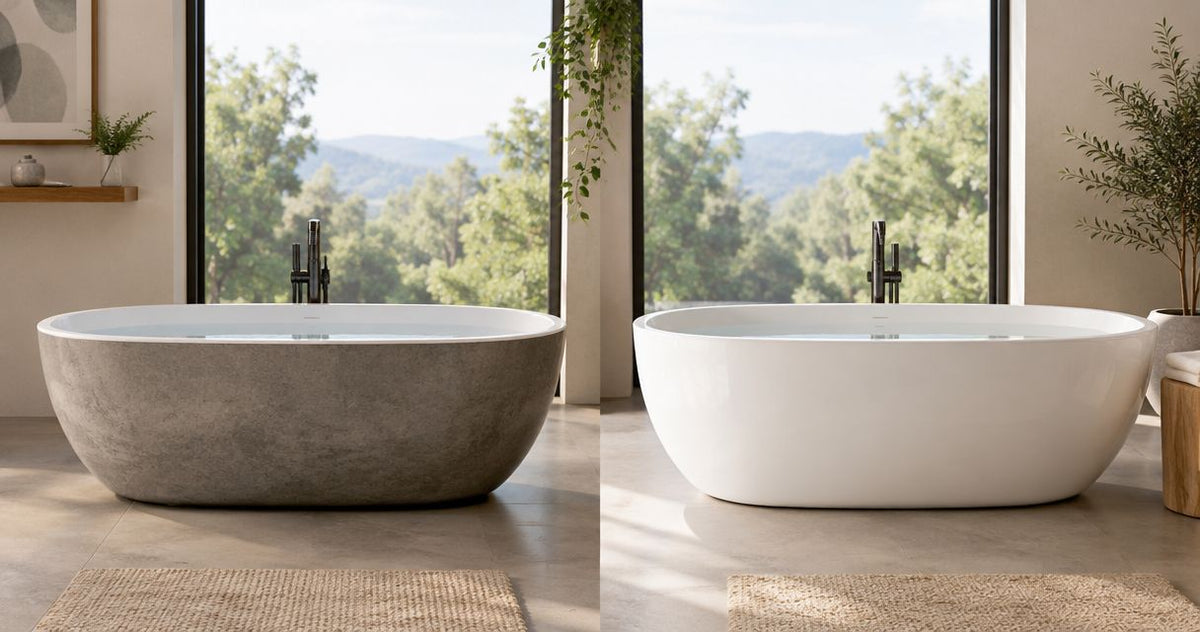
Neither stone resin nor acrylic automatically holds bathwater heat better: the finished tub’s construction matters more than its material label. Stone resin can store heat in its mass after warming, while acrylic resists heat flow through the shell; insulation, wall thickness, water volume, and room conditions determine the result. For stone resin vs acrylic tub heat retention, choose on documented construction and comparable cooling tests—not an unsupported promise of longer-lasting warmth.
By Editorial Team
- Stone resin vs acrylic tub heat retention has no universal winner; compare finished construction and cooling tests.
- Stone resin’s thermal mass stores heat after warming, but a cold shell first absorbs heat from bathwater.
- Acrylic’s material properties do not prove that every acrylic tub is insulated.
- Aeva Vital freestanding bathtubs suit shoppers comparing documented acrylic sizes; size alone does not establish heat retention.
Stone resin or acrylic: which tub holds heat better?
A material name is not a cooling-rate specification. To establish which tub holds heat better, you need measurements taken with comparable water volume, starting temperature, room temperature, and elapsed time.
Stone resin and acrylic manage heat differently. Thermal mass describes how much heat an object stores as its temperature changes. Thermal conductivity describes how readily heat moves through a material. A tub can have substantial thermal mass without being well insulated.
| Decision factor | Stone resin | Acrylic |
|---|---|---|
| Best for | Buyers who want a substantial composite shell and can accommodate its documented installed load | Buyers seeking an acrylic shell with clearly documented reinforcement and insulation |
| Relevant material behavior | A substantial shell stores heat once warmed | Acrylic resists heat flow, but shell construction still matters |
| Main limitation | A cold shell absorbs heat from the initial fill | An acrylic label does not establish insulation or wall thickness |
| Evidence to request | Composition, shell thickness, empty weight, and cooling-test conditions | Shell construction, insulation details, empty weight, and cooling-test conditions |
| What the label cannot prove | A guaranteed warm-soak duration | A guaranteed warm-soak duration |
For a broader material comparison, see the guide to freestanding tubs by material: acrylic vs stone resin. Treat material selection and measured thermal performance as related questions, not interchangeable answers.
Why this matters
A tub that feels substantial in a showroom does not necessarily keep your bathwater warmer at home. Your water heater supplies the initial heat; the shell, exposed water surface, surrounding air, and your body all participate in the heat exchange afterward.
For a 2026 bathroom purchase, separate comfort claims from measurable evidence. Dimensions establish fit. Material descriptions explain construction. Neither establishes how much the water temperature falls during your bath.
That distinction prevents a common buying mistake: choosing a material for a promised outcome that the specification sheet never measures.
Stone resin: thermal mass with an initial warm-up trade-off
Stone resin generally describes a composite made with mineral material and resin. The name does not identify a single standardized formulation, so two stone resin tubs need not have identical thermal properties.
A substantial composite shell absorbs heat as it warms. Once warm, it contains stored thermal energy that participates in the cooling process. That is the basis for discussing stone resin’s thermal mass—not proof that every stone resin tub outperforms every acrylic alternative.
The trade-off occurs at filling. If the shell starts cooler than the water, heat moves from the water into the shell. More heat stored in the tub means that heat came from somewhere, including the initial fill.
Best for: buyers who prefer a substantial composite tub and will check its installation requirements. The advantage is heat-storage capacity in a warmed shell; the limitation is that neither mass nor material composition alone predicts bathwater cooling.
Ask for the actual model’s empty weight, construction details, and installation instructions. Do not substitute a general description of stone resin for those documents.
Acrylic: low heat conduction is not the same as insulation
Acrylic is a plastic used to form bathtub shells. The finished tub can also include reinforcement, supporting structures, cavities, or insulation, depending on its design.
Acrylic’s resistance to heat flow is relevant, but a thin material layer and an insulated assembly are different things. An acrylic tub is not automatically an insulated tub. The product documentation must identify any insulation rather than leaving you to infer it from the material name.
Likewise, an exterior shell does not establish what sits between the inner and outer surfaces. A description such as double-wall construction identifies an arrangement, not a measured cooling rate.
Best for: buyers who want an acrylic tub and can compare its complete construction. The advantage is a material that resists heat conduction; the limitation is that reinforcement, shell thickness, and insulation remain model-specific.
For a 2026 shortlist, request those details before treating an acrylic model as a thermal upgrade. A clear construction drawing is more useful than a vague statement that the tub keeps water warm.
Why bathtub heat retention varies
The water loses heat through several routes at once. These factors explain why a material-only comparison cannot establish a reliable winner:
- Shell construction: thickness, reinforcement, cavities, and insulation change the path heat takes through the tub.
- Starting temperature: a cold shell absorbs heat from warm water, regardless of whether the material is stone resin or acrylic.
- Water volume: more water stores more thermal energy at the same temperature, although a larger tub also changes exposed surface area.
- Exposed surface: evaporation and heat transfer occur at the water’s surface; the shell material does not eliminate them.
- Room conditions: cooler surrounding air and airflow affect heat loss from the water and tub.
- Filling conditions: water arriving at the faucet and the time spent filling determine the temperature you actually start with.
These variables interact. Comparing a deep, narrow tub with a broad, shallow tub changes more than the material, even if their outside lengths match.
What counts as a useful heat-retention test?
A useful comparison records temperature change under matched conditions. A claim that a tub stays warm, without a starting temperature or test method, does not tell you whether it will outperform another model.
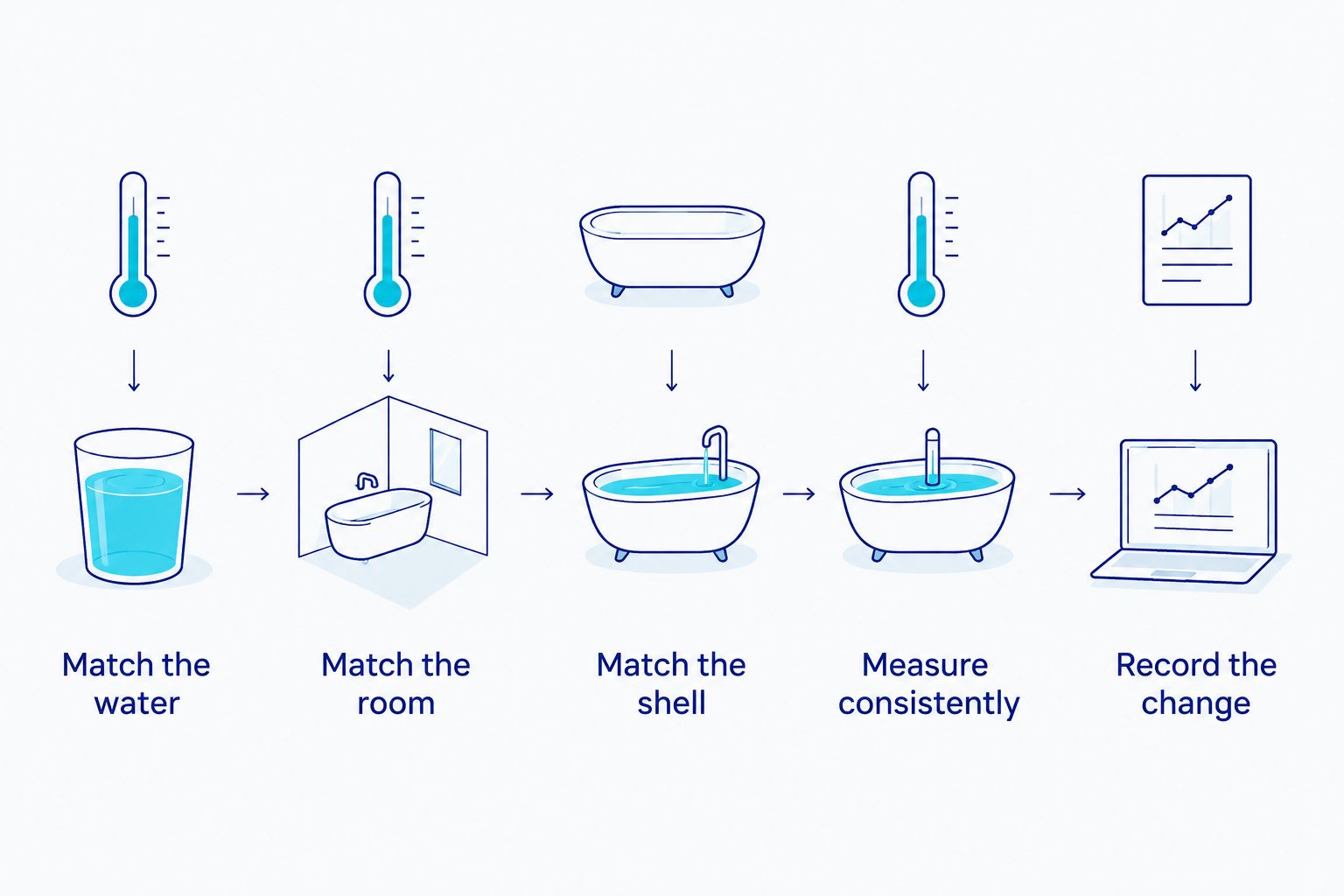
Use this sequence when reviewing a manufacturer’s report or arranging a practical comparison:
- Match the water: document the fill volume and use the same starting water temperature.
- Match the room: record room temperature and avoid comparing different airflow conditions.
- Match the shell: establish whether each empty tub begins at room temperature or has been prewarmed.
- Measure consistently: use the same thermometer, measurement position, and elapsed intervals.
- Record the change: compare temperature loss over the same period without topping up either tub.
A test with nobody in the water answers a different question from a bath with an occupant. Both can be informative, but the comparison must use the same setup.
When reviewing a 2026 product claim, look for the method alongside the result. A single final temperature without the starting conditions is not enough to rank tubs.
Does stone resin keep water warm longer than acrylic?
Stone resin does not have a universal warm-water duration advantage over acrylic. Its thermal mass matters, but insulation and the complete tub design also affect heat loss.
A heavier shell is not automatically a better insulator. To choose between specific models, compare documented cooling results or acknowledge that thermal performance remains unranked.
Does a thicker bathtub hold heat better?
A thicker wall changes heat transfer, but thickness alone does not establish better bathwater heat retention. You also need to know the material, wall assembly, insulation, and starting shell temperature.
Compare like-for-like construction details. A thick solid composite wall and a reinforced acrylic assembly are not equivalent simply because both specifications mention thickness.
Will a longer bathtub keep the water warmer?
A longer bathtub does not automatically retain heat better. Length is only one dimension; internal shape, actual fill volume, and exposed water area also matter.
Choose a length that fits your body and bathroom. Then assess thermal construction separately rather than using exterior size as a heat-retention rating.
Aeva Vital acrylic bathtubs: what the listed facts establish
The Aeva Vital freestanding bathtub selection supplied for this comparison includes 55-inch, 59-inch, and 67-inch acrylic models. Those dimensions distinguish the listed sizes; they do not establish usable soaking depth, water capacity, insulation, or a cooling-rate ranking.
| Listed model | Stated size | Best for | What the listing does not establish |
|---|---|---|---|
| 55" Acrylic Freestanding Soaking Bathtub with Chrome Drain | 55 inches | Shoppers starting with the shortest listed size | Comparative heat retention or complete installation clearance |
| 59" Acrylic Freestanding Bathtub – Diamond Pattern, Gloss White, Chrome Drain | 59 inches | Shoppers considering the intermediate listed size and named exterior finish | Insulation performance or a measured cooling advantage |
| 67" Acrylic Freestanding Bathtub – Gloss White, Chrome Drain, cUPC Certified | 67 inches | Shoppers considering the longest listed size and stated certification | A guaranteed soak duration or thermal ranking |
The 67-inch model’s title states cUPC certification. That is a plumbing-product compliance designation, not a statement of bathwater cooling performance. Do not convert a certification into a heat-retention claim it does not make.
The 59-inch model’s diamond pattern and gloss-white finish describe the product, not its thermal behavior. The 55-inch model’s stated size likewise does not establish the room required around it for installation or access.
For a 2026 comparison, use these sizes to narrow fit—not to rank warmth. Confirm the full dimensional drawing, empty weight, drain arrangement, and construction details before selecting a model.


Check installation compatibility before choosing the material
A thermal preference cannot override the bathroom’s physical constraints. The installation must account for the tub, water, occupant, drain position, and the route used to bring the tub into the room.
Ask your installer to evaluate the documented filled load rather than assuming a material is suitable for any floor. Empty weight alone leaves out the water and occupant.
Also check the water-heating system against the intended fill. A larger tub that receives an inadequate warm-water supply does not become more comfortable because its shell has favorable thermal properties.
Your final 2026 shortlist should satisfy fit, structural support, plumbing compatibility, and usable bathing dimensions before heat-retention claims become the deciding factor. Reject undocumented performance claims, not an entire material category.
FAQ
Which is better for heat retention, stone resin or acrylic?
Neither material is a universal winner for heat retention. Compare the finished tub’s insulation, shell construction, water volume, and cooling results under matched conditions.
Does stone resin absorb heat from bathwater?
A stone resin shell absorbs heat when it starts cooler than the bathwater. Once warmed, the shell stores thermal energy, but that does not establish a guaranteed warm-soak duration.
Are all acrylic bathtubs insulated?
No, an acrylic material description does not establish that a bathtub has insulation. Look for explicit insulation details in the model’s construction documentation.
Does cUPC certification mean a bathtub keeps water hot?
No, cUPC certification is not a heat-retention rating. The 67-inch Aeva Vital acrylic bathtub lists cUPC certification, but that designation does not establish a cooling rate.
Is a 67-inch tub warmer than a 55-inch tub?
A 67-inch tub is not automatically warmer than a 55-inch tub. Internal volume, exposed water surface, construction, and room conditions determine the thermal comparison.
Can I compare tubs using their empty weights?
Empty weight alone cannot establish which tub retains bathwater heat better. Weight helps assess handling and installation, while thermal performance also depends on material properties and construction.
What should I ask before buying a tub for long baths?
Ask for shell construction, insulation details, internal bathing dimensions, and any documented cooling test. Also confirm the floor support, drain arrangement, and water-heating compatibility for the selected model.
Related guides
- How long does freestanding tub installation take?
- How much weight can a floor hold under a freestanding tub?
- How to keep bathwater hot longer in a freestanding tub
One last thing
A warm-feeling shell and warm bathwater are different measurements. Before choosing a tub for longer baths, ask one precise question: what temperature loss was measured, under what conditions? If the answer only repeats the material name, base your decision on documented fit and construction instead.