
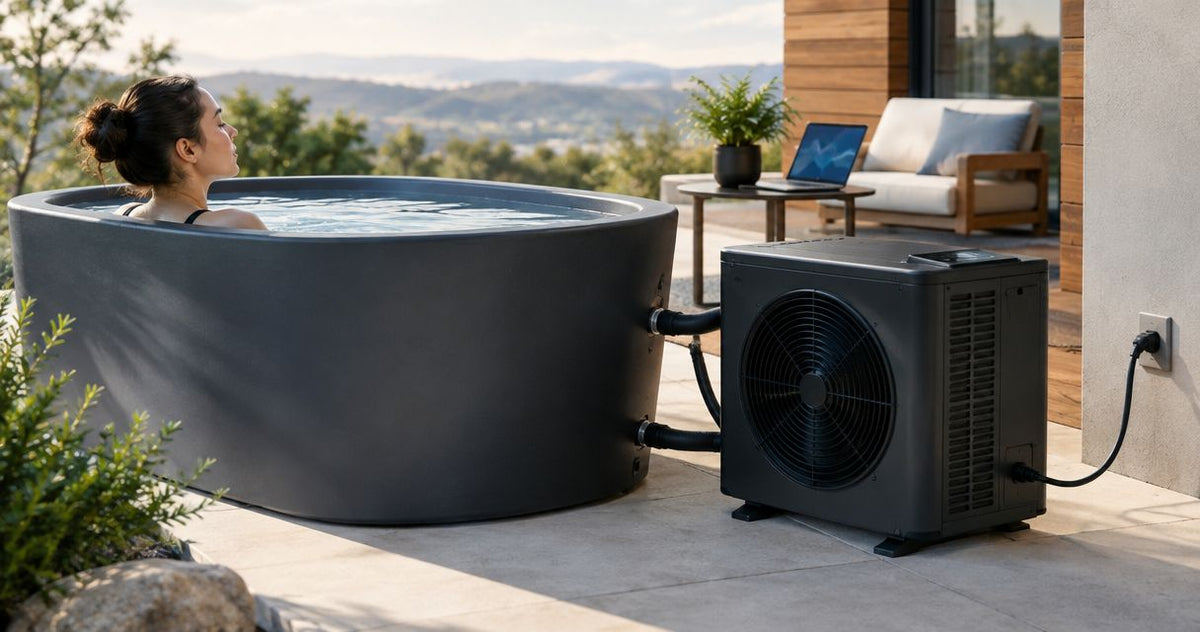
A cold plunge chiller’s electricity use equals its average electrical input in kilowatts multiplied by its operating time in hours; there is no single daily consumption figure that applies to every setup. Include circulation, filtration, and standby power—not just the compressor—and measure the complete system in kilowatt-hours, or kWh, to establish your actual usage.
By Editorial Team
- How much electricity does a cold plunge chiller use? Measure total kWh rather than relying on horsepower.
- Aeva Vital tub capacities describe water volume, not chiller electrical consumption.
- Separate initial cooldown from temperature maintenance when comparing energy readings.
- Include pumps, filtration, and standby loads in your cold plunge electricity total.
How much electricity does a cold plunge chiller use?
Your measured kWh total is the answer; rated watts alone are not. A chiller changes operating state as it cools the water and maintains the selected temperature. Its connected electrical load and its accumulated electricity consumption describe different things.
For a home installation in 2026, start with the equipment’s electrical instructions and a suitable energy meter. Review the requirements for connecting a cold plunge tub to a dedicated GFCI outlet before adding any monitoring equipment. A meter does not replace electrical protection or establish whether a circuit is suitable.
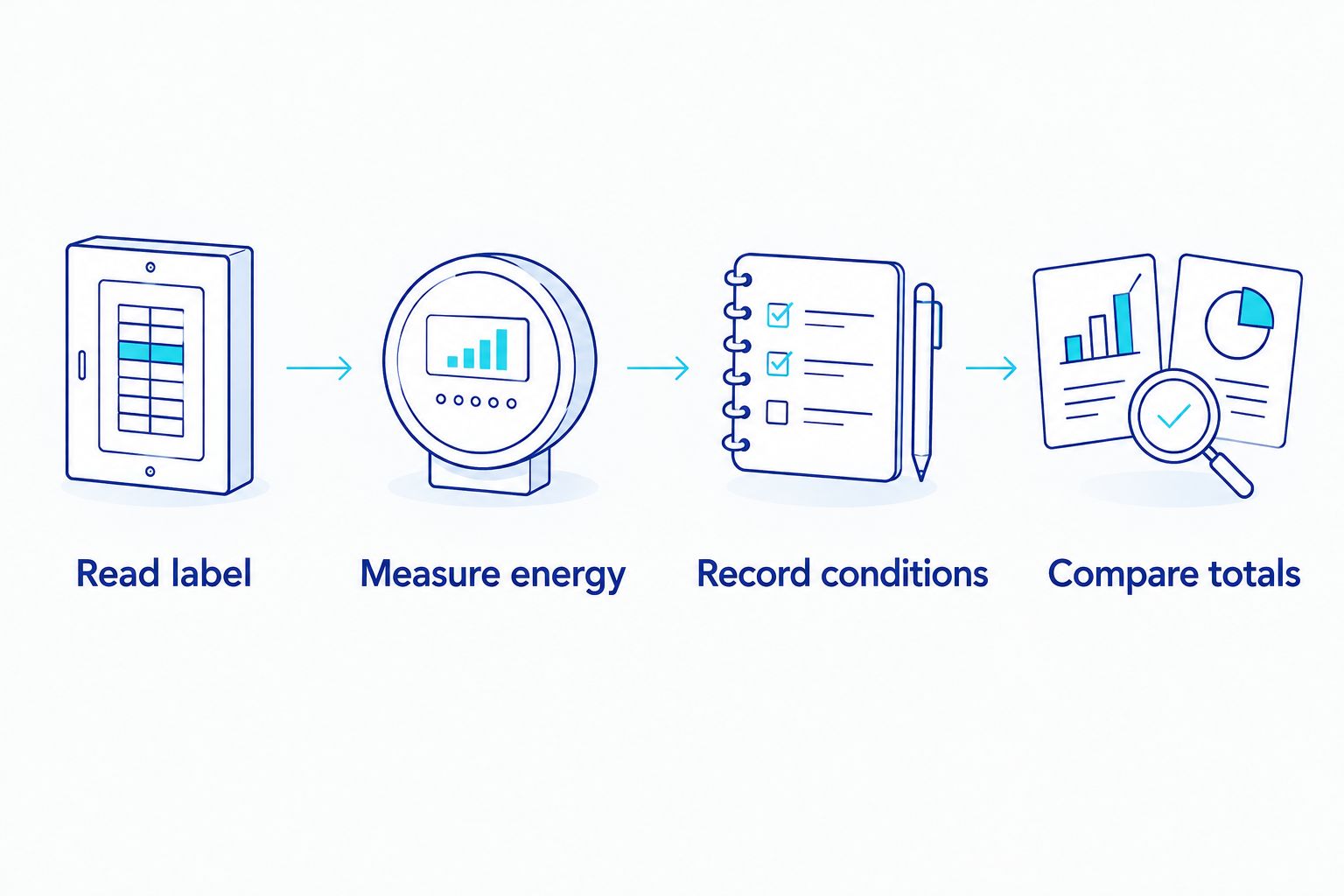
Use this sequence to establish consumption:
- Identify every powered component. Include the chiller, circulation pump, filtration equipment, and any separately powered accessories.
- Measure accumulated kWh. Read energy over a complete operating period, not just instantaneous watts while the compressor runs.
- Record the conditions. Note starting water temperature, target temperature, actual fill volume, cover use, and surrounding conditions.
- Separate operating phases. Keep initial cooldown readings separate from readings taken while maintaining cold water.
- Compare equivalent periods. Use matching measurement durations and similar conditions before judging which setup consumes less.
This method gives you a defensible household measurement. It also prevents a brief compressor reading from becoming an unsupported monthly estimate.
What each electrical measurement tells you
| Measurement | What it tells you | Best for | Limitation |
|---|---|---|---|
| Input watts, W | Electrical power at a particular operating state | Checking a documented operating load | Does not establish daily consumption |
| Kilowatts, kW | The same power measurement expressed in larger units | Calculating energy from known power and runtime | Requires representative power and runtime data |
| Kilowatt-hours, kWh | Electricity accumulated over time | Comparing actual operating consumption | Needs a defined measurement period |
| Amperes, A | Electrical current | Reviewing equipment and circuit requirements | Current alone does not establish energy use |
| Horsepower, hp | A power rating whose meaning depends on the specification | Understanding a clearly defined equipment rating | Does not establish whole-system kWh |
Watts versus kWh: the calculation that matters
A kilowatt equals 1,000 watts. A kilowatt-hour is the energy used by a constant 1 kW load operating for 1 hour. These are unit definitions, not estimates for a cold plunge chiller.
Use the following relationship when electrical input remains constant:
Energy in kWh = input watts ÷ 1,000 × operating hours.
For equipment that cycles or changes power, use average electrical input over the measurement period or read accumulated kWh directly. Multiplying the highest observed wattage by every connected hour treats the equipment as though it draws that power continuously.
A thermostat-controlled system does not necessarily behave that way. The compressor, fan, pump, and controls can have different operating schedules, so a single operating-watts figure does not describe every part of the day.
Why cooling capacity is not electrical input
Cooling capacity describes heat removed from the water. Electrical input describes power drawn from the supply. They are not interchangeable specifications.
A cooling-capacity figure expressed in watts is particularly easy to misread because electrical input also uses watts. Look for wording such as electrical input, rated input power, or power consumption, and check what components the figure includes.
For a 2026 comparison, keep the manufacturer’s terminology beside each recorded value. Do not place cooling capacity and electrical input in the same comparison column simply because both use a power unit.
How to measure your cold plunge’s electricity use
Measure the whole installation if your goal is household electricity consumption. Monitoring only the compressor leaves out any equipment connected through a separate supply.
A plug-in energy meter is appropriate only when its instructions and electrical ratings permit use with the equipment and installation. For hardwired equipment or an unsuitable plug-in arrangement, ask a qualified electrician about an appropriate monitoring method.
Read label
Find the electrical label and installation manual before connecting a monitor. Check the supply requirements, rated current, input power where stated, and any instructions concerning external controls or switching devices.
A maximum electrical rating helps establish equipment requirements. It is not automatically the average operating load. Keep those two meanings separate in your notes.
Measure energy
Reset the meter at the beginning of a defined operating period and record accumulated kWh at the end. Record elapsed time alongside the reading so the total has a clear basis.
If the pump uses a separate outlet, measure that supply too. Add the energy totals for the same period rather than adding isolated watt readings taken at different times.
Record conditions
Write down the water’s starting temperature, selected temperature, actual fill volume, cover position, and installation location. Include whether the reading covers freshly filled water or an already cold tub.
Keep the record simple enough to repeat. A consumption figure without its operating conditions is difficult to use when comparing seasons, locations, or changes to your routine.
Compare totals
Compare initial cooldown with initial cooldown, and maintenance operation with maintenance operation. Do not compare a freshly filled tub against one that has already reached its target temperature.
Use these same headings in your 2026 energy log. Consistent records make changes in consumption easier to interpret without assuming that every difference comes from the chiller itself.
Initial cooldown versus temperature maintenance
Initial cooldown removes heat from water that starts above your selected temperature. Maintenance operation removes heat that enters after the water reaches that setting. These are different workloads.
Neither phase alone establishes your complete operating consumption. If you drain and refill the tub, the next cooldown belongs in your energy record rather than disappearing into a maintenance-only estimate.
| Operating phase | What the chiller is doing | Best for measuring | Main limitation |
|---|---|---|---|
| Initial cooldown | Reducing water temperature toward the selected setting | Energy associated with preparing freshly filled water | Does not represent an already cold tub |
| Temperature maintenance | Removing incoming heat around the selected setting | Consumption while keeping water ready | Depends on the conditions during measurement |
| Circulation or filtration | Moving or treating water according to the system’s design | Loads outside active compressor cooling | Can be missed when only the chiller supply is monitored |
| Standby | Supplying controls or other inactive-system functions | Consumption while connected but not actively cooling | Requires measurement rather than an assumption of zero |
Keep cooldown and maintenance totals separate, then include both when assessing your actual routine. This preserves useful detail without understating the complete system’s consumption.
Why cold plunge chiller electricity use varies
Heat load, equipment operation, and installation conditions determine consumption. The following factors explain why another owner’s electricity reading is not automatically a useful forecast for your home:
- Actual water volume. More water requires more heat removal for the same temperature reduction. Nominal tub capacity is not necessarily your operating fill volume.
- Starting and target temperatures. A larger temperature reduction requires more heat removal from the same quantity of water.
- Surrounding temperature and sunlight. Heat entering the tub changes the cooling work required. Outdoor conditions also change over time.
- Insulation and cover use. The tub, lid, and exposed plumbing affect heat transfer. A cover’s presence alone does not quantify energy savings.
- Equipment efficiency and airflow. Electrical input depends on the equipment and operating conditions. Follow the specified ventilation clearances rather than enclosing a chiller to hide it.
- Pump, filtration, and control schedules. Auxiliary equipment contributes to total consumption even when it operates separately from the compressor.
Change one condition at a time when investigating consumption. If you change the temperature setting, cover routine, and location together, the resulting meter reading cannot isolate the effect of any single change.
Does leaving a chiller connected mean it runs continuously?
Connected hours are not necessarily compressor-running hours. A controller can cycle cooling equipment while other components remain powered. The operating manual establishes how your particular system behaves.
Leaving a compatible system connected offers readiness, but maintaining cold water also creates an ongoing cooling workload. Switching equipment off changes that workload and can require another cooldown before use; it does not prove lower total consumption without a comparison.
Do not assume an external timer or smart plug is suitable. Check compressor restart instructions, pump requirements, sanitation procedures, and any restrictions on interrupting power before changing the operating schedule.
For your 2026 comparison, measure the complete routine under each manufacturer-permitted schedule. Include preparation and maintenance, not just the hours when the water is ready.
What Aeva Vital tub specifications do—and do not—tell you
Aeva Vital cold plunge tubs are best for home buyers comparing documented tub capacity; evaluate chiller electricity use separately. Capacity helps describe the vessel, but it does not establish electrical input, cooling efficiency, or daily kWh.
The listed products distinguish a portable inflatable format from a tub with a thermo lid included. Those details support a physical-format comparison, not a claim that either consumes less electricity.
| Listed tub | Stated capacity | Best for comparing | Documented distinction | Electricity limitation |
|---|---|---|---|---|
| Portable Inflatable Ice Bath Tub | 76.6 gallons | Portable inflatable tub formats | Portable and inflatable in the product title | Capacity does not establish chiller consumption |
| Cold Plunge Tub with Thermo Lid Included | 79 gallons | Tub options supplied with a lid | Thermo lid included in the product title | Lid inclusion does not quantify energy savings |
For Aeva Vital cold plunge tubs, compare the actual intended fill volume as well as the listed capacity. Then confirm the proposed chiller’s connection requirements and electrical specifications independently; a tub listing does not establish chiller compatibility.
The product cards below identify the listed tubs. They are not a chiller efficiency ranking, and neither capacity figure should be used as a substitute for measured energy consumption.


What should you ask before choosing a chiller?
Request electrical input specifications, not just cooling capacity or horsepower. Ask whether any stated consumption measurement includes the pump and filtration equipment, and obtain the conditions under which it was recorded.
A useful comparison identifies water volume, starting temperature, target temperature, ambient conditions, measurement duration, and cover use. Without matching conditions, a lower reported kWh total does not establish a more efficient installation.
Also check whether the equipment is intended for your installation environment. Electrical suitability, ventilation, plumbing compatibility, and maintenance access remain separate decisions from energy consumption.
Choose a documented, compatible system before optimizing its operating schedule. An apparently low energy reading does not compensate for an installation that fails to meet the equipment’s instructions.
FAQ
How much electricity does a cold plunge chiller use per day?
Daily electricity use is the system’s accumulated kWh over the day, not a universal figure. Measure the chiller and any separately powered pumps or filtration equipment under your normal operating conditions.
Can I calculate electricity use from a chiller’s wattage?
You can calculate energy from representative electrical input and operating time: input watts divided by 1,000, multiplied by operating hours. A maximum rating or brief watt reading does not establish average daily consumption.
Does a cold plunge chiller run all day?
A connected chiller does not necessarily run its compressor continuously. Cooling, circulation, filtration, and standby functions can follow different schedules, depending on the equipment.
Does chiller horsepower tell me how much electricity it uses?
Horsepower alone does not establish whole-system electricity use. Check the specified electrical input and measure accumulated kWh, including auxiliary equipment.
Will a lid reduce my cold plunge’s electricity consumption?
A suitable lid changes heat transfer at the water surface, but its electricity effect requires measurement under comparable conditions. Lid inclusion alone does not establish a particular energy saving.
Is initial cooldown the same as maintaining cold water?
Initial cooldown and temperature maintenance are different cooling workloads. Record them separately, then include both when assessing your complete operating routine.
Can I use a smart plug to measure my cold plunge chiller?
Use a smart plug only when its ratings, monitoring function, and instructions suit the equipment and installation. Check the chiller manufacturer’s restrictions on external switching and compressor restarts before connecting it.
Does a larger cold plunge tub always use more electricity?
A larger actual water volume requires more heat removal for the same temperature reduction, but tub size alone does not determine total electricity consumption. Insulation, surroundings, temperature settings, and equipment operation also matter.
Related guides
- Cold plunge tubs ranked by tank capacity
- How cold does a cold plunge tub need to be?
- Connecting a water filtration system to your cold plunge tub
One last thing
For your 2026 purchase decision, ask for the measurement conditions whenever someone presents a daily electricity figure. A kWh total without water volume, temperatures, elapsed time, and included equipment is not a like-for-like comparison. Start with a compatible installation, then measure the complete routine before changing settings.