
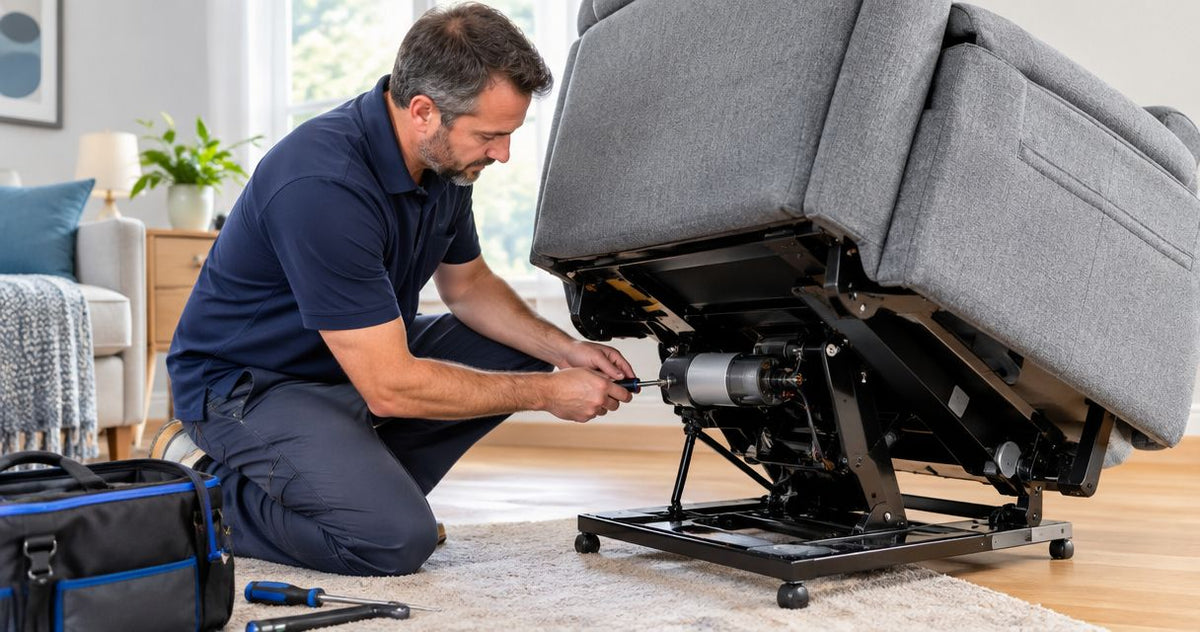
Lift chair motor service or repair requires a model-specific, itemized quote: the total depends on the diagnosed fault, the compatible replacement part, labor, and any visit or transport charges. Do not authorize a motor replacement until the technician identifies the failed component, because a power supply, handset, connection, or mechanical obstruction can also prevent movement.
By Editorial Team
For a 2026 repair decision, start with diagnosis rather than a replacement-part listing. Aeva Vital's guide to repairing a lift chair when the motor stops working covers the related repair question; this page explains what belongs in a service quote and how to compare the proposed work.
- How much does it cost to service or repair a lift chair motor? Request an itemized, model-specific quote.
- A stopped lift chair does not prove that its motor has failed; diagnosis comes before replacement.
- Compare diagnosis, parts, labor, travel, and repair coverage rather than the replacement part alone.
- Aeva Vital's lift chair guides suit homeowners checking repair and setup questions before arranging service.
How much does it cost to service or repair a lift chair motor?
The usable answer is the total for a diagnosed repair, not the amount attached to a motor advertised online. A part listing excludes the work needed to identify the fault, confirm compatibility, install the component, and check the chair afterward.
Ask for the following breakdown in your 2026 estimate. Have the provider identify which charges apply before you approve a visit or order a part.
| Quote component | What it covers | What to clarify |
|---|---|---|
| Diagnosis | Finding the cause of the movement failure | Whether this charge remains separate if you approve the repair |
| Replacement part | The identified motor, actuator, or other failed component | Exact part number and compatibility with your chair |
| Labor | Removing, installing, and checking the component | Whether installation and functional testing are both included |
| Service logistics | A home visit, transport, or a return appointment | Whether these are included or charged separately |
| Additional work | Other faults identified during inspection | Whether additional work requires your approval |
| Repair coverage | Terms applying to the replacement part and workmanship | Who handles a repeat fault and what the written terms cover |
An itemized quote lets you compare the same job across providers. A quote for a loose component and a quote for an installed, tested repair describe different purchases. Keep that distinction visible when deciding what to authorize.
Service, component replacement, or motor replacement?
A lift chair's movement depends on more than its motor. Electrical power must reach the control system, the correct command must reach the actuator, and the mechanism must move without an obstruction.
An actuator is the assembly that converts motor rotation into movement. Your technician should clarify whether the proposed repair replaces an entire actuator assembly or another component, rather than using the word motor for every electrical fault.
| Repair approach | Best for | Advantage | Limitation |
|---|---|---|---|
| Diagnose before replacing | An unexplained movement failure | Identifies the component responsible | Inspection does not itself restore operation |
| Repair a connection or control fault | A confirmed fault outside the actuator | Addresses the diagnosed problem without unnecessary motor replacement | Does not resolve a separate mechanical or actuator failure |
| Replace the actuator assembly | A confirmed actuator failure | Replaces the identified movement component | Requires verified electrical and mechanical compatibility |
| Assess the whole chair | Damage affecting the frame, mechanism, or several systems | Keeps the decision focused on the chair's overall condition | Requires more than checking the motor alone |
These are repair paths, not interchangeable upgrades. Choose the work that matches the diagnosis, and ask the technician to explain the evidence supporting it. A functioning handset light, a clicking sound, or a stationary footrest is a symptom—not a complete diagnosis.
What should you check before booking service?
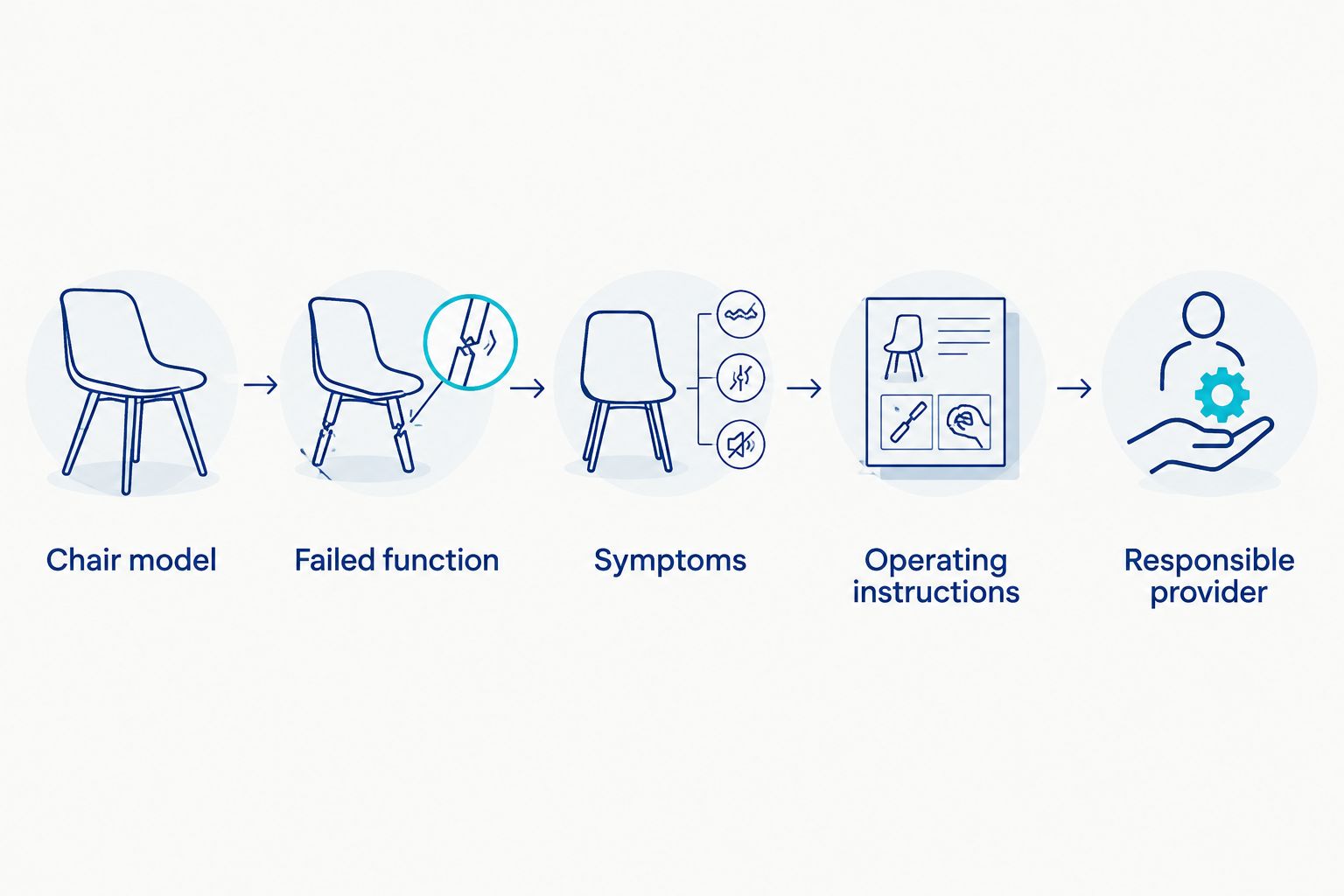
Collect information without dismantling the chair. You can make the service request more useful by describing the failure precisely and supplying the model identification.
- Record the chair model. Photograph the accessible manufacturer label and keep the purchase paperwork with your service request. Do not move or tip a heavy chair alone to find a label.
- Describe the failed function. State whether the lift, backrest, footrest, or every movement has stopped. Describe intermittent operation separately from complete failure.
- Record the symptoms. Note a clicking sound, unusual grinding, visible cable damage, or an interrupted movement. Take a photograph rather than reaching into the mechanism.
- Check the operating instructions. Follow only the owner's manual's troubleshooting steps, including any instructions about power connections or reset procedures.
- Contact the responsible provider. Send the model details and symptoms to the manufacturer, retailer, or qualified repair technician. Ask whether they service that specific chair.
Do not repeatedly operate a chair that makes unusual noises, moves unevenly, or has damaged wiring. Stop using it and arrange an inspection. If someone is seated and cannot exit safely, get assistance rather than attempting to release the mechanism yourself.
Why lift chair repair quotes vary
A 2026 quote should describe the actual chair and repair scope. These factors explain why separate estimates are not directly comparable until their inclusions match:
- Diagnosed component: Replacing a handset, power supply, or actuator involves different parts and work. Ask which component failed and how the provider confirmed it.
- Part compatibility: The replacement must match the chair's requirements. A similar appearance or matching plug is not sufficient evidence.
- Access to the mechanism: The technician needs safe access to the failed component. Ask whether the chair stays in place or requires transport.
- Condition of the chair: Frame damage, damaged wiring, or a binding mechanism needs assessment alongside the electrical fault. A replacement motor does not repair unrelated damage.
- Service arrangement: Clarify whether diagnosis, installation, testing, and return visits belong to the same job. Separate appointments need separate confirmation of scope.
- Written coverage: Check the original warranty and the proposed repair terms. Do not assume that coverage for a component also covers installation, travel, or transport.
These are questions to resolve before approval, not reasons to accept an unexplained total. Ask the provider to separate confirmed work from anything that still requires inspection.
What makes a replacement motor compatible?
Compatibility includes both electrical requirements and the way the actuator connects to the mechanism. The chair model and original component identification are the starting points, followed by the manufacturer's specified replacement information.
Ask the technician to confirm the part number, electrical rating, connector arrangement, mounting points, and travel requirements. These details explain how the component fits and moves the chair. They do not, by themselves, prove that the original fault has been diagnosed correctly.
Do not buy an actuator solely because the plug looks familiar. A connector can fit while other requirements differ. Likewise, a listing described as universal needs explicit confirmation for your model before you treat it as compatible.
Keep photographs of the original label and the proposed replacement identification with your repair paperwork. If the provider proposes a substitute, request written confirmation that it is suitable for the chair and ask who is responsible if it does not fit or operate correctly.
Is repairing a lift chair better than replacing it?
Repair is a decision about the entire chair, not just its electrical movement. An isolated, diagnosed component fault presents a different situation from damage involving the frame, mechanism, wiring, and seating support.
Use these criteria when comparing repair with replacement in 2026:
| Decision factor | Supports considering repair | Supports assessing replacement |
|---|---|---|
| Fault scope | A clearly identified component failure | Several unresolved faults or structural damage |
| Parts match | A confirmed compatible component | No confirmed replacement identified |
| Chair condition | The remaining chair is serviceable | The chair has other significant damage |
| User fit | The chair still suits the user's needs | Fit or transfer needs have changed |
| Repair terms | Clear scope and written responsibilities | Unclear scope or unresolved compatibility questions |
The table is a decision checklist, not a promise that either route is appropriate. Ask the technician to assess structural condition before approving electrical work, especially if the chair moves unevenly or the mechanism appears distorted.
Do not apply an arbitrary repair-versus-replacement percentage. Compare the complete proposed repair with your actual replacement options, including fit, delivery arrangements, setup, and the user's ability to transfer safely.
Is a lift chair motor covered by warranty?
Coverage depends on the written warranty for your specific chair. Check the applicable component terms and claim procedure before paying for independent work or ordering a replacement.
Separate the questions: does the warranty cover the failed component, and does it cover the work required to replace it? Ask about diagnosis, labor, transport, and service visits individually. Obtain claim authorization when the warranty procedure requires it.
For a 2026 claim, keep the model identification, purchase documentation, symptom description, and provider correspondence together. Do not treat a general warranty headline as confirmation that every part of your repair is covered.
Can you replace a lift chair motor yourself?
Motor replacement is not a routine cleaning task. It involves electrical connections and a mechanism that supports and moves a person, so follow the manufacturer's service requirements and use a qualified technician when the work exceeds the owner's instructions.
Unplugging the chair does not remove the physical hazards of a raised or unsupported mechanism. Keep hands clear of moving linkages, do not bypass controls, and do not force a stuck chair into another position. Do not work beneath a mechanism without the manufacturer's prescribed support procedure.
Your useful preparation is identifying the model, documenting symptoms, and locating the manual. Leave mechanical disassembly and electrical fault testing to someone qualified for the chair.
What should happen after the repair?
The repair should finish with a functional check, not merely the installation of a part. Ask the technician to verify the affected movements according to the manufacturer's instructions and explain any remaining restrictions before the chair returns to use.
Keep the invoice, replacement part identification, and written repair terms. Record what was repaired and whether the provider identified other faults. If the original symptom returns, that paperwork gives the next service conversation a clear starting point.
Do not use a person as the first test of an uncertain repair. Have the provider complete the appropriate checks and confirm that the chair is ready for normal operation.
FAQ
How much does it cost to service or repair a lift chair motor?
A lift chair motor repair needs an itemized, model-specific quote based on a confirmed diagnosis. Ask for the replacement part, labor, diagnosis, and any visit or transport charges to be identified separately.
Does a lift chair that won't move need a new motor?
A lift chair that will not move does not automatically need a new motor. A power supply, handset, connection, or mechanical fault also needs consideration during diagnosis.
What should a lift chair motor repair quote include?
A lift chair repair quote should identify the diagnosed fault, replacement part, labor, service logistics, and repair terms. Ask whether testing and any return appointment are included.
Can I use a universal replacement lift chair motor?
Use a replacement only after compatibility with your chair is confirmed. The connector alone does not establish the correct electrical rating, mounting arrangement, or actuator travel.
Will a lift chair warranty pay for motor replacement?
Warranty coverage depends on the written terms for your chair and the claim procedure. Ask separately about the component, diagnosis, labor, travel, and transport before approving work.
Is it safe to keep using a lift chair that makes a grinding noise?
Stop using a lift chair that makes an unusual grinding noise and arrange an inspection. Do not repeatedly operate it to test whether the noise disappears.
Should I repair the motor or replace the whole lift chair?
Base the decision on the diagnosed fault, the chair's overall condition, part compatibility, and the user's needs. A motor replacement does not resolve separate frame damage or poor fit.
Does Aeva Vital provide lift chair motor repair service?
Aeva Vital's published lift chair guides are educational resources, not confirmation of a motor repair service. Confirm service arrangements with the chair manufacturer, retailer, or qualified repair provider.
Related guides
- Is a lift chair motor covered by warranty?
- Can you manually operate a power lift recliner if the power fails?
- Routing lift chair power cords safely in small apartments
One last thing
Before approving a 2026 repair, ask the provider to put the failed component and compatible replacement part number on the estimate. The most useful detail is not the word motor—it is the identification of the part responsible for the failure.