
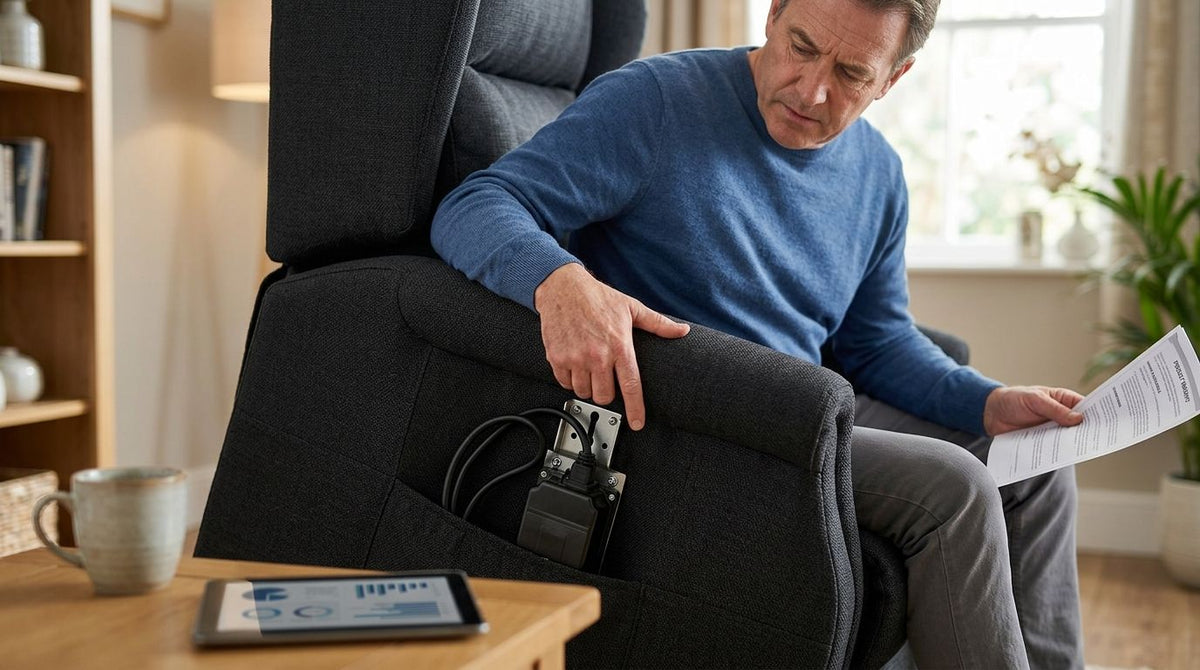
A lift chair motor is typically covered for 2 to 5 years under a separate mechanism warranty, not the same term as the frame warranty or the fabric warranty. That gap matters because a motor that's technically "covered" in 2026 can still leave you paying for a technician visit, return shipping, or labor, none of which the base motor warranty usually includes.
By Editorial Team
- Lift chair motors are usually covered for 2 to 5 years, shorter than most frame warranties.
- Labor and shipping are often excluded even when the motor part itself is covered.
- Unauthorized repairs, commercial use, and exceeding the rated weight capacity commonly void motor coverage.
- Registering the chair after delivery is often required to activate the full warranty term.
- Extended retailer warranties add years of coverage but layer on top of, not replace, the manufacturer term.
Why this matters
A lift chair's motor is the part that actually does the work — it drives the actuator that raises the seat and reclines the back. When it fails outside the warranty window, replacement usually means a service call plus a new motor unit, not a simple part swap you do yourself.
Knowing how long a lift chair typically lasts before mechanical wear sets in helps you judge whether a 2-year motor warranty or a 5-year one is the better fit for how the chair will actually get used. A chair used daily by one person wears differently than one shared by multiple household members or used in a rental setting.
Is a lift chair motor covered by warranty?
Yes, in almost every case — but the motor warranty is one of several separate coverage terms on the chair, not a blanket policy. Manufacturers split coverage by component because each part fails on a different timeline.
| Warranty Component | Typical Coverage Length | What It Covers |
|---|---|---|
| Motor / lift mechanism | 2 to 5 years | Electric motor, actuator, lifting mechanism |
| Frame | 5 to 15 years (sometimes lifetime) | Wood or steel frame structure |
| Fabric / upholstery | 1 year | Seams, stitching, fabric defects |
| Electrical components | 1 to 2 years | Hand control, wiring, power cord |
The motor sits in the middle of that stack. It outlasts the fabric but doesn't match the frame, which is usually the longest-covered part because it has no moving pieces to wear out.
Motor and lift mechanism warranty: 2 to 5 years
This is the coverage that matters most for a lift chair, since the motor is the only powered, moving component. A motor warranty under 2 years is a red flag on an otherwise full-price chair — it usually signals a budget mechanism built for lighter, occasional use.
Frame warranty: 5 to 15 years, sometimes lifetime
The frame carries the longest coverage because it's structural and static. A cracked or bent frame after heavy daily use is rare, which is why manufacturers can afford to extend this term well past the motor's.
Fabric and upholstery warranty: 1 year
Fabric wear is cosmetic, not mechanical, and it's also the most subjective to evaluate — normal fading or wear from sun exposure typically isn't covered even inside the 1-year window.
Electrical components warranty: 1 to 2 years
The hand control, wiring, and power cord get their own shorter term because they're the parts most exposed to accidental damage — pinched cords, dropped remotes, spilled liquids.
Why lift chair motor coverage varies
- Manufacturer and price tier. Budget chairs often bundle a shorter motor term than mid-range and premium models with heavier-duty actuators.
- Weight usage relative to capacity. Running a chair consistently near its rated limit strains the motor faster; check how much weight a lift chair can hold before assuming the warranty accounts for your use case.
- DIY or third-party repairs. Opening the mechanism housing or swapping a motor with a non-manufacturer part typically voids the remaining term immediately.
- Commercial or facility use. Many motor warranties are written for single-family residential use only and shorten or void automatically in assisted living or rental settings.
- Registration requirements. A number of manufacturers require the chair to be registered after delivery to activate full coverage — skipping this step can reduce you to a shorter default term.
- Extended retailer plans. These add years of coverage on top of the manufacturer term but are a separate purchase, not an automatic extension.
Does normal wear void the motor warranty?
No — normal wear from daily reclining and lifting cycles is exactly what the motor warranty exists to cover, not a reason for denial. Warranty denials almost always trace back to unauthorized repair work, exceeding the rated weight capacity, or use outside the terms (commercial versus residential), not ordinary daily operation.
What actually voids a lift chair motor warranty?
The most common voiding events are opening the mechanism yourself, installing a non-approved replacement motor, exceeding the chair's rated weight capacity, and using a residential-rated chair in a commercial or facility setting. Water damage from spills near the motor housing is another frequent exclusion across manufacturers.
Is Medicare coverage the same as the motor warranty?
No — a manufacturer's motor warranty and Medicare's lift chair coverage are entirely separate systems. Medicare, when it applies, reimburses part of the mechanized lifting mechanism cost at purchase; it has no role in repairing or replacing a motor after the sale.
Browse home recovery essentials
See Aeva Vital's home wellness and recovery equipment lineup.
FAQ
Is a lift chair motor covered by warranty?
Yes, most lift chair motors carry a 2 to 5 year manufacturer warranty separate from the frame and fabric terms. Labor and shipping are frequently excluded even when the part itself is covered.
How long does a lift chair motor last?
A lift chair motor's practical lifespan tracks closely with the length of its warranty term, typically 2 to 5 years before wear becomes noticeable. Heavier daily use near the chair's weight capacity shortens that window.
Does the frame warranty cover the motor?
No, the frame warranty and the motor warranty are separate coverage terms with different lengths. Frame coverage often runs 5 to 15 years, well past the 2 to 5 year motor term.
What voids a lift chair motor warranty?
Unauthorized repairs, third-party motor replacements, exceeding the rated weight capacity, and commercial or facility use are the most common voiding events. Water damage near the motor housing is another frequent exclusion.
Does Medicare cover a lift chair motor repair?
No, Medicare's lift chair benefit applies to the purchase of the lifting mechanism, not post-purchase motor repairs. Motor repair coverage comes only from the manufacturer's or retailer's warranty.
Do I need to register my lift chair for the motor warranty to apply?
Many manufacturers require product registration after delivery to activate the full motor warranty term. Skipping registration can default you to a shorter coverage period.
Is an extended warranty worth it for a lift chair motor?
An extended warranty adds coverage years on top of the manufacturer's base motor term, which is useful if you expect heavy daily use. It's a separate purchase and does not replace or extend the original term automatically.
One last thing
The detail most owners miss in 2026 isn't the warranty length — it's what's excluded from it. A motor warranty covering the part itself but not labor or return shipping can still mean an out-of-pocket repair bill even while the chair is "under warranty." Read the exclusions before you need them, not after the motor stops responding.
A lift chair is one piece of a broader home recovery setup, and pairing it with the right adjustable bed, mattress, or recovery equipment from Aeva Vital's home wellness lineup matters more for daily comfort than the warranty paperwork alone.