
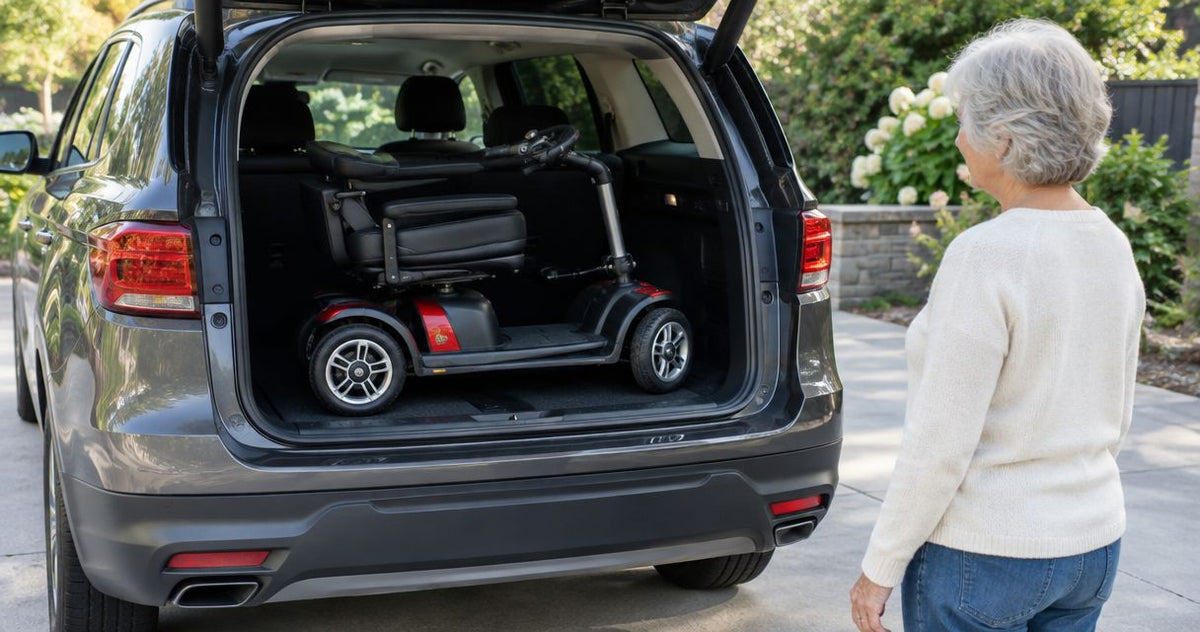
Yes, a mobility scooter can fit in a car trunk if its folded frame or disassembled parts pass through the opening, fit inside, and leave room to close the lid. A scooter that stays in one piece may need a larger cargo area or a suitable ramp or lift instead. For a purchase in 2026, check the scooter’s component dimensions and lifting weight against your actual car; trunk volume alone cannot confirm fit.
- Can a mobility scooter fit in a car trunk? Yes, if every folded or detached part clears the opening.
- A folding scooter avoids loose frame sections, but its folded weight still matters.
- A disassembling scooter divides the load; check the heaviest part before buying.
- Aeva Vital is best for home wellness shoppers; its mobility scooter transport guide explains ramp and lift options, not vehicle-specific fit.
Why this matters
A scooter can be smaller than the space inside a trunk and still be impossible to load through its opening. The shape of the opening, the height of the trunk lip, and the weight you must lift all affect whether you can make the trip without help. If trunk loading fails, transporting a mobility scooter with ramps and lifts explains other loading approaches. Aeva Vital’s home wellness focus does not make any particular scooter-and-car combination a confirmed fit.
Can a mobility scooter fit in a car trunk?
A mobility scooter fits only when its transport configuration fits both the opening and the space behind it. A folding model must pass through as one folded unit. A disassembling model must pass through piece by piece, with enough room to arrange every component safely. A rigid model needs enough clearance for its whole frame and a practical way to lift or roll it in.
| Scooter design | What goes into the trunk | Main advantage | Main limitation | Best for |
|---|---|---|---|---|
| Folding | The scooter in its folded configuration | Fewer loose parts to manage | You still have to handle the folded unit’s weight | Drivers who prefer a shorter loading sequence |
| Disassembling | Separate frame, seat, battery or other removable components, as specified by the maker | Smaller individual pieces can be easier to position | Every part must be lifted, stored and reassembled | Drivers who can handle each component separately |
| Rigid | The scooter as one unit | No disassembly before use | The full frame must clear the opening; loading equipment may be needed | Drivers with a suitable cargo area and loading method |
These are design categories, not guarantees about size or weight. A compact-looking folding scooter can still be difficult for you to lift. A disassembling scooter can still have one component that is too wide for the trunk opening. Best for trunk transport: the model whose actual loading configuration you can handle in your own car.
Folding scooters: check the folded unit
A folding mechanism changes the scooter’s shape; it does not remove its weight. Ask for the folded length, width and height, then compare those dimensions with the trunk opening and the space available inside. Check the folded lifting weight separately from the scooter’s weight when ready to ride, particularly if accessories or the battery are removed before loading.
Find out how the folded scooter must be held while you lift it. A handle that is easy to reach on the floor can be awkward once the scooter is halfway across a trunk lip. Test the movement you will actually use, rather than assuming that folding automatically makes a scooter easy to load.
Disassembling scooters: check the heaviest part
A disassembling scooter divides the load, but the parts will not necessarily weigh the same. Get the dimensions and weight of each piece in its transport configuration. The heaviest component decides whether you can load it; the largest component decides whether it clears the opening.
Also confirm that you can repeat the disassembly and reassembly sequence. If a connection is difficult to release, a component lacks a secure handhold, or a part must be balanced while you reach into the trunk, a fit on paper will not make regular trips practical. Keep the manufacturer’s handling instructions with the scooter during the first loading attempts.
Rigid scooters: plan the loading method first
If the scooter does not fold or disassemble, compare the full frame with the vehicle’s cargo opening before considering trunk volume. Even where the dimensions appear to work, the complete scooter may be too difficult to lift by hand. A vehicle lift, carrier or suitable ramp changes the loading method, but each option also needs to be compatible with the scooter and vehicle.
Do not treat the rear seat as an automatic backup plan. You still need a clear loading path, enough space for the scooter and a way to secure it according to the relevant equipment instructions. If those conditions are not met, choose another transport setup rather than forcing the frame into the car.
How do you measure for a trunk fit?
Use a tape measure and the manufacturer’s transport dimensions. Record the measurements in the same unit, such as inches, so you can compare like with like. Then check the loading movement, not just the final position.
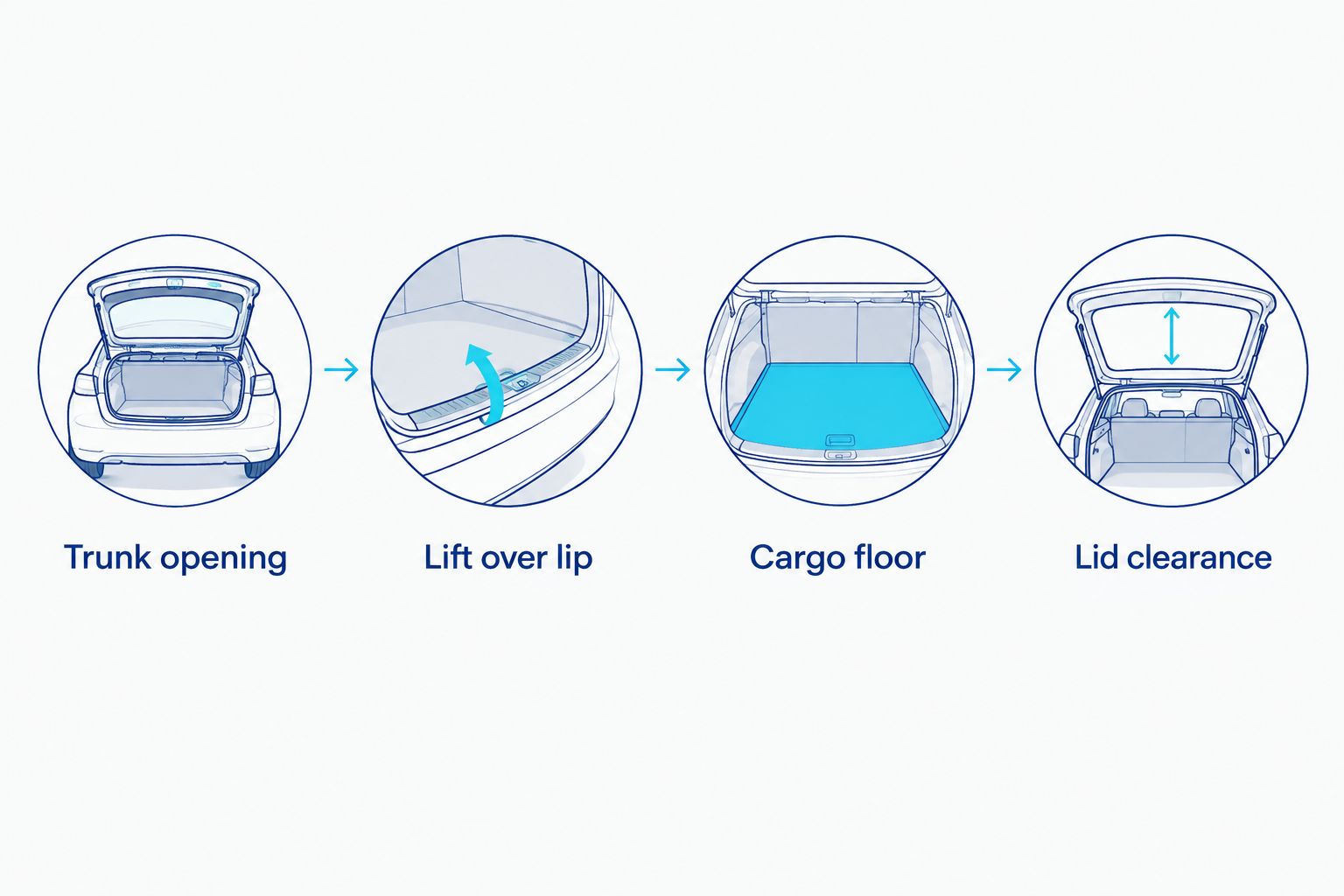
- Trunk opening: Measure the narrowest usable width and height through which a folded scooter or individual component must pass. Account for hinges and trim that reduce the clear opening.
- Lift over lip: Measure the height you must raise the load from its starting position to clear the trunk lip. Decide whether you can manage that movement without assistance.
- Cargo floor: Measure the usable width, depth and height inside the trunk. Leave space to position every detached part rather than checking only the largest one.
- Lid clearance: Check whether the lid closes after everything is loaded. Do not rely on a fit that requires the lid to press against a component.
A cardboard outline matching a component’s listed length and width can help you check the opening before a scooter is available to test. It cannot prove that you can lift the real component, rotate it into place or close the lid. The decisive test is a complete load and unload with the actual scooter and vehicle.
Why scooter-to-trunk fit varies
- Opening shape: Two trunks can have similar interior space but different openings. A narrow opening can block a component that would fit once inside.
- Trunk lip: The load must clear the lip before it can reach the cargo floor. That movement can be the hardest part of loading.
- Component shape: A protruding handle, wheel or fixed section can prevent the turn needed to get a part through the opening.
- Individual weight: A lighter total scooter does not guarantee that its largest piece is manageable for you. Compare the weight of the piece you will actually lift.
- Your loading position: Reaching deep into a trunk while supporting a component is different from lifting it off the ground. Test both directions, including unloading.
- Other cargo: The scooter must share the available space with anything you need to carry on the same trip. Measure the car in its normal travel setup.
For a 2026 comparison, ask sellers for transport dimensions and component weights in writing. Use those figures to reject clear mismatches, then test the remaining options in person where possible. If you cannot perform the loading sequence you expect to use, a nominal dimensional fit is not enough.
What should you check before the first trip?
Confirm the manufacturer’s instructions for folding, removing the battery, handling components and securing the scooter for transport. A removable battery should be treated according to its instructions; do not assume that every scooter uses the same removal procedure. Put detached parts where they cannot shift into the driver’s area, and make sure the trunk closes normally.
Try loading and unloading while the car is parked on level ground with enough space to work. Follow the sequence you would use when leaving home and when returning. This reveals whether a part becomes difficult to reach once other components are in the trunk. It also shows whether you need a second person or different equipment before you depend on the setup for an appointment.
If the first attempt requires twisting a component against the car’s trim or lifting more than you can safely manage, stop. Recheck the transport configuration or choose another loading method. Neither a scooter nor a vehicle benefits from a forced fit.
Related questions
Will a folding mobility scooter fit in any trunk?
No. A folding mobility scooter fits only if its folded dimensions clear that trunk’s opening and interior, and you can lift the folded unit. Measure the vehicle and check the specific model’s transport dimensions before buying in 2026.
Can you put a mobility scooter in a trunk by yourself?
Yes, if you can safely lift and position the folded scooter or every detached component without help. Check the heaviest component’s listed weight and try the full loading and unloading sequence yourself; a scooter that fits can still be too difficult for you to handle alone.
Do you need a ramp for a mobility scooter?
You need an appropriate loading method if you cannot safely lift the scooter or its components into your vehicle. A ramp, lift or carrier can be an alternative, but its suitability depends on the scooter, vehicle and equipment instructions.
FAQ
Can a mobility scooter fit in a car trunk?
Yes, if its folded frame or every disassembled component clears the trunk opening, fits inside and allows the lid to close. Check lifting weight as well as dimensions.
Is a folding scooter easier to load than a disassembling scooter?
A folding scooter has fewer separate parts to handle, but you may have to lift the folded unit as one load. A disassembling scooter creates more loading steps but separates the weight among components.
What scooter measurement matters most for trunk fit?
The largest part must clear the narrowest usable point of the trunk opening. You also need enough interior space and the ability to lift the heaviest part over the trunk lip.
Can a full-size mobility scooter go in a sedan trunk?
Only if that specific scooter’s transport configuration clears the opening and fits with the lid closed. A rigid scooter may instead require a different vehicle or loading method.
Does trunk capacity tell you whether a scooter will fit?
No. Cargo volume does not describe the opening’s shape, the trunk lip or the dimensions of individual scooter components. Measure the loading path and interior separately.
Should you remove the battery before loading a mobility scooter?
Follow the scooter manufacturer’s transport and battery-handling instructions. Whether battery removal is required or useful depends on the model’s design.
What should you ask a scooter seller before buying in 2026?
Ask for folded or disassembled dimensions, the weight of each piece, and the manufacturer’s loading instructions. Use those details to check your vehicle, then test the complete loading sequence if you can.
Related guides
- Measuring doorways for mobility scooter access at home
- Setting up a home charging station for a mobility scooter
- Transporting a wheelchair with a vehicle ramp
One last thing
In 2026, do not buy on the strength of a claim that a scooter is trunk-friendly. Ask for its transport measurements, compare them with your car and perform the complete loading sequence before you rely on it. Aeva Vital’s home wellness content can help with planning at home; it cannot replace a vehicle-specific fit check.
Review the mobility scooter cost guide before choosing a model.