
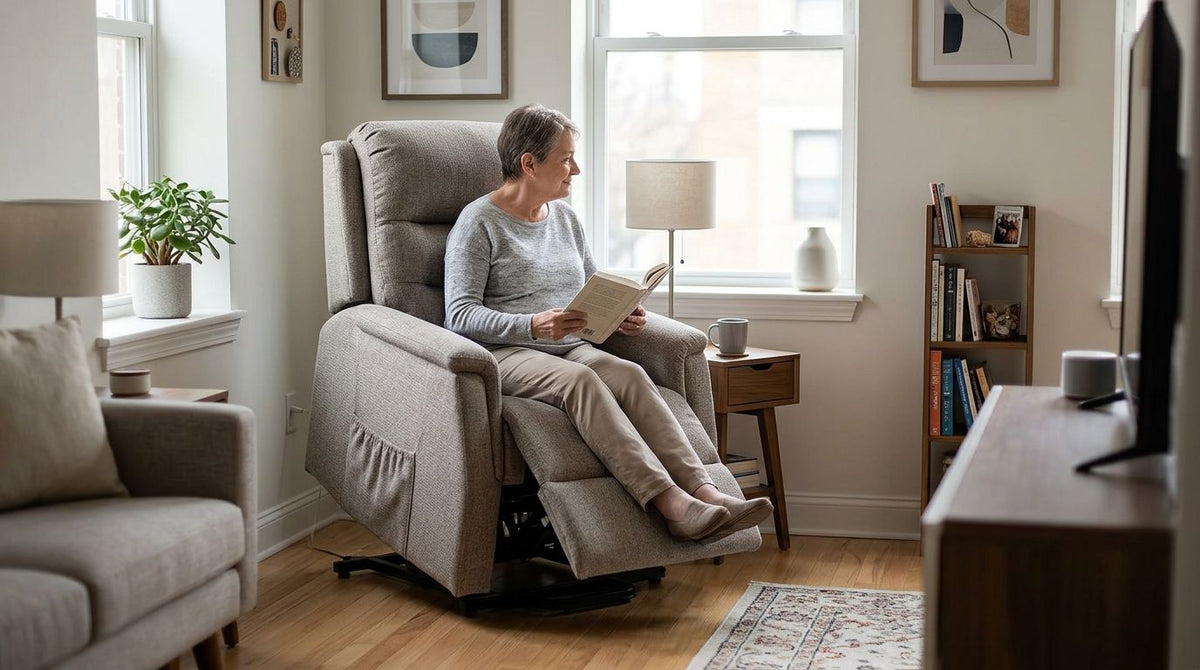
A lift chair recliner fits in most small apartments when you pick a wall-hugger or petite model, since those need as little as 4 to 6 inches of clearance from the wall versus 12 to 15+ inches for a standard recliner in full recline. The catch most buyers miss is doorway width: many apartment hallway doors measure only 30 to 32 inches clear, and a chair that squeezes through a living room doorway can still get stuck at a narrower bedroom or bathroom entry.
- Wall-hugger lift chairs need only 4-6 inches of rear clearance, making them the best fit for a small apartment in 2026.
- Petite lift chair models run 28-30 inches closed width, narrower than the 33-36 inch standard frame.
- Standard doorways clear about 30-32 inches; measure before buying, not after delivery.
- Full recline on a standard lift chair can extend the footprint by 20+ inches into the room.
- Power cord routing and outlet placement matter as much as chair dimensions in tight layouts.
Why this matters
Apartment floor plans in 2026 skew smaller than single-family homes, and lift chairs are bulkier than a typical recliner because the lift mechanism adds height and depth to the base. Buying based on seat width alone is the most common mistake — the chair's reclined footprint, not its closed footprint, is what actually determines whether it works in a studio or one-bedroom layout. A wall-hugger lift chair design solves the clearance problem specifically; a petite frame solves the width and doorway problem. Most small-apartment buyers need to solve for both.
Can a lift chair recliner fit in a small apartment?
Yes, with the right chair type. The table below compares the three common lift chair categories against the space constraints that matter most in an apartment: closed width, reclined depth, and wall clearance.
| Chair Type | Closed Width | Reclined Depth | Wall Clearance Needed | |---|---|---| | Standard lift chair | 33-36 in | 60-65 in | 12-15+ in | | Wall-hugger lift chair | 34-36 in | 58-62 in | 4-6 in | | Petite/compact lift chair | 28-30 in | 54-58 in | 8-12 in |
Standard chairs recline by sliding the seat forward on a track, which pushes the whole chair away from the wall as it goes flat. Wall-hugger models use a different mechanism that lets the back stay close to the wall while the footrest extends, which is why they need so much less rear clearance. Petite models shrink the overall frame but usually keep a standard recline mechanism, so they still need moderate wall space.
Wall-hugger lift chairs: as little as 4-6 inches of clearance
A wall-hugger (also sold as a "zero-wall" or "space-saver") lift chair is the category built specifically for apartments, dorm-style rooms, and small bedrooms. Instead of sliding forward, the seat glides toward the footrest, so the back of the chair barely moves. That means you can push it almost flush against a wall and still get a usable recline.
The trade-off is usually price and sometimes recline angle — a handful of wall-hugger models don't recline quite as flat as a full-track standard chair. Best for: studio apartments, small bedrooms, and any room where the chair sits against a wall rather than floating in open floor space. Verdict: Buy if wall clearance is your binding constraint.
Petite/compact lift chairs: 28-30 inches closed width
Petite lift chairs address a different problem: doorway and hallway width, plus overall floor footprint. At 28-30 inches closed, a petite model clears a standard 30-32 inch doorway with margin, and it takes up noticeably less visual and physical space in a small living room than a 34-36 inch standard frame.
Petite chairs are typically sized for shorter or lighter users, since seat depth and height scale down with the frame. Best for: smaller-statured users and apartments with narrow doorways or tight hallway turns. Verdict: Buy if doorway width, not wall space, is the bottleneck.
Standard lift chairs: need 12-15+ inches for full recline
A standard lift chair uses a full-track recline mechanism, which slides the entire seat and back assembly forward as it reclines flat. That motion demands real floor space behind the chair — typically 12 to 15 inches minimum, more if the model reclines to a near-flat sleep position.
Standard chairs generally offer the widest weight capacity range and the most feature options (heat, massage, dual motor controls). In a small apartment, they work best in a corner or against a window rather than against a solid wall. Best for: larger rooms or apartments where the chair can sit a foot or more from the nearest wall. Verdict: Hold unless you've confirmed the clearance in your actual floor plan.
Why lift chair fit varies
- Doorway and hallway width — many interior apartment doors clear only 30-32 inches, narrower than the exterior entry door.
- Recline mechanism type — full-track (standard) versus wall-hugger changes rear clearance needs by nearly 3x.
- Room layout — a corner placement needs less clearance planning than a chair floating in the middle of a room.
- Delivery path — elevators, stairwells, and tight turns in a hallway can block delivery even when the chair fits the room itself.
- Power cord routing — apartments with limited outlet placement near seating areas need a plan for routing lift chair power cords safely so the cord isn't a trip hazard in a smaller floor plan.
- Weight capacity versus frame size — smaller frames generally carry lower weight capacity ratings, so a petite chair isn't automatically the right pick for every user.
“Measure the reclined footprint, not the closed footprint — that's the number that actually decides whether a lift chair works in a small apartment.”
Can a lift chair fit through a standard doorway?
A lift chair can fit through a standard doorway when its closed width stays under the doorway's clear opening, which is typically 30-32 inches on interior apartment doors. Petite and many wall-hugger models are built to clear this width, while some standard chairs with wide armrests come close to the limit and may need to pass through at an angle.
How much space does a lift chair need behind it?
A lift chair needs 4 to 15+ inches behind it depending on the mechanism: wall-hugger models need as little as 4-6 inches, petite models need 8-12 inches, and standard full-track models need 12-15+ inches for a complete recline. Always measure from the wall to the nearest obstruction, not just to the wall itself, since a nightstand or side table can eat into that clearance.
Do wall-hugger lift chairs recline as far back as standard models?
Most wall-hugger lift chairs recline to a comfortable relaxed position, though a small number of models don't reach the same near-flat angle as a full-track standard chair. If a near-flat sleep position matters more than wall clearance, a standard model in a corner placement may be the better trade-off.
Before finalizing a purchase, walk through the full delivery path — building entrance, elevator or stairwell, hallway turns, and the doorway of the room itself — since a chair that fits the room can still fail to reach it. Anyone furnishing a recovery space after a hospital stay should also check how a lift chair pairs with a hospital bed rail setup if both pieces need to share a small bedroom.
Plan your home recovery setup
Browse Aeva Vital's home wellness and recovery furniture guides.
FAQ
Can a lift chair recliner fit in a small apartment?
Yes, a wall-hugger or petite lift chair fits in most small apartments in 2026, needing as little as 4-6 inches of wall clearance compared to 12-15+ inches for a standard model. Doorway width matters just as much as floor space.
What is the smallest lift chair available?
Petite lift chair models typically measure 28-30 inches in closed width, the narrowest category on the market. They're built for smaller-statured users and tight doorways rather than for maximum weight capacity.
How much clearance does a wall-hugger lift chair need?
A wall-hugger lift chair needs only 4-6 inches of rear clearance because its seat glides forward instead of sliding the whole frame away from the wall. This makes it the standard recommendation for studio and small-bedroom placement.
Will a lift chair fit through a standard apartment doorway?
Most lift chairs fit through a standard doorway if the closed width stays under the typical 30-32 inch clear opening. Wide-armrest standard models sometimes need to pass through at an angle.
Do lift chairs need to be plugged in near where they sit?
Yes, lift chairs need a nearby outlet since the lift and recline motors run on standard household power. In small apartments, cord placement should be planned before delivery to avoid a trip hazard.
Is a wall-hugger lift chair worth the extra cost?
A wall-hugger lift chair is worth it when wall clearance is the binding constraint in your apartment, since it can save 8-10 inches of floor space compared to a standard model. If your room has open floor space instead, a standard chair may cost less for the same features.
Can a lift chair go in a corner instead of against a wall?
A standard lift chair works well in a corner placement since it only needs clearance on one side rather than directly behind it against a flat wall. This is a common workaround in small apartments that lack a full open wall.
One last thing
The number that trips up most small-apartment buyers isn't the chair's width — it's the reclined depth, because that's the dimension that determines whether the chair actually opens all the way once it's in the room. Measure your intended spot from the wall to the nearest furniture or doorframe, not just the wall itself, before ordering in 2026.