
By Editorial Team
Yes, you can return a lift chair that does not fit through your door, but the outcome depends on the seller's return policy, not on the fact that the chair is stuck in your hallway. Most furniture and mobility retailers accept returns on oversized items, though they typically apply a restocking fee, charge return freight, or require the chair to be broken down and reboxed in its original crating before a refund is processed. The real fix is measuring the doorway, hallway turns, and any stairwell before you order — a lift chair's widest point is almost always the base or the arms, not the seat back where most people measure.
- Most retailers accept returns on a lift chair that doesn't fit through your door, but restocking fees and return freight usually apply.
- Standard interior doors open to about 32 inches wide; many lift chairs measure 33 to 38 inches across the arms.
- Reboxing the chair in its original packaging before pickup avoids the steepest fees in 2026.
- Measuring the doorway, hallway turn radius, and stairwell width before ordering prevents the return entirely.
- Some lift chairs disassemble into a base and back cushion section, which can solve a tight-doorway problem without a return.
Why this matters
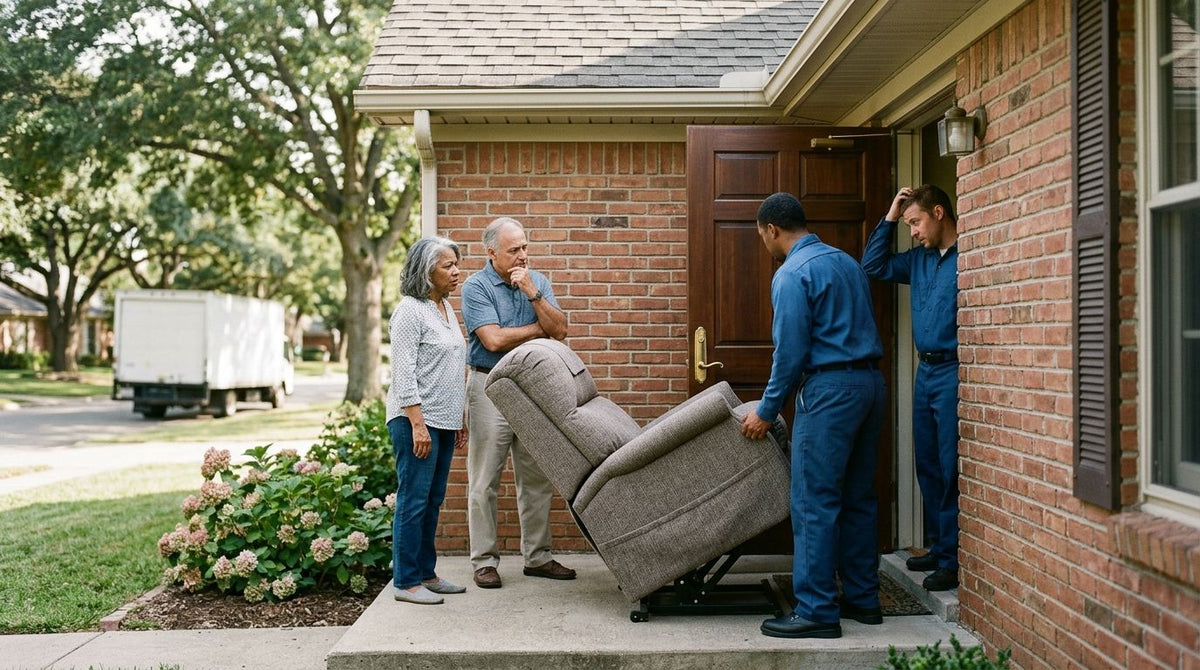
A lift chair that won't clear your door isn't a small inconvenience — it's a stalled delivery, a truck idling outside, and a decision to make on the spot. Delivery crews rarely wait around while you re-measure, and once the chair is back on the truck, you're now dealing with a return process instead of a setup process. Knowing the policy landscape before the truck shows up in 2026 saves both money and a wasted afternoon.
Can you return a lift chair if it does not fit through your door?
The short answer is yes, almost every retailer will take the chair back, but "return" rarely means a no-cost, no-questions process for large furniture. Here's what typically factors into the return:
| Factor | What it usually looks like | Why it matters |
|---|---|---|
| Restocking fee | A percentage of the purchase price deducted from the refund | Covers the cost of reprocessing an oversized item |
| Return freight | Charged separately from the original delivery fee | Large furniture ships freight, not standard parcel |
| Reboxing requirement | Chair must go back into original packaging or crating | Protects the item in transit for resale or restock |
| Return window | A limited number of days from delivery | Varies by retailer; check before the delivery date, not after |
Before you order, check whether a lift chair fits through a standard doorway for typical clearance numbers, since the arm width — not the seat back — is usually what gets stuck.
Standard doorway widths vs. lift chair dimensions
A standard U.S. interior door opens to roughly 32 inches wide when fully swung, and exterior doors commonly run 36 inches. That sounds generous until you account for door trim, hinge clearance, and the fact that most people can't swing a door to a full 90 degrees while carrying a chair through it. Lift chairs measure across the arms, and that figure is what determines whether the chair clears the frame — the seat width printed on a spec sheet is almost never the number that matters at the doorway.
Measuring doorways before delivery is the single step that prevents most fit-related returns, and it takes less time than the delivery crew spends unloading the truck.
Why lift chair fit issues vary
- Doorway width at the narrowest point — trim and hinges shave inches off the raw opening measurement.
- Hallway turn radius — a chair that clears the front door can still stall at a 90-degree hallway turn.
- Stairwell width and landing space — multi-level homes need a turn allowance most people don't measure until delivery day.
- Chair arm width vs. seat width — the arms, not the seat cushion, are usually the widest point on a lift chair.
- Whether the chair disassembles — some models split into a base and backrest section, which changes the clearance math entirely.
- Delivery crew policy — some crews will attempt a door-off removal or a tilt maneuver before calling the delivery a failure.
“Measure the arms, not the seat back — that's the number that decides whether a lift chair clears your door.”
What if the chair gets stuck mid-delivery?
Ask the delivery crew whether the chair disassembles before assuming a return is the only option. Many lift chairs separate at the base, and assembly time for a lift chair usually runs under an hour once it's inside — the same disassembly can sometimes solve a doorway problem on the spot instead of triggering a full return.
Can a lift chair be returned after assembly?
A lift chair can still be returned after assembly in most cases, but assembled returns commonly cost more because the retailer has to inspect for wear and repackage the unit before resale. If the fit issue shows up during setup rather than at the door, stop assembly immediately and repack the components in their original foam and boxes — this keeps the return in the lowest-fee category available.
Does a tight doorway count as a defect for return purposes?
No — a doorway clearance issue is a fit problem, not a product defect, so it falls under standard return terms rather than warranty or defect policies. Retailers process it the same way they'd process a "changed my mind" return: restocking fee and return freight may apply, and the return window still starts from the delivery date.
Should you measure before or after ordering a lift chair?
Measure before ordering, every time — it's the only step that eliminates the return risk entirely instead of managing it after the fact. Compare the chair's widest arm-to-arm measurement against your narrowest doorway, hallway turn, and stairwell point before you submit an order in 2026.
Measure your space before you order
Check doorway width and hallway turns first to avoid a return entirely.
Aeva Vital's lift chair guides walk through the same measurement steps before delivery day, and the goal is the same one covered here: a lift chair that clears the door on the first attempt is always cheaper than one that gets returned after a failed delivery.
FAQ
Can you return a lift chair if it does not fit through your door?
Yes, most retailers accept the return, but restocking fees and return freight typically apply, and the chair usually needs to go back in its original packaging.
How wide does a doorway need to be for a lift chair?
A standard interior door opens to about 32 inches, while a lift chair's arm-to-arm width commonly runs wider than that, so the arms — not the seat — decide whether it clears.
Do lift chairs come apart to fit through narrow doorways?
Many lift chairs separate into a base and backrest section, and checking whether your model disassembles before delivery day can avoid a return altogether.
Who pays for return shipping if a lift chair doesn't fit?
Return freight is commonly charged to the buyer on oversized furniture returns, separate from the original delivery fee, so confirm this before ordering.
Is there a time limit to return a lift chair that doesn't fit?
Yes, retailers set a limited return window starting from the delivery date, so a fit issue discovered late can fall outside the eligible period.
Does Medicare cover a lift chair that has to be returned for fit issues?
Medicare coverage applies to the lifting mechanism itself under certain conditions, not to return logistics, so a fit-related return is handled through the retailer's standard policy.
Can a delivery crew remove a door to get a lift chair inside?
Some delivery crews will remove a door from its hinges as a first attempt before calling a delivery unsuccessful, though this isn't guaranteed on every delivery.
What measurement matters most for lift chair doorway clearance?
The arm-to-arm width of the lift chair matters most, since the arms are typically the widest point and the first thing to catch on a doorframe.
One last thing
The measurement that gets skipped most often isn't the doorway — it's the hallway turn right after it. A chair can clear a 34-inch doorway and still stall at a 90-degree turn into a narrower hallway, so measure both the opening and the turn radius before you order in 2026, not just the frame width.