
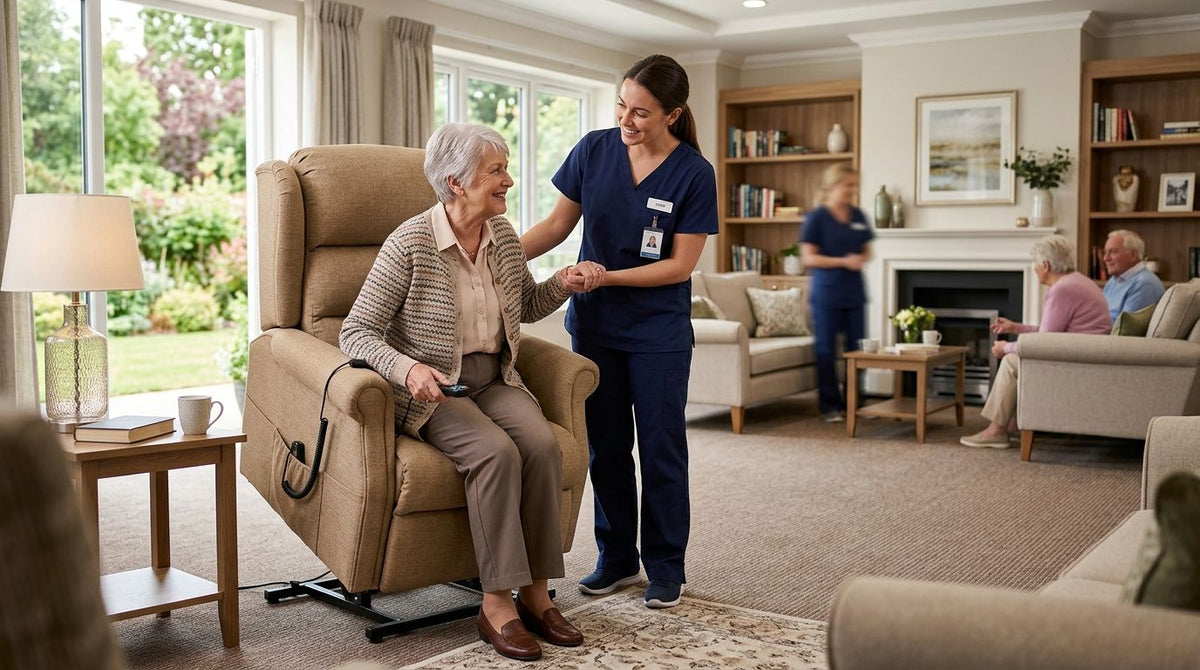
Lift chairs for assisted living facilities are powered recliners that lift a resident to near-standing position, installed to reduce staff-assist transfers and fall risk in resident rooms and common areas. Facility buyers face different requirements than a single home shopper: multiple weight-capacity tiers under one roof, infection-control upholstery, battery backup for scheduled and unscheduled power loss, and procurement that scales to dozens of units at once.
- Lift chairs for assisted living facilities need dual-motor mechanisms and 300-500 lb weight ratings to cover mixed resident populations.
- Battery backup is non-negotiable in facility settings — a lift chair stuck in recline during a power outage is a transfer hazard.
- Wipeable, seam-sealed upholstery cuts infection-control turnaround time between residents versus fabric or leather.
- Bariatric and petite-frame models both belong in a facility's procurement mix, not a single one-size chair.
- Staff training on manual reset and emergency lowering matters as much as the chair spec sheet.
Why lift chairs matter for assisted living facilities
A resident who can self-transfer with a lift chair needs less staff time per shift than one requiring a two-person manual assist. That's the operational case administrators care about: fewer lift-related staff injuries, faster room turnover, and a documented fall-prevention measure for state surveys.
Assisted living procurement also differs from single-unit home buying in volume and mix. A 60-bed facility rarely needs 60 identical chairs — it needs a spread across weight capacities, recline depths, and motor types matched to resident mobility levels documented in care plans. Guides built for one household, like general roundups of lift chairs for elderly shoppers, cover the baseline mechanics but skip the facility-scale decisions below.
Match weight capacity to your resident population
Facilities skew toward higher average resident weight than the general senior population, and a single 300 lb-rated chair fleet under-serves a meaningful share of residents.
- Standard lift chairs typically rate to around 300 lbs — fine for petite and average-frame residents
- Heavy-duty and bariatric models commonly rate 500 lbs and higher with reinforced frames and wider seat decks
- Order at least two capacity tiers per unit if resident weights vary by more than 100 lbs across the population
- Document each chair's rated capacity on the room chart, not just the care plan
- Review capacity ratings annually as resident census changes
Running a mixed-capacity fleet costs less in injury claims than retrofitting after a chair fails under an over-capacity resident. A dedicated look at heavy-duty lift chairs for big and tall users breaks down frame and motor differences at the top end of that range.
Verify motor type against transfer needs
Single-motor chairs move the backrest and footrest together; dual-motor chairs move them independently, which matters for residents who need to sit fully upright before standing rather than reclining flat first.
- Dual-motor chairs support independent backrest/footrest positioning for residents with limited trunk control
- Single-motor chairs cost less to maintain with one moving assembly instead of two
- Ask the vendor for the motor's rated lift cycles per year, not just per day
- Confirm hand controls use large, high-contrast buttons for residents with low vision or reduced grip strength
Build in battery backup before you need it
A lift chair stuck mid-recline during a power outage traps the resident in a position they can't exit alone — this is the single most avoidable safety gap in facility lift chair fleets.
- Battery backup units let staff complete a lowering cycle without grid power
- Test backup batteries on a quarterly schedule, not just at install
- Keep a manual hand-crank release accessible on any chair without battery backup
- Log battery test dates alongside your fire drill and generator test records
Prioritize wipeable, seam-sealed upholstery
Infection control turnaround between residents is a daily operational cost, and fabric upholstery with exposed seams holds moisture and takes longer to disinfect than sealed synthetic leather.
- Seam-sealed vinyl or polyurethane surfaces wipe down with standard disinfectant between uses
- Removable, washable seat cushions cut deep-clean time compared to fixed upholstery
- Avoid fabric-covered arm panels in shared common-area chairs — they absorb more than resident rooms typically require
- Check manufacturer disinfectant compatibility before adding a new cleaning product to protocol
Plan for delivery, assembly, and floor space at scale
Ordering ten chairs and receiving ten flat-packed boxes on the same delivery day creates a staffing bottleneck most facilities don't budget for.
- Request pre-assembled or partial-assembly delivery for orders over five units
- Measure doorway and hallway clearance before ordering wider bariatric frames
- Confirm the chair's reclined footprint fits the resident room layout, not just the upright footprint
- Stagger delivery across two or three days if staff also handle daily care duties
Compare lift chair options for facility procurement
| Option | Best for | Key limitation |
|---|---|---|
| Single-motor standard lift chair | Average-weight residents with straightforward transfer needs | Backrest and footrest move together, less positioning control |
| Dual-motor lift chair | Residents needing independent backrest/footrest positioning | Higher maintenance complexity with two motor assemblies |
| Bariatric/heavy-duty lift chair | Residents above 300 lbs | Larger footprint, may not fit standard-size resident rooms |
| Zero-gravity lift chair | Residents needing pressure redistribution for circulation or edema | Deep recline angle needs extra floor clearance |
| Petite-frame lift chair | Small-frame or shorter-stature residents | Limited weight capacity, not suited to mixed-population fleets |
Common mistakes assisted living facilities make
- Buying one chair spec for the whole facility. Mixed resident weights and mobility levels need a mixed fleet, not a single SKU ordered in bulk.
- Skipping the battery backup line item to cut order cost. This turns a routine power blip into a trapped-resident incident.
- Choosing fabric upholstery for common areas. High-traffic communal chairs need the same wipeable surface standard as resident rooms.
- Not measuring room clearance before ordering bariatric frames. Oversized chairs that don't fit the reclined footprint end up parked in hallways.
- Leaving staff untrained on manual release. Every unit needs at least one staff member per shift who can operate the manual lowering mechanism without the motor.
FAQ
What weight capacity should assisted living facilities order for lift chairs?
Order a mixed fleet: standard chairs rated around 300 lbs for average-weight residents, plus heavy-duty or bariatric models rated 500 lbs or higher for residents above that threshold. A single capacity tier under-serves part of most resident populations.
Is battery backup necessary for facility lift chairs?
Yes — without it, a power outage can trap a resident mid-recline with no way to lower the chair. A manual hand-crank release should also be available as a backup to the battery.
Do dual-motor lift chairs work better than single-motor for facility use?
Dual-motor chairs give independent backrest and footrest control, which helps residents who need to sit upright before standing rather than reclining flat first. Single-motor chairs are simpler to maintain but move both sections together.
How often should facilities test lift chair batteries?
Test backup batteries quarterly and log the date alongside other facility safety checks like fire drills. A battery that fails silently is only discovered during an actual outage otherwise.
What upholstery works best for infection control in shared lift chairs?
Seam-sealed vinyl or polyurethane surfaces wipe down with standard disinfectant faster than fabric, which absorbs moisture and holds bacteria in exposed seams. Removable, washable cushions add another layer of cleanability.
How many lift chairs does a typical assisted living facility need?
There's no fixed ratio — base the count on the number of residents whose care plan documents a self-transfer or fall-risk need, then add a spare capacity tier for weight and frame-size variation.
Should common areas and resident rooms use the same lift chair spec?
No — common-area chairs see more turnover between users and need the same wipeable, seam-sealed upholstery standard as resident rooms, even if the motor type or weight capacity differs.
What's the difference between a home lift chair and a facility-grade lift chair?
Facility-grade chairs are specified around battery backup, infection-control upholstery, and a documented weight-capacity match to a resident population rather than a single household user.
One last thing
The fleet mistake that costs facilities the most in 2026 procurement cycles isn't the chair itself — it's ordering a single weight-capacity tier for an entire building and discovering mid-year that a third of residents don't fit the spec. Build the resident weight distribution into the purchase order before the vendor call, not after delivery.