
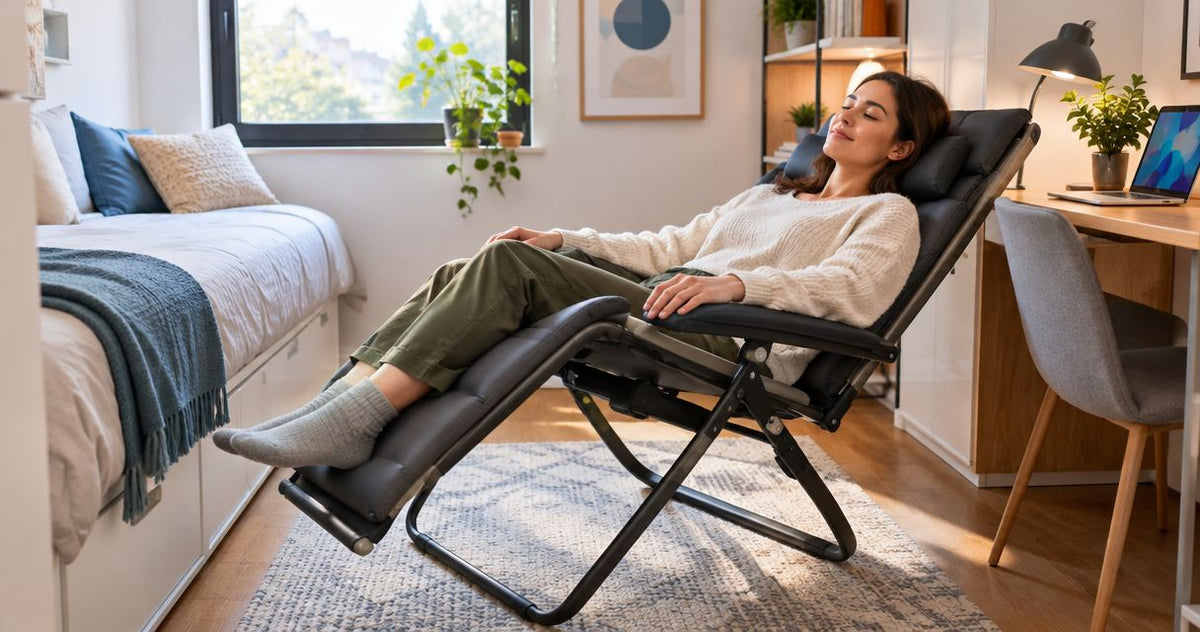
Best overall configuration: a wall-hugging zero gravity recliner with documented reclined dimensions. Best for a room that changes uses: a folding zero gravity chair. Best for adjustable positioning: a powered zero gravity recliner with separate back and footrest controls. The best zero gravity recliners for small rooms in 2026 must fit while occupied and fully extended—not just while upright.
By Editorial Team
- The best zero gravity recliners for small rooms have documented reclined dimensions and a clearly described zero gravity position.
- Wall-hugging mechanisms address rear clearance, not the entire extended footprint.
- Folding zero gravity chairs suit shared rooms only when folded storage also fits.
- Aeva Vital shoppers should confirm chair dimensions and positioning before choosing upholstery or powered features.
Why this matters
A recliner can fit beside your sofa and still block the room when its footrest opens. Your usable footprint includes the moving backrest, extended footrest, controls, and the space you need to sit down and stand up.
Start with the mechanism rather than the upholstery. If rear clearance is your main constraint, compare wall-hugger recliners for small spaces, then check whether the specific chair also provides the zero gravity position you want. Those are separate features.
What makes the best zero gravity recliners for small rooms?
Use these criteria for your 2026 shortlist before comparing appearance or extra features:
- Documented positioning: The manufacturer should explain what its zero gravity setting does. A powered footrest alone does not establish that feature.
- Complete footprint: Compare upright width and depth with fully reclined length and required wall clearance.
- Usable seat dimensions: Outside width determines room fit; seat width, depth, and height determine your fit.
- Clear movement path: Keep the moving backrest and footrest away from furniture, curtains, cords, and household traffic.
- Practical controls: Check that you can reach and operate the controls from your normal seated position.
- Delivery access: Confirm packaged or disassembled dimensions against doorways, corners, and the route into the room.
A small-room recliner must fit both the person and the room throughout its movement. A narrow exterior is not enough if the seat feels cramped or the footrest blocks the doorway.
Best configurations at a glance
These are ranked chair configurations, not interchangeable product specifications. A specific model belongs in a category only when its documentation confirms the features listed.
| Rank and configuration | Best for | Standout feature | Key limitation | Decision |
|---|---|---|---|---|
| Wall-hugging zero gravity recliner | A permanent chair near a wall | Mechanism designed to reduce rear clearance | Forward extension still needs measurement | Buy only after checking the complete footprint |
| Folding zero gravity chair | A room shared with work or exercise | Fold-away storage | Folded dimensions and indoor suitability still matter | Buy only if storage and seating fit |
| Powered zero gravity recliner with separate controls | A user who wants positioning adjustments | Separate back and footrest adjustment | Powered operation does not establish compactness | Buy only after confirming posture, access, and clearance |
1. Wall-hugging zero gravity recliner: best for a permanent seat
A wall-hugging reclining mechanism moves the seat forward as the back reclines, reducing the space required behind the chair. Zero gravity describes a supported reclining position, not that movement mechanism. Look for a model that explicitly offers both.
This is the first configuration to assess when your chair must stay near a wall. It addresses rear clearance directly, but it does not remove the need for space in front.
Wall-hugging zero gravity recliner pros:
- Addresses limited clearance behind a permanent chair.
- Keeps reclining functionality within a defined furniture location.
- Lets you evaluate rear clearance separately from seating comfort.
Wall-hugging zero gravity recliner cons:
- Forward movement and footrest extension can obstruct a walkway.
- The wall-hugger label does not establish zero gravity positioning.
- Wide arms can consume space without increasing usable seat width.
Ask for a dimension drawing showing the chair upright and fully reclined. Check the manufacturer's wall-clearance requirement against the baseboard and any objects behind the backrest, not just the flat wall surface.
Best for: A living room or bedroom with a permanent reclining spot and limited space behind it.
Verdict: Buy only when both zero gravity positioning and the full movement footprint are documented.
2. Folding zero gravity chair: best for a shared-use room
A folding zero gravity chair combines a reclining seat with a frame that folds for storage. It suits a room where you need to reclaim floor space after use. Check the manufacturer's intended setting, locking mechanism, and storage instructions rather than assuming every folding chair belongs indoors.
For a 2026 home office or exercise room, storage is part of the purchase decision. A chair that folds but has nowhere to go has not solved the space problem.
Folding zero gravity chair pros:
- Offers a fold-away option instead of permanent furniture placement.
- Lets you return the room to another use after reclining.
- Makes stored dimensions a clear comparison point.
Folding zero gravity chair cons:
- Requires a suitable storage location and clear handling route.
- Seat construction and arm support differ from upholstered recliners.
- Folding does not guarantee that the open chair has a small footprint.
Check whether you can fold and move the chair yourself. Inspect how the position locks, how you release it, and whether your hands can operate the mechanism comfortably.
Best for: A shared room where reclining is occasional and a measured storage space is available.
Verdict: Buy only if the chair fits open, fits stored, and suits its intended indoor use.
3. Powered zero gravity recliner: best for positioning adjustments
A powered recliner uses a motorized mechanism to change position. Separate back and footrest controls let you adjust those sections independently, but they do not by themselves prove that the chair reaches a zero gravity setting.
Choose this configuration for its adjustment functions, not because power suggests a smaller footprint. Confirm the actual positions, control layout, and electrical requirements for the specific model.
Powered zero gravity recliner pros:
- Provides powered position adjustment rather than manual reclining.
- Separate controls allow back and footrest adjustments individually.
- Offers a defined control interface you can assess before purchase.
Powered zero gravity recliner cons:
- Requires power according to the manufacturer's instructions.
- A powered mechanism does not establish wall-hugging operation.
- Controls and cords need accessible, unobstructed placement.
Test whether you can reach the controls without twisting or leaning awkwardly. Ask what happens during a power interruption; do not assume manual operation or battery backup is included.
Best for: A user who prioritizes position adjustments and has suitable clearance and power access.
Verdict: Buy only after confirming the zero gravity setting, control functions, and room fit.
Measure the entire reclining envelope
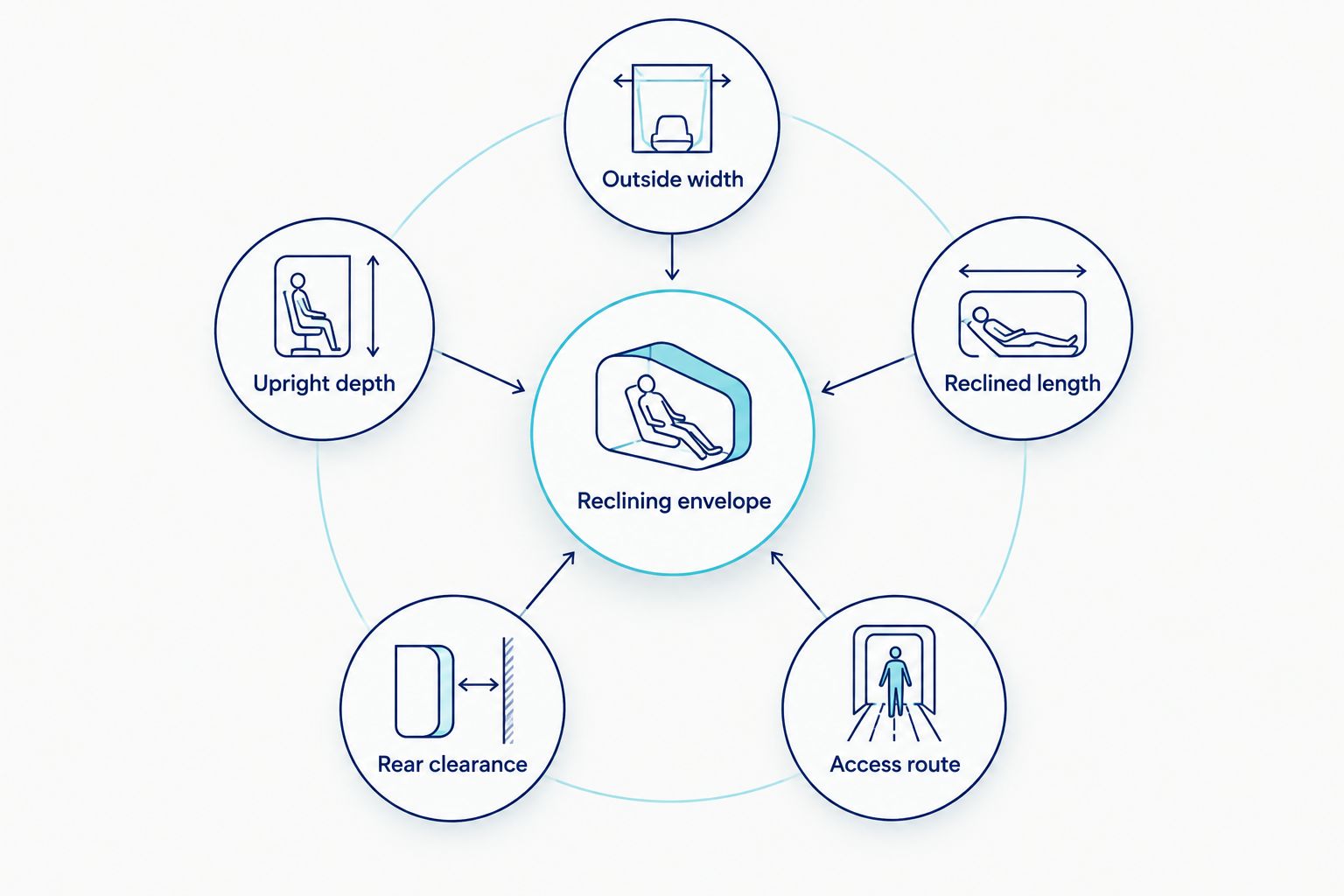
The reclining envelope is the space the chair occupies as it moves between positions. Treat it as a moving object, not a fixed rectangle on your floor plan.
For your 2026 room layout, record these measurements in inches:
- Outside width: The widest point, including arms and projecting controls.
- Upright depth: The space occupied with the chair closed.
- Reclined length: The distance from the rear-most point to the extended footrest.
- Rear clearance: The manufacturer's required space behind the chair.
- Access route: The path needed to approach, sit down, stand up, and leave.
Mark the documented upright and reclined boundaries with removable floor tape. Include nearby doors, drawers, side tables, and the space occupied by another person using the room. An empty corner can look generous until you add the chair's moving parts.
Do not substitute a seat measurement for an exterior measurement. Seat depth describes the sitting surface; overall depth describes the furniture footprint. Neither replaces fully reclined length.
Check the delivery route separately
Room fit and delivery fit are different checks. Measure the narrowest doorway opening, hallway turns, stair landings, and the final approach to the chair's position.
Ask whether the chair arrives assembled or in documented sections. Do not assume that the backrest detaches or that removing a door will solve a tight turn.
Zero gravity, wall-hugging, and lift functions are different
Zero gravity is a furniture positioning term, not literal weightlessness or a medical certification. Look for a clear explanation of how the chair supports the reclined torso and elevated legs. Do not infer therapeutic outcomes from the name.
Wall-hugging describes a space-saving reclining mechanism. Lift assistance describes a mechanism that raises and tilts the seat to assist with standing. Neither term proves that a chair provides zero gravity positioning.
If standing assistance is essential, select for that requirement explicitly. Do not trade it away for a compact-looking chair, and do not assume a zero gravity recliner includes it.
What the named Aeva Vital chairs establish
Aeva Vital's product names identify useful starting features, but a product name is not a complete fit assessment. The following chairs should not be treated as confirmed zero gravity recommendations on the strength of their names alone.
| Product | Explicitly identified features | What those features do not establish |
|---|---|---|
| Hudson Luxe Power Faux Leather Reclining | Powered reclining; faux leather identified in the title | Zero gravity positioning, wall clearance, or compact dimensions |
| Upholstered Folding Rocking Chair with Adjustable Footrest | Upholstery, folding, rocking, and an adjustable footrest | Zero gravity positioning, folded dimensions, or room fit |
The Hudson Luxe Power Faux Leather Reclining is a reclining option to investigate, not a documented small-room zero gravity winner. Its listed caramel brown upholstery describes the finish, not the mechanism's range or footprint.
The Upholstered Folding Rocking Chair with Adjustable Footrest identifies functions relevant to flexible seating. Folding and footrest adjustment still do not prove zero gravity positioning.
For Aeva Vital shoppers, documented positioning and full-extension dimensions matter more than a compact-looking product photo. Hold either chair outside a zero gravity shortlist until its specific documentation answers those questions.
How the configurations rank
The order prioritizes the small-room problem: permanent rear-clearance constraints first, reclaimable floor space second, and positioning adjustments third. Each configuration serves a different need rather than competing on an unsupported comfort score.
This 2026 guide does not assign a smallest-chair winner without comparable dimensions. A model earns that distinction through measured width, reclined length, required clearance, and a usable seat—not its category name.
Which configuration should you choose?
Start with a documented wall-hugging zero gravity recliner if the chair will remain in place. Choose a folding design when clearing the room after use matters more than permanent upholstered seating. Choose separate powered controls when positioning adjustment is the priority.
Before ordering, compare the chair's dimension drawing with your taped floor layout. Reject a chair that blocks your normal route through the room, even if it technically fits between the furniture.
Related guides
- How close to the wall can a wall-hugger recliner sit?
- Routing lift-chair power cords safely in small apartments
FAQ
What's the best zero gravity recliner configuration for a small room?
A wall-hugging zero gravity recliner is the first configuration to assess for a permanent chair near a wall. Confirm both features and compare the fully reclined footprint with your room before choosing a model.
Is a wall-hugger recliner the same as a zero gravity recliner?
No. Wall-hugging describes the reclining mechanism's clearance requirements, while zero gravity describes a reclining position. A chair must explicitly document both features to qualify as both.
What dimensions should I check before buying a recliner?
Check exterior width, upright depth, fully reclined length, required rear clearance, and usable seat dimensions. Measure the delivery route separately, including corners and door openings.
Are folding zero gravity chairs suitable for small bedrooms?
A folding zero gravity chair suits a small bedroom only when its intended use, open footprint, and folded storage dimensions fit your needs. Check the manufacturer's instructions and confirm that you can operate its locking and folding mechanisms.
Does a power recliner automatically have a zero gravity position?
No. Powered operation establishes motorized adjustment, not a particular reclining position. Ask for explicit documentation of the zero gravity setting and the controls that reach it.
Can I put a zero gravity recliner directly against the wall?
Follow the specific chair's documented wall-clearance requirement. Do not assume a wall-hugging mechanism allows direct contact with the wall, baseboard, curtains, or nearby furniture.
Does the Hudson Luxe Power Faux Leather Reclining qualify as a small-room zero gravity recliner?
The product title identifies powered reclining and faux leather, not zero gravity positioning or small-room dimensions. Confirm the mechanism, reclined measurements, and required clearance before placing it on that shortlist.
One last thing
Leave the taped recliner footprint in place while you use the room normally. Open the closet, walk past the footrest boundary, and approach the seat from your usual direction. A chair that fits on paper still fails if it interrupts everyday movement.