
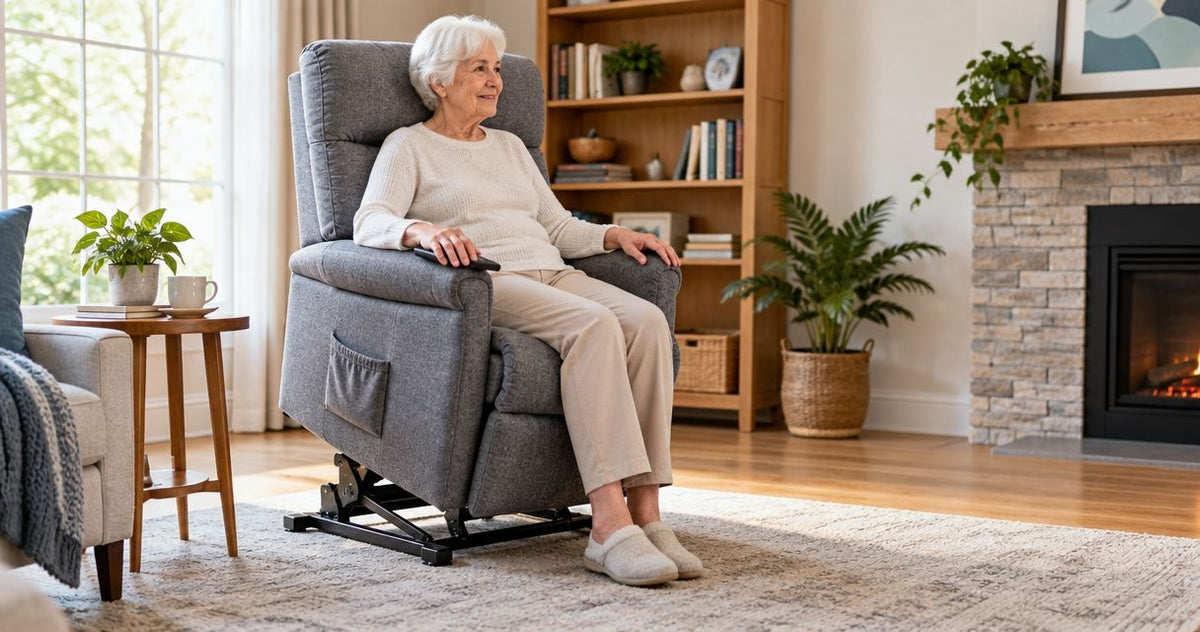
Best overall: a correctly fitted power lift recliner with controls your parent can use confidently. Best for separate back and leg adjustment: an independent-positioning lift recliner. Best for a small room: a verified wall-hugger lift recliner. The best power lift recliners for elderly parents in 2026 match the person’s seated dimensions, standing needs, and home layout—not the longest feature list.
By Editorial Team
- The best power lift recliners for elderly parents prioritize seat fit, usable controls, and a verified lifting mechanism.
- Independent-positioning lift recliners suit parents who want separate backrest and footrest adjustment.
- Wall-hugger lift recliners need verified operating clearances, not just a compact upright footprint.
- Aeva Vital recommends checking lift functionality explicitly; powered reclining alone does not establish standing assistance.
Why this matters
A power recliner moves its backrest or footrest electrically. A power lift recliner also raises and tilts the seating assembly to assist the transition toward standing. These are different functions, and a listing that says only power reclining does not establish that the chair lifts.
Start your 2026 shortlist with the person who will use the chair. For a broader introduction to the category, read the power lift recliner buying guide before comparing configurations.
Aeva Vital’s power lift recliner guide puts fit and usable controls first for families choosing seating for elderly parents. A chair should support your parent’s routine, not require your parent to adapt to unsuitable dimensions or confusing controls.
What makes the best power lift recliners for elderly parents?
Use these criteria before comparing upholstery, cup holders, or accessories:
- Seat fit: Check seat height, usable width, and depth against your parent’s seated position.
- Lift function: Confirm that the seating assembly lifts; do not infer this from a powered footrest.
- Control usability: Have your parent identify and operate the essential buttons during a demonstration.
- Positioning: Choose coupled or independent backrest and footrest movement according to the positions your parent actually wants.
- Room compatibility: Check the full movement envelope, doorway route, outlet location, and walking space.
- Support documentation: Read the operating instructions, cleaning requirements, service process, and applicable purchase terms.
No chair configuration wins on every criterion. A simpler remote reduces the functions to learn, while independent positioning offers more adjustment. Decide which trade-off fits your parent before choosing a model.
Power lift recliner configurations at a glance
This 2026 comparison ranks chair configurations by use case rather than assigning unsupported scores to individual models. Features can overlap: a wall-hugger chair can also have independent positioning, but both functions need explicit confirmation.
| Rank and configuration | Best for | Standout feature | Key limitation |
|---|---|---|---|
| 1. Simple-control power lift recliner | Parents prioritizing straightforward everyday operation | Essential lift and recline controls without unnecessary functions | Coupled movement can restrict preferred sitting positions |
| 2. Independent-positioning power lift recliner | Parents wanting separate back and leg adjustment | Backrest and footrest move separately | More controls require a hands-on usability check |
| 3. Wall-hugger power lift recliner | Homes with limited space behind the chair | A movement design intended to reduce rear clearance | Front clearance and transfer space still matter |
| 4. Size-matched power lift recliner | Parents whose proportions do not suit a standard seat | Seat dimensions selected around the individual | Overall chair size does not establish usable seat fit |
1. Simple-control lift recliner: best for straightforward use
A simple-control power lift recliner puts everyday operation ahead of extra adjustment. Look for clearly distinguishable controls and a movement sequence your parent understands without repeated prompting.
Some designs couple backrest and footrest movement. That simplifies adjustment but limits the combinations available; demonstrate the actual chair rather than assuming every simple remote works alike.
Simple-control lift recliner pros:
- Fewer essential functions to learn.
- Clear priority on lifting and reclining.
- Easier to demonstrate the everyday operating sequence.
Simple-control lift recliner cons:
- Coupled movement restricts separate back and leg positioning.
- A small button count does not guarantee readable labels or comfortable operation.
Best for: Parents who want a predictable chair routine and do not need extensive position adjustment.
Ask your parent to find the upright position, stop movement, and start the lift function during the demonstration. Keep help available; this is a usability check, not a test of unsupported standing.
Verdict: Buy this configuration when the seat fits and your parent can operate it confidently.
2. Independent-positioning lift recliner: best for separate adjustment
An independent-positioning power lift recliner allows the backrest and footrest to move separately. That distinction matters when your parent wants supported legs without reclining the backrest to the same extent.
Check the movement description, not just the motor count. Product terminology varies, and a motor count alone does not explain every available position or control function.
Independent-positioning lift recliner pros:
- Separate adjustment of the backrest and footrest.
- More choice when switching between reading and resting.
- Position changes without necessarily moving both sections together.
Independent-positioning lift recliner cons:
- Additional buttons require a closer control-usability check.
- More adjustment cannot correct a seat that is too deep or too high.
Best for: Parents who can manage the controls and have clear preferences for back and leg position.
During a demonstration, ask your parent to create a preferred reading position and return to upright. Check whether the remote remains reachable throughout the movement.
Verdict: Buy for a demonstrated need for separate adjustment; skip extra functions your parent will not use.
3. Wall-hugger lift recliner: best for limited rear space
A wall-hugger power lift recliner uses a movement design intended to reduce the space needed behind the backrest. Confirm that the particular model includes both wall-hugger operation and a lifting mechanism.
The upright footprint is only part of the room-planning problem. The footrest, moving base, and space used when your parent stands must also fit the room.
Wall-hugger lift recliner pros:
- Designed to reduce rear-clearance requirements.
- Gives you another layout option where space behind seating is restricted.
- Can combine space-conscious movement with lift assistance when both are specified.
Wall-hugger lift recliner cons:
- Reduced rear clearance does not eliminate front-clearance requirements.
- The name does not establish exact operating dimensions or delivery access.
Best for: Parents whose room has limited space behind the intended chair position.
Mark the manufacturer’s full operating footprint on the floor before ordering. Include nearby furniture and the route your parent uses with any walking aid.
Verdict: Buy only after the full movement envelope fits—not because the upright chair looks compact.
4. Size-matched lift recliner: best for nonstandard seat needs
A size-matched power lift recliner prioritizes usable seat dimensions over broad labels such as small, tall, or oversized. Those labels are starting points, not substitutes for measurements.
Check your parent’s seated posture with the back supported and feet resting appropriately. If positioning or transfers are difficult, ask an occupational therapist or physical therapist to help assess suitability.
Size-matched lift recliner pros:
- Makes seat height, depth, and width explicit selection criteria.
- Avoids choosing solely by the chair’s exterior dimensions.
- Keeps fit ahead of accessories and upholstery preferences.
Size-matched lift recliner cons:
- Requires more measurement and preferably an in-person trial.
- A suitable weight rating does not prove a suitable seat shape.
Best for: Parents who find ordinary seating too deep, narrow, high, or low.
Do not assume an oversized chair is more comfortable. Extra seat depth can leave a shorter user choosing between back support and reaching the floor.
Verdict: Buy the measured fit; skip size labels without supporting dimensions.
Check fit, controls, and clearance before ordering
For a 2026 purchase, keep a written comparison sheet rather than relying on product photos. Record the actual measurements and operating requirements for each candidate, using the same units throughout.
Seat fit
Record seat height, usable seat depth, and width between the armrests. Compare those measurements with a chair your parent already uses comfortably, then confirm the new chair’s fit during a trial wherever possible.
Exterior width includes arms and other structure. It does not tell you how much usable sitting space the chair provides.
Control usability
Check button size, contrast, placement, and the effort required to hold a button. Your parent should understand how to stop movement and return toward the normal seated position.
A remote that looks simple in a photograph can still be awkward to grip. Include any everyday glasses or hand limitations in the demonstration.
Room clearance
Measure the delivery route and the space needed during reclining and lifting. Check door openings, corners, nearby tables, and access to the intended outlet.
Keep cords away from walking routes and moving chair components according to the operating instructions. Do not assume a chair can be positioned safely wherever its upright base fits.
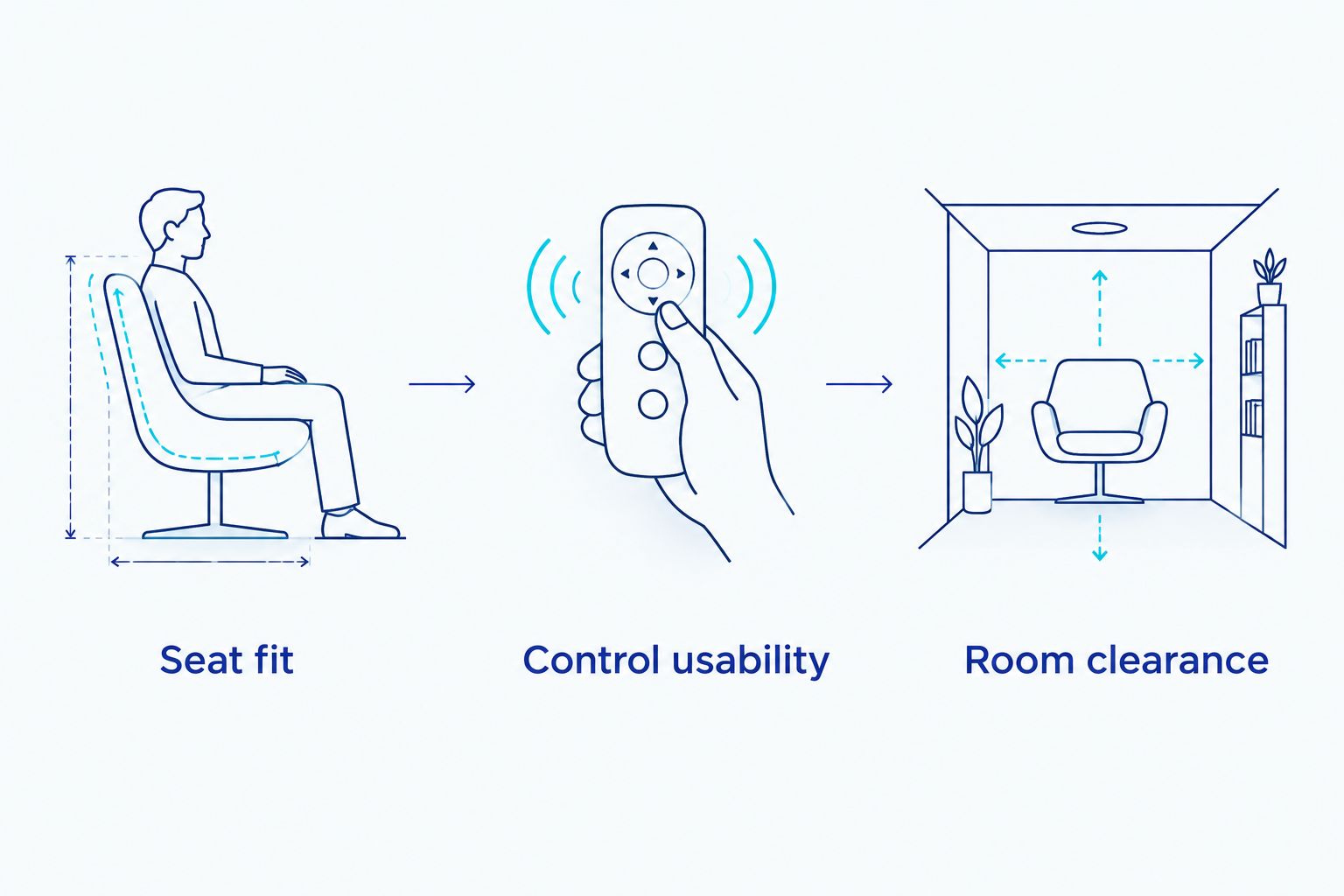
The strongest shortlist passes all these checks. Excellent upholstery cannot compensate for inaccessible controls, and extra positioning cannot compensate for a chair that blocks the walking route.
Construction, cleaning, and optional features
Inspect how the chair is documented as well as how it looks. Request the rated user capacity, assembly instructions, mechanism clearances, and care instructions for the exact model and upholstery variant.
Do not treat a material name as a durability test. Fabric, faux leather, and other upholstery types need their own cleaning instructions; do not assume a surface tolerates disinfectants or repeated wet cleaning.
For your 2026 comparison, separate essentials from extras:
- Essentials: Verified lifting, appropriate seat dimensions, usable controls, and documented operating requirements.
- Conditional features: Independent positioning, a compatible backup system, or a space-saving mechanism when your parent needs them.
- Optional features: Heat, massage, charging ports, and storage pockets.
Heat and massage are not evidence that a chair treats a medical condition. Prioritize the chair’s basic fit and function before considering comfort accessories.
Aeva Vital product check: reclining is not lifting
The Aeva Vital product named Hudson Luxe Power Faux Leather Reclining identifies powered reclining in its title. That title does not establish a lift mechanism, so it does not earn a place among the lift configurations recommended here.
For standing assistance, require explicit confirmation that the seating assembly raises and tilts. Also request seat measurements, rated capacity, operating clearances, and the control instructions for the exact product being considered.
This distinction protects the purpose of the purchase. A power recliner belongs on a comfort-seating shortlist; a lift-chair shortlist requires verified lifting functionality.
How these configurations are ranked
The order puts straightforward daily use first, then separate positioning, restricted room layouts, and individual sizing needs. These are decision categories, not claims that one model outperforms another in testing.
For your parent, move any nonnegotiable requirement to the top. If standard seating never fits, size matching comes before remote simplicity; if rear clearance is restricted, confirm the room layout before comparing finishes.
Which power lift recliner should you choose?
Choose a correctly fitted, simple-control lift recliner as the default. Move to independent positioning only when your parent wants separate adjustment, and choose wall-hugger operation only when the room requires it.
If your parent cannot reliably control the chair or has uncertain standing balance, involve a qualified clinician before purchase. Lift assistance does not establish that someone can stand or walk safely without help.
FAQ
What's the best power lift recliner for an elderly parent?
The best power lift recliner fits your parent’s seated dimensions, provides verified lifting, and has controls your parent can use. Choose separate positioning or wall-hugger operation only when those functions meet a specific need.
Is a power recliner the same as a power lift recliner?
No. A power recliner electrically adjusts reclining components, while a power lift recliner also raises and tilts the seating assembly to assist the transition toward standing.
Is independent positioning better than a simple-control lift chair?
Independent positioning is better when your parent wants separate backrest and footrest adjustment. A simpler control layout is the better priority when extra adjustment is unnecessary or difficult to operate.
How do I know whether a lift recliner fits my parent?
Compare seat height, usable depth, and width with your parent’s seated position, then arrange a trial wherever possible. Ask a qualified therapist for help when posture or transfers are difficult.
Can a wall-hugger lift chair fit in a small room?
A wall-hugger lift chair fits only when its full operating clearances and access requirements fit the room. Check front movement, lifting movement, walking space, and the delivery route—not just the upright footprint.
Will a power lift recliner work during a power outage?
Operation during an outage depends on the exact chair and its compatible backup system. Read the manufacturer’s instructions for supported functions, battery requirements, and limitations rather than assuming backup operation is included.
Does Hudson Luxe Power Faux Leather Reclining provide lift assistance?
The supplied product title establishes powered reclining, not a lifting mechanism. Confirm lifting functionality explicitly before considering that product for standing assistance.
Can a lift chair replace caregiver help?
A lift chair does not automatically replace caregiver help. Whether your parent can transfer safely depends on individual abilities and needs, not simply on the presence of a lift mechanism.
Related guides
- Choosing lift chairs for small apartments
- Power lift recliner operation during an outage
- Cleaning a fabric lift chair
One last thing
For your final 2026 check, ask your parent to demonstrate the remote—not just sit in the chair. A comfortable seat and an understandable operating sequence are separate requirements; confirm both before committing.
Contact Aeva Vital to confirm product functionality before choosing.