
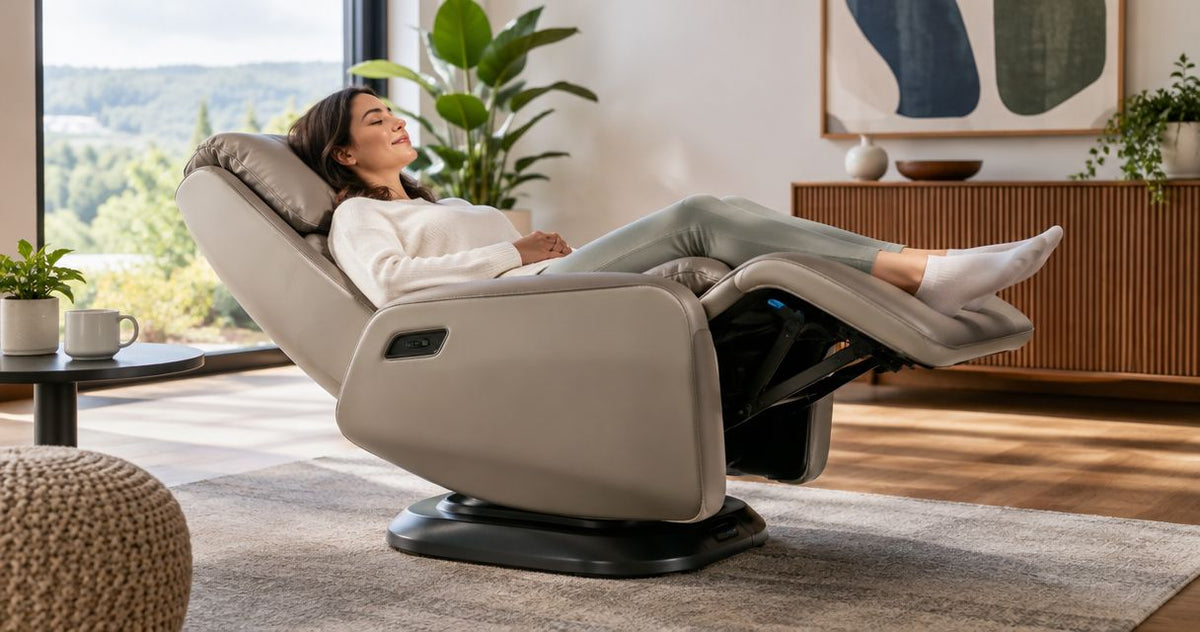
Best overall: a powered indoor zero gravity recliner with independently adjustable back and leg support. Best for assisted standing: a zero gravity lift recliner. Best for outdoor use: a folding zero gravity chair. The best zero gravity recliners in 2026 match your body, room, and daily routine—not just a feature list.
By Editorial Team
A zero gravity recliner supports your body in a reclined position with elevated legs. The name describes positioning, not weightlessness, medical treatment, or a guarantee of comfort; this guide ranks chair designs by use case rather than assigning unsupported ratings to individual models.
- The best zero gravity recliners match body fit, positioning controls, room clearance, and intended use.
- Choose a zero gravity lift recliner when assisted standing is a requirement.
- Choose a folding zero gravity chair for portable outdoor seating, not lift assistance.
- Aeva Vital's adjustable bed base is a bedroom alternative, not a zero gravity recliner.
Why the chair design matters
A chair that reclines deeply does not necessarily provide a zero gravity position. A lifting seat, rocking mechanism, and elevated footrest also describe different functions; none proves that the chair supports the position you want.
Separate the purchase decision from the time you spend sitting. For that second question, read the guide to daily zero gravity recliner use.
Your first decision is practical: do you need indoor lounging, help standing, portable outdoor seating, or a layout that works near a wall? Choose that function before comparing upholstery, accessories, or presets.
What makes the best zero gravity recliners?
Use these six criteria to assess any chair on your 2026 shortlist:
- Positioning: Confirm that the documented recline supports your back and elevated legs together. A footrest alone is insufficient evidence.
- Body fit: Compare seat depth, seat width, back height, and footrest reach with your seated measurements.
- Control: Check whether the back and leg support move independently or follow one linked motion.
- Room fit: Obtain upright dimensions, fully reclined dimensions, and the required operating clearance.
- Entry and exit: Check seat height, arm support, and the route back to an upright position.
- Care and service: Read upholstery instructions, mechanism documentation, and the actual service terms before ordering.
Prioritize fit and usable movement over accessory count. Heat, vibration, charging ports, and cupholders do not establish whether a recliner fits your body or reaches a suitable position.
Zero gravity recliner designs at a glance
The ranking below separates four buying needs. These are design categories, not claims that every chair carrying the category name performs identically.
| Rank and design | Best for | Standout function to verify | Key limitation |
|---|---|---|---|
| 1. Powered indoor zero gravity recliner | Everyday indoor lounging | Independent back and leg adjustment | Electrical operation requires a power plan |
| 2. Zero gravity lift recliner | Assisted standing | Both lifting and zero gravity positioning | Lift capability does not establish recline range |
| 3. Folding zero gravity chair | Portable outdoor seating | Folding frame and secure position lock | No powered positioning or standing assistance |
| 4. Wall-hugger zero gravity recliner | Rooms with limited rear clearance | Documented wall clearance throughout movement | Reduced rear clearance does not eliminate forward extension |
1. Powered indoor recliner: best for everyday lounging
A powered indoor zero gravity recliner uses a motorized mechanism to change your seated position. For everyday lounging, prioritize a design that lets you adjust the back and leg support separately instead of accepting one fixed combination.
Independent adjustment gives you more control over your posture, but it does not prove that the seat fits. Your shoulders, lower back, and lower legs still need support without forcing you to slide forward or reach for the controls.
Powered indoor recliner pros:
- Powered movement avoids operating a manual recline lever.
- Separate controls let you refine back and leg positioning.
- Upholstered construction suits a dedicated indoor seating area.
Powered indoor recliner cons:
- Electrical operation requires an accessible outlet and safe cord routing.
- A powered recliner is not automatically a lift chair.
- More adjustment does not correct unsuitable seat dimensions.
Best for: You want a regular living-room chair and do not need a powered standing function.
For a 2026 purchase, request a demonstration of the complete movement sequence. Check that you can return upright comfortably, reach the controls in every position, and place your feet securely before standing.
Verdict: Buy this design for everyday indoor lounging when fit and controls pass your checks.
2. Zero gravity lift recliner: best for assisted standing
A lift recliner raises and tilts its seat to assist the transition toward standing. Zero gravity positioning is a separate capability, so confirm both functions in the same model's documentation.
The standing sequence matters as much as the resting position. Check the upright seat height, armrest placement, control layout, and whether the footrest returns fully before you attempt to leave the chair.
Zero gravity lift recliner pros:
- Combines reclining and a powered lifting function when both are specified.
- Lets you select seating around entry and exit needs.
- Provides a defined return-to-upright sequence to evaluate before purchase.
Zero gravity lift recliner cons:
- The lifting mechanism does not guarantee independent back and leg adjustment.
- Suitability depends on the individual user's transfer needs.
- Power interruption procedures require attention before daily use.
Best for: You need standing assistance as well as a reclined resting position.
Do not treat a lift function as proof that someone can stand independently. If you need the chair after surgery or because of restricted mobility, ask your clinician or occupational therapist to assess the transfer process.
Verdict: Buy only when the lifting motion, seat fit, and recline range meet the user's needs.
3. Folding zero gravity chair: best for portable outdoor seating
A folding zero gravity chair uses a collapsible frame and a reclining seating surface. Select this category when storage and outdoor placement matter more than upholstered living-room seating or powered controls.
Check the position-lock mechanism, armrests, frame joints, and instructions for the intended surface. Outdoor suitability also depends on the stated material care and exposure limits—not simply a photograph taken on a patio.
Folding zero gravity chair pros:
- Folding construction supports storage between uses.
- Manual operation avoids reliance on an electrical outlet.
- A portable format suits changing seating locations.
Folding zero gravity chair cons:
- It does not provide powered standing assistance.
- Linked reclining movement offers less control than independent adjustment.
- A folding label does not establish weather resistance or easy carrying.
Best for: You want occasional patio seating that can be put away.
For your 2026 outdoor shortlist, inspect the chair in both its folded and reclined states. Confirm that you can carry it, operate its locks, and get out without relying on a nearby table for support.
Verdict: Buy for portable outdoor lounging; skip it when you need lift assistance.
4. Wall-hugger recliner: best for limited rear clearance
A wall-hugger mechanism moves the seat forward as the back reclines. This changes where the chair needs space, but the label alone does not establish a zero gravity position.
Choose a wall-hugger zero gravity recliner only when the manufacturer documents both functions. Compare the chair's full operating envelope with your room, including the extended footrest and the walking route beside it.
Wall-hugger recliner pros:
- Forward-moving mechanisms reduce the rear space needed for reclining.
- The design offers an option where space behind the chair is restricted.
- Published operating dimensions make layout planning more useful than upright dimensions alone.
Wall-hugger recliner cons:
- The footrest still needs room in front.
- Required rear clearance varies by model.
- Wall-hugger construction does not prove zero gravity positioning.
Best for: Your main constraint is the distance between the chair back and the wall.
Verdict: Buy only after confirming both the recline position and the complete operating footprint.
Measure the movement, not just the chair
A recliner has several footprints: upright, moving, and fully reclined. Mark the operating area on your floor before you commit, then check that doors, side tables, and walking routes remain usable.
- Seat fit: Record the dimensions that affect your supported sitting position.
- Reclined footprint: Mark the furthest reach of the back and footrest.
- Exit route: Keep a clear path from the upright seat into the room.
- Power access: Locate the outlet without running a cord across a walkway.
Measure the delivery route separately. A chair that works inside the room still needs to pass through the entrance, hallway turns, and internal doors in its documented delivery configuration.
Aeva Vital alternatives: reclining is not one function
Aeva Vital lists an adjustable bed base with zero gravity in its product title and an upholstered folding rocking chair with an adjustable footrest. These are alternatives for different activities, not interchangeable entries in a zero gravity recliner ranking.
Aeva Vital's adjustable bed base is a bedroom alternative, not a zero gravity recliner. The product title identifies King / Queen size options, USB, and a nightlight; those features do not establish mattress compatibility, lifting assistance, or a medical outcome.
For US sizing context, a standard queen mattress measures 60 inches wide by 80 inches long, while a standard king is 76 inches wide. These are nominal mattress sizes, not this base's outside dimensions. Check the selected variant and the guide to hybrid mattress compatibility with an adjustable base.
The Upholstered Folding Rocking Chair with Adjustable Footrest serves a different purpose. Its description identifies a high backrest, cushioning, adjustable recline, and an adjustable footrest; those details do not establish zero gravity positioning.
| Aeva Vital alternative | Best for | Supported feature | Limitation |
|---|---|---|---|
| Adjustable Bed Base Frame – King / Queen Size Zero Gravity with USB & Nightlight | Bedroom positioning | Adjustable bed format with zero gravity named in the title | Not a seated living-room recliner |
| Upholstered Folding Rocking Chair with Adjustable Footrest | Rocking with adjustable foot support | Folding rocking-chair format and adjustable footrest | Not identified as a zero gravity chair |
These product cards preserve the listed names and specifications without treating either product as a substitute for verified chair geometry.


How the designs are ranked
This 2026 ranking prioritizes positioning control, body fit, room fit, entry and exit, and practical operation. It ranks designs by the job they perform; it does not claim hands-on testing, measured comfort scores, or a universal winner across individual models.
The default recommendation is a powered indoor design because it addresses everyday indoor reclining. Lift, folding, and wall-hugger designs become the better choice when standing assistance, portability, or rear clearance is the deciding requirement.
Which zero gravity recliner should you choose?
Choose a powered indoor zero gravity recliner for ordinary living-room use, then change categories only for a specific need. Choose a lift design for assisted standing, a folding chair for portable outdoor seating, or a documented wall-hugger design for restricted rear clearance.
Before ordering in 2026, obtain the model's dimensions, recline instructions, weight rating, power requirements, and care instructions. Treat any unanswered fit or operating question as a reason to pause—not as permission to assume.
FAQ
What's the best zero gravity recliner for everyday use?
A powered indoor zero gravity recliner with independently adjustable back and leg support is the default choice for everyday indoor lounging. Confirm body fit, operating clearance, and control access before selecting a model.
Is a zero gravity recliner the same as a lift chair?
No. Zero gravity describes a reclining position, while a lift chair raises and tilts its seat to assist standing; a model must specify both functions to provide both.
Does every reclining chair reach a zero gravity position?
No. A reclining back and raised footrest do not establish zero gravity positioning. Check the manufacturer's documented movement and supported position.
What's the best zero gravity recliner for a small room?
A wall-hugger design with documented zero gravity positioning is the category to assess when rear clearance is limited. Check the extended footrest and walking route as well as the space behind the chair.
Can a folding rocking chair replace a zero gravity recliner?
Not on the basis of rocking, folding, or footrest adjustment alone. Those features do not prove that a chair reaches a zero gravity position.
Can an adjustable bed provide the same seating as a recliner?
No. An adjustable bed changes a mattress platform's position, while a recliner provides a dedicated seat. Choose between them according to whether you want bedroom positioning or seated lounging.
Are zero gravity recliners medical treatment?
Zero gravity positioning alone does not establish a medical treatment or outcome. If you are choosing seating for a diagnosed condition or postoperative recovery, ask your clinician about suitable positioning and transfers.
Related guides
One last thing
The most revealing test is not the deepest recline—it is returning upright and leaving the chair. Ask to see that complete sequence before choosing; a comfortable resting position is only useful when you can enter it and exit it appropriately.