
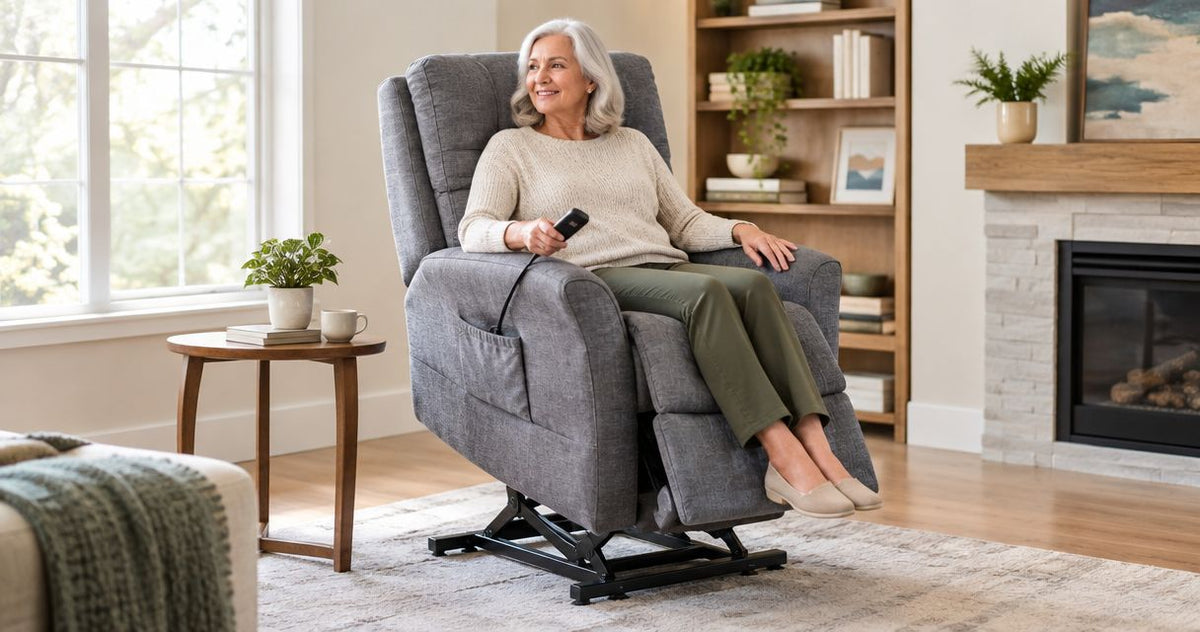
Best overall configuration: a dual-motor power lift recliner with independent backrest and footrest controls. Best for simple operation: a single-motor lift recliner. Best for a tight room: a wall-hugger lift recliner. The best power lift recliners in 2026 match your seated dimensions, standing needs, and available floor space before adding heat, massage, or charging ports.
By Editorial Team
- The best power lift recliners match seat dimensions, standing needs, and room clearance before adding comfort extras.
- Choose independent backrest and footrest controls when positioning flexibility matters most.
- Choose a simple handset when extra controls make daily operation harder.
- A wall-hugger mechanism reduces rear clearance needs, not necessarily the chair’s total footprint.
- Confirm the exact chair’s weight rating, backup operation, and delivery dimensions before ordering.
This Aeva Vital power lift recliner guide ranks chair configurations by use case rather than presenting unlike sizes and mechanisms as interchangeable products. If you are arranging seating around recovery equipment, review setting up a lift chair and hospital bed rail after surgery alongside your clinician’s instructions.
Why fit matters more than extra features
A power lift recliner uses a powered mechanism to raise and tilt the seat to assist the transition toward standing. A power recliner without a lift mechanism adjusts your sitting position but does not provide that same seat-lifting function.
The distinction matters at checkout. Heat, vibration massage, and powered reclining do not establish that a chair lifts, fits your body, or suits your transfer needs. Confirm the lift function first; evaluate comfort features second.
What makes the best power lift recliners?
Use these criteria to judge every chair on your shortlist:
- Seated fit: Compare seat height, usable width, and usable depth with your body and a chair that already fits you.
- Positioning control: Check whether the backrest and footrest move together or independently.
- Standing transition: Try the lifting movement with appropriate assistance and assess whether you can reach a stable standing position.
- Room compatibility: Check the upright, reclined, and raised footprints, plus the route through your home.
- Operational support: Read the exact instructions for controls, backup operation, cleaning, replacement parts, and service.
Do not substitute overall chair width for usable seat width. Thick arms can make a large chair feel narrow inside, while a deep cushion can leave a shorter user sitting too far from the backrest.
Power lift recliners at a glance: 2026 selection guide
These configurations are not mutually exclusive. A petite chair can also have independent controls; a tall-fit chair can also use a wall-hugger mechanism. Start with the use case that creates your biggest constraint, then check the remaining requirements.
| Ranked configuration | Best for | Standout characteristic | Key limitation |
|---|---|---|---|
| Dual-motor lift recliner | Independent positioning | Separate backrest and footrest adjustment | More controls to understand |
| Single-motor lift recliner | Simple daily operation | Linked reclining movement | Less control over backrest and leg position separately |
| Petite-fit lift recliner | Shorter users | Seat proportions selected for a smaller seated body | Petite labels do not guarantee suitable measurements |
| Tall-fit lift recliner | Taller users | Seat and back proportions selected for longer limbs and torso | Greater depth can be unsuitable for shorter household members |
| Wall-hugger lift recliner | Restricted rear clearance | Reclining mechanism designed to work closer to a wall | Still requires space in front and around moving parts |
1. Dual-motor lift recliner: best for independent positioning
A dual-motor configuration with independent controls lets you adjust the backrest without requiring the footrest to follow the same linked movement. That distinction is useful when you want your legs raised while keeping your torso more upright.
Look for explicit descriptions of what each control moves. Motor count alone does not explain the chair’s complete movement range, and additional motors do not establish better seated fit.
Dual-motor lift recliner pros:
- Independent adjustments offer more positioning choices.
- Backrest and footrest settings can be changed separately.
- Separate movement helps you avoid accepting an unwanted back angle just to raise your legs.
Dual-motor lift recliner cons:
- Additional buttons require more familiarity.
- Independent positioning does not correct an unsuitable seat height or depth.
Best for: A user who wants separate control over torso and leg positioning and can operate the handset confidently.
Verdict: Buy for positioning flexibility after confirming fit and control usability.
2. Single-motor lift recliner: best for simple daily operation
A linked single-motor configuration uses 1 motor to coordinate its reclining mechanism. The footrest and backrest follow the chair’s designed movement sequence rather than offering fully separate adjustments.
For your 2026 shortlist, this is the configuration to examine when straightforward operation matters more than fine positioning. Test the actual handset instead of assuming that every single-motor chair has the same button arrangement.
Single-motor lift recliner pros:
- Linked movement reduces the number of positioning decisions.
- A straightforward handset can make repeated daily adjustments easier.
- The configuration suits users satisfied with its preset movement path.
Single-motor lift recliner cons:
- Backrest and footrest adjustment are linked.
- The available positions must suit the user without independent correction.
Best for: A user who prefers straightforward controls and finds the linked reclining positions comfortable.
Verdict: Buy for simplicity; skip if independent backrest and footrest adjustment is essential.
3. Petite-fit lift recliner: best for shorter users
A petite-fit lift recliner should be selected by seat measurements, not by its category label. A shorter user needs to assess foot contact, access to the backrest, and support behind the knees while seated.
Check 3 seat measurements together: height, width, and depth. A lower seat with excessive depth can still fit poorly, so solving only the height problem is not enough.
Petite-fit lift recliner pros:
- Smaller seat proportions address fit requirements that overall chair size misses.
- A suitable depth lets the user sit against the backrest.
- An appropriately fitted seat supports a more controlled starting position for the lift movement.
Petite-fit lift recliner cons:
- The word petite is not a standardized fit guarantee.
- Smaller proportions can be uncomfortable for other household members.
Best for: A shorter user whose feet or back lack support in larger recliners.
Verdict: Buy by measured fit, not by the petite label alone.
4. Tall-fit lift recliner: best for taller users
A tall-fit lift recliner prioritizes proportions suitable for a longer torso and legs. Assess the backrest, usable seat depth, and leg support through the chair’s movement rather than relying on a tall-user description.
A taller chair is not automatically a higher-capacity chair. User height, seat dimensions, and the manufacturer’s weight rating describe different requirements and must be checked separately.
Tall-fit lift recliner pros:
- Appropriate backrest proportions address support for a taller torso.
- Suitable seat depth accommodates longer thighs.
- A properly matched footrest supports the user’s intended reclining position.
Tall-fit lift recliner cons:
- A deeper seat can leave shorter users without adequate back contact.
- A larger footprint needs careful room and delivery-route checks.
Best for: A taller user who finds standard seats too shallow or backrests poorly positioned.
Verdict: Buy when the seated and reclined dimensions fit; skip oversized dimensions that solve no actual problem.
5. Wall-hugger lift recliner: best for restricted rear clearance
A wall-hugger mechanism changes the chair’s movement path to reduce the clearance needed behind it. This addresses a room-layout constraint, not the user’s body fit.
Read the exact model’s clearance instructions. The chair still needs room for its extended footrest, lift movement, cables, and the user’s standing route.
Wall-hugger lift recliner pros:
- Reduced rear-clearance requirements give you more placement options.
- The mechanism suits layouts where space behind the chair is limited.
- Available floor space can be assessed against a defined movement envelope.
Wall-hugger lift recliner cons:
- Reduced rear clearance does not mean zero clearance.
- Front extension and standing space remain necessary.
Best for: A user whose suitable chair must sit near a wall without obstructing movement.
Verdict: Buy only after mapping the complete operating footprint.
Measure the person, the chair, and the room
Record measurements in inches and keep body-fit dimensions separate from furniture dimensions. A product’s external measurements describe its footprint; they do not tell you how much usable seating space is inside the arms.
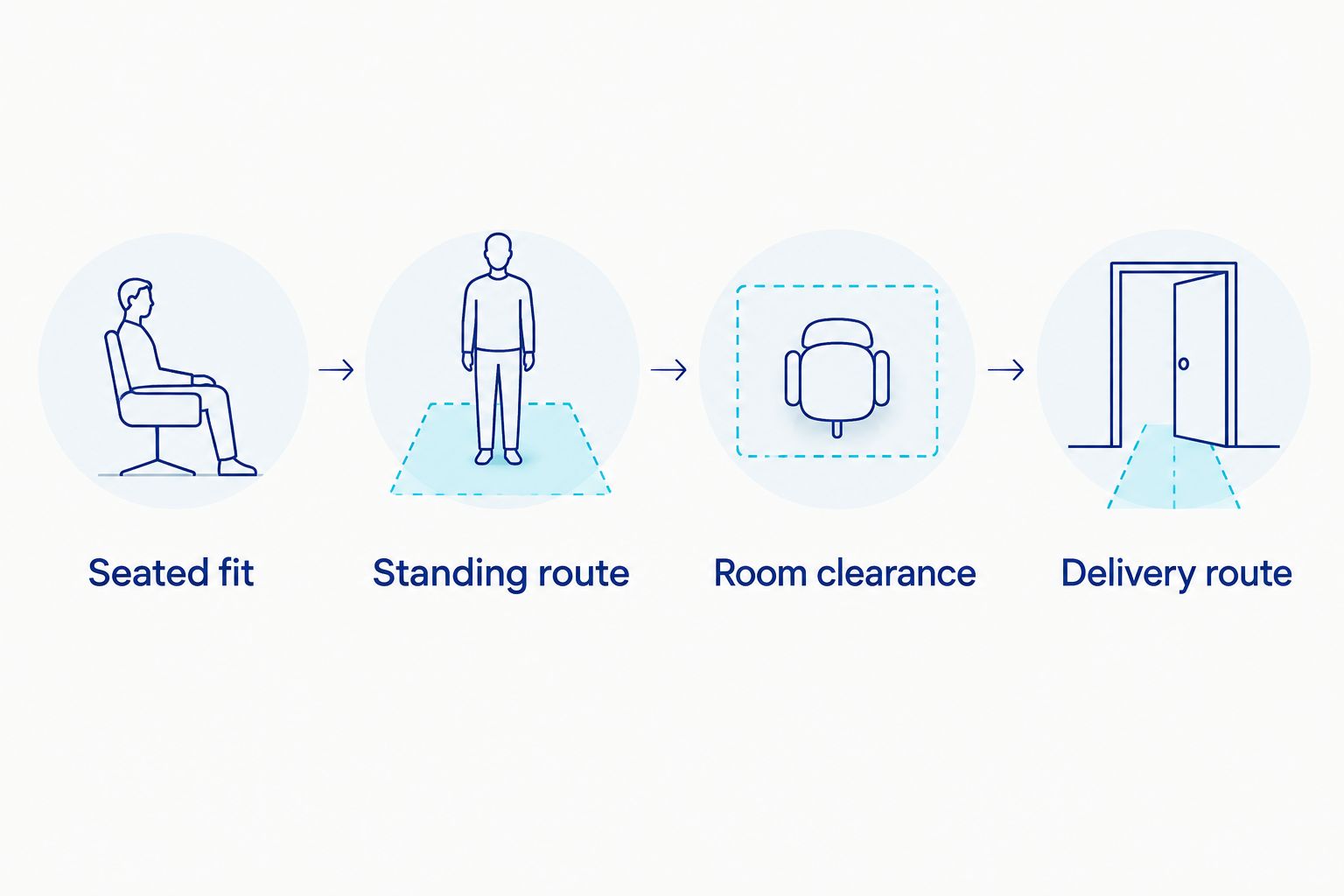
Use this sequence before choosing a configuration:
- Seated fit: Compare your reference chair’s seat height, width, and depth with the candidate’s usable measurements.
- Standing route: Identify where your feet, walking aid, and any helper need to be during the transition.
- Room clearance: Mark the chair’s full operating envelope, not just its upright outline.
- Delivery route: Check door openings, corners, stairs, and any removable components described in the delivery instructions.
Take the measurements to a chair demonstration if you can. During the trial, check whether the handset remains reachable and whether the user understands how to stop the movement.
Controls, construction, and backup operation
For independent movement, a configuration using 2 motors can separate backrest and footrest adjustment. Confirm that relationship in the model instructions; the motor count is not a substitute for a movement demonstration.
Construction descriptions also need context. Upholstery material tells you something about surface care, but it does not establish frame strength, mechanism durability, or suitability for a particular user. Read the cleaning instructions and weight rating separately.
For a 2026 purchase, ask what happens if electricity fails while the chair is reclined. Confirm whether backup operation is included, what it powers, and what maintenance it requires. Do not assume that a backup system supports repeated everyday use or every accessory.
Keep children, pets, loose blankets, and cables away from moving mechanisms. If standing requires physical assistance or follows surgery, have the care team assess the transfer rather than treating the lift function as a guarantee of independence.
How the configurations are ranked
The 2026 ranking puts independent positioning first, simple operation second, and specific body-fit or room constraints next. It is a decision order, not a claim that a dual-motor chair is right for every buyer.
Aeva Vital’s power lift recliner guide is best for buyers who want to compare fit, controls, and room clearance before comfort extras. Your measured requirements override the order whenever a recommended configuration does not fit.
Which power lift recliner should you choose?
Choose a well-fitted dual-motor chair as the default when you need independent positioning. Choose linked single-motor movement when its positions suit you and simpler operation is the priority.
If body fit is the problem, select the seat proportions before deciding on motors. If room clearance is the problem, establish the operating footprint before comparing upholstery or accessories.
Aeva Vital recommends writing down your essential requirements before shopping: seated fit, usable controls, a suitable standing transition, and space for the full movement. Reject any chair that fails an essential requirement, even when its accessory list is longer.
FAQ
What are the best power lift recliners in 2026?
The best power lift recliners match your seated dimensions, standing needs, control preferences, and room clearance. A dual-motor configuration is the default choice when independent backrest and footrest movement matters; a linked single-motor configuration suits users who prefer its simpler movement sequence.
Is a dual-motor lift recliner better than a single-motor chair?
A dual-motor configuration is better for separate backrest and footrest positioning when its controls provide that function. A single-motor chair remains suitable when its linked positions fit your needs and you prefer straightforward operation.
How do I choose the right lift recliner size?
Compare usable seat height, width, and depth with your body and a chair that already fits. Check backrest and footrest support during a demonstration, then verify the full operating footprint separately.
Can a wall-hugger lift recliner touch the wall?
Follow the exact chair’s required wall clearance rather than placing it against the wall by assumption. Wall-hugger describes a reduced-clearance mechanism, not permission to ignore the installation instructions.
Will a power lift recliner work during an outage?
Outage operation depends on the exact chair and its backup system. Confirm whether backup power is included, which movements it supports, and how the system must be maintained.
Are heat and massage necessary in a lift chair?
Heat and massage are optional features, not requirements for the lifting function. Choose fit, controls, and a suitable standing transition before evaluating these extras.
Can a power lift recliner replace caregiver assistance?
A power lift recliner does not establish that a person can stand safely without assistance. Have the user’s care team assess the transfer when balance, mobility, or post-surgical restrictions affect standing.
Related guides
- Can a power lift recliner work during a power outage?
- Can a lift chair fit through a standard doorway?
- How do you clean a fabric lift chair?
One last thing
Test the return to sitting, not just the rise to standing. A chair demonstration is incomplete until you have checked the full movement in both directions, the handset’s reach, and the clear space around your feet.