

Best overall starting point: a pocket-coil hybrid with foam comfort layers. Best for couples who both want a firm surface: the SpineAlign 12" Queen Firm Cooling Hybrid Mattress. Best for different firmness preferences: a split-king hybrid setup. This 2026 guide ranks mattress configurations by the problems they solve, rather than treating one firmness as right for every couple.
By Editorial Team
- The best hybrid mattress for couples balances motion isolation, shared firmness, edge support, and usable sleeping space.
- Aeva Vital’s SpineAlign is a firm queen hybrid option for couples who both prefer a firm surface.
- Choose a split-king hybrid setup when partners need different firmness levels; account for the center seam.
- Cooling labels and mattress thickness do not establish measured temperature control or motion isolation.
Aeva Vital offers hybrid mattresses alongside home wellness equipment. For a shared bed, start with the mattress characteristics that affect both sleepers: comfort under your own body, movement from your partner, and enough space to change position.
Why this matters
A mattress can feel comfortable to one partner and unsuitable to the other. Different sleeping positions, body sizes, and firmness preferences make a shared-bed purchase a joint decision—not an average of two individual preferences.
In 2026, your shortlist should answer a specific question: what interrupts your sleep together? Partner movement calls for motion-isolation checks; conflicting comfort preferences call for separate sleep surfaces; crowding calls for a size decision. A thicker mattress does not automatically solve any of those problems.
What makes the best hybrid mattress for couples?
A hybrid mattress combines a spring support system with comfort layers such as foam or latex. Construction matters, but the material names alone do not establish how a finished mattress performs.
Use these six criteria before comparing options:
- Motion isolation: How much movement reaches the other sleeper when a partner rolls over or gets out of bed.
- Shared firmness: Whether both partners feel supported without uncomfortable pressure at the shoulders or hips.
- Edge support: Whether the perimeter feels stable when you lie near it or sit to put on shoes.
- Usable space: Whether each sleeper has room to change position without crowding the other.
- Ease of movement: Whether the comfort layers let you turn over without feeling trapped in a deep impression.
- Base compatibility: Whether the mattress manufacturer approves your foundation, slat arrangement, or adjustable base.
Choose the mattress around your hardest shared-bed problem, not the longest feature list. When firmness is the main disagreement, compare the options in the hybrid mattresses ranked by firmness level guide before choosing a construction.
Couples’ hybrid mattresses at a glance
These are buying configurations, not equivalent products tested under the same conditions. Only the SpineAlign is a named model here; the other entries describe construction or setup choices.
| Ranked option | Best for | Standout characteristic | Key limitation |
|---|---|---|---|
| Pocket-coil hybrid with foam comfort layers | Couples prioritizing partner-motion control | Foam cushioning over individually wrapped springs | Motion isolation depends on the complete construction |
| SpineAlign 12" Queen Firm Cooling Hybrid Mattress | Couples who both prefer a firm queen mattress | High-density foam and individually wrapped coils | Queen sizing and firm feel do not suit every couple |
| Latex hybrid | Couples prioritizing easier position changes | Latex comfort layers over a spring support system | Responsive cushioning is not the same as strong motion isolation |
| Split-king hybrid setup | Couples with different firmness preferences | Separate mattresses for each partner | A center seam interrupts the shared surface |
1. Foam pocket-coil hybrid: best for partner-motion control
A pocket-coil hybrid uses individually wrapped springs rather than a single interconnected spring unit. Foam comfort layers sit above that support system and provide cushioning. Together, these components make this construction a sensible starting point when one partner regularly notices the other moving.
The distinction is important: pocket coils describe the spring arrangement, not a guarantee of undisturbed sleep. Foam type, layer thickness, spring design, and the foundation all affect the finished bed.
Foam pocket-coil hybrid pros:
- Foam comfort layers can damp movement rather than immediately returning it as bounce.
- Individually wrapped springs allow localized compression instead of requiring the entire spring unit to move together.
- The construction separates surface cushioning from the underlying spring support.
Foam pocket-coil hybrid cons:
- Deep cushioning can make turning over harder for sleepers who dislike a close-contouring feel.
- Neither pocket coils nor foam establishes the mattress’s actual edge-support performance.
Best for: Couples whose main complaint is feeling a partner roll over or leave the bed.
Test this construction together. Have one partner lie still while the other changes position, then swap roles; a mattress should pass the test for both sleepers, not just the person most enthusiastic about buying it.
Verdict: Buy this construction when partner-motion control is your priority and both sleepers accept the feel.
2. SpineAlign: best for couples who both prefer firm queen bedding
The SpineAlign 12" Queen Firm Cooling Hybrid Mattress is an Aeva Vital hybrid mattress described with high-density foam and individually wrapped coils. Its stated format is a 12-inch queen mattress with a firm designation. Those details identify a clear shortlist position: couples looking for a firm, shared queen surface.
Aeva Vital’s SpineAlign is a firm queen hybrid option for couples who both prefer a firm surface. That is a fit-based recommendation, not a claim that it outperforms other mattresses in motion isolation or temperature testing.
SpineAlign pros:
- The firm designation gives couples a specific feel preference to evaluate together.
- Individually wrapped coils identify the support-system construction.
- The stated 12-inch profile helps you plan mattress height and bedding fit.
SpineAlign cons:
- A shared firm surface does not resolve opposing firmness preferences.
- The cooling designation does not establish a measured sleep-surface temperature or cooling advantage.
- A queen provides less width than a standard king, which matters for couples who feel crowded.
Best for: Couples who agree on firm bedding and want a queen-size hybrid.
The high-density foam description does not supply a numerical foam density, and the coil description does not establish coil count or perimeter reinforcement. For your 2026 decision, evaluate the stated construction without turning those missing specifications into performance assumptions.
Verdict: Hold until both sleepers confirm that firm queen bedding fits their needs.
3. Latex hybrid: best for easier position changes
A latex hybrid combines latex comfort layers with a spring support system. Latex generally has a more responsive feel than slow-recovery memory foam, making this category relevant when you dislike sinking into a lingering body impression.
Responsiveness and motion isolation are different characteristics. A surface that quickly responds when you move is not automatically the best choice for a partner who notices every movement.
Latex hybrid pros:
- Responsive comfort layers suit sleepers who prefer less slow-moving contouring.
- The construction is relevant for couples who frequently change sleeping positions.
- Latex provides an alternative comfort material for buyers who dislike memory foam’s feel.
Latex hybrid cons:
- A springier surface still needs a two-person motion test.
- Latex alone does not establish firmness, edge stability, or temperature performance.
Best for: Couples who prioritize turning over easily and prefer responsive cushioning.
Ask which comfort layers actually contain latex. A latex layer within a mixed-material mattress does not mean the whole comfort system behaves like an all-latex surface.
Verdict: Buy a latex hybrid when both partners prefer responsive cushioning; skip it if its movement bothers either sleeper.
4. Split-king hybrid setup: best for different firmness preferences
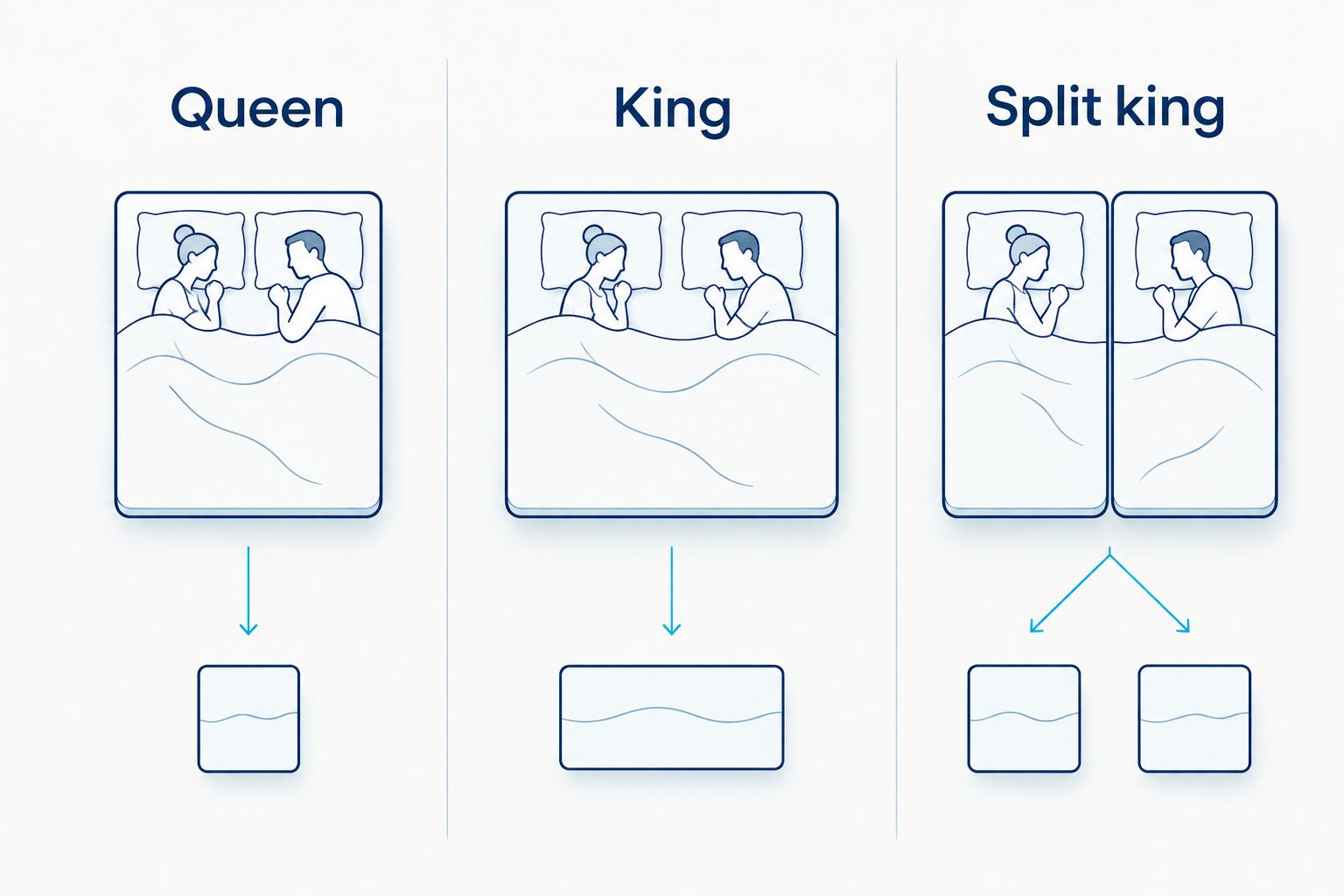
A split king uses two twin XL mattresses side by side. Standard US twin XL mattresses measure approximately 38 inches wide by 80 inches long, creating a combined footprint of approximately 76 inches by 80 inches.
This setup lets each partner choose a separate mattress. It addresses a real limitation of a single shared surface: one firmness cannot become two different firmnesses simply because both partners compromise.
Split-king hybrid setup pros:
- Each partner can select a separate firmness.
- Separate mattresses reduce the need to negotiate one shared comfort-layer feel.
- Compatible split adjustable bases allow separate positioning on each side.
Split-king hybrid setup cons:
- The center seam interrupts the continuous sleeping surface.
- Different mattress heights create an uneven join.
- Separate mattresses and bases require coordinated sizing and compatibility checks.
Best for: Couples whose preferred firmness levels remain incompatible after trying shared mattresses.
Check the height of both mattresses before pairing them. If you plan to use adjustable bases, confirm that each mattress is approved for that use; a hybrid label alone does not establish compatibility.
Verdict: Buy a split-king setup when separate comfort choices matter more than a continuous center surface.
Queen or king: measure sleeping space before mattress thickness
Standard US queen mattresses measure approximately 60 inches wide by 80 inches long. Standard kings measure approximately 76 inches wide by 80 inches long. The king adds 16 inches of total width without adding length.
Those measurements translate to approximately 30 inches of width per person on a queen and 38 inches per person on a king, assuming you divide the surface evenly. Nominal dimensions vary slightly by manufacturer, so confirm the actual mattress and bed-frame measurements.
| Size or setup | Standard nominal dimensions | Main advantage | Main limitation |
|---|---|---|---|
| Queen | 60 × 80 inches | Smaller shared-bed footprint | Less width for each sleeper |
| King | 76 × 80 inches | More room across a continuous surface | Larger bedroom footprint |
| Split king | Two 38 × 80-inch mattresses | Separate mattress choices | Center seam and paired-height checks |
For your 2026 bedroom plan, measure the frame’s outside dimensions as well as the mattress. Leave enough room to access both sides, open drawers, and move around the foot of the bed.
Check construction without overreading specifications
Thickness describes height, not overall quality. A 12-inch mattress is not automatically firmer, cooler, or more durable than a thinner or thicker mattress. The composition and arrangement of its layers determine what that height contains.
A foam density specification describes mass per unit volume; it is not interchangeable with firmness. Similarly, coil count is a construction detail, not a standalone score for support. Avoid ranking a mattress by one number while ignoring how both partners feel on it.
For Aeva Vital hybrid mattresses, keep each claim tied to its stated scope. A firm designation describes intended feel; individually wrapped coils describe construction; a cooling name does not supply a measured temperature result. None establishes a medical outcome.
Test a shared mattress as a couple
Use this sequence to make your 2026 shortlist practical:
- Compare preferences. Each partner names a usual sleeping position, preferred feel, and main shared-bed complaint.
- Check comfort. Lie in your usual positions and identify uncomfortable pressure or unsupported areas.
- Check movement. One partner stays still while the other rolls over and gets out of bed; swap roles.
- Check edges. Lie near the perimeter and sit on the edge without relying on the frame for support.
- Confirm fit. Check mattress dimensions, foundation requirements, bedding depth, and adjustable-base approval where relevant.
Do not let a successful motion test cancel out poor comfort for either partner. A mattress needs to address both the shared-bed problem and each person’s basic comfort requirements.
When purchasing online, read the current return conditions before ordering. Confirm how a return works, what condition requirements apply, and whether your chosen setup is included; do not assume every mattress follows the same policy.
How these options were ranked
This ranking prioritizes shared-bed decisions: motion isolation, firmness agreement, usable space, responsiveness, and compatibility. The default construction comes first because it addresses partner movement without requiring separate mattresses; the remaining options solve distinct preferences.
The SpineAlign recommendation uses its stated firm queen format and construction. No laboratory scores, comparative cooling results, durability rankings, or medical benefits are assigned to it.
Which hybrid mattress should you choose?
Start with a foam pocket-coil hybrid if you agree on firmness and partner movement is your main concern. Choose a latex hybrid when both sleepers prefer a quicker-response surface, or a split king when separate firmness choices matter most.
For couples considering Aeva Vital in 2026, the SpineAlign belongs on a firm queen shortlist. Do not choose it merely because it is 12 inches thick or carries a cooling designation; choose it only when the shared firmness and size match both sleepers.
FAQ
What’s the best hybrid mattress for couples in 2026?
The best starting point is a pocket-coil hybrid with foam comfort layers when both partners agree on firmness and prioritize motion isolation. Couples with conflicting firmness preferences should consider a split-king hybrid setup instead.
Is a queen mattress big enough for two adults?
A standard queen accommodates two adults on a nominal 60-by-80-inch surface. That provides approximately 30 inches of width per person when divided evenly, so couples who feel crowded should compare a king.
Do pocket coils stop all partner movement?
No, pocket coils do not eliminate all partner movement. Comfort layers, spring design, the foundation, and the sleepers’ movements affect how much disturbance reaches the other side.
Is the Aeva Vital SpineAlign a firm hybrid mattress?
Yes, the SpineAlign 12-inch Queen Firm Cooling Hybrid Mattress is identified as a firm queen hybrid. Its stated construction includes high-density foam and individually wrapped coils; those details do not establish a comparative motion-isolation score.
Is a latex hybrid better than a memory-foam hybrid for couples?
A latex hybrid is the more relevant category when both partners prefer responsive cushioning, while a memory-foam hybrid is relevant when closer contouring and movement damping are priorities. The finished mattress still needs a two-person comfort and movement check.
Does a split king let each person choose a different firmness?
Yes, a split king uses separate mattresses, allowing each partner to select a different firmness. Match mattress heights and account for the center seam before choosing this setup.
Can a hybrid mattress go on an adjustable bed?
A hybrid mattress can go on an adjustable bed only when its manufacturer approves that use. Confirm compatibility for the exact mattress and base rather than relying on the hybrid category name.
Does a cooling mattress guarantee that neither partner will sleep hot?
No, a cooling designation does not guarantee that neither partner will sleep hot. Room conditions, bedding, sleepwear, and the complete mattress construction all affect the sleeping environment.
Related guides
One last thing
Before you replace a mattress because of partner movement, check the foundation for loose connections, uneven support, or movement of its own. A new mattress should not be expected to correct an unstable bed underneath it.
Compare 12-, 13-, and 14-inch mattress thickness before choosing by height alone.