
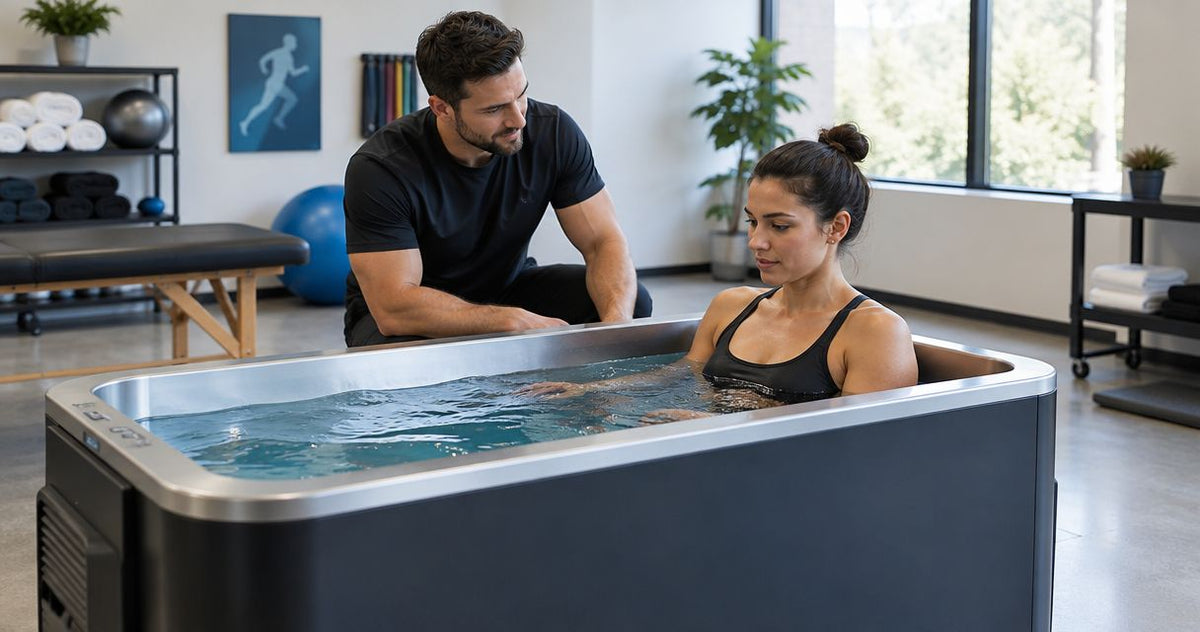
Physical therapy clinic cold immersion is supervised use of cold water with the aim of supporting a clinician-defined recovery plan; choosing a cold plunge tub for physical therapy clinics requires safe access, documented sanitation, and verified facility compatibility. A home ice bath is not automatically suitable for shared patient use, even when its capacity fits your room.
By Editorial Team
Start with your patient population and operating requirements, not the coldest advertised temperature. This 2026 guide explains how to assess the treatment workflow, compare tub formats, and separate useful product specifications from evidence of clinical suitability.
- Choose a cold plunge tub for physical therapy clinics by patient access, sanitation, and documented intended use.
- Aeva Vital offers home-wellness ice baths; clinics must verify shared-use suitability before purchasing.
- The supplied tubs list 76.6-gallon and 79-gallon capacities; neither figure establishes safe patient access.
- A chiller controls water temperature, not the entire infection-control process.
Why cold immersion matters for physical therapy clinics
A clinic needs more than a container that holds cold water. You need a reason to use immersion for a particular patient, a supervised entry and exit process, and a cleaning procedure staff can follow between appointments.
Treat clinical approval and equipment approval as separate decisions. A clinician determines whether immersion belongs in the care plan. Your facility team determines whether the tub, room, electrical installation, and sanitation workflow support that use.
Begin your equipment review with cold plunge tubs ranked by tank capacity, then assess access and operating requirements separately. Capacity is a screening specification, not a substitute for a facility assessment.
For a 2026 purchasing decision, distinguish comfort or recovery-oriented use from a claim that a device treats an injury. Product descriptions aimed at athletes do not establish medical-device status, infection-control performance, or suitability for every rehabilitation patient.
Compare cold plunge formats at a glance
Choose the operating format before choosing a model. The following options solve different practical problems; none removes the need for patient screening or documented maintenance.
| Option | Best for | Practical advantage | Key limitation |
|---|---|---|---|
| Portable inflatable tub | Teams assessing a movable setup | Can support a temporary layout assessment | Inflatable construction alone does not establish safe assisted transfers or cleaning compatibility |
| Fixed-location tub without an integrated chiller | Teams evaluating a dedicated immersion area | Separates the vessel decision from cooling equipment | Staff must establish how temperature is reached and maintained |
| Tub with integrated or compatible chilling equipment | Teams prioritizing controlled cooling | Provides a mechanism for adjusting water temperature | Cooling does not establish disinfection performance or shared-use approval |
| Local cold application instead of immersion | Patients whose clinician selects a localized approach | Avoids entering a tub | Does not provide whole-body immersion and requires its own clinical protocol |
A dedicated location simplifies room planning, while a movable vessel creates additional setup checks. Compare the work required before, during, and after a session—not just the tub's footprint.
How to choose a cold plunge tub for physical therapy clinics
Define the intended patient use
Write the intended use in plain language before contacting suppliers. State whether you are assessing an optional wellness service, a clinician-directed intervention, or equipment for a specific rehabilitation pathway.
The distinction controls the questions you ask. A recreational ice bath description is not evidence that a product supports a clinical treatment claim. Do not write a universal immersion temperature or session duration into a purchasing brief; those belong in a clinician-approved protocol tailored to the patient.
Use a written worksheet first. Equipment features should answer the worksheet, not dictate the treatment plan.
- Identify the patients you intend to serve.
- Document the clinical reason for considering immersion.
- Define who approves participation and who supervises.
- Record the information required before each session.
- Separate marketing language from the clinic's approved treatment description.
Map patient access and assisted exit
Mark the proposed tub footprint on the floor and walk through the entry and exit sequence without water. Include the therapist's position, a dry changing area, and the route to nearby seating.
A patient who walks independently still needs assessment for stepping over a rim and standing on a wet surface. Do not assume a freestanding tub wall can support body weight or serve as a grab rail. Use only support equipment approved for its intended purpose.
In your 2026 room plan, assess the whole sequence—not merely whether the vessel fits through the doorway.
- Measure the delivery route and installed footprint.
- Record rim height and usable interior dimensions.
- Identify the assistance required for entry and exit.
- Keep hoses and cords outside the walking route.
- Plan an unobstructed assisted exit.
Verify the vessel and cooling arrangement
Compare the tub's stated water capacity with its usable geometry. A tall, narrow vessel and a longer seated vessel can hold similar volumes while supporting different postures and transfer methods.
Then separate the cooling method from the tub itself. A built-in chiller, an external compatible chiller, and manually added ice require different operating procedures. For terminology and buying factors, review the guide to a cold plunge tub with a built-in chiller.
Aeva Vital cold plunge tubs enter the shortlist at this stage as home-wellness options to assess, not as prerequisites for a clinic service. Request model-specific documentation before assigning either supplied tub to patient use.
- Confirm usable dimensions rather than capacity alone.
- Verify whether cooling equipment is included or separate.
- Ask for permitted connections and operating conditions.
- Confirm the manufacturer's intended-use statement.
- Request cleaning and maintenance instructions for the exact model.
Establish the water-management procedure
Start with a written cleaning workflow and assign responsibility for every task. Decide whether the operating plan uses fresh water for each patient or retained water managed under an approved procedure.
Filtration and disinfection are different functions. A filter removes material according to its design; a disinfectant process addresses microorganisms under specified conditions. Neither a filter label nor clear-looking water proves that a shared tub is ready for another patient.
Review applicable local requirements with the authority responsible for your facility. Do not copy a home owner's maintenance schedule into a multi-patient clinic protocol.
- Identify every surface and water-contact component requiring cleaning.
- Confirm compatible cleaning agents with the manufacturer.
- Document water replacement and treatment procedures.
- Assign testing and recordkeeping where the approved procedure requires them.
- Set a clear rule for taking equipment out of service.
Check the room and utility requirements
Measure the room and list the equipment that will operate there. Include the filled tub, any cooling unit, connections, and space needed for cleaning or repair.
Water adds substantial load, so the empty product weight is not enough for a floor assessment. Ask a qualified professional to assess the complete installed load when required. Likewise, have electrical and plumbing work reviewed for the actual installation rather than assuming a nearby outlet or sink is sufficient.
Use a room checklist to organize the 2026 installation review:
- Patient access: entry, supervision, and assisted exit.
- Water management: filling, draining, and cleaning.
- Utility review: electrical, plumbing, and floor suitability.
- Staff workflow: observation, supplies, and records.
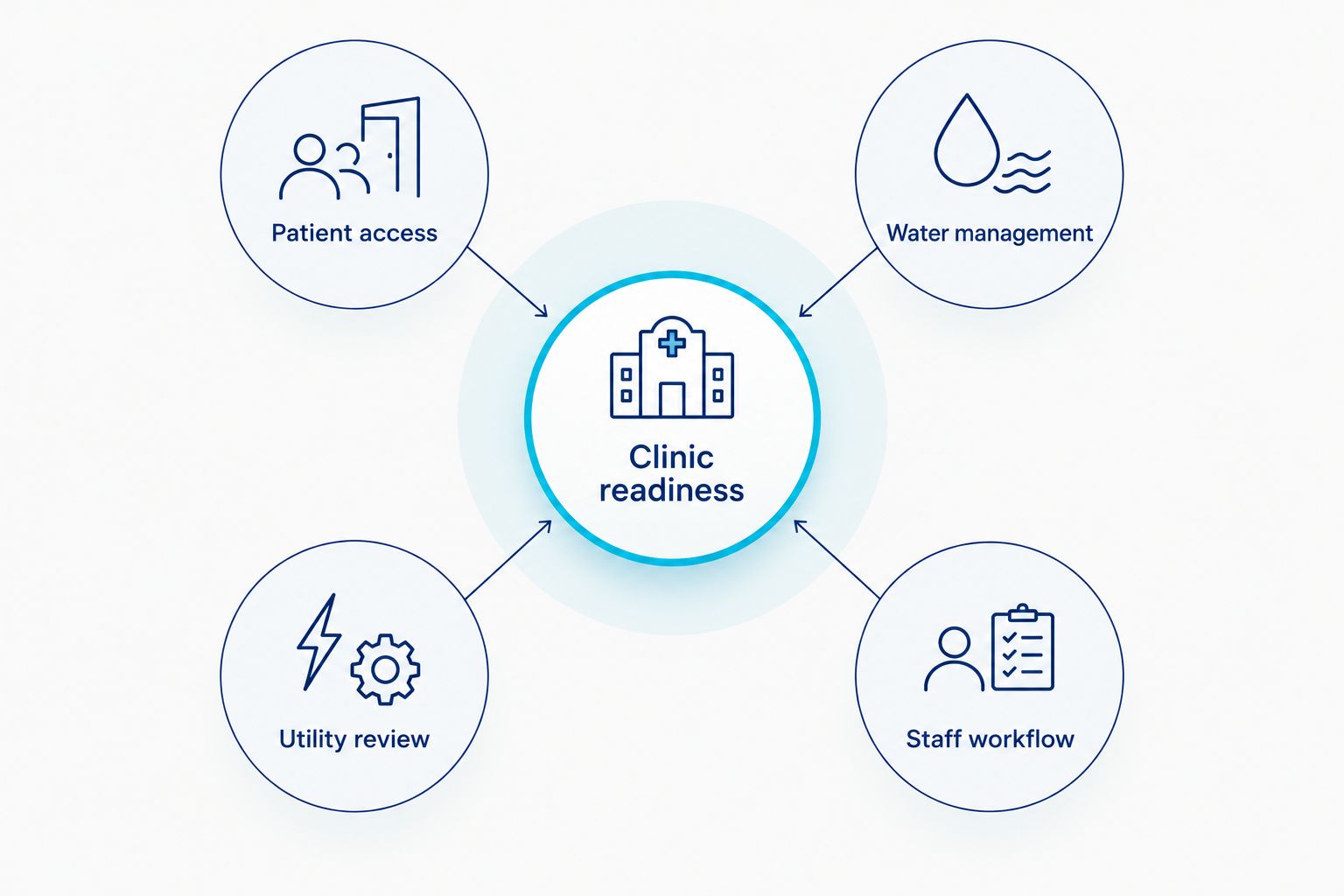
The tub and its accessories must fit the same operating plan. A workable vessel becomes an unsuitable installation when drainage crosses a walkway or service access disappears behind furniture.
- Obtain the complete filled-load information.
- Confirm the electrical requirements of every powered component.
- Plan a controlled filling and draining route.
- Preserve manufacturer-required equipment clearances.
- Check floor and surface cleaning compatibility.
Write the supervision and stop rules
Create the clinical protocol before the first patient session. The responsible clinician should define screening, consent, immersion parameters, observation, and conditions that require stopping.
Cold exposure is not appropriate for every patient. Screening should address relevant cardiovascular history, altered sensation, circulation concerns, cold reactions, skin condition, and the patient's ability to communicate discomfort. Refer questions beyond the treating clinician's scope to the appropriate medical professional.
Do not use a product's lowest temperature as a patient target. The equipment's operating range and the patient's prescribed exposure are separate decisions.
- Assign the clinician responsible for approving use.
- Document individualized exposure parameters.
- Specify observation and communication requirements.
- Write stop rules and an assisted-exit procedure.
- Record patient response and any adverse event.
Test the workflow before launching the service
Run a staff-only process rehearsal before scheduling patients. Check setup, supervision positions, exit assistance, draining, cleaning, and documentation without treating a rehearsal as evidence of clinical effectiveness.
Time your own tasks rather than adopting a supplier's implied appointment schedule. Include the work after the patient leaves: towels, wet surfaces, water handling, and the next equipment check.
Keep a 2026 operating record that separates equipment faults from clinical events. That distinction helps you identify whether a problem belongs to the treatment protocol, installation, maintenance procedure, or product.
- Rehearse the complete session sequence.
- Record actual setup and reset time.
- Check access to emergency assistance.
- Train staff on taking equipment out of service.
- Review the workflow before expanding use.
What the supplied Aeva Vital tubs establish
Aeva Vital is best for home-wellness buyers; physical therapy clinics need separate confirmation of clinical suitability. The brand describes its equipment as bringing recovery and rest into the home, so a clinic purchase requires an additional documentation review.
The supplied product names establish different stated capacities and construction descriptions. They do not establish commercial-use approval, patient-transfer capability, or an infection-control system.
| Supplied option | Best for | Stated specification | What it does not prove |
|---|---|---|---|
| Portable inflatable ice bath | Buyers assessing a portable format | 76.6 gallons; inflatable construction | Assisted-transfer safety, clinical suitability, or cleaning-agent compatibility |
| Outdoor cold plunge tub | Buyers assessing an outdoor format with a lid | 79 gallons; thermo lid included | Indoor facility compatibility, active chilling, or shared-use sanitation performance |
The capacity difference is 2.4 gallons. That difference alone does not tell you which vessel accommodates your patients better: interior dimensions, rim height, posture, and transfer method remain separate selection factors.
For Aeva Vital cold plunge tubs, the advantage is a clearly identified home-wellness format with stated capacity. The limitation is equally clear: those facts are not enough to approve shared clinical use. Confirm the exact model's documentation before purchasing, and do not treat a lid as evidence of temperature control or sanitation.


Common mistakes physical therapy clinics make
- Choosing by water volume alone. Gallons describe capacity, not the patient's posture, rim clearance, or therapist access. Obtain dimensional drawings before approving the layout.
- Treating a home-use description as clinical approval. Athlete-focused wording does not establish suitability for patients with mobility limitations or shared facility use. Request the intended-use documentation.
- Confusing cooling with sanitation. A chiller does not replace an approved water-management procedure. Evaluate cooling, filtration, and disinfection separately.
- Scheduling only the immersion period. Your room remains occupied during assisted exit, changing, cleaning, and reset. Measure the whole workflow before setting appointments.
- Using one protocol for every patient. A generalized wellness routine is not an individualized care plan. Assign clinical responsibility for screening and exposure decisions.
FAQ
What's the best cold plunge tub for physical therapy clinics?
The best cold plunge tub for physical therapy clinics is one that meets the clinic's documented access, sanitation, installation, and intended-use requirements. Water capacity or a low temperature setting alone cannot establish suitability.
Can a physical therapy clinic use a home ice bath?
A clinic should not assume a home ice bath is suitable for patient use. Confirm the manufacturer's intended use, cleaning requirements, shared-use suitability, and applicable facility requirements before purchasing.
Does a clinic cold plunge tub need a chiller?
A chiller is not the only way to cool water, but the clinic needs a documented method for reaching and maintaining its prescribed temperature. Active cooling does not replace sanitation or patient supervision.
How cold should the water be for physical therapy patients?
The responsible clinician should set the water temperature for the individual patient and treatment purpose. Do not use a product's minimum operating temperature as a universal treatment target.
Is filtration enough for a shared cold plunge tub?
Filtration alone does not establish adequate sanitation for a shared cold plunge tub. The clinic needs an approved procedure addressing water treatment, surface cleaning, monitoring, and maintenance.
Are larger cold plunge tubs easier for patients to enter?
A larger stated capacity does not prove easier entry. Assess rim height, interior geometry, approved supports, and the patient's transfer method separately.
What do the supplied 76.6-gallon and 79-gallon specifications tell me?
The specifications identify stated water capacities, with a difference of 2.4 gallons. They do not establish usable patient space, weight limits, commercial suitability, or infection-control performance.
What should a clinic verify before buying in 2026?
Before buying in 2026, verify intended use, dimensions, installation requirements, cleaning compatibility, and the complete supervised workflow. Keep the supporting documentation with the clinic's equipment and operating records.
Related guides
One last thing
A lid and a larger tank do not solve the hardest clinic problem: getting a patient safely out of the water. Before selecting equipment, rehearse the assisted-exit route in the proposed room and resolve every obstruction. Buy only after the clinical protocol and equipment documentation agree.