
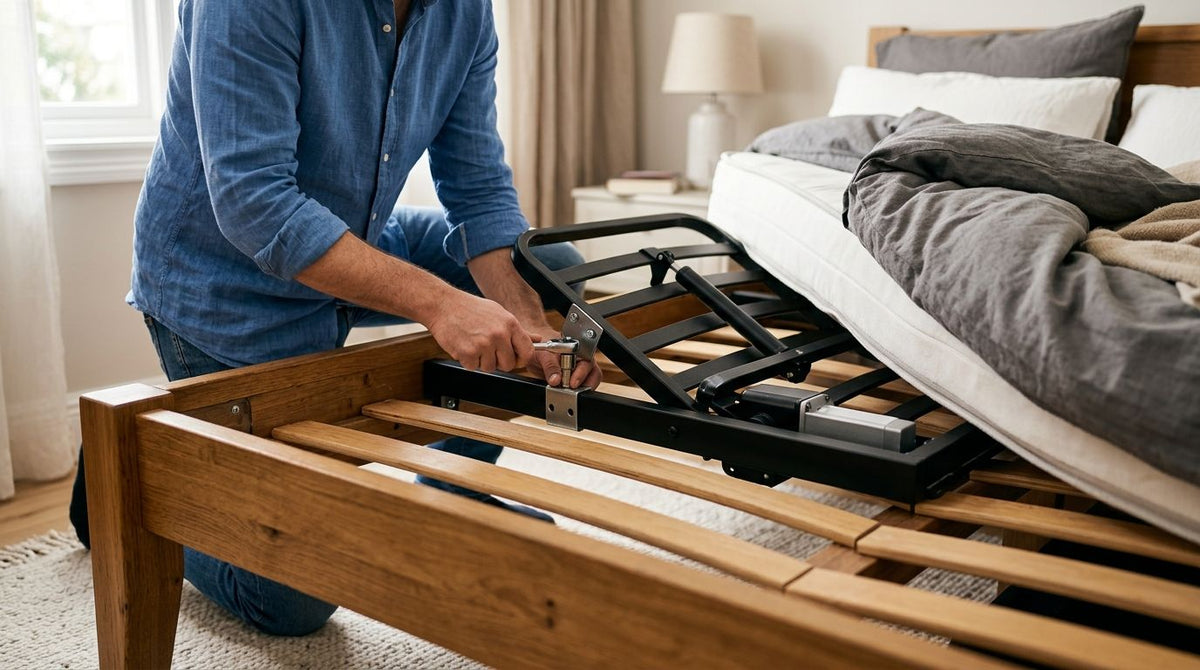
Fitting an adjustable bed backrest into a bed frame you already own works only when the frame's interior is open and unobstructed — no fixed center support beam, no cross rail sitting where the base's motor housing needs to go. If your frame has that clearance, the backrest unit drops in and bolts to the existing rails in under an hour. If it doesn't, you're better off swapping the frame rather than fighting the fit.
- You can fit an adjustable bed backrest to an existing bed frame only if the interior has no fixed center support rail.
- Measure interior length, width and headboard clearance before ordering — standard queen interiors run close to 60 by 80 inches.
- The Aeva Vital Adjustable Bed Base Frame ships with its own zero-gravity motor housing built for a rail-free fit in 2026.
- Most failed installs trace back to one thing: a center support beam nobody measured for.
- Retrofitting a platform frame without slats needs a support board kit, not just the base unit.
Why this matters
An adjustable backrest base is a motorized unit that has to physically clear the inside of your frame — headboard to footboard, rail to rail — while leaving room for the hinge mechanism to lift and lower without hitting anything. Order one for a frame with a fixed center rail and you'll spend a weekend returning it. Aeva Vital sees this mistake constantly in support tickets: the base arrives, the motor works fine on the showroom floor, and then it won't sit flush because a steel support beam runs straight through the middle of the customer's existing frame.
The fix isn't complicated. It's five minutes with a tape measure before you buy, not after.
Before you start
- A tape measure and your frame's interior dimensions — length, width, and the clearance between the rails and the floor or any center support.
- Confirm your frame size matches a standard mattress size (queen: roughly 60 by 80 inches; king: roughly 76 by 80 inches) — non-standard or vintage frames often run narrower.
- The gotcha that ruins installs: platform frames with a fixed center support beam bolted or welded in place can't accept most adjustable bases at all. If you can't unbolt that beam, stop here and look at a frame built for it instead of forcing the fit.
Measure your bed frame's interior clearance
- Remove your current mattress and box spring, if you have one.
- Measure the interior width between the inside edges of the side rails — this needs to clear the width of your adjustable bed base frame with, at minimum, no gap wider than an inch on either side.
- Measure interior length from the inside of the headboard rail to the inside of the footboard rail (or to the end of the frame if there's no footboard).
- Check headboard clearance height — some backrest units need 2 to 3 inches of vertical space at the head end so the incline hinge doesn't strike the headboard panel at full recline.
Expected result: you have three numbers — interior width, interior length, headboard clearance — that you can match directly against the adjustable base's listed footprint before you order anything.
Remove obstructions inside the frame
- Locate any center support rail or leg running down the middle of the frame.
- If it's removable (bolted, not welded), take it out — most metal platform frames use a bolt-on center rail specifically so it can come out for exactly this reason.
- If the rail is welded or structurally load-bearing and can't come out, the frame is not a candidate for retrofitting. Skip to the second variant below.
- Clear any wooden slat supports that sit lower than the adjustable base's own frame height — the base needs to rest on the rails, not on the slats.
Expected result: an open rectangular cavity with nothing between the side rails from headboard to footboard.
Set the adjustable base rails or brackets
- Position the adjustable bed base frame inside the existing rails, aligning the head end with your headboard side.
- Attach the included mounting brackets to the existing rail using the bolts or brackets supplied with the base — most adjustable bases use a universal bracket that clamps to standard 2-to-3-inch-wide bed rails.
- Tighten every bracket fully before testing. A loose bracket at this stage is the single most common cause of rocking once the mattress is loaded.
- Plug in the base and run a full recline-to-flat cycle with no mattress on it, watching for contact with the headboard or footboard at any point in the motion.
Expected result: the base moves through its full recline range without touching the frame, and every bracket stays tight after the test cycle.
Retrofitting a platform frame with slats instead of a box spring
Slatted platform frames need one extra step most backrest guides skip: the slats have to come out entirely, not just get pushed aside. An adjustable base has its own internal support structure and sitting it on top of existing slats raises the whole unit above the rail line, which throws off headboard clearance and can void the base's weight rating. Pull every slat, confirm the rail height matches the base's footprint, and mount directly to the rails as above.


The Aeva Vital Adjustable Bed Base Frame is built to sit inside a standard queen or king rail set without a center-beam conflict, which makes it the more predictable choice for anyone retrofitting in 2026 rather than gambling on a universal base and an unknown frame.
If your existing frame has a welded center rail you can't remove, replacing the frame rather than the base is usually the cheaper fix in labor and time, even though it means buying two pieces instead of one.
Troubleshooting
- Base rocks once the mattress is loaded — a bracket wasn't fully tightened during setup. Recheck every mounting point, not just the ones near the headboard.
- Gap between the base and headboard at full recline — the base sat too far from the head rail during mounting. Reposition and re-test the motion cycle before final tightening.
- Motor stalls partway through recline — usually a mattress that's too heavy or stiff for the hinge point, common with dense hybrid or memory foam builds over roughly 90 lbs. Check your mattress's weight against the base's rated capacity.
- Remote won't connect or has short range — reset by unplugging the base for 30 seconds and re-pairing; most wireless remotes on 2026 base models default to a 15 to 20 foot range.
- Mattress buckles or creases at the hinge fold — the mattress isn't rated for adjustable use. Not every mattress flexes cleanly at the lumbar and knee break points; check the product listing for adjustable-base compatibility before blaming the base.
Customize your setup
Once the base is mounted and tested, the mattress on top matters as much as the frame underneath it. A mattress with too little flex resistance won't hold its shape through repeated recline cycles, and one that's too dense will fight the motor. If you're shopping mattresses to pair with a new adjustable base, hybrid mattresses ranked by firmness level breaks down which builds flex cleanly at the hinge points versus which stay rigid.
Heavier sleepers should check capacity numbers before locking in a mattress-and-base combo — the best hybrid mattress for heavy people covers weight-rated builds that won't stress an adjustable base's lift motor over time.
And since most people fit a backrest specifically to read or work upright in bed, a stand that clips to the frame rail beats balancing a book on your lap once the incline holds a fixed angle — the best book holder stands for reading in bed lists options that mount without interfering with the base.
Anyone shopping this project for a parent or an aging household member should start with clearance and safety features before firmness — the best adjustable beds for elderly users covers low-entry heights and controls sized for reduced grip strength, both relevant once the base is mounted and in daily use.
FAQ
Can you fit an adjustable bed backrest to any existing bed frame?
No — only frames with an open interior and no fixed center support rail can accept most adjustable bases. Frames with a welded center beam need to be replaced, not retrofitted.
Do I need to remove my box spring before installing an adjustable base?
Yes. An adjustable base replaces the box spring entirely and needs to mount directly to the rails, not sit on top of one.
What size clearance does a queen adjustable base need?
A standard queen frame interior runs close to 60 by 80 inches, and the base needs 2 to 3 inches of headboard clearance so the incline hinge doesn't strike the panel at full recline.
Will any mattress work on an adjustable bed base?
No. The mattress needs to flex cleanly at the lumbar and knee break points — rigid innerspring builds without a flexible top layer tend to crease or buckle over repeated cycles.
How much does an adjustable bed base cost in 2026?
Pricing varies by size and feature set — check current listings for exact figures rather than relying on last year's numbers.
Can two people share one adjustable base with independent controls?
Split king configurations use two independent bases side by side, each with its own motor and remote, so each side reclines separately.
What happens if the center support rail is welded in place?
A welded center rail can't be removed without cutting the frame, which usually voids any warranty and risks structural integrity — replacing the frame is the safer route.
Do adjustable bases work with platform beds that have slats?
Only after the slats are removed entirely. The base needs to mount to the rails directly, not rest on top of existing slat supports.
One last thing
The detail most people skip isn't the measuring tape — it's the mattress warranty. Some mattress warranties specifically exclude damage from adjustable base use if the mattress wasn't built or rated for it, which means a mismatch can cost you the mattress warranty and the base install in the same afternoon. Check compatibility before you mount anything, not after.