
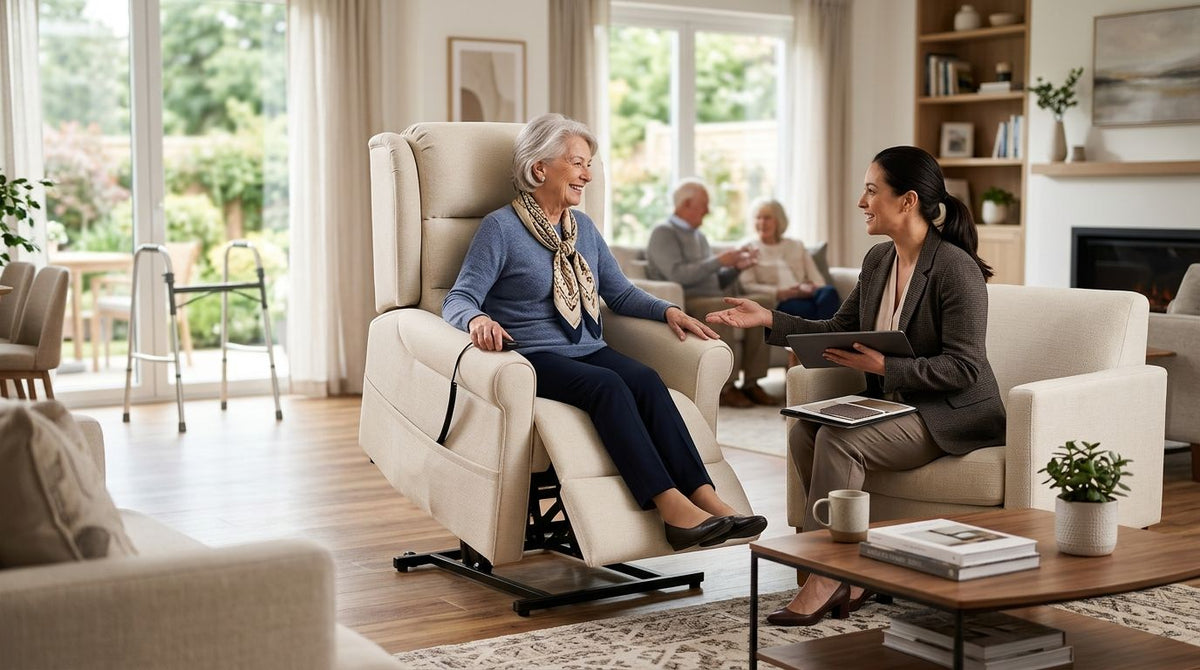
Senior living interior designers specifying power lift recliners are matching weight capacity, motor type, and CAL 133 fire-rated fabric to a specific care level, not just picking a color. Independent living, assisted living, and memory care wings each carry different clearance, mobility, and infection-control demands, so a chair that works in one wing can fail code or fall-risk review in another.
- Power lift recliner senior living interior design specs hinge on CAL 133 fire rating and 375+ lb standard weight capacity in common areas.
- Dual-motor lift chairs give separate back and leg control, which matters more in assisted living than in independent living units.
- Bariatric power lift recliners rated to 500-700 lbs belong in at least one shared room per wing, not in every unit.
- ADA turning radius rules apply to the chair fully reclined, not just parked, and this trips up more specs than fabric choice does.
Why this matters for senior living interior design
A power lift recliner spec that works for a single-family living room fails fast in a licensed facility. Fire marshals and state surveyors check upholstery flammability ratings during inspection, and a chair without documented CAL 133 or equivalent compliance gets flagged, sometimes after it's already in forty rooms.
Weight capacity is a life-safety issue here, not a comfort spec. A resident using a lift mechanism rated below their body weight risks a stalled lift or a fall during the sit-to-stand transition, which is exactly the moment lift recliners exist to protect against.
Designers working on Aeva Vital adjacent projects — adjustable beds, supportive mattresses, bathroom fixtures for the same suites — already treat weight rating and fabric class as non-negotiable line items. Power lift recliner specs deserve the same discipline.
Match weight capacity to the care level, not the room type
Standard residential lift chairs cap out around 300 to 375 lbs. Senior living projects need a mixed spec across a wing.
- Independent living common areas: standard-capacity chairs, 300-375 lbs, are usually sufficient
- Assisted living private rooms: verify per-resident capacity during intake, not at time of furniture order
- Memory care and skilled nursing shared lounges: stock at least one bariatric-rated chair, commonly 500-700 lbs
- Rehab and transitional care: match capacity to the heaviest expected short-stay resident, not the average
- Reorder cycles: revisit capacity specs every 3-5 years as resident population shifts
Specify CAL 133 or equivalent fire-rated upholstery on every unit
Commercial and institutional settings require fire-rated fabric that residential furniture skips entirely.
- Confirm CAL 133 (or the applicable state fire code) documentation before the PO goes out, not after delivery
- Choose vinyl or Crypton-type performance fabric over standard residential textiles for infection control
- Avoid mixing fire-rated and non-rated fabric on the same floor plan — surveyors check by wing, not by room
- Keep a fabric sample and cert binder on-site for state inspection
- Reject any vendor quote that can't produce a current fire cert on request
Set the lift chair footprint against ADA turning radius rules
ADA guidance calls for a 60-inch turning radius in common areas, and the recliner has to be measured fully reclined, not parked upright.
- Measure wall-to-chair-back clearance with the chair in full recline, add 4-6 inches of buffer
- Confirm the 60-inch turning circle still clears with the chair extended
- Route power cords along baseboards, never across the walking path to the chair
- Flag any room under 10 ft x 10 ft for a wall-hugger or zero-wall model instead of a standard-throw recliner
- Re-check clearance any time flooring or furniture layout changes
Choose lift mechanism type by resident mobility
Single-motor and dual-motor mechanisms solve different problems.
- Single-motor: back and footrest move together, adequate for independent living residents with typical mobility
- Dual-motor: back and legs move independently, better for residents who need to elevate legs without fully reclining the back
- Three-position vs. infinite-position lift: infinite-position gives finer control for residents managing edema or circulation issues
- Remote placement: oversized buttons and tethered remotes reduce drop-and-loss complaints in memory care
- Battery backup: specify units with backup power for lift function during outages in skilled nursing wings
Standardize fabric and frame specs across a facility
Mixed vendors across one building create a maintenance problem that shows up two years after move-in.
- Lock in one or two approved vendors per fabric class to simplify reorders
- Match frame width and seat depth across a wing so replacement parts are interchangeable
- Keep a master spec sheet with model number, capacity rating, and fabric code per room type
- Note wear patterns during annual furniture audits and reorder proactively, not reactively
- Coordinate recliner delivery timing with parallel furniture specs — adjustable beds and mattresses in the same suites often ship on a related schedule, and the specs in Aeva Vital's best adjustable beds for elderly guide follow the same capacity-first logic
Budget for reupholstery and mechanism service cycles
Lift mechanisms and fire-rated fabric both wear on a predictable schedule in high-turnover facilities.
- Plan reupholstery on a 3-5 year cycle for high-traffic common areas
- Budget mechanism service calls separately from fabric replacement — they run on different clocks
- Track which units are under warranty vs. out of warranty per wing
- Flag any chair with a stalling or slow-lift complaint for immediate service, not the next scheduled visit
“If the lift recliner can't fully recline without the chair back touching the wall, it's not going in that room.”
Comparison: power lift recliner options for senior living
| Option | Best For | Key Limitation |
|---|---|---|
| Single-motor lift recliner | Independent living, standard mobility residents | Back and legs move together, less positioning control |
| Dual-motor lift recliner | Assisted living residents needing separate back/leg control | Heavier unit complicates room-to-room moves |
| Bariatric lift recliner (500-700 lb rated) | Memory care and skilled nursing shared lounges | Larger footprint eats into ADA turning clearance |
| Zero-wall / wall-hugger lift recliner | Small footprint private rooms | Requires precise wall-to-chair-back measurement at full recline |
Verdict: for a mixed-care wing in 2026, the dual-motor lift recliner with a documented CAL 133 fire rating is the safest default spec, with at least one bariatric unit stocked per shared common area.
Common mistakes senior living designers make
- Specifying residential-grade fabric instead of confirming CAL 133 compliance before the order ships
- Budgeting one weight-capacity tier for an entire wing instead of matching capacity to actual resident intake data
- Measuring ADA clearance with the chair upright instead of fully reclined, which fails inspection later
- Standardizing a single motor type facility-wide instead of matching mechanism to care level
- Routing power cords across walking paths to save an outlet run, creating a fall hazard next to the exact chair meant to prevent falls
Designers handling the rest of the suite — mattress firmness for pressure relief, adjustable bed angles for the same residents — find the decision framework repeats. Aeva Vital's hybrid mattresses ranked by firmness level guide and its best hybrid mattress for heavy people guide both apply the same weight-capacity-first logic used above for lift recliners.
FAQ
What's the best power lift recliner for senior living interior design?
A dual-motor lift recliner with documented CAL 133 fire-rated upholstery is the safest default for mixed-care wings in 2026. Independent living areas can use single-motor, standard-capacity units instead.
Is a dual-motor lift recliner better than single-motor for assisted living?
Yes, for assisted living, because dual-motor units let the back and legs move independently, which helps residents managing edema or limited mobility. Single-motor units move both together and suit residents with typical mobility.
How much weight can a bariatric power lift recliner hold?
Bariatric power lift recliners are commonly rated 500 to 700 lbs, compared to 300 to 375 lbs for standard residential units. Stock at least one bariatric-rated chair per shared common area in memory care or skilled nursing wings.
Is CAL 133 fire rating required for senior living furniture?
Most licensed senior living facilities require CAL 133 or an equivalent state fire code rating on upholstered furniture. Confirm the specific requirement with the local fire marshal before finalizing a fabric order.
How much clearance does ADA require around a lift recliner?
ADA guidance calls for a 60-inch turning radius in common areas, measured with the chair fully reclined, not parked upright. Add 4 to 6 inches of buffer between the wall and the fully reclined chair back.
Do power lift recliners need a wall gap to fully recline?
Standard-throw lift recliners need several inches of wall clearance to recline fully, while zero-wall or wall-hugger models slide forward on the base instead. Small rooms under roughly 10 by 10 feet usually need the wall-hugger design.
How often should senior living facilities reupholster lift recliners?
Plan reupholstery on a 3 to 5 year cycle for high-traffic common area chairs. Private room units in lower-traffic areas can often run longer between reupholstery cycles.
Can power lift recliners be paired with adjustable beds in the same suite?
Yes, and many facilities spec both together using the same weight-capacity and care-level logic. Adjustable bed specs for elderly residents follow nearly identical criteria to lift recliner specs.
One last thing
The detail that trips up more 2026 specs than fabric choice: designers measure ADA clearance with the chair parked upright, then fail inspection because the fully reclined chair back closes the turning radius. Measure every lift recliner spec in its full-recline position before the floor plan gets locked.