
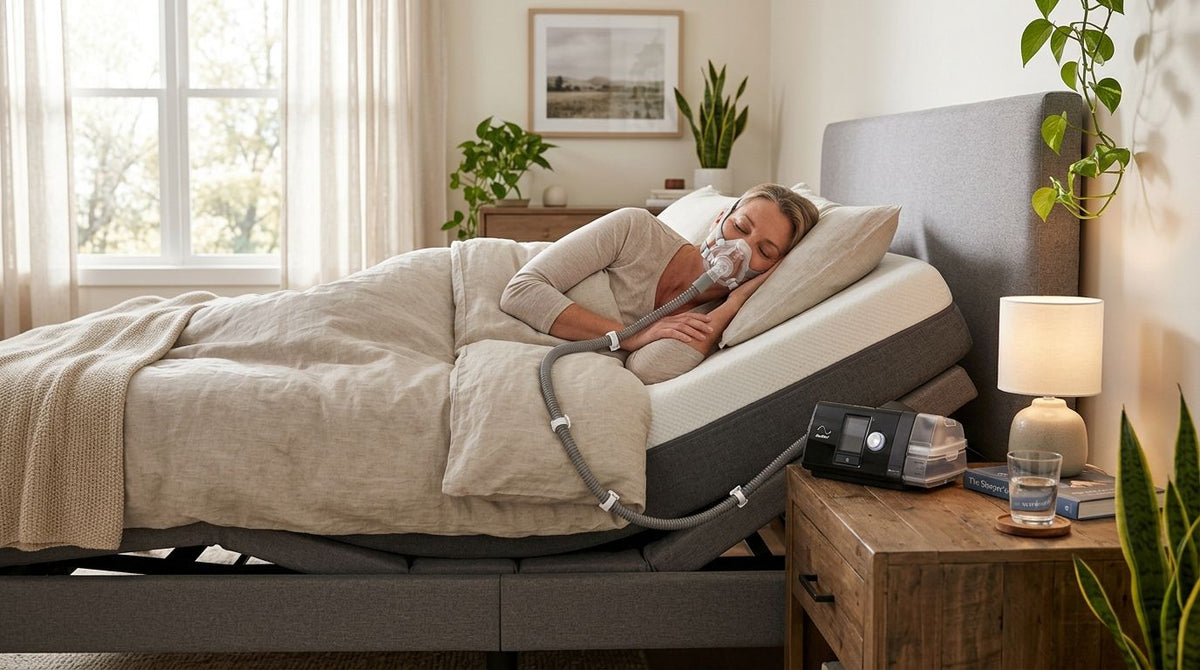
Manually propping pillows behind your back every night to keep a CPAP mask sealed wrecks your sleep before the machine even gets a chance to work. Set an adjustable bed base to a fixed head-elevation angle and route the hose along a dedicated path, and you stop refighting your bedding every time you roll over.
- A cpap machine with adjustable bed setup works best at 30-45 degrees of head elevation, not flat.
- Route the hose along the frame's side rail, never straight down the mattress hinge, to stop kinking.
- Aeva Vital's Adjustable Bed Base Frame ships with a Zero Gravity preset that keeps head angle steady all night.
- Reset to Flat before you unplug or move the CPAP machine to avoid hose tension at the joint.
Why this matters
A flat mattress does nothing to help a CPAP mask hold its seal. Gravity pulls your jaw and soft palate back the same way whether you're on therapy or not, and a mask that leaks air mid-sleep means the machine spends the night compensating instead of delivering steady pressure.
Raising the head of the bed 30 to 45 degrees is a common recommendation for reducing airway collapse and nighttime reflux, and it's the same angle range most adjustable bed remotes preset as "Incline" or "Read." The problem isn't the angle. It's that most people set the angle once, then let the hose fight the frame every time the bed moves. Adjustable beds built for elevation, like the models covered in Aeva Vital's guide to adjustable beds for elderly users, solve half the problem. The other half is routing.
Before you start
- Know your hose length. Standard CPAP hoses run about 6 feet; heated hoses are shorter and stiffer, which matters once the bed articulates.
- Check your bed's max incline angle against your CPAP manufacturer's stated safe operating angle — most machines list this in the manual, and exceeding it can cause water buildup in a heated humidifier chamber to shift toward the mask.
- The gotcha nobody warns you about: if you route the hose straight down the center of the mattress, it kinks exactly at the bed's hinge point the first time you incline past 20 degrees. Route it along the side rail instead, and this never happens.
Set the head-elevation angle
- Lie flat and locate your remote's Head Up button (or the Incline preset on newer Aeva Vital remotes).
- Raise the head section in small increments, pausing every 5 degrees to check mask seal and hose slack.
- Stop between 30 and 45 degrees — most CPAP users land around 35 degrees before the mask starts pulling at the nose bridge.
- If your remote has a Memory button, hold it for 2-3 seconds once you find your angle. This saves the position so you're not re-finding it every night.
Expected result: the head section holds a fixed incline without drifting, and your mask seal doesn't need adjusting once you've settled in.
Route the CPAP hose and cord
- Unplug the machine before rerouting — this keeps you from yanking the hose off the mask mid-adjustment.
- Run the hose along the outside edge of the mattress, following the frame's side rail rather than crossing the center hinge.
- Clip or loosely tie the hose to the headboard or a bedside rail 12-18 inches from the mask connector, giving it slack to move with the incline.
- Route the power cord separately from the hose path — a shared path means one snag pulls both.
Expected result: the hose moves with the bed's articulation instead of against it, with zero tension on the mask when the head section is at full incline.
Position the CPAP machine and stand
- Place the machine on a stand or nightstand at or below mattress height — never on the floor, where dust gets pulled into the intake.
- Keep the machine within hose length of the mask connector at full incline, not at flat. Measure at the steepest angle you'll actually use.
- If the nightstand sits close to the frame's motor housing, add 2-3 inches of clearance — motor vibration on some adjustable bases travels through a touching nightstand and rattles the machine's water chamber.
Expected result: the machine stays put and quiet through a full range of motion, from Flat to your saved incline preset.
Lock in the mattress-frame fit
An adjustable base only works with a mattress built to flex at the same hinge points. A rigid innerspring mattress on a flexing frame creates a gap at the head hinge exactly where your CPAP hose needs clearance. Hybrid mattresses with segmented coil zones are built for this; the firmness tier matters less than the flex zones lining up with the frame's joints. If you're retrofitting an existing frame rather than buying new, fitting an adjustable bed backrest to your existing frame covers the compatibility checks before you commit to a hinge-flex mattress.
“If the hose kinks before your head does, you're routing it wrong.”
Elevating for CPAP plus oxygen concentrator use
A second, adjacent setup comes up often: CPAP users who also run a concentrator overnight. The elevation steps are identical, but the routing changes — two lines now need separate paths off the same head section, and a concentrator's tubing is stiffer than a CPAP hose, so it needs a wider turn radius at the hinge. The same side-rail routing principle from Step 2 applies to both lines. Setting up a lift chair next to an oxygen concentrator walks through concentrator-specific tubing clearance if you're running both machines from the same side of the bed.
Troubleshooting
- Hose pulls the mask off mid-incline: you've routed through the hinge instead of the side rail — reroute per Step 2.
- Mask seal breaks only at full recline (Zero Gravity preset): your saved angle exceeds the CPAP manufacturer's rated operating angle — drop the preset by 5-10 degrees and re-test.
- Remote resets position after a power outage: most bases lose Memory settings on power loss — re-save the preset after any outage before your next sleep.
- Machine hums or rattles at full incline: the nightstand is touching the frame's motor housing — add clearance per Step 3.
- Frame won't articulate to your saved angle under a heavier mattress: check the frame's stated weight capacity against your mattress weight before assuming a motor fault.
Customize your workflow
Once elevation and routing are dialed in, the rest is comfort tuning. If reflux or leg swelling factors into your sleep, the Zero Gravity preset that raises both head and foot sections works alongside your CPAP angle rather than against it — the head elevation stays in your saved CPAP range while the foot section lifts independently. Mattress choice still matters here: firmer hybrid builds hold their flex zones longer under nightly incline than softer memory foam layers, which is worth checking against Aeva Vital's ranked hybrid mattress guide before you buy a new mattress for the frame. If reading before sleep is part of your routine, a hose-friendly reading setup means keeping your book or tablet clear of the hose path rather than resting it across your chest.
FAQ
What's the best adjustable bed angle for CPAP users?
Most CPAP users do best between 30 and 45 degrees of head elevation. Start at 30 degrees and increase in 5-degree steps until the mask seal stops shifting.
Can I use a CPAP machine with any adjustable bed base?
Yes, but the routing matters more than the base model. Any adjustable frame works as long as the hose is routed along the side rail instead of across the head-section hinge.
Does elevating the head of the bed help with sleep apnea?
Head elevation of 30-45 degrees is commonly used to reduce airway collapse and nighttime reflux alongside CPAP therapy, though it doesn't replace prescribed pressure settings.
How do I stop my CPAP hose from pulling when the bed moves?
Route the hose along the frame's outer rail and clip it 12-18 inches from the mask connector. Routing straight down the mattress center causes kinking at the hinge point.
Is the Zero Gravity position safe to use with a CPAP machine?
Zero Gravity is safe as long as the combined head-and-foot angle stays within your CPAP manufacturer's rated operating range, which is typically listed in the machine's manual.
What mattress works best with an adjustable base for CPAP users?
Hybrid mattresses with segmented coil zones flex at the same hinge points as the frame, which keeps the mattress surface from gapping under the hose path.
How much does an adjustable bed with CPAP-friendly features cost in 2026?
Pricing varies by size and feature set — check current listings for specific models rather than relying on a fixed figure, since 2026 pricing shifts by retailer and configuration.
One last thing
The single fix most CPAP users skip is the simplest one: resetting the bed to Flat before unplugging the machine in the morning. Skipping this step means the hose holds tension at the hinge all day, which is the single biggest cause of hose wear and slow leaks showing up months later.