
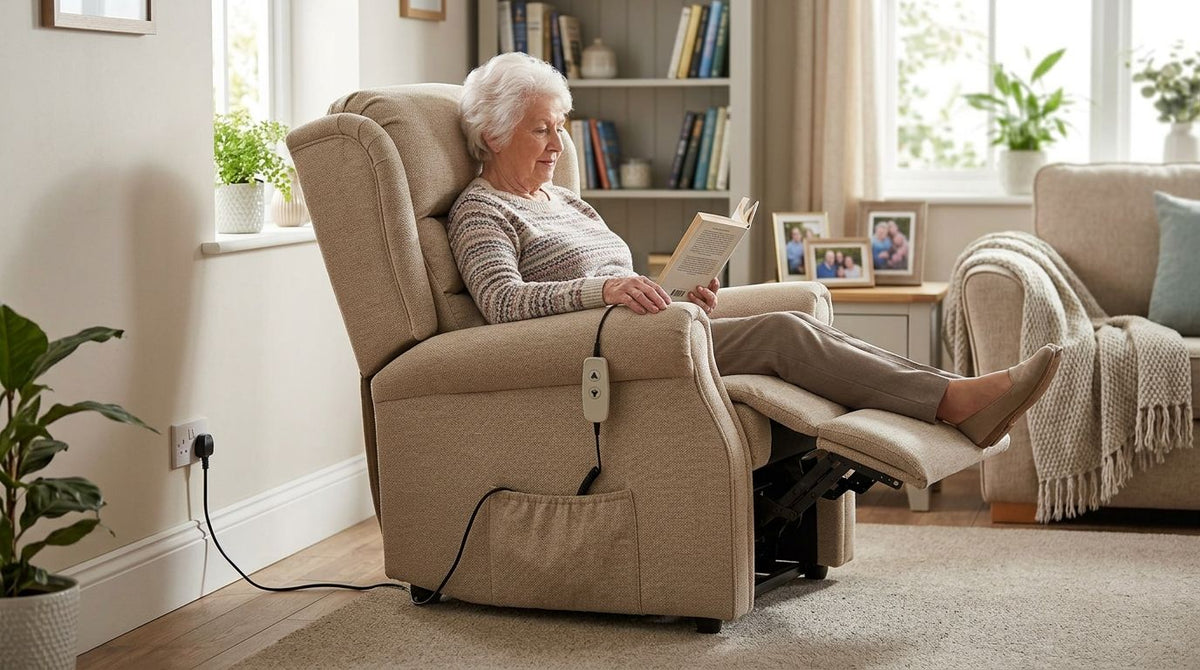
A lift chair is safe to leave plugged in all the time as long as it's connected to a dedicated, grounded outlet, the cord shows no fraying or heat discoloration, and it isn't routed through a household extension cord. The chair's motor only pulls real current while it's actually reclining or lifting — sitting idle and plugged in draws a trickle of standby power, the same category of draw as a TV or a cable box left connected in 2026.
By Editorial Team
- Leaving a lift chair plugged in all the time is safe on a dedicated grounded outlet with a sound cord.
- The motor draws real power only while lifting or reclining; idle standby draw is minimal.
- Cord damage, daisy-chained power strips, and shared circuits cause more incidents than the outlet itself.
- A smart plug lets you monitor and cut power remotely without unplugging the chair by hand.
- Check the cord and plug prongs every few months for heat marks, cracking, or looseness.
Why this matters
People worry about leaving any powered furniture plugged in around the clock, and lift chairs get extra scrutiny because they're often used by someone with limited mobility who can't quickly move away from a problem. The honest answer for 2026: the risk isn't the lift chair itself, it's the outlet, the cord, and what else shares that circuit. Get those three things right and a lift chair sitting plugged in is no different from a refrigerator or a router that never gets unplugged.
Is it safe to leave a lift chair plugged in all the time?
Yes, for the overwhelming majority of setups. Lift chair manufacturers design these units to stay connected continuously — that's how the remote and the battery backup (on models that have one) stay functional. The variable that actually matters is the power path between the wall and the chair, not the chair's internal wiring.
| Power setup | Safe to leave plugged in? | Why |
|---|---|---|
| Direct wall outlet, dedicated circuit | Yes | Full-rated capacity, no shared load |
| Grounded 3-prong outlet | Yes | Matches the chair's grounded plug |
| Heavy-duty surge-protected power strip | Usually | Rated for continuous load, but don't daisy-chain a second strip off it |
| Household extension cord | No | Not rated for continuous appliance draw; overheats over time |
| Outlet shared with a space heater or medical device | No | Combined draw risks tripping the breaker or overheating the outlet |
If you're planning the electrical setup rather than reacting to one already in place, the specifics on circuit load and outlet placement are covered in wiring your home for a power lift recliner — worth reading before you settle a lift chair into a permanent spot.
Why concern about leaving it plugged in comes up
The worry isn't irrational — a handful of specific conditions do turn a plugged-in lift chair into a real hazard. None of them are about the chair sitting idle; all of them are about what's happening at the connection point.
- Cord wear from foot traffic or furniture pinch points — a cord run under a rug or pinched behind a baseboard heats up faster than one left exposed and slack.
- Extension cords rated for light-duty use — most household extension cords are built for lamps, not for an appliance that draws a motor-level spike every time it lifts.
- Overloaded power strips — plugging a lift chair, a space heater, and a phone charger into one strip stacks the load past what a standard 15-amp circuit handles comfortably.
- Older home wiring — homes built before the 1990s sometimes have undersized circuits that weren't designed for modern appliance loads.
- Pets chewing cords — a chewed cord is an exposed-wire risk regardless of what's plugged into it.
- Moisture nearby — a lift chair positioned too close to a bathroom doorway or a spill-prone area needs a cord path that avoids standing water.
Apartments with limited outlet placement raise a separate but related question — how to route the cord without creating a trip hazard or a pinch point. That's addressed directly in routing lift chair power cords safely in small apartments.
A lift chair plugged into a dedicated, grounded outlet with an undamaged cord is as safe left connected around the clock as any other major appliance in the house.
Does a lift chair use electricity when not in use?
A lift chair pulls minimal standby power when it's plugged in but not moving — comparable to any small electronic appliance left connected in 2026. The motor only spikes to full draw during the seconds it takes to recline, lift, or return to a seated position; the rest of the time it's essentially idle.
Can a lift chair be plugged into a power strip?
A lift chair can be plugged into a heavy-duty, surge-protected power strip as long as nothing else heavy shares that same strip. Skip basic multi-outlet adapters with no surge protection, and never plug a second power strip into the first one to add capacity.
Should I unplug a lift chair during a thunderstorm?
Unplugging during a severe electrical storm is a reasonable precaution for any powered furniture, not a lift chair-specific requirement. A surge protector handles routine spikes, but a direct lightning strike on the line can bypass it, so unplugging is the safer call if the storm is close.
If a family member relies on medical equipment near the same outlet cluster, load-sharing gets more sensitive. That scenario — a lift chair sitting close to powered medical gear — is walked through in setting up a lift chair next to an oxygen concentrator, which covers keeping the two devices on separate circuits.
What actually shortens a lift chair's electrical life
It's rarely the outlet. Repeated full-cycle use, dust buildup around the motor housing, and a cord that gets kinked in the same spot every day do more damage over a few years than simply leaving the unit connected. For a broader picture of how long these units typically hold up and what wears out first, see how long does a lift chair last.
One practical fix for households that still want the reassurance of physically cutting power without crawling behind the chair every night: a smart plug on the wall side lets you kill power remotely or on a schedule while leaving the connection itself intact and undisturbed.
Set up remote power control
See how a smart plug lets you cut power to a lift chair without unplugging it by hand.
FAQ
Is it safe to leave a lift chair plugged in all the time?
Yes, it's safe to leave a lift chair plugged in all the time when it's connected to a dedicated grounded outlet with an undamaged cord. The motor draws real power only during lift or recline cycles, not while idle.
Does leaving a lift chair plugged in raise the electric bill?
Standby draw from an idle lift chair is minimal, comparable to other small electronics left connected. The bulk of any electricity use comes from the actual lift and recline cycles, not from being plugged in.
Can a lift chair overheat if left plugged in overnight?
A lift chair itself won't overheat from sitting idle overnight; the risk comes from a damaged cord, an overloaded power strip, or an undersized extension cord carrying the load, not the chair's internal components.
Do lift chairs need to be on a GFCI outlet?
GFCI protection is a building-code requirement in bathrooms and other wet locations, not a lift chair-specific rule. A standard grounded outlet in a living room or bedroom is fine for most setups.
Should a lift chair share an outlet with other appliances?
Avoid sharing an outlet or power strip with a space heater, another motorized appliance, or medical equipment, since combined draw can overload a standard circuit. A dedicated outlet is the safer default.
Can I use an extension cord with a lift chair?
A standard household extension cord is not rated for the continuous, motor-level draw a lift chair produces and can overheat over time. Route the chair to a wall outlet directly whenever the layout allows it.
Does a lift chair need to be unplugged during a power outage?
Unplugging during an outage isn't required, but it does prevent a surge from damaging the chair's control board when power restores unevenly. Many households unplug it as a precaution anyway.
How often should I inspect a lift chair's power cord?
Check the cord and plug every few months for cracking, heat discoloration, or looseness at the outlet. A cord that feels warm to the touch during normal use should be replaced immediately.
One last thing
The single habit that prevents most lift chair electrical issues costs nothing: unplug it, inspect the cord end-to-end for cracks or heat spots, and plug it back in — once every few months. A lift chair left plugged in around the clock on a dedicated, undamaged circuit is safer in 2026 than one that gets unplugged and re-plugged daily, since repeated plugging is what loosens prong connections and wears down the outlet contacts over time.