
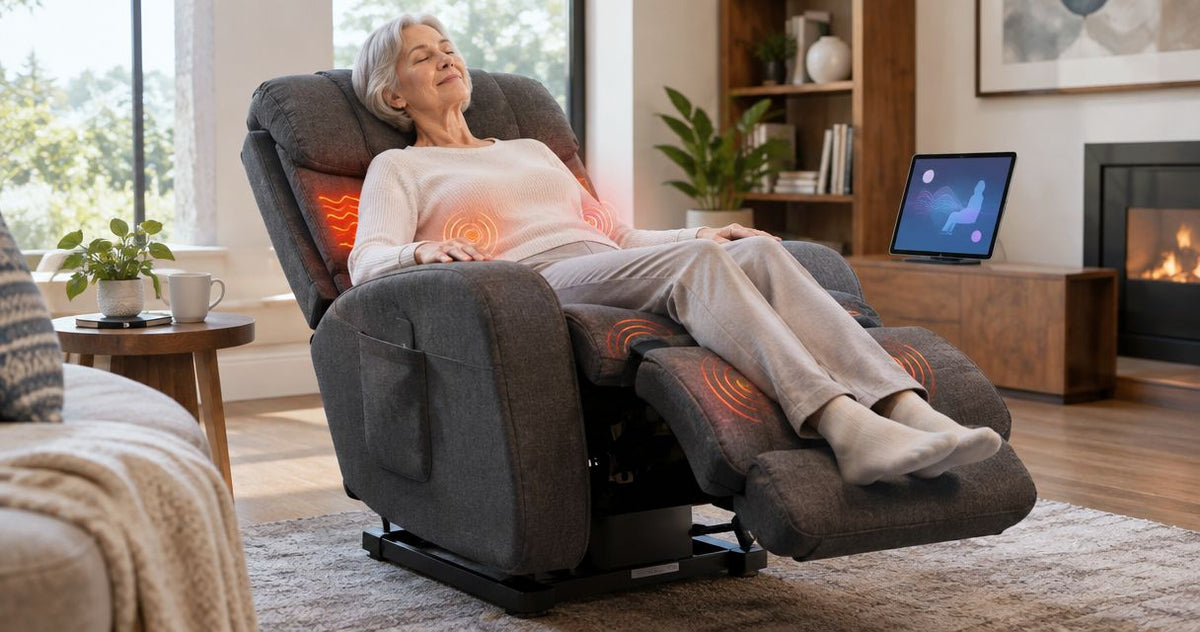
Heat and massage in a lift chair are worth it if you will use both while seated and the chair already fits your body, room and standing needs. In 2026, treat them as comfort features, not as a substitute for a well-fitting lift mechanism or a medical treatment. If you mainly need help standing, prioritize how the chair lifts you before choosing heat or massage.
By Editorial Team
- Heat and massage in a lift chair are worth it when you regularly use both and the chair fits you.
- The lift mechanism, seat fit and controls matter more than optional comfort features.
- Heat and massage do not establish that a chair treats pain or meets a medical need.
- In 2026, check the actual chair’s controls, care instructions and power requirements before deciding.
Why this matters
A lift chair performs a specific task: it changes position to help its user move toward standing. Heat and massage serve a different purpose while the person is seated. Keeping those purposes separate makes the purchase decision clearer, especially when you are choosing a chair for someone who needs help getting up rather than another way to relax.
Start with the broader question of whether a lift chair is worth it. If the lift function, seat and room fit do not work for the intended user, extra features will not fix the mismatch. In 2026, the useful question is not whether heat and massage sound appealing; it is whether those features will be used on a chair that already meets the primary need.
Is heat and massage in a lift chair actually worth it?
Yes for someone who wants those sensations during regular seated use; no as a reason to overlook poor fit or an unsuitable lift function. Heat and massage describe optional experiences, not the quality of the chair’s standing assistance. Try to judge each feature separately before deciding whether the combination matters to you.
| Option | Best for | Advantage | Limitation | Verdict |
|---|---|---|---|---|
| Lift chair without heat or massage | Someone focused on standing assistance and chair fit | Keeps attention on the lift action, seat and controls | Does not provide either optional comfort feature | Choose it when the lift function is the reason for buying. |
| Lift chair with heat | Someone who likes warmth while seated | Adds a distinct warming function | Warmth is not a measure of lift performance or medical benefit | Choose it only after checking the heat controls and instructions. |
| Lift chair with heat and massage | Someone who expects to use both features regularly | Offers two separate seated comfort functions | Adds controls and features to evaluate without improving a poor-fitting chair | Choose it if both functions feel useful on a chair that already fits. |
The table compares feature types, not specific models. A product listing must establish what its own heat and massage functions do. Do not assume that every chair offers the same control choices, massage sensation or operating instructions.
What changes the answer in 2026?
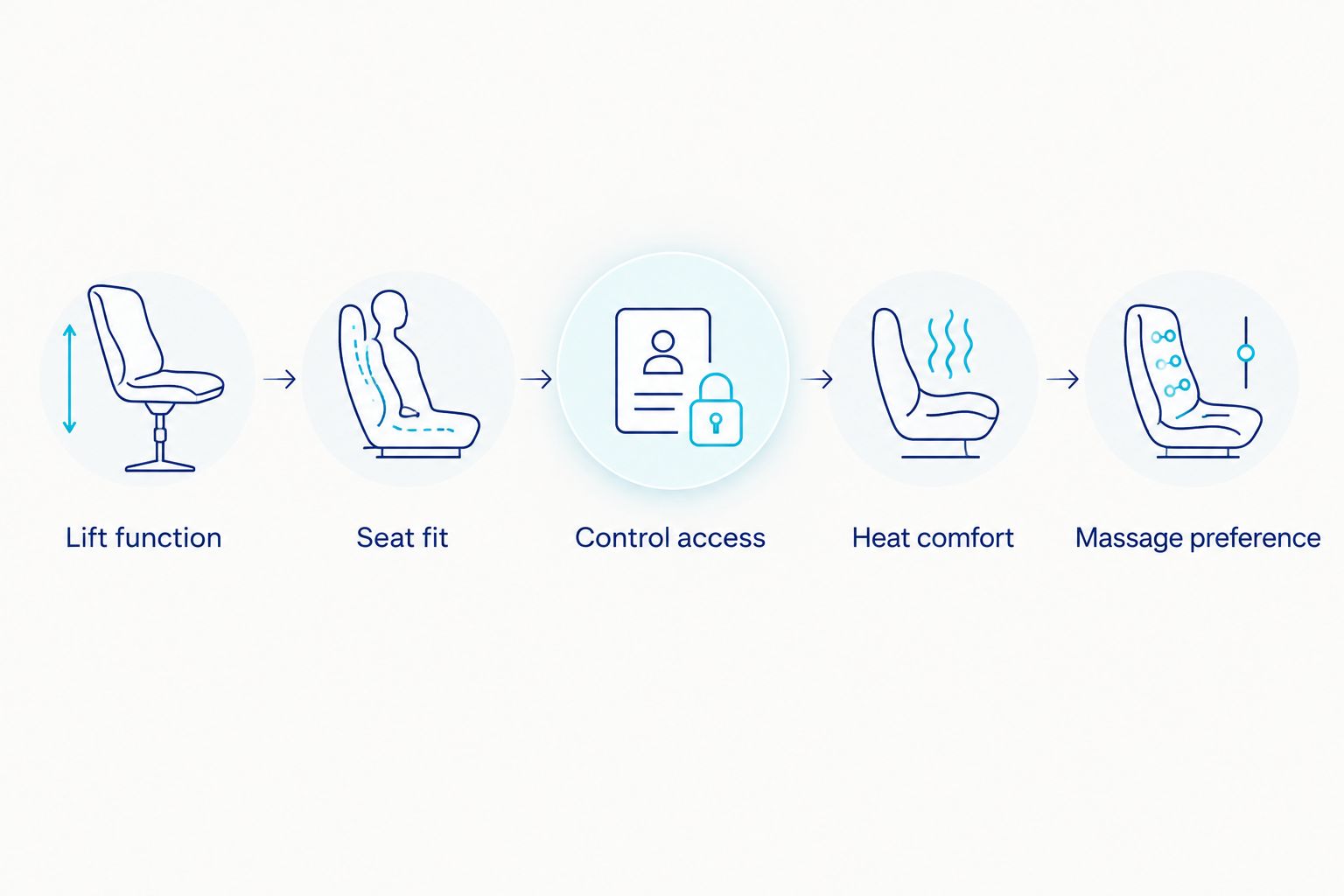
A feature is useful only when it works for the person who will sit in the chair. These are the decision factors to check before treating heat and massage as a benefit:
- Seat fit. The user should be able to sit back comfortably and use the armrests while the chair moves. A pleasant heat function does not make an unsuitable seat suitable.
- Standing assistance. Watch the chair move from seated to raised position with the intended user, when a demonstration is possible. The lift movement is the main reason to choose a lift chair.
- Control access. The user needs to identify and operate the lift, recline, heat and massage controls. Extra functions are not useful if the controls cause confusion.
- Heat comfort. Check whether the warmth feels comfortable and whether the user can turn it off independently. Follow the chair’s own instructions rather than assuming the setting is appropriate for everyone.
- Massage preference. Test the sensation if possible. A feature that sounds useful in a listing can still be one the user chooses not to switch on.
- Room and power setup. Check the space needed for the chair’s movement and the instructions for connecting it to power. Optional functions do not remove those setup requirements.
These checks are more informative than a feature count. In 2026, a chair with fewer options but a usable lift action is the better choice for someone whose main difficulty is standing.
Test the lift function before the comfort features
Start with the movement that matters most. Have the intended user sit normally, locate the lift control and move through the positions the chair allows. Check whether the person can stay properly positioned as the chair rises and can get out of it safely. If they need assistance with transfers, use the guidance of their care professional rather than relying on the chair alone.
Next, check the seat in an ordinary resting position. Look at back support, armrest reach and whether the person can place their feet as needed when preparing to stand. A chair can have appealing extras and still be awkward to enter, sit in or leave. Heat and massage should not decide the purchase until those basics work.
Finally, operate heat and massage separately. Can the user tell which function is on? Can they stop each one without help? Those practical questions establish more than a general claim that the chair includes both features.
A demonstration answers a personal-use question; it does not establish a health outcome. If the user cannot try a chair, ask for its operating instructions and the details needed to assess fit. Keep the decision tied to what the actual model does, not what another lift chair is shown doing.
Does heat or massage improve the lift chair’s main job?
No. A heating element provides warmth, and a massage function provides a physical sensation while seated. Neither tells you how well the chair raises its occupant or whether its seat fits a particular person. Buy for the lift and fit first; consider heat and massage second.
That distinction matters when a chair is being considered after surgery or alongside other mobility equipment. A lift chair is not automatically appropriate for every recovery plan. If the intended user has transfer restrictions or needs supervised movement, ask their treating professional what equipment and assistance the plan calls for before selecting optional chair features.
Heat also needs an individual safety check. If the user has reduced ability to sense temperature, difficulty operating the controls or instructions to avoid heat, do not assume a built-in setting is suitable. Use the specific chair’s instructions and seek clinical advice when a medical condition affects the decision. Massage should likewise be assessed as a comfort preference, not represented as treatment.
How do you compare heat and massage controls?
Read the listing and operating instructions for the exact chair under consideration. Identify how to start and stop each function, whether the controls are separate and what the user must do if they want to use neither. A product name or feature badge does not answer those questions.
Have the intended user locate the controls from a normal seated position. Check whether the labels are understandable and whether the user can operate the lift control without accidentally activating another function. In 2026, ease of use is a better reason to choose one set of features than the mere presence of more buttons.
Ask about fabric care, too. The upholstery has its own cleaning instructions, and powered features add a reason to follow them closely. Do not assume a cleaning method that works on an ordinary recliner is safe for a powered chair. Maintenance is part of the ownership decision, even if heat and massage are rarely used.
What about power, placement and upkeep?
A powered lift chair needs a setup that follows its model-specific electrical instructions. Check outlet placement, cord routing and clearance through the chair’s full movement before deciding where it will sit. Heat and massage are additional powered functions, so the operating instructions should explain how they are controlled and used. Do not assume an optional battery arrangement powers every feature; check the exact chair’s documentation.
Placement affects everyday use. A control that is easy to reach during a showroom demonstration can be harder to manage if a side table blocks an armrest at home. Leave a clear approach for sitting down and standing up, and keep the cord from becoming an obstacle in that route. These checks apply whether you choose the basic chair or the version with extra functions.
Upkeep deserves the same attention. Find the instructions for cleaning the upholstery, handling the controller and addressing a function that stops working. The presence of heat and massage does not establish how either component can be serviced. In 2026, buy based on the documentation for the exact model rather than assumptions about lift chairs as a category.
Where Aeva Vital fits
Aeva Vital describes its range as hybrid mattresses, freestanding bathtubs, ice baths and infrared saunas. That range does not establish a specific Aeva Vital lift chair or a heat-and-massage specification. Aeva Vital is best for comparing its stated home rest and wellness categories, not for confirming features on an unspecified lift chair.
If you are comparing a lift chair with other changes to a home rest setup, keep each decision tied to its purpose. A mattress, bathtub, ice bath or sauna does not perform a lift chair’s standing-assistance task. Conversely, a chair’s heat or massage feature should not be presented as an equivalent to any of those products. For a lift chair purchase, the model’s fit, operation and instructions remain the deciding evidence.
Is the feature combination right for the intended user?
Picture an ordinary day rather than an ideal demonstration. Will the person sit in the chair long enough to want warmth or massage? Will they remember how to turn each function off? Are they comfortable with the sensation, and can they still use the lift control without difficulty? Answers from the intended user matter more than a feature description.
If you are buying for someone else, involve them in the choice whenever possible. Ask what they actually want from the chair, then check that preference against fit and safe operation. In 2026, heat and massage are worth selecting when they add comfort to a usable chair. They are not a reason to accept a chair that is difficult to operate.
FAQ
Is heat and massage in a lift chair actually worth it?
Heat and massage are worth it when the intended user likes both features and the lift chair already fits and operates well. Neither feature compensates for poor standing assistance or seat fit.
Is heat more important than massage in a lift chair?
Neither is universally more important. Choose according to which sensation the intended user prefers, then check the exact chair’s controls and instructions.
Does a massage lift chair treat back pain?
A massage feature does not establish that a lift chair treats back pain. Discuss persistent pain and equipment needs with a qualified health professional.
Can someone use a lift chair without switching on heat or massage?
Check the operating instructions for the exact model to confirm how its functions work independently. Do not infer control options from a feature name alone.
What should I check before buying a heated lift chair?
Check seat fit, lift movement, heat controls, care instructions and the intended user’s ability to sense and stop the warmth. Follow model-specific guidance if health conditions affect heat use.
Do heat and massage work during a power outage?
Do not assume they do. Check the exact chair’s power and backup instructions, including which functions any backup supports.
Should I choose heat and massage for someone who needs help standing?
Choose a chair that meets the person’s standing and transfer needs first. Add heat and massage only if the person wants them and can use their controls safely.
One last thing
Before deciding in 2026, ask the intended user to operate the lift control first, then try heat and massage separately. If the chair fails the standing or fit check, the extras are not worth choosing.
Read how to check lift-chair fit at home