

A standard chair slipcover usually will not fit an oversized recliner well. The cover must accommodate the chair’s full dimensions and its moving footrest, back, arms, and controls; a cover that stretches over the chair while upright can still pull loose when you recline.
- Can a chair slipcover fit an oversized recliner? Usually not; choose a cover sized for the chair and its moving sections.
- A recliner-specific cover is best for a close fit; a draped protector is easier to remove but less tailored.
- Measure the chair upright and reclined, then check that fabric does not obstruct the footrest or controls.
By Editorial Team
Can a chair slipcover fit an oversized recliner?
Yes, but only if the slipcover’s stated dimensions match the oversized recliner and its design allows the chair to move freely. A cover labeled for a standard chair is the wrong starting point. Width alone does not establish fit: the back, arms, seat, and footrest all need enough coverage without fabric pulling tight when the chair changes position.
A recliner-specific cover is the better choice when you want the fabric to follow the chair’s shape. A draped chair protector is an alternative when you want a removable layer rather than a close-fitting slipcover. Neither option should block a lever, button, power cord, or the path of a moving footrest.
| Cover type | Best for | Advantage | Limitation | Verdict |
|---|---|---|---|---|
| Standard chair slipcover | A stationary chair whose measurements match the cover | Follows a simple chair shape | Usually lacks a separate allowance for a reclining back or footrest | Skip for an oversized recliner unless the maker explicitly confirms fit |
| Recliner-specific slipcover | An oversized recliner within the cover’s stated size range | Designed around reclining chair sections | Still needs a dimension and control-access check | Choose when fit and movement both check out |
| Draped chair protector | Someone who prioritizes easy removal over a tailored appearance | Does not need to wrap every part of the chair | Can shift or leave upholstery exposed | Choose when loose coverage is acceptable |
Why this matters
A recliner is not a stationary chair with a larger seat. Its back and footrest change position, while the arms and controls need to remain usable. A cover can look acceptable in the upright position yet restrict movement or expose the original upholstery when the footrest opens.
Fit also affects cleaning. A cover that is difficult to remove defeats the purpose if you expect to wash it regularly. Before choosing one, check the cover’s care instructions and the chair’s upholstery instructions; the approach to the exposed fabric still matters. For upholstery-specific care, see how to clean a fabric lift chair.
How to check the fit before you buy
Measure the chair itself, not a photo or a generic size label. Keep the recliner upright for the first set of measurements, then open it fully to identify every section the cover needs to follow. Write down measurements in the same units used by the cover maker.
- Measure the back. Record its height and width at the widest point. Check whether a loose cover would interfere with movement at the back of the chair.
- Measure the seat. Record the usable width between the arms and the depth from the backrest to the front edge. Compare these with the cover’s seat dimensions, not its overall width alone.
- Measure the arms. Check both arm width and the distance across the outside of the arms. Arm shape matters: a cover cut for narrow, straight arms need not follow wide or rounded ones.
- Inspect the footrest. Open and close it, noting where the fabric would need to move or separate. A single uninterrupted cover over a moving joint is not equivalent to a cover designed for that joint.
- Locate the controls. Identify levers, buttons, and any cord route before choosing a cover. You need access to them after installation.
- Compare the measurements with the actual size chart. Check every listed dimension and any guidance about arm shape or footrest configuration. If the listing does not address your chair’s layout, its size label alone cannot confirm fit.
The movement check is essential. Do not judge a cover by whether you can stretch it onto a stationary chair. Judge it by whether it stays in place and leaves the recliner fully operable through its normal range of motion.
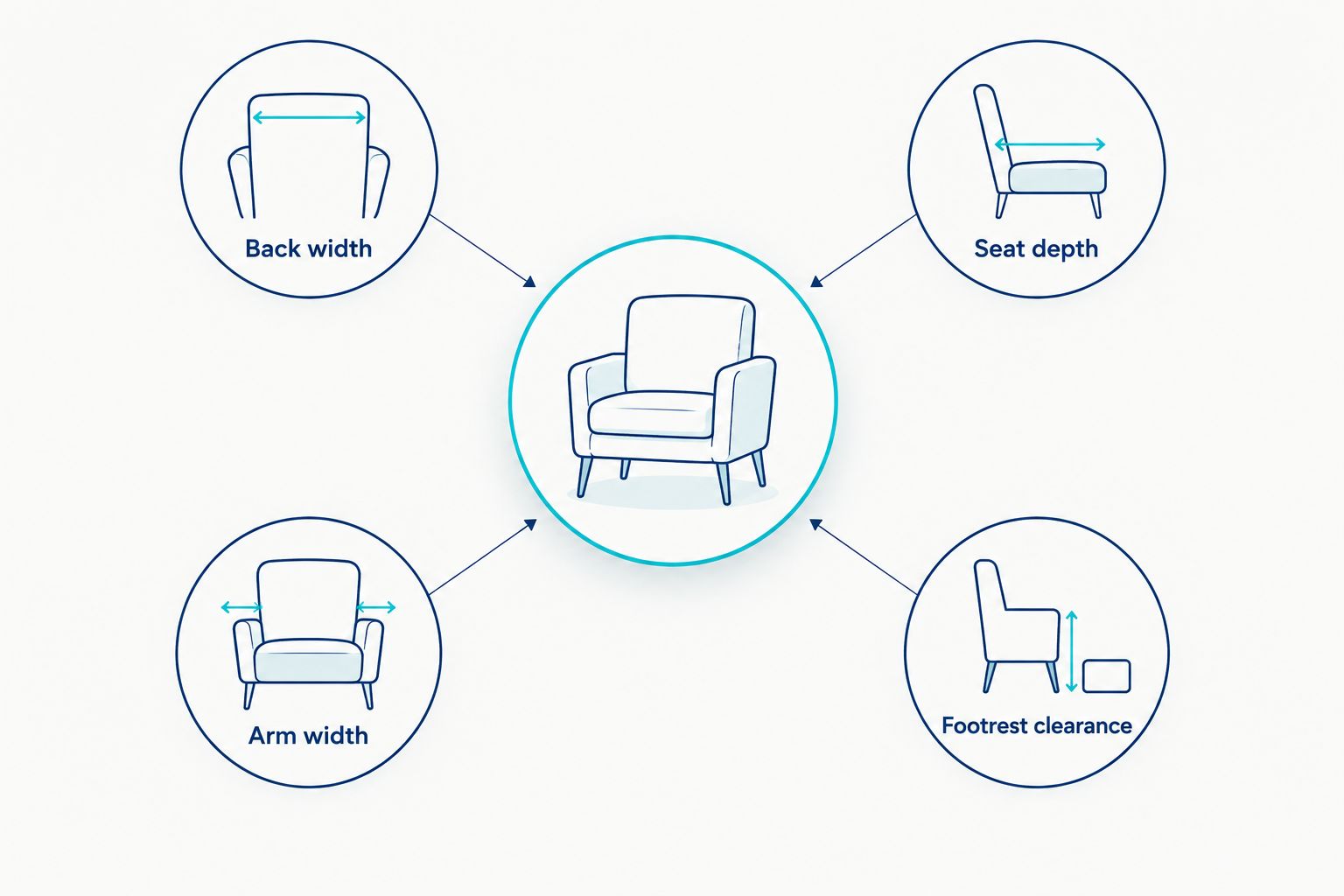
Back width and seat depth are different checks
An oversized recliner can have a broad outside profile without having the same seat proportions as another chair with that label. Compare the back and seat separately. If a cover listing gives only one overall dimension, it leaves important parts of the fit unresolved.
Look at the shape as well as the measurement. A high back, prominent side cushions, or arms that widen toward the front change how fabric sits on the chair. Stretch fabric can accommodate some shape differences, but stretch does not create a cutout for a control or a separate moving footrest panel.
Footrest clearance decides whether the cover works
The footrest needs to open and close without pulling the cover across a hinge or trapping loose fabric. After fitting any cover, cycle the chair while watching the areas where the seat meets the footrest and where the back changes angle. Stop if fabric bunches into a moving part or pulls a control out of reach.
A draped protector and a fitted slipcover solve different problems here. The protector can leave the moving sections separate but shift on the seat. The fitted cover can stay neater, provided its construction matches the chair. Neither type gets a pass on the movement check.
Why oversized recliner slipcover fit varies
- Overall dimensions: A label such as oversized does not tell you whether a particular cover matches the chair’s back, seat, and arms.
- Chair shape: Wide arms, a high back, and prominent cushions change where the fabric needs room.
- Footrest design: The cover must allow the footrest to move without tension or trapped material.
- Control placement: A lever, button, or cord route cannot be concealed by a cover that prevents access or normal operation.
- Cover construction: Separate panels, attachment points, and stretch fabric behave differently from a single draped piece.
- Your coverage goal: Covering the seat for day-to-day protection requires a different fit from concealing the full chair.
These are reasons to use a specific cover size chart rather than assume that a standard chair cover will stretch enough. If a seller does not provide the measurements or chair configuration needed to check fit, you cannot verify that the cover suits your recliner before buying it.
Is a stretch slipcover enough for an oversized recliner?
Stretch helps with shape; it does not establish compatibility. The fabric still needs enough material to cover the back, seat, and arms without excessive tension. It also needs a design that lets the footrest move and leaves the controls accessible.
A stretch cover can look fitted on an upright chair while pulling upward from the seat when the back reclines. Check the cover in each position you normally use. If it slips off an arm, rides up the back, or tightens across a moving section, it does not fit that chair in use.
Do not solve a short cover by forcing it farther around the chair. Extra tension can make removal difficult and still leave gaps elsewhere. If the size chart places your chair outside the cover’s stated range, choose a different cover rather than treating stretch as an extension of that range.
Should you choose a fitted cover or a draped protector?
Choose a recliner-specific fitted cover when you want coverage that follows the chair’s sections and you can verify the required dimensions. Its drawback is that matching the cut to your particular back, arms, and footrest takes more checking. A recliner-specific label is useful, but it is not a substitute for measurements.
Choose a draped protector when you mainly need a removable layer over the areas you sit on. It is less dependent on an exact upholstery-like fit, but it can move as you stand, sit, or recline. Check that it stays away from controls and moving joints.
A standard chair slipcover belongs on the list only if its maker explicitly states that it accommodates your recliner’s dimensions and movement. Otherwise, its apparent fit while the chair is upright is not enough evidence to buy it for this use.
What should you test after putting the cover on?
Start with the chair empty. Operate the recliner through the positions you normally use and watch the fabric rather than focusing only on how it looks. Confirm that the footrest clears the cover, the back moves without pulling fabric taut, and every control remains accessible.
Then sit down and get up as you normally would. Check whether the seat panel shifts, the arms come loose, or loose material gathers where you need a stable surface to stand. If the cover needs constant readjustment, it is not a practical fit even when it technically reaches every edge.
Finally, remove and refit it once. That tells you whether routine cleaning is manageable and whether the attachment method depends on tucking fabric into a moving gap. Follow the cover’s care label when washing; do not assume its care requirements match the chair upholstery beneath it.
Will a regular chair cover work on a power recliner?
Only if it matches the chair’s dimensions and leaves the power recliner’s controls, cord, and moving sections unobstructed. A regular chair cover is not designed for those features by default. Test movement after fitting it, with particular attention to fabric near the footrest and controls.
If your chair uses a power cord, route it according to the chair’s own instructions rather than using the cover to hide or hold it. The cover is upholstery protection, not a way to manage electrical parts. For a separate discussion of placement, see the related guide on routing lift chair power cords.
Can you cover a lift chair the same way?
A lift chair needs its own movement check. The seat rises as well as reclines, so a cover that works on a conventional recliner does not automatically work through the lift motion. Keep fabric clear of moving areas and maintain access to the controls.
Test the lift function with the chair empty after fitting the cover. Then assess whether the cover shifts or gathers when the chair returns to its seated position. If it interferes with operation or creates loose fabric where someone steps or stands, remove it and look for a different fit.
FAQ
Can a chair slipcover fit an oversized recliner?
Yes, if the cover matches the recliner’s measurements and accommodates its moving back and footrest. A standard chair slipcover usually does not provide enough information to confirm that fit.
What kind of cover is best for an oversized recliner?
A recliner-specific cover is best when its size chart and design match your chair. Choose a draped protector instead if easy removal matters more than a close fit.
Can I use a stretch chair cover on a recliner?
Yes, but stretch alone does not make a chair cover recliner-compatible. Check the stated dimensions, footrest movement, and access to controls.
How do I measure an oversized recliner for a slipcover?
Measure the back, seat, and arms separately, then inspect the chair fully reclined. Compare those measurements and the footrest layout with the cover’s size chart.
Will a slipcover stop an oversized recliner from reclining?
A poorly fitted slipcover can restrict movement or bunch near moving parts. Test the covered chair through its normal positions and remove the cover if it interferes.
Can I put a chair protector on a power recliner?
Yes, if the protector stays clear of moving parts and does not obstruct controls or the power cord. Check it again after sitting and reclining because a draped layer can shift.
Does a lift chair need a different cover from a regular recliner?
A lift chair cover must allow the chair’s lifting motion as well as its reclining motion. Do not assume a cover intended only for a conventional recliner will stay clear of the lift mechanism.
Related guides
- Can you use a lift chair as a regular recliner?
- Can a swivel rocker recliner rock and swivel at the same time?
One last thing
The decisive fit test happens with the chair moving, not while it sits upright. If the cover stays clear of the footrest and controls through normal use, its measurements mean something. If it catches, pulls tight, or shifts under you, choose another cover even if the size label says oversized.