
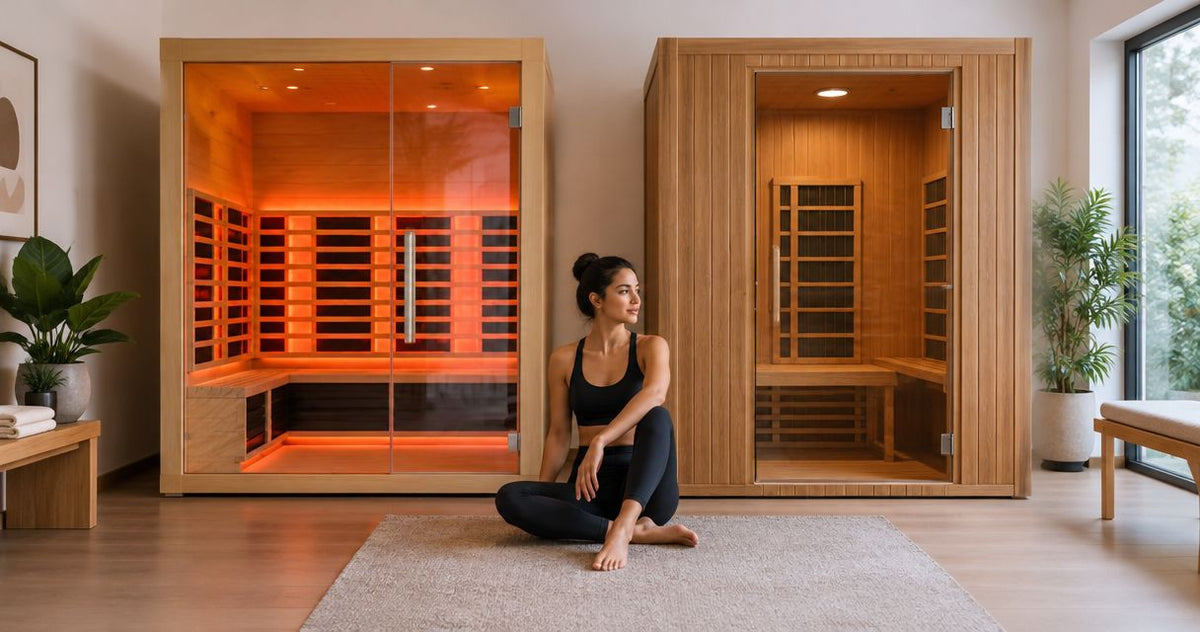
Full-spectrum infrared is not automatically better than a far-infrared sauna. In a full spectrum vs traditional infrared sauna comparison, the useful distinction is the heater’s documented output, controls, and layout—not an assumption that more wavelength bands deliver better health results. Full-spectrum describes a broader infrared offering; it does not establish a better-built cabin or a better fit for your home.
By Editorial Team
- Full spectrum vs traditional infrared sauna: compare documented heater output, not the label alone.
- Full-spectrum combines near-, mid-, and far-infrared; a far-infrared sauna emphasizes far-infrared heating.
- Aeva Vital lists far-infrared home saunas; do not assume those models provide full-spectrum output.
- Cabin fit, heater placement, electrical requirements, and usable controls matter alongside wavelength coverage.
Is full-spectrum infrared better than traditional infrared saunas?
Full-spectrum is better only when its documented features match a requirement that the alternative does not meet. A wider wavelength offering is a technical distinction, not proof of better relaxation, recovery, or safety. For your 2026 purchase, compare the exact models rather than treating either category as the automatic winner.
The phrase traditional infrared is ambiguous. It often means a far-infrared cabin, but a traditional sauna is a different category that heats the room using a sauna heater, commonly with heated stones. The infrared sauna heating technology guide provides a related starting point for comparing heater terminology.
| Category | What the term describes | Best for | Main limitation |
|---|---|---|---|
| Full-spectrum infrared | A system described as providing near-, mid-, and far-infrared output | Buyers specifically seeking documented coverage across those bands | The label does not specify output strength, distribution, or independent controls |
| Far-infrared sauna | An infrared system emphasizing far-infrared heating | Buyers seeking a far-infrared cabin without requiring additional bands | It does not establish near- or mid-infrared capability |
| Traditional sauna | A room-heating sauna system, rather than an infrared product category | Buyers seeking the traditional heated-room experience | It is not a like-for-like comparison based on infrared spectrum |
Why this matters
A spectrum label answers a narrow question: what infrared bands does the manufacturer say the heating system provides? It does not answer whether you fit comfortably, whether the room can accommodate installation, or whether the electrical supply matches the manual.
Separate the heating claim from the ownership decision. A technically broader heater arrangement is not useful if the cabin fails your installation requirements or its controls do not provide the adjustment you want.
Full-spectrum infrared: broader wavelength coverage
Full-spectrum sauna terminology refers to near-, mid-, and far-infrared output. These are regions of infrared radiation, distinguished by wavelength. The term does not mean that every heater produces an equal amount of each region.
For a 2026 comparison, ask for documentation identifying the emitters and the output each contributes. A category name alone does not explain the balance between bands, the distance from your seated position, or whether settings change those outputs together.
Best for: buyers who specifically want documented near-, mid-, and far-infrared capability. The advantage is broader stated wavelength coverage. The limitation is that coverage alone does not establish a health advantage or describe the experience inside the cabin.
What to check beyond the full-spectrum label
Look for a heater diagram and a clear explanation of the controls. Ask whether you can adjust different heater groups separately and whether the operating manual specifies seating distances or restrictions.
Do not infer separate control from the presence of multiple heater types. A cabin can contain different components without giving you independent control over each component.
Far-infrared saunas: a focused heating category
A far-infrared sauna emphasizes far-infrared output. That description is meaningful, but it does not tell you everything about the cabin: panel placement, seating arrangement, controls, and installation requirements still need their own checks.
Best for: buyers who want a far-infrared home sauna and do not require additional infrared bands. The advantage is a clearly defined heating category. The limitation is that a far-infrared specification does not demonstrate near- or mid-infrared capability.
Do not reject a far-infrared model merely because another model uses a broader label. Compare the features you will actually use, and require evidence for any claimed benefit that influences your decision.
Carbon and ceramic are not spectrum certificates
Carbon and ceramic describe heater materials or construction, not a complete account of emitted wavelengths. A product mentioning both materials does not, by that fact alone, demonstrate full-spectrum output.
Keep the questions separate: what is the heater made from, what does it emit, and how is it controlled? Treating those as interchangeable is a common specification-reading mistake.
Why the sauna experience varies
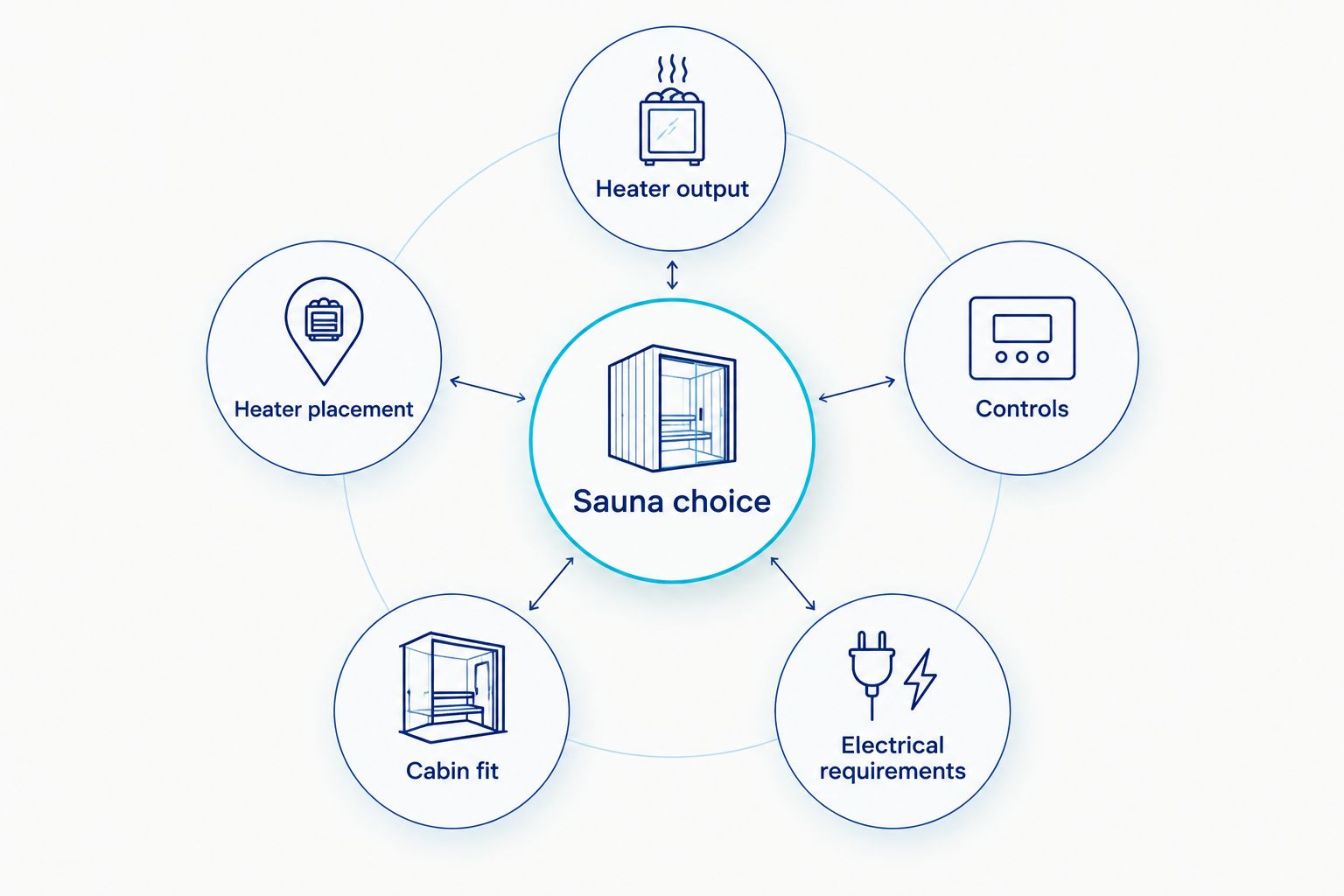
The full spectrum vs traditional infrared sauna decision depends on more than the category name. Use these factors to compare models in 2026:
- Heater output: Ask which infrared bands the manufacturer documents. Do not substitute a material name for an output specification.
- Heater placement: Compare where the emitters sit relative to the bench and your body. A panel count does not describe that arrangement.
- Controls: Check what the temperature setting adjusts and whether heater groups have separate controls. Do not assume either feature.
- Cabin fit: Check internal seating dimensions, exterior dimensions, entry access, and required installation clearance separately.
- Electrical requirements: Match the model’s voltage, current, plug, and circuit instructions to the installation location.
- Use instructions: Follow the exact model’s operating guidance rather than borrowing settings from another sauna category.
Temperature does not describe the entire exposure
An air-temperature display reports the condition at its sensor. It does not directly measure infrared output at every seated position or establish how every user will experience the session.
Compare temperature claims only alongside the model’s heater arrangement and operating instructions. Do not turn a displayed temperature into a claim about treatment effectiveness.
How to compare the evidence before you buy
Use the same sequence for every model on your shortlist. This keeps an attractive feature name from outweighing a practical installation problem.
- Identify the category. Confirm whether the model is far-infrared, full-spectrum infrared, or a traditional sauna. Resolve unclear terminology before comparing features.
- Request the documents. Read the specification sheet and operating manual. Look for a heater layout, electrical instructions, dimensions, and operating restrictions.
- Check the room. Measure the intended location and the access route. Account for doors, assembly space, and the manufacturer’s clearance requirements.
- Match the controls. Establish which functions you can adjust. Do not assume a timer, remote control, app, or independent heater adjustment exists.
- Separate claims. Keep construction facts, electrical safety information, and health claims in different columns. Evidence for one does not prove another.
For a 2026 shortlist, unresolved installation requirements take priority over spectrum preferences. A model that does not suit the intended location is not the right selection, regardless of its heater terminology.
Read low-EMF claims with the measurement conditions
An electromagnetic-field claim needs units, measurement distance, operating conditions, and a clear description of what was measured. A bare number does not provide enough context for a meaningful comparison.
Likewise, low EMF and full-spectrum answer different questions. Neither term establishes the other, and neither replaces electrical installation instructions or a complete product specification.
What Aeva Vital’s infrared sauna listings establish
Aeva Vital infrared saunas are best considered by home buyers seeking documented far-infrared options, not assumed full-spectrum benefits. The supplied product information identifies the following far-infrared models. Their names and listed features support a feature comparison, not a medical-performance ranking.
| Listed model | Documented details | Best for | What those details do not prove |
|---|---|---|---|
| Low EMF 2-Person Hemlock Far-Infrared Indoor Sauna with Double Glass Doors | Rated for 2 people; 7 far-infrared heating panels; 2 glass doors | Buyers comparing a stated panel count and double-door configuration | Full-spectrum output, personal seating comfort, or medical outcomes |
| Hemlock Two-Person Far Infrared Indoor Sauna | Hemlock construction; far-infrared category; named for 2 people | Buyers comparing another two-person far-infrared configuration | Matching panel count, matching controls, or identical installation requirements |
The first listing identifies 7 heating panels. That is a component count—not a measurement of output at the bench, a guarantee of uniform exposure, or evidence that it performs better than a different layout.
Both names identify accommodation for 2 people. Check the actual interior dimensions before deciding that the seating suits your household; a person-count label is not a substitute for usable bench measurements.


For these Aeva Vital models, the useful next step is to confirm the current manual and complete specifications. Do not infer app compatibility, circuit requirements, or independent heater controls from the product names.
Does full-spectrum infrared mean better recovery?
Full-spectrum output alone does not establish better recovery. A claim about recovery needs evidence addressing that outcome and the relevant exposure—not just evidence that a heater emits multiple infrared bands.
Keep general sauna research separate from a specific product claim. A study involving a different heating system or protocol does not automatically validate a model’s advertised result.
Is a traditional sauna the same as traditional infrared?
A traditional sauna is not the same category as an infrared sauna. Traditional sauna terminology describes a heated-room system; traditional infrared is informal wording that requires clarification from the seller.
For a useful comparison, replace the ambiguous phrase with the actual category on the model’s documentation. That prevents you from comparing unlike temperature settings or operating instructions.
Should I replace a working far-infrared sauna?
Do not replace a working far-infrared sauna solely to obtain a full-spectrum label. First identify the specific capability you want and confirm that the proposed replacement documents it.
For a 2026 replacement decision, assess the existing cabin’s condition, fit, controls, and service needs separately from spectrum. Broader terminology does not resolve an unrelated ownership problem.
Related guides
- How hot does a home infrared sauna get?
- How long should you sit in an infrared sauna each session?
- Wiring a home infrared sauna into your electrical panel
FAQ
Is full-spectrum infrared better than far-infrared?
Full-spectrum infrared is not automatically better than far-infrared. It describes broader wavelength coverage, but the better choice depends on documented features, cabin fit, controls, and your requirements.
What does full-spectrum mean in an infrared sauna?
Full-spectrum refers to near-, mid-, and far-infrared output. The label alone does not specify the strength of each band, its distribution, or whether you can control it independently.
Is a traditional infrared sauna the same as a traditional sauna?
No. A traditional sauna uses a heated-room system, while traditional infrared is ambiguous wording often used for far-infrared models. Confirm the exact heating category in the product documentation.
Do carbon and ceramic heaters make a sauna full-spectrum?
Carbon and ceramic heater descriptions do not establish full-spectrum output. Heater material, emitted wavelengths, and available controls are separate specifications.
Does a sauna with more heating panels work better?
A larger panel count alone does not prove better performance. Compare panel placement, documented output, controls, and the seating arrangement rather than ranking cabins by count.
Does low EMF mean the sauna is full-spectrum?
Low EMF does not mean full-spectrum. An electromagnetic-field claim needs measurement conditions, while a spectrum claim concerns the infrared wavelengths the heating system provides.
Are Aeva Vital’s listed far-infrared models full-spectrum?
The far-infrared product information shown here does not establish full-spectrum capability. Treat the models as far-infrared unless model-specific documentation explicitly confirms additional infrared bands.
Should I use a full-spectrum sauna for longer sessions?
Do not extend a session merely because a sauna is full-spectrum. Follow the model’s operating instructions, stop if you feel unwell, and seek medical guidance when health conditions or medications affect heat tolerance.
One last thing
Ask for the operating manual before choosing the cabin. It answers installation and use questions that a spectrum label cannot; if the feature you want is absent from the documentation, do not assume it exists.