
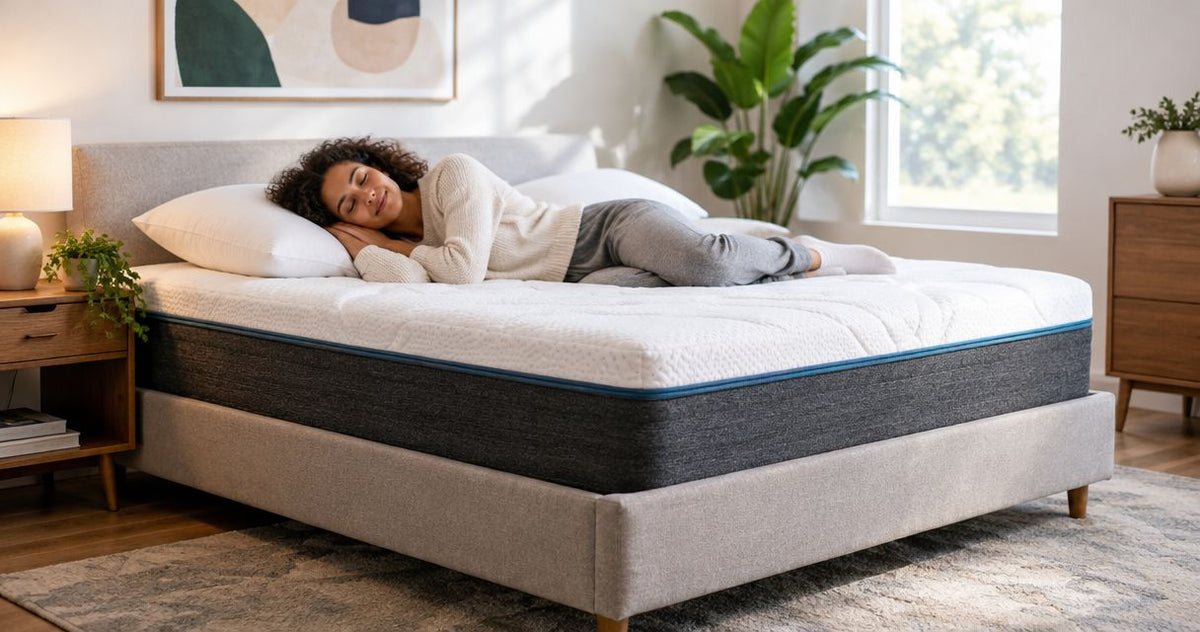
Yes—a hybrid mattress is worth it in 2026 if you want cushioning over a spring support system and the specific mattress suits your sleeping position. The hybrid label alone does not establish comfort, cooling, durability, or suitability for back pain. Check the construction, bed-frame requirements, and return conditions before choosing one.
By Editorial Team
A hybrid mattress combines comfort layers, commonly foam or latex, with a coil support core. This guide explains when that combination makes sense, what its limitations are, and how to assess a listed specification without treating it as proof of performance. Start with hybrid mattresses ranked by firmness level if your main concern is the sleeping feel.
- Is a hybrid mattress worth it? Yes, when the cushioning, coil support, and foundation requirements suit you.
- Aeva Vital lists a firm, 12-inch queen hybrid mattress; those specifications do not prove personal comfort.
- Compare hybrid mattresses with all-foam and innerspring options by construction, not category labels alone.
- Check firmness, edge support, motion transfer, and return conditions before choosing a mattress.
Is a hybrid mattress worth it in 2026?
A hybrid mattress is worth choosing when you prefer its combination of surface cushioning and spring response—not simply because it contains more components. A thick comfort layer changes how directly you feel the coils underneath. The materials and arrangement matter more than the word hybrid.
Use this comparison to identify which construction matches your preferences. These are category-level distinctions, not performance ratings for individual mattresses.
| Mattress construction | Best for | Main advantage | Main limitation |
|---|---|---|---|
| Hybrid | Shoppers seeking cushioning over a coil support core | Combines comfort layers with spring response | Foam, coil, and edge designs vary; the label does not predict the feel |
| All-foam | Shoppers who prefer a mattress without a spring core | Can provide close contouring without coil bounce | Firmness, ease of movement, and heat retention depend on the foam construction |
| Innerspring | Shoppers who prefer a more direct spring feel | Offers coil-based support with comparatively less cushioning in conventional designs | Limited comfort padding can feel less accommodating at pressure points |
These categories overlap in feel. A firm hybrid can feel less contouring than a softer all-foam mattress, while a hybrid with substantial foam can mute much of the spring response. Compare the actual construction rather than assuming every mattress in a category behaves alike.
Why this matters
You sleep on the finished mattress, not its specification list. Coil type, foam density, mattress height, and firmness each describe something different; none answers every comfort question.
For your 2026 purchase, separate measurable facts from subjective claims. Height is measurable. Whether your shoulder feels comfortable when you lie on your side is personal, and a taller mattress does not settle that question.
A useful decision starts with the problem you want to solve: uncomfortable pressure, excessive sinking, difficulty turning, movement from a partner, or a mattress that does not fit your bed. Choose features that address that problem rather than collecting unrelated specifications.
What the foam and coils actually do
Comfort layers: cushioning at the surface
Comfort layers sit above the main support system and shape your first impression of the mattress. Depending on their material and construction, they compress around your body and influence pressure distribution, surface feel, and ease of movement.
More cushioning is not automatically better. If you dislike sinking into a mattress, a deep, conforming surface can feel restrictive even when the underlying support core is firm. If you sleep on your side, a surface that barely yields can feel uncomfortable around your shoulder or hip.
Coil support: the underlying spring system
The coil core supplies spring-based support beneath the comfort layers. Individually wrapped coils have separate fabric pockets, unlike spring systems that connect coils more directly.
That construction detail does not establish motion isolation by itself. The finished mattress also includes comfort materials, perimeter components, and a cover. Evaluate the whole mattress rather than assuming pocketed coils eliminate movement from a partner.
Edge construction: support near the perimeter
Edge support describes how the mattress behaves near its sides. It matters when you sit to get dressed, enter or leave the bed, or sleep close to the perimeter.
A mattress can feel supportive in the center yet compress noticeably at the edge. Look for an explicit description of perimeter construction, then distinguish sitting support from lying support. Those are different uses of the same edge.
Why hybrid mattress value varies
The usefulness of a hybrid mattress depends on these factors:
- Sleeping position: Your shoulder, hips, and torso load the surface differently when you sleep on your side, back, or stomach.
- Comfort-layer construction: Material, thickness, and density affect how the surface compresses and responds.
- Coil construction: The support core contributes spring response, but its design must be assessed alongside the comfort layers.
- Shared-bed behavior: Motion transfer and usable edge space matter when you share the mattress.
- Bedroom conditions: Bedding, room temperature, and the comfort materials all affect how warm the bed feels.
- Foundation compatibility: The mattress must work with the frame or base you intend to use.
Choose around your main requirement first. A mattress that matches your preference for firmness but fails the manufacturer's foundation requirements is not a suitable purchase.
How to decide whether a hybrid suits you
Follow this sequence when comparing mattresses in 2026. It keeps a construction detail from becoming a substitute for a fit check.
- Identify the problem. Describe what you dislike about your current mattress: pressure, sinking, movement, heat, or getting in and out of bed.
- Check the construction. Read the comfort-layer and support-core descriptions. Separate stated materials from claims about sleep quality.
- Test the feel. If you can try the mattress, use your normal sleeping position and check whether turning feels comfortable. An in-store impression is useful, but it does not reproduce a full night at home.
- Check the foundation. Compare the mattress requirements with your existing frame, slats, platform, or adjustable base.
- Read the conditions. Review the current return, exchange, delivery, and warranty terms before ordering.
The order matters. You should know what problem the mattress is meant to address before deciding whether a feature is relevant. Otherwise, a long specification list can distract from a poor fit.

Mattress height and queen size: what the numbers mean
Mattress height describes the distance from the bottom to the sleeping surface. It does not reveal how much of that height belongs to comfort foam, coils, or other components.
A 12-inch mattress is not automatically firmer, cooler, or more durable than another height. Ask what fills those 12 inches. Layer arrangement and materials explain more than total thickness alone.
A standard US queen mattress measures 60 inches wide by 80 inches long. Those are category dimensions, not a measurement verification for a particular model; confirm the product's stated dimensions before ordering.
Also check the complete bed height. Your frame, foundation, and mattress all contribute to the height you sit on. Measure the space for the bed, check fitted-sheet pocket depth, and assess whether the finished setup will be comfortable to enter and leave.
What Aeva Vital's listed hybrid specification tells you
The supplied product listing names the SpineAlign 12" Queen Firm Cooling Hybrid Mattress and describes high-density foam and individually wrapped coils. Its title identifies a 12-inch height, queen size, firm designation, and cooling positioning.
Aeva Vital's hybrid mattress is best considered by shoppers seeking the listed firm, 12-inch queen configuration. That is a specification match, not a promise that the mattress will suit every sleeper.
| Listed detail | What it tells you | What it does not prove |
|---|---|---|
| 12-inch height | The height named in the product title | Comfort-layer thickness, durability, or ease of getting out of bed |
| Queen size | The stated size category | Exact finished dimensions or compatibility with your particular frame |
| Firm designation | The listed firmness positioning | A universal firmness score or comfort for your sleeping position |
| High-density foam | The description identifies this foam characteristic | A numerical density, measured lifespan, or pressure-relief result |
| Individually wrapped coils | The description identifies pocketed coil construction | Zero motion transfer or a particular edge-support result |
| Cooling wording | The title positions the mattress around cooling | A measured temperature reduction or a guarantee against overheating |
For Aeva Vital's hybrid mattress, the practical advantage is a clearly identified construction direction: foam over individually wrapped coils in a firm queen configuration. The limitation is that these details alone do not establish how the finished mattress feels to you.
In 2026, use the same standard for every mattress listing. A numerical measurement supports a measurement claim; a material description supports a construction claim. Neither automatically proves a health benefit or an overnight comfort result.
Is a hybrid mattress better than memory foam?
A hybrid mattress is better for you only if you prefer its finished feel and support. Memory foam is a material, while hybrid describes a construction category; a hybrid mattress can contain memory foam above its coils.
If you prefer close contouring without much spring response, investigate an all-foam design. If you want cushioning with noticeable spring response, investigate a hybrid. In either case, check the actual layers rather than treating the categories as opposites.
Is a hybrid mattress worth it for couples?
A hybrid mattress is worth considering for couples when both sleepers find the surface comfortable and its motion transfer is acceptable. Individually wrapped coils are a useful construction detail to examine, but they do not guarantee an undisturbed bed.
Test movement as well as firmness. Have one person change position while the other lies still, and assess the edge area if either person regularly sleeps near it. Different comfort preferences can remain a problem even when the mattress handles movement well.
Does a cooling hybrid mattress guarantee cooler sleep?
A cooling hybrid mattress does not guarantee cooler sleep. Coil spaces and comfort-layer materials are relevant to airflow and heat behavior, but the cover, bedding, protector, and room conditions also affect your experience.
Look for a specific explanation of the cooling feature. A material name or cooling label without a test method does not establish a measured temperature change. Avoid turning that wording into a promised result.
FAQ
Is a hybrid mattress worth it in 2026?
A hybrid mattress is worth it in 2026 when you prefer cushioning over a coil support core and the specific mattress suits your sleeping position. Check firmness, construction, foundation compatibility, and purchase conditions rather than choosing by the hybrid label alone.
What's the main disadvantage of a hybrid mattress?
The main decision-making disadvantage is that the hybrid label does not predict the finished feel. Comfort layers, coils, and perimeter construction vary, so assess the individual mattress.
Is a firm hybrid mattress good for side sleepers?
A firm hybrid mattress suits a side sleeper only if its surface accommodates the shoulder and hip comfortably. Firmness wording alone does not establish that fit.
Does a 12-inch mattress provide better support?
A 12-inch mattress does not provide better support solely because of its height. The comfort layers, support core, and foundation determine how the complete setup behaves.
How big is a standard queen mattress?
A standard US queen mattress measures 60 inches wide by 80 inches long. Confirm the specific product's dimensions and your frame's requirements before ordering.
Can I use a hybrid mattress on an adjustable bed?
Use a hybrid mattress on an adjustable bed only when the mattress manufacturer confirms compatibility. A coil core alone does not establish whether the finished mattress is designed to bend with the base.
Will a hybrid mattress fix back pain?
A hybrid mattress is not a guaranteed treatment for back pain. Choose for comfort and support, and seek medical advice for persistent symptoms rather than relying on a mattress category or product name.
What does Aeva Vital list for its SpineAlign hybrid mattress?
Aeva Vital lists the SpineAlign 12-inch queen firm cooling hybrid mattress and describes high-density foam and individually wrapped coils. Those details identify its stated configuration but do not prove individual comfort, cooling performance, or medical outcomes.
Related guides
- Best hybrid mattress for couples
- Best hybrid mattress for hot sleepers
- 12 vs 13 vs 14-inch mattress thickness guide
One last thing
Before your 2026 purchase, write down the exact problem your next mattress must solve. Then ask whether the listed construction addresses it, whether the bed setup is compatible, and whether the purchase conditions give you an acceptable way to resolve a poor fit. A mattress earns its place through fit—not its category name.