
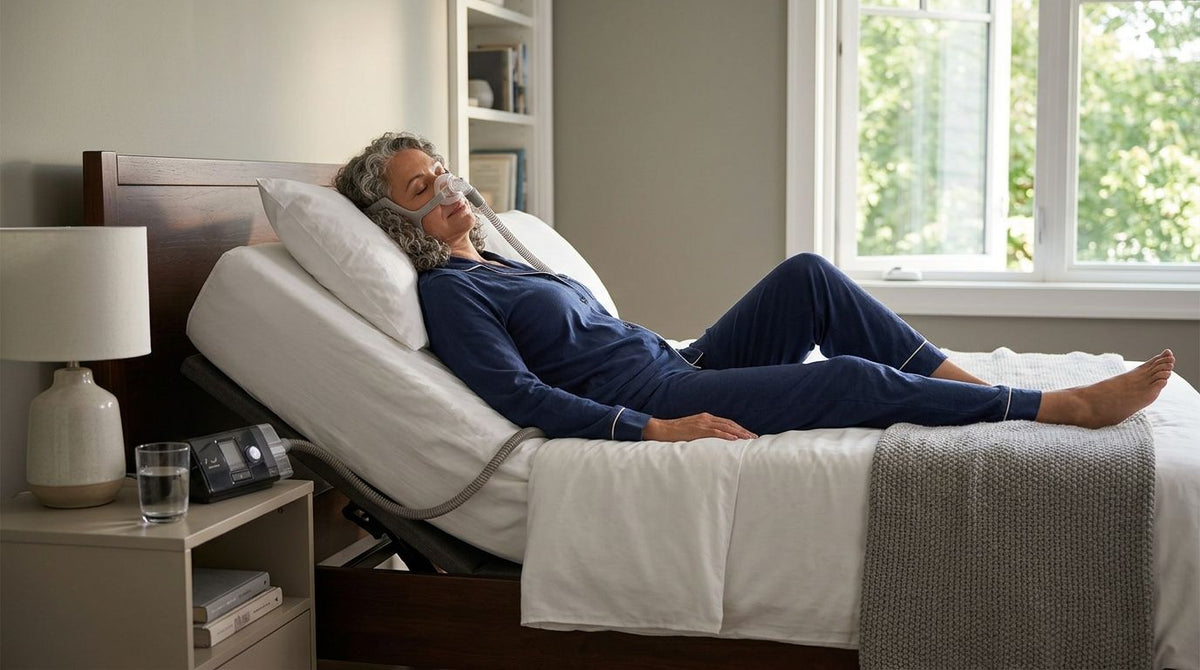
Yes, an adjustable bed can help some people with obstructive sleep apnea by raising the upper body and reducing breathing interruptions linked to sleeping flat. The benefit depends on the type and severity of apnea, and an adjustable bed does not treat the underlying condition or replace prescribed positive airway pressure (PAP) therapy. If you already use CPAP, keep using it unless your sleep clinician changes your treatment plan.
By Editorial Team
- Can an adjustable bed help with sleep apnea? Yes, head elevation can help some people, but it does not replace prescribed PAP therapy.
- Side sleeping targets position-dependent apnea differently from raising the head of a bed.
- Aeva Vital's adjustable bed base is a positioning option, not a proven sleep apnea treatment.
- Use sleep-test results and follow-up data to judge whether a position change helps you.
Can an adjustable bed help with sleep apnea?
An adjustable bed can help when sleep position contributes to obstructive breathing events, but it is not a stand-alone answer for everyone with sleep apnea. Raising the upper body changes your sleeping position; it does not provide the airway pressure delivered by a CPAP machine. Sleep testing and treatment follow-up matter more than whether an elevated position feels comfortable.
| Option | Best for | What it can do | Main limitation |
|---|---|---|---|
| Head elevation on an adjustable bed | Someone whose clinician identifies position as a factor and who wants to change upper-body position | Raises the torso without adding loose pillows | Improvement in breathing is not guaranteed and must not be assumed from comfort alone |
| Side sleeping | Someone with position-dependent obstructive sleep apnea | Avoids sleeping on the back, the position associated with worse breathing for some people | It does not reliably control every case, and staying on your side can be difficult |
| Prescribed PAP therapy | Someone whose clinician recommends airway-pressure treatment | Delivers pressure to help keep the airway open during sleep | Requires a suitable mask, settings, and consistent use |
The distinction is position versus treatment. An adjustable bed changes where your head and torso sit. PAP therapy actively supports an open airway. If both are part of your routine, the bed is an addition to the prescribed treatment, not a reason to stop it.
Why this matters
Obstructive sleep apnea involves repeated narrowing or blockage of the upper airway during sleep. Central sleep apnea has a different mechanism; changing bed position is not a substitute for evaluating either condition. If you suspect sleep apnea but have not been tested, start with a medical assessment rather than choosing a bed position based on snoring alone.
The practical question in 2026 is not whether you can raise the head of a bed. It is whether a position change improves your measured breathing while asleep without interfering with treatment you already use. If you use a machine, the guide to positioning a CPAP machine with an adjustable bed covers the related setup question; keep the machine's instructions and your clinician's advice ahead of any general bed-layout tips.
Why the effect varies
An adjustable bed does not create the same result for every sleeper. These factors determine whether head elevation is a useful addition:
- Type of apnea: Position changes address a physical sleeping posture. They do not replace assessment of the cause of breathing interruptions.
- Position dependence: If breathing events are worse on your back, changing position is more relevant than it is when events occur across positions.
- Where the bed bends: Upper-body elevation differs from raising only your head with stacked pillows. Neck position and torso support both affect how the setup feels.
- Time spent in each position: A setting cannot help during periods when you slide out of it or sleep elsewhere.
- Your current treatment: A position that disrupts a CPAP mask seal or pulls on the hose can make an otherwise comfortable setup impractical.
- How improvement is checked: Less snoring or better comfort is useful feedback, but neither establishes that breathing interruptions are controlled.
Ask your clinician what your sleep-test report says about back sleeping versus side sleeping. That answer gives you a reason to try a position change—or a reason not to rely on one.
Does raising the head of the bed work like side sleeping?
No. Head elevation and side sleeping change posture in different ways. An adjustable bed can lift your upper body while you remain on your back; side sleeping turns your body away from that position entirely. A person whose apnea is markedly worse on the back should not assume that raising the backrest produces the same effect as turning onto a side.
The comparison also explains why a preset labeled zero gravity is not a medical setting. Such presets position more than one part of the body, including the legs on some bases. The label does not tell you whether the upper-body angle improves your breathing. In 2026, choose a position for comfort and treatment compatibility, then assess its effect through appropriate follow-up rather than the preset name.
If your clinician has recommended positional therapy, clarify which change they mean. Ask whether the goal is to avoid back sleeping, elevate the upper body, or use a specific approach alongside PAP therapy. These instructions are not interchangeable.
How should you try an adjustable bed safely?
- Start with the diagnosis. Review your sleep-test findings and treatment plan with your sleep clinician. If you have not been evaluated, do not use a bed adjustment as a home test for sleep apnea.
- Keep prescribed treatment in place. Continue PAP therapy or another prescribed treatment while you discuss position changes with the clinician who manages your apnea.
- Change upper-body position gradually. Choose a setting you can maintain while sleeping. Avoid a posture that bends your neck uncomfortably or causes you to slide down the mattress.
- Check your equipment fit. If you use CPAP, lie in your intended sleep position with the mask on. Make sure the hose has room to move and the mask remains seated when the bed rises.
- Arrange follow-up. Report any change in symptoms, sleep quality, mask fit, or machine data. Your clinician can decide whether further testing or a treatment adjustment is needed.
This sequence separates a useful comfort experiment from an unsupported treatment claim. The test is not whether an elevated bed feels better on the first night; it is whether your treatment remains effective when you sleep in that position.
What should you check before choosing a bed base?
Focus on how the base supports the position you intend to use, not on a preset's name. You need a stable sleeping position, a mattress that works with the base, and enough room for any prescribed equipment. Confirm compatibility with the specific mattress and bed frame you plan to use before changing your setup.
Aeva Vital lists an adjustable bed base described as a King / Queen Size Zero Gravity model with USB & Nightlight. Those listing details identify a positioning product; they do not establish a sleep apnea benefit, identify a therapeutic angle, or show that the base will fit your existing frame. Aeva Vital's adjustable bed base is best for shoppers seeking adjustable positioning, not a replacement for sleep apnea treatment. Its limitation is the same one that applies to any unverified bed setup: comfort features do not prove clinical effectiveness.
In 2026, check the current product information for mattress and frame compatibility before choosing any adjustable base. If you are considering a backrest with an existing frame, the physical fit is a separate question from whether the position helps your breathing. Neither a compatibility claim nor a comfortable night answers the medical question.
Can you use an adjustable bed with CPAP?
Yes, you can use an adjustable bed with CPAP if the sleeping position allows the mask and hose to function as intended. Put the bed in the position you plan to use before checking the mask fit. A seal that works while flat can feel different once the upper body is raised or you turn to a side.
Keep the hose free to move when the bed changes position. Do not route it where the moving base can catch it, and do not change prescribed machine settings to compensate for a new bed position on your own. If leaks, discomfort, or machine-reported events change, discuss them with your treatment provider.
The combined setup has a clear division of roles: the bed adjusts posture, while CPAP delivers prescribed airway pressure. That remains true in 2026 regardless of the bed's comfort presets.
When is an adjustable bed not enough?
An adjustable bed is not enough when it is being used instead of an evaluation or a prescribed treatment. It is also not evidence of control when the only sign of improvement is quieter snoring. Breathing interruptions can persist even when a sleeper or partner notices less noise.
Get medical advice if you have symptoms that prompted concern about apnea, if you cannot tolerate your prescribed treatment, or if a new sleeping position makes your equipment harder to use. A clinician can review whether position dependence appears in your test results and whether follow-up data supports a change. Do not stop PAP therapy because an elevated setting feels easier to sleep in.
What can sleep-test results tell you about position?
A sleep study can help your clinician determine whether breathing events differ by sleeping position. That is more useful for this decision than a bed's feature list. If your results do not establish that position plays a meaningful role, buying a base specifically to address apnea is an unsupported choice.
Your treatment plan still depends on the full clinical picture, not just a comparison between back and side sleeping. In 2026, bring the question to the clinician reviewing your results: Would upper-body elevation or avoiding back sleeping be a useful addition to my prescribed treatment? Ask how any benefit would be checked.
FAQ
Can an adjustable bed help with sleep apnea?
Yes, an adjustable bed can help some people with obstructive sleep apnea when sleep position affects their breathing. It does not replace diagnosis or prescribed treatment.
Is sleeping with your head elevated enough to treat sleep apnea?
No, head elevation alone is not a reliable substitute for sleep apnea treatment. Your clinician can assess whether position changes help alongside your treatment plan.
Is an adjustable bed better than side sleeping for sleep apnea?
Neither position is universally better. Side sleeping avoids the back position, while an adjustable bed raises the upper body; your sleep-test findings determine which question matters more.
Can I stop using CPAP if I buy an adjustable bed?
No, do not stop prescribed CPAP because you buy an adjustable bed. Discuss treatment changes with the clinician managing your sleep apnea.
Does a zero-gravity bed setting treat sleep apnea?
No, a zero-gravity label does not establish that a bed setting treats sleep apnea. It describes a positioning feature, not a verified medical result.
Can I use CPAP on an adjustable bed?
Yes, CPAP can be used on an adjustable bed when the mask and hose work in your chosen position. Check for leaks and hose interference after adjusting the bed.
How do I know whether raising my bed helps my sleep apnea?
Review your sleep-test findings and follow-up information with your clinician. Feeling more comfortable or hearing less snoring does not, by itself, confirm that breathing interruptions are controlled.
One last thing
If position affects your apnea, the most useful bed setting is one you can sleep in while your prescribed treatment still works. Check that relationship before treating any comfort preset as a breathing solution in 2026.