
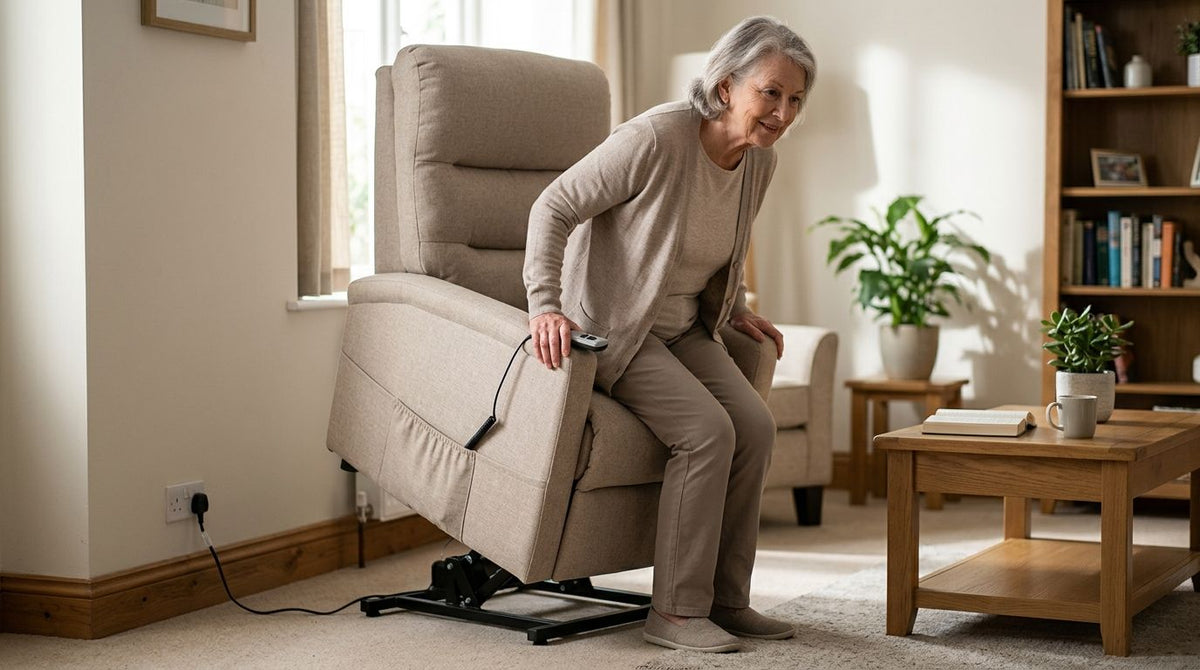
A lift chair motor draws about 200 to 300 watts while it's actively lifting or reclining, and that cycle typically runs 20 to 45 seconds per use — so the motor itself costs somewhere between $0.25 and $0.60 a year to operate at the US average residential rate of roughly $0.16 per kWh in 2026. The cost most owners never account for is standby draw: the transformer stays plugged in around the clock pulling 1 to 5 watts even when nobody's touching the chair, and that phantom load usually adds up to more than the actual lifting does.
By Editorial Team
- A lift chair motor pulls 200-300W only during the 20-45 second lift or recline cycle.
- Standby draw from the transformer runs 1-5W continuously and often costs more per year than actual use.
- Total annual electricity cost for a lift chair lands around $2 to $7 at 2026 US average rates.
- Dual-motor lift chairs cost slightly more to run than single-motor models because two motors cycle instead of one.
- Unplugging the chair when traveling for weeks eliminates standby draw entirely with no downside.
Why this matters
Families shopping for a lift chair for an aging parent usually ask two questions back to back: will it fit through the doorway, and will it spike the power bill. It won't. Compared to a space heater at 1,500W or a window AC unit at 900-1,400W, a lift chair motor's active draw is trivial — the entire concern is really about the always-on transformer, and even that adds up to a few dollars a year, not a few dollars a month.
What matters more for total cost of ownership is where the chair plugs in and how the outlet is wired. If you're planning wiring changes anyway, wiring your home for a power lift recliner outlet is worth reading before an electrician shows up, since a dedicated circuit isn't necessary for the load a lift chair actually pulls.
How much electricity does a lift chair use?
The honest answer breaks into two separate loads: the motor during operation, and the transformer at rest. Here's the breakdown at a national average rate of $0.16/kWh in 2026.
| Load | Power draw | Typical duration | Est. monthly cost | Est. annual cost |
|---|---|---|---|---|
| Motor (lifting/reclining) | 200-300W | 1-2 min/day combined | $0.02-$0.05 | $0.25-$0.60 |
| Standby (transformer/control box) | 1-5W continuous | 24 hrs/day | $0.12-$0.55 | $1.50-$6.60 |
| Total | — | — | $0.15-$0.60 | $2-$7 |
Standby draw dominates the total. A lift chair used twice a day for a full year runs its motor for roughly 6 to 12 minutes across the entire year. The transformer, meanwhile, draws power for all 8,760 hours whether the chair moves or not.
The verdict: a lift chair is one of the cheapest powered items in a home, costing $2 to $7 a year to run in 2026 — and the transformer, not the motor, is where that money goes.
Single-motor lift chairs: about $2 to $4 a year
Single-motor chairs move the seat and backrest together in one linked motion, using one motor for the whole lift-and-recline cycle. Because only one motor cycles per use and standby draw sits at the low end of the range, single-motor models land at the bottom of the annual cost band.
Pros: lowest standby draw, fewer electrical components to fail, simplest wiring. Cons: no independent leg or back positioning, so comfort options are limited. Best for: daily sit-to-stand assistance where positioning flexibility isn't needed. Buy.
Dual-motor lift chairs: about $3 to $6 a year
Dual-motor chairs, often marketed as infinite-position models, use separate motors for the backrest and the footrest. You can recline the back without raising the legs, or lift the legs while staying upright. Only one motor runs at a time during normal use, but the extra control hardware nudges standby draw upward.
Pros: independent positioning, zero-gravity-style angles, better for long sitting sessions. Cons: slightly higher standby draw, more components. Best for: users who sit for hours or need legs elevated for circulation. Buy.
Why lift chair electricity cost varies
- Motor wattage rating — older or budget motors sit closer to 300W, while newer DC motors on some models run leaner.
- Cycles per day — someone standing up 6-8 times a day burns more motor-minutes than someone who mainly sleeps upright in the chair.
- Transformer age and design — older transformers can leak 3-5W at idle; newer switch-mode units often idle under 1W.
- Battery backup — chairs with a backup battery keep a trickle charge running even when the chair sits unused, adding to standby draw.
- Local electricity rate — $0.16/kWh is the 2026 US average, but rates run higher across much of the Northeast and California and lower in parts of the South and Pacific Northwest.
- Left plugged in during travel — a chair plugged in for a month while the house is empty still pulls standby watts the whole time.
If you want standby draw cut to zero without unplugging by hand every night, connecting a smart plug to control your lift chair remotely is the low-effort fix: schedule the plug to cut power overnight and the phantom draw disappears for those hours.
“The lift motor barely registers on a power bill. The transformer sitting idle 23 hours a day is where the annual cost actually comes from.”
How much does a lift chair cost to run per year?
A lift chair costs $2 to $7 a year to run at 2026 US average electricity rates, combining motor use and standby draw. That's less than running a single 60-watt incandescent bulb two hours a day, and the figure barely moves whether the chair gets used twice a day or eight times.
Do lift chairs use a lot of electricity compared to other home medical equipment?
No — the 200-300W motor draw happens only in brief cycles, far below continuous-draw equipment like an oxygen concentrator or CPAP machine that run for hours at a stretch. For placement guidance when both are in the same room, see setting up a lift chair next to an oxygen concentrator.
Should I unplug my lift chair when it's not in use?
Unplugging saves the 1-5W of standby draw, worth doing if the chair sits idle for weeks during travel, but unnecessary for daily use. One caveat: a chair with battery backup needs to stay plugged in to hold its charge for outages.
Does electricity cost change whether a lift chair is worth buying?
No. At $2 to $7 a year in 2026, running cost is a rounding error against purchase price and expected lifespan. Is a lift chair worth it in 2026 covers the numbers that actually move that decision.
Explore home wellness equipment
Hybrid mattresses, freestanding tubs, ice baths, and infrared saunas from Aeva Vital.
What the wattage number does and doesn't tell you
A motor's wattage rating tells you peak draw under load, not average draw over time. A 300W motor lifting a 250-pound user works harder than the same motor lifting a 150-pound user, and it will sit closer to its rated ceiling for the length of that cycle. That affects motor wear far more than it affects the power bill — a heavier load on the same 30-second cycle is still a fraction of a watt-hour.
What wattage does not tell you: lifespan, duty cycle limits, or whether the transformer is efficient at idle. Two chairs with identical 300W motors can differ by 4W in standby draw, which is the number that actually shapes the annual total. Aeva Vital's guide on how long a lift chair lasts covers the durability side of the same hardware.
FAQ
How much does it cost to run a lift chair for a year?
A lift chair costs about $2 to $7 a year to run at the 2026 US average electricity rate of roughly $0.16 per kWh. Most of that comes from standby draw on the transformer, not from the motor.
How many watts does a lift chair motor use?
A lift chair motor uses roughly 200 to 300 watts while actively lifting or reclining, then drops to 1-5 watts of standby draw. The motor rarely runs more than a couple of minutes total per day.
Do lift chairs use a lot of electricity?
No. The motor only draws 200-300 watts for 20-45 seconds per cycle, so annual consumption is comparable to running one light bulb a few hours a day. A space heater uses roughly five times the wattage continuously.
Should I unplug my lift chair when it is not in use?
Unplugging eliminates the 1-5 watts of standby draw and is worth doing when the chair will sit unused for weeks. Skip it if the chair has a battery backup, since that battery needs wall power to stay charged.
Does a lift chair use more power than a regular recliner?
Yes, because a manual recliner uses none at all. A lift chair draws 200-300 watts during its powered cycle plus 1-5 watts at idle, which totals $2 to $7 a year in 2026.
Is a dual-motor lift chair more expensive to run than a single-motor model?
A dual-motor lift chair runs about $3 to $6 a year versus $2 to $4 for a single-motor model, because the second motor and control box add slightly to standby draw. The gap is a few dollars a year and should not drive the purchase decision.
Can a lift chair share an outlet with other equipment?
Yes. A lift chair's 200-300 watt peak draw is a small fraction of a standard 15-amp household circuit's capacity, so it coexists fine with lamps or a TV. Avoid sharing a circuit with high-draw appliances like space heaters.
Does a lift chair keep drawing power after the cycle finishes?
Yes, the transformer stays live and pulls 1 to 5 watts continuously as long as the chair is plugged in. Across 8,760 hours a year, that standby load exceeds what the motor itself consumes.
One last thing
Here's the part most buyers get backwards: electricity is the smallest line item in owning a lift chair, but outlet placement is one of the biggest usability factors. A chair positioned 12 feet from the nearest outlet either gets an extension cord across a walkway or gets moved somewhere worse for the user. Solve placement first, and the power bill takes care of itself at $2 to $7 a year in 2026. If cord routing is the real constraint, routing lift chair power cords safely in small apartments is the guide to read next.