
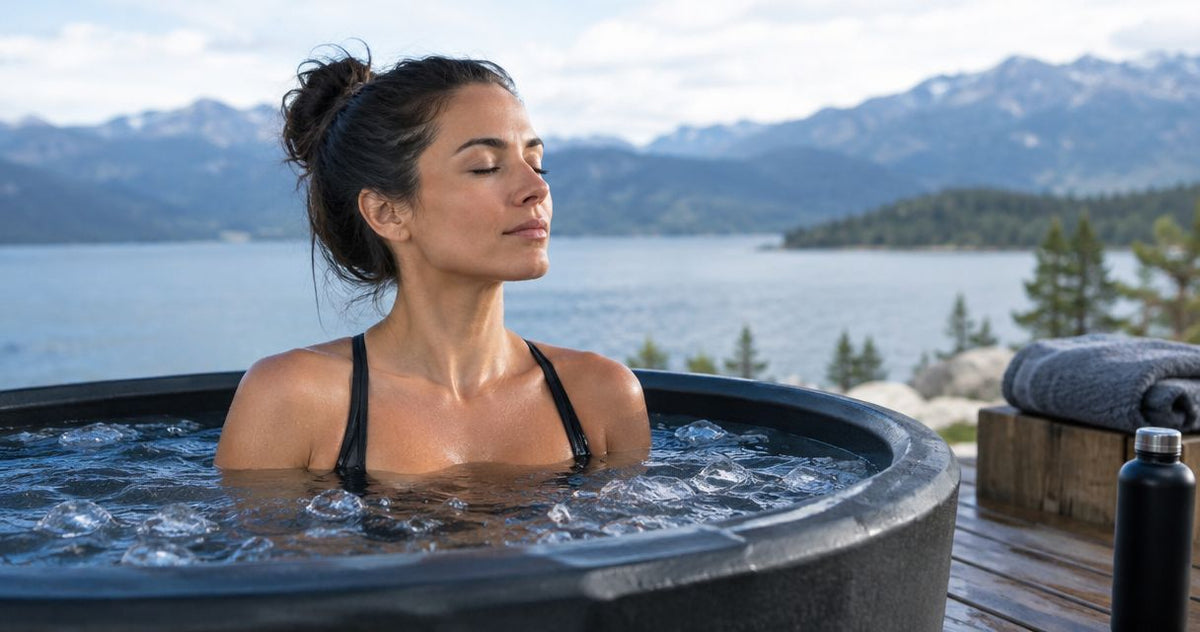
There is no fixed number of days or sessions it takes to get used to cold plunging. Repeated exposure can reduce the initial gasp and rapid-breathing response, but feeling calmer does not mean cold water has become safe or that you should stay in longer. Judge progress by controlled breathing, clear thinking, and an easy exit—not a deadline or tolerance challenge.
By Editorial Team
- How long to get used to cold plunging depends on exposure conditions; there is no universal adaptation deadline.
- Reduced cold shock does not eliminate cold-water risks or justify longer immersion.
- Record water temperature, immersion duration, breathing response, and recovery rather than chasing colder sessions.
- Aeva Vital ice baths are equipment for home immersion, not proof of a safe personal exposure limit.
How long does it take to get used to cold plunging?
Cold-plunge adaptation is a change in your response, not a countdown to complete protection. Research on repeated cold-water exposure describes habituation: the initial response becomes less pronounced after repeated exposure. That does not establish a universal schedule for a home user with a different temperature, immersion depth, health history, or routine.
Separate the immediate response during one plunge from changes across repeated sessions. Breathing settling during an immersion is not the same as becoming accustomed to repeated immersion over time. Neither establishes protection against continued cooling.
For a useful record, follow the same basic tracking approach each time. This guide to logging cold-plunge sessions covers the recording side; your actual water temperature and response still matter more than an app streak.
What does getting used to cold plunging actually mean?
People use the phrase to describe several different experiences. These are related, but they are not interchangeable measures of readiness.
| Change you notice | What it tells you | What it does not establish |
|---|---|---|
| Less hesitation before entering | The routine feels more familiar | Your cardiovascular response is harmless |
| A less pronounced initial breathing response | You are responding differently to that exposure | You can safely increase immersion time |
| Easier entry and exit | You have practiced the physical setup | A deeper or colder plunge is appropriate |
| Less perceived discomfort | The sensation feels more tolerable | Your body is no longer losing heat |
| More consistent session records | Your comparisons are more useful | A particular number of sessions guarantees adaptation |
Familiarity is not immunity to cold. Use that distinction whenever you assess progress or compare your experience with someone else's.
Why this matters
The strongest sensation often arrives at entry, which makes the first part of a plunge feel like the entire challenge. Continued cooling is a separate concern. A quieter initial response does not tell you how much longer you should remain immersed.
The RNLI's cold-water safety guidance identifies water below 15°C, or 59°F, as cold enough to seriously affect breathing and movement. That is a hazard reference, not a recommended beginner temperature or a guarantee that warmer water is risk-free.
A home tub removes waves and currents, but it does not remove the body's response to cold immersion. You still need a stable exit, appropriate medical advice, and another person present rather than relying on confidence alone.
Why the time needed to adapt varies
You cannot compare two adaptation stories without comparing the exposures behind them. These factors change the experience and make a fixed calendar misleading:
- Water temperature: Colder water changes the intensity of the exposure. Record the actual temperature rather than describing every session as an ice bath.
- Immersion depth: Immersing more of your body changes the exposure. Keep your head out and do not treat deeper immersion as an automatic progression.
- Immersion duration: A longer session is a different exposure, even when the water temperature stays the same. Longer is not proof of better adaptation.
- Previous exposure: Familiarity with cold water affects how you approach a plunge. Experience does not remove the need for precautions.
- Health and medication: Cardiovascular conditions, circulation problems, and medicines can affect suitability. Ask your clinician about your circumstances before starting.
- Session conditions: Wind, wet clothing, and the environment after exit affect your experience. Plan the exit and recovery environment before entering.
Changing several factors together makes progress difficult to interpret. If a session feels easier after you use warmer water and immerse less deeply, that does not demonstrate adaptation to the earlier exposure.
How should you approach the first sessions?
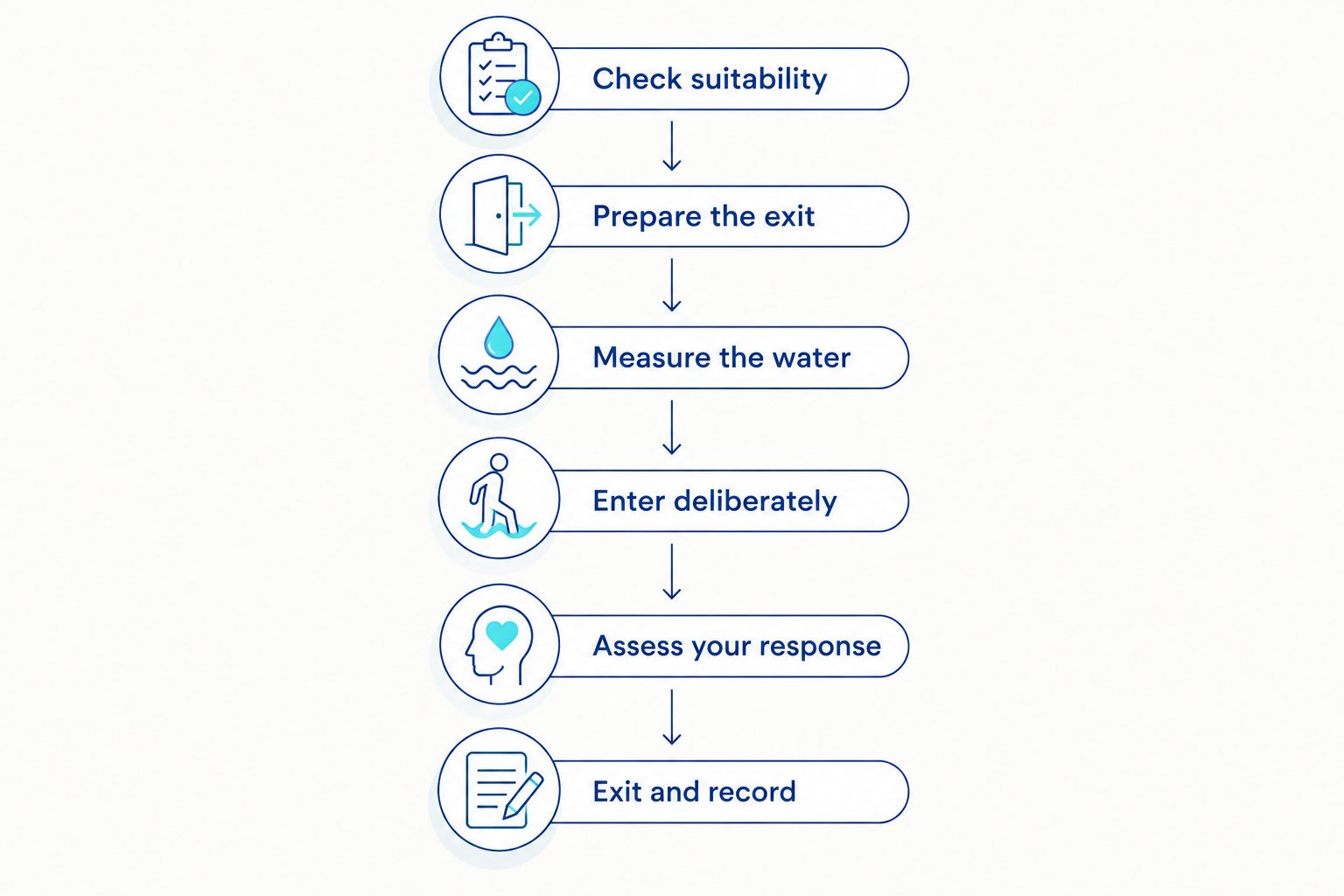
Use a repeatable setup rather than a predetermined endurance target. The following sequence organizes preparation; it is not a medical clearance or a universal temperature-and-time prescription.
- Check suitability. Discuss cold immersion with your clinician, particularly if you have a heart condition, blood-pressure concerns, circulation problems, a history of fainting, or take relevant medication.
- Prepare the exit. Check footing, hand support, and the route out. Put dry clothing within reach and have another adult present.
- Measure the water. Use a suitable thermometer. A chiller setting or the amount of ice added is not a substitute for checking the water you enter.
- Enter deliberately. Keep your head above water. Do not combine immersion with breath-holding or intentional hyperventilation.
- Assess your response. Pay attention to breathing, thinking, coordination, and symptoms. End the immersion instead of trying to override distress.
- Exit and record. Dry off, dress appropriately, and note the exposure and how you felt afterward. Do not use the record as pressure to exceed the previous session.
You do not need a dramatic first session to establish a useful routine. Being able to leave promptly and describe your response accurately is more useful than enduring a plunge that leaves you frightened, unsteady, or unwell.
What should you track instead of an adaptation deadline?
Keep the record short enough that you will actually use it. Write down the measured water temperature, immersion duration, immersion depth, breathing response, and symptoms during and after the session.
Record temperature consistently in degrees Fahrenheit or degrees Celsius, and duration consistently in seconds or minutes. Also note changes such as moving the tub outdoors or adding a heat session beforehand. Otherwise, an apparent improvement can simply reflect a different exposure.
Before entry
Note whether you feel well and whether the setup matches the previous session. Do not treat a scheduled plunge as an obligation when you are ill or feel unwell.
During immersion
Describe your breathing and ability to think clearly. Avoid a single toughness score: it can hide the difference between tolerable discomfort and a symptom that needs attention.
After exit
Record whether you could exit independently and how you felt while drying and dressing. A successful exit is part of the session, not an administrative detail after the timer stops.
A longer duration is not automatically a better result. The useful trend is a manageable response under comparable conditions—not a steadily increasing exposure.
When should you stop a cold plunge?
Exit immediately if you develop chest pain, dizziness, faintness, confusion, significant breathing difficulty, or loss of coordination. Do not wait for a timer or assume these symptoms are a necessary part of adaptation.
Persistent or severe symptoms need urgent medical attention. If someone collapses, becomes unresponsive, or is not breathing normally, contact emergency services and follow the dispatcher's instructions.
Do not use numbness as a success signal. Reduced sensation is not evidence that your tissues have stopped cooling, and difficulty using your hands can interfere with getting out safely.
Your exit plan should work before you are distressed. A slippery rim, unstable step, or awkward climb becomes more consequential when you are cold and your coordination is impaired.
Does getting comfortable mean you should go colder?
No—comfort alone does not justify colder water or a longer plunge. Habituation describes a reduced response to a familiar stimulus; it does not establish a personal safety limit.
Keep the purpose of the session separate from the urge to progress. If you cannot explain why you are changing temperature or duration, maintaining the existing setup is more sensible than escalating it.
Do not copy a social-media routine simply because its creator looks relaxed. Their apparent comfort does not reveal their health history, measured water temperature, supervision, or symptoms afterward.
Do you need to plunge every day to get used to it?
No universal daily schedule establishes safe cold-plunge adaptation. Repeated exposure and daily exposure are not the same instruction, and a missed day does not create a reason to compensate with a colder or longer session.
Choose frequency with appropriate clinical guidance and your response in mind. Stop treating consistency as a goal if it encourages you to ignore illness, distress, or an unsafe setup.
Does a home ice bath make adaptation easier?
A home ice bath gives you a dedicated place for immersion. It does not determine how quickly you adapt, and capacity alone does not tell you whether the entry, seated position, or exit will suit you.
Aeva Vital ice baths are best suited to shoppers seeking home-immersion equipment, not a prescribed adaptation program. The supplied product names identify a 76.6-gallon portable inflatable option and a 79-gallon outdoor option with a thermo lid. Those details describe the products; they do not establish a safe exposure duration.
| Option | Stated capacity | Best for | Stated feature | Limitation to check |
|---|---|---|---|---|
| Portable inflatable ice bath | 76.6 gallons | Buyers prioritizing a portable format | Inflatable construction | Confirm dimensions, entry, support, and temperature-management requirements |
| Outdoor cold-plunge tub | 79 gallons | Buyers seeking an outdoor-designated format | Thermo lid included | Confirm placement, entry, maintenance, and temperature-management requirements |
The portable format addresses a different buying priority from the outdoor designation. Neither specification proves personal fit, temperature stability, easy exit, or suitability for a particular health condition.
Before choosing Aeva Vital cold-plunge equipment, check the product's current instructions and measurements against your available space. Do not assume either product includes a chiller, filtration system, or temperature controls unless its current specifications explicitly confirm them.


What should you check before buying a tub?
Start with the physical task of getting in and out. A capacity figure describes water volume, not the height you must step over or the space you need to stand safely beside the tub.
Check the floor or ground requirements, filled load, drainage route, cleaning instructions, and storage needs against the manufacturer's documentation. For powered equipment, follow the electrical requirements and use qualified installation support where required.
Separate equipment convenience from health claims. A lid, portable construction, or outdoor designation does not prove a recovery benefit or make an aggressive immersion routine appropriate.
FAQ
How long to get used to cold plunging as a beginner?
There is no universal number of days or sessions for a beginner to get used to cold plunging. Repeated exposure can reduce the initial response, but temperature, immersion depth, health, and prior experience affect the experience.
Will cold plunging eventually stop feeling cold?
Cold plunging does not need to stop feeling cold for you to become more familiar with it. Reduced discomfort does not mean your body has stopped losing heat.
Should I stay in until my breathing settles?
Do not stay in solely to make your breathing settle. Exit if breathing is difficult or you feel distressed, dizzy, faint, or unwell rather than treating a calmer response as a requirement to finish.
What temperature should beginners use for cold plunging?
There is no single beginner temperature that is safe for everyone. Seek individualized guidance; the RNLI identifies water below 15°C, or 59°F, as cold enough to seriously affect breathing and movement, not as a recommended starting target.
Do I have to cold plunge every day to adapt?
You do not have to follow a universal daily cold-plunge schedule. Choose frequency with appropriate clinical guidance and do not compensate for missed sessions with longer or colder immersion.
Can I get used to cold plunging by holding my breath?
Do not combine cold plunging with breath-holding or intentional hyperventilation. Keep your head above water and leave if you cannot breathe comfortably.
Does a larger ice bath help you adapt faster?
A larger ice bath does not establish faster adaptation. Capacity describes volume; measured water temperature, immersion depth, exposure duration, and your individual response are more relevant to the experience.
Is it safe to cold plunge alone once I feel comfortable?
Feeling comfortable does not make solo cold plunging safe. Have another adult present and maintain an easy exit even after the routine becomes familiar.
Related guides
- Cold-plunge tubs ranked by tank capacity
- Portable cold-plunge tubs for home use
- Connecting a cold-plunge tub to a dedicated GFCI outlet
One last thing
The most useful sign of progress is not a longer timer reading. It is making a clear decision about whether to enter, remain, or exit without letting a streak or comparison override symptoms. Choose equipment around that decision: accessible entry, a dependable exit, and instructions you can follow.