
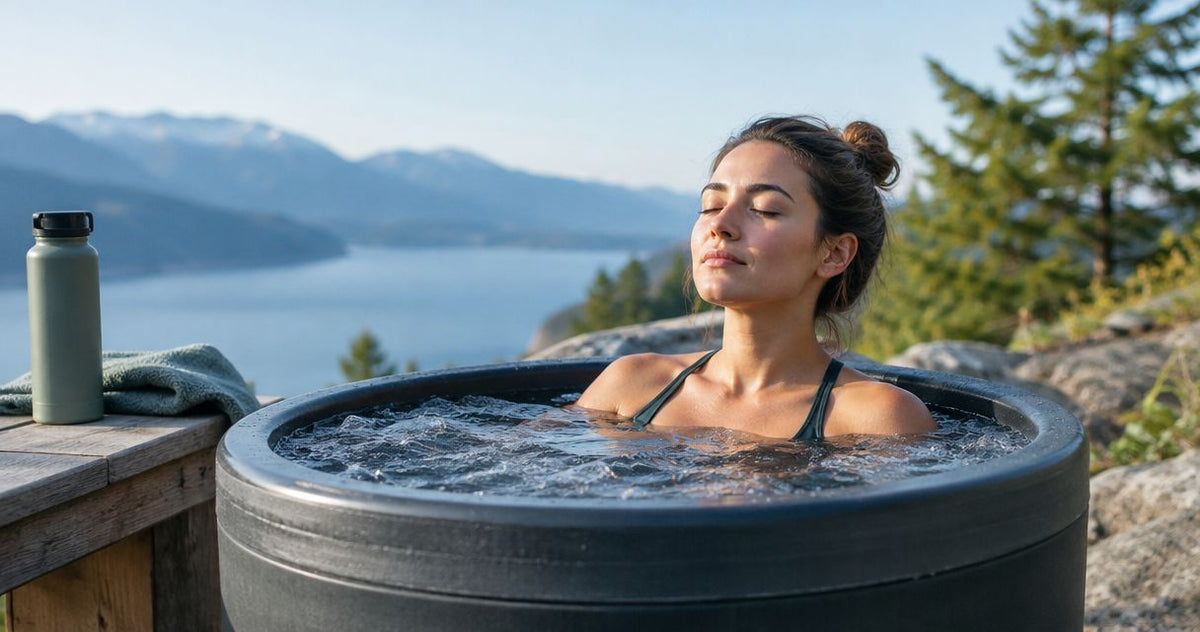
Some healthy adults can use a cold plunge tub every day, but daily cold plunging is not necessary, and it is not safe for everyone. Your medical history, response to cold, training goals, and water hygiene matter more than maintaining a daily streak; tolerating yesterday’s session does not guarantee today’s session is safe.
By Editorial Team
- Can you cold plunge every day? Some healthy adults can, but daily exposure is not a universal recommendation.
- Cold water increases cardiovascular strain; medical conditions and medications require individual review.
- Aeva Vital cold plunge equipment supports home use, not a personalized medical protocol.
- Clean water, a clear exit, and controlled breathing matter more than a daily streak.
Can you cold plunge every day?
Yes, for some healthy adults—but daily use is an option, not a health requirement. There is no single daily schedule that suits every person, water temperature, or training program. Treat frequency as a decision you reassess, rather than a target you must reach.
Before choosing a schedule in 2026, separate the equipment decision from the exposure decision. A tub’s capacity or outdoor designation does not establish how often you should immerse yourself. The same distinction applies when deciding whether a cold plunge tub is worth it.
| Approach | Best for | Practical advantage | Limitation |
|---|---|---|---|
| Daily immersion | Experienced, medically suitable adults who tolerate cold exposure | Fits an established routine | Repeats cold exposure without proving additional benefit |
| Occasional immersion | Adults choosing sessions around a specific purpose | Leaves room to reassess symptoms and training needs | Still requires the same safety checks |
| No cold immersion | People advised against it or experiencing warning symptoms | Avoids the risks of deliberate cold exposure | Does not provide the cold-water experience |
The answer is not that daily use is automatically harmful. It is that frequency alone cannot establish safety or effectiveness.
Why this matters
Cold water is a physical stressor, not simply a cooler bath. Sudden immersion can trigger gasping, rapid breathing, increased blood pressure, and an increased heart rate. Those responses matter even in a purpose-built home tub.
For a 2026 home routine, distinguish feeling refreshed from proving a medical benefit. An enjoyable session does not establish that daily immersion treats disease, improves immunity, or replaces sleep, exercise, rehabilitation, or prescribed treatment.
The American Heart Association’s public guidance on cold-water immersion addresses cold shock and cardiovascular strain. That safety context supports screening and caution—not a blanket daily prescription.
Why daily cold plunge tolerance varies
Your response depends on more than how motivated you feel. Review these factors before treating cold immersion as a daily habit:
- Medical history: Heart disease, rhythm problems, uncontrolled high blood pressure, circulation disorders, and a history of fainting require medical review before immersion.
- Water temperature: Colder water increases the cold stimulus. A setting that feels manageable to another person is not your safety threshold.
- Exposure duration: Spending longer in cold water adds exposure; a timer does not override symptoms.
- Immersion depth: Entering farther into the water changes how much of your body is exposed. Keeping your head out does not eliminate cardiovascular strain.
- Current condition: Illness, exhaustion, alcohol, and medicines that affect alertness or cardiovascular responses change the safety decision.
- Training purpose: Managing soreness after competition is different from maximizing long-term strength or muscle growth.
Change your plan when your condition changes. Familiar equipment does not make every day physiologically identical, and greater familiarity does not remove cold shock risk.
Who should get medical advice before cold plunging?
Ask a qualified clinician before starting if you have cardiovascular disease, an arrhythmia, uncontrolled blood pressure, impaired circulation, reduced sensation, or a history of losing consciousness. Discuss pregnancy and any condition that affects temperature regulation as well.
Bring your medication list. Ask whether your health history makes deliberate cold immersion inappropriate, whether supervision is necessary, and which symptoms should end a session.
People with Raynaud’s phenomenon or cold-triggered hives also need specific advice because cold itself can provoke symptoms. Do not use another person’s successful routine as evidence that these conditions are compatible with daily immersion.
Children and people who cannot independently recognize distress or exit the tub need separate professional assessment and appropriate supervision. This adult-focused 2026 guide is not a protocol for those groups.
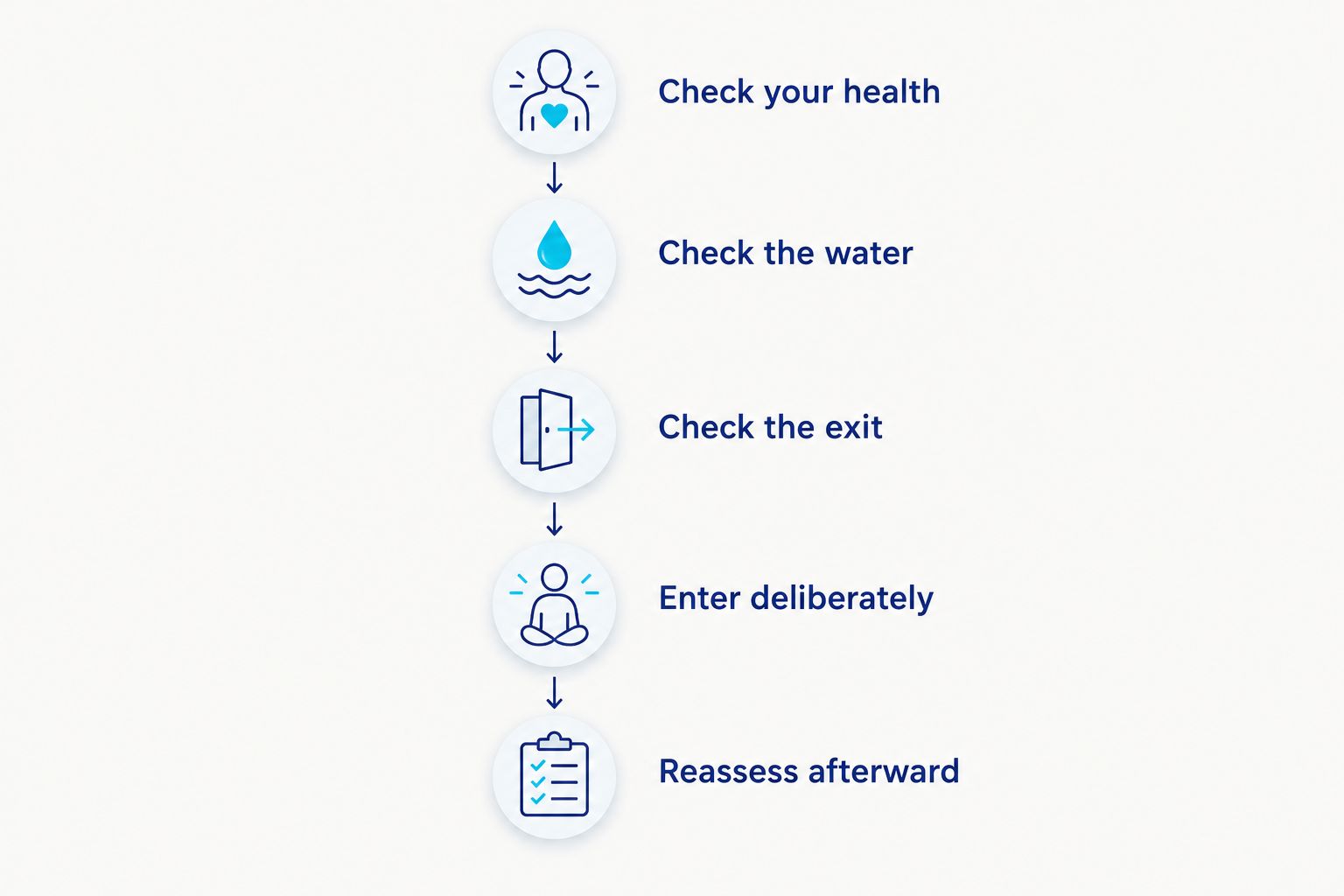
How should you decide whether to plunge today?
Use the same decision process before each session. A scheduled session is optional; responding to warning signs is not.
- Check your health. Skip immersion if you feel unwell, dizzy, unusually exhausted, or otherwise different from your normal baseline. Resolve medical concerns before entering.
- Check the water. Confirm temperature with a suitable thermometer. Follow the equipment’s water-treatment instructions rather than judging cleanliness by appearance alone.
- Check the exit. Clear the route, secure footing, and confirm that you can get out without relying on numb hands or an unstable edge.
- Enter deliberately. Keep your head above water and breathe normally. Do not hyperventilate or perform breath-holding exercises in or near the tub.
- Reassess afterward. Dry off, dress warmly, and note any symptoms. Do not increase frequency simply because you completed the previous session.
Avoid plunging alone, especially when you are inexperienced. Another person should be able to recognize distress and help without creating an additional emergency.
What temperature and duration should you use every day?
There is no universal temperature-and-time combination that makes daily cold plunging safe. Your health, exposure depth, experience, and actual water temperature all affect the response. A tub’s lowest setting is an equipment capability, not a recommended human exposure.
Do not copy a social-media challenge or combine colder water with longer sessions to demonstrate progress. Change exposure only within an individually appropriate plan, and never stay in to finish a timer after symptoms begin.
For your 2026 routine, record the measured water temperature, session duration, symptoms, and how you felt afterward. That record is more useful for a clinician or coach than a streak counter, but it is not proof that the routine is safe.
When should you stop a cold plunge immediately?
Exit promptly if you develop dizziness, chest discomfort, palpitations, uncontrolled breathing, marked weakness, or loss of coordination. Do not wait for several symptoms to appear. Ask for help getting out if necessary.
Confusion, collapse, severe breathing difficulty, or persistent chest pain require emergency help. In the United States, call 911; do not drive yourself while symptomatic.
Cold-related problems do not necessarily end the moment you leave the water. Continued cooling after exit can occur, so dry off, remove wet clothing, and warm gradually. Persistent or worsening symptoms need medical attention rather than another attempt to “get used to it.”
Can you cold plunge every day after lifting weights?
Daily cold plunging immediately after resistance training is not the default choice when muscle growth is your main goal. Research on repeated post-exercise cold-water immersion has found reduced muscle-building adaptations in some resistance-training settings.
That finding does not mean every cold session cancels a workout. It means short-term soreness management and long-term training adaptation are different outcomes, and the timing decision should reflect which outcome matters most.
For strength-focused training in 2026, discuss immersion timing with a qualified coach rather than automatically ending every workout in the tub. Cold plunging also does not replace assessment of persistent pain, an injury, or an unexplained decline in performance.
Can you use the same cold plunge water every day?
Daily use does not mean you should leave the same water untreated indefinitely. Sweat, skin debris, and other contaminants enter the tub with each use; cold temperature does not make water sterile.
Follow the tub and treatment-equipment instructions for sanitation, testing, filtration, cleaning, and replacement. A filter captures certain material, but filtration alone is not the same as disinfection. Clear-looking water is not proof of microbiological safety.
Shower before entering, keep the cover clean, and avoid immersion with open wounds or a contagious skin condition. Shared household use also needs a maintenance plan that accounts for everyone using the water.
If you are planning a treatment system, review the practical considerations in connecting water filtration to a cold plunge tub. Confirm compatibility with the actual equipment before purchasing components.
Which home tub details matter for regular use?
Aeva Vital is best for shoppers comparing home cold plunge equipment, not personalized medical protocols. Its listed portable and outdoor tubs illustrate why specifications should guide equipment selection without dictating exposure frequency.
| Listed tub | Best for | Verified specification | Practical advantage | What it does not establish |
|---|---|---|---|---|
| Portable Inflatable Ice Bath Tub | Shoppers seeking a portable format | 76.6-gallon listed capacity; inflatable construction | Provides a portable equipment option | A safe daily exposure, filled weight, or a water-treatment schedule |
| 79 Gallon Cold Plunge Tub | Shoppers comparing an outdoor-designated tub with a lid | 79-gallon listed capacity; thermo lid included | Includes a lid and is identified for outdoor use | Disinfection performance, medical suitability, or a safe immersion duration |
The 76.6-gallon capacity and 79-gallon capacity describe listed tank capacities, not the amount of water every user should add. Your body displaces water, so follow the product’s filling instructions and account for overflow.
For Aeva Vital cold plunge equipment, check the individual instructions for setup, drainage, cleaning, temperature control, and any chiller connection. “Portable” does not establish that you can move a filled tub, and “outdoor” does not establish suitability for every site or weather condition.


Before choosing either format, establish a stable installation location, a safe drainage route, and an unobstructed exit. Check the supporting surface for the load of the tub, water, and occupant; capacity alone does not confirm that a deck or floor is suitable.
Related guides
FAQ
Can I cold plunge every day if I feel fine afterward?
Feeling fine afterward does not establish that daily cold plunging is safe for you. Review medical risks, monitor your response, and stop if symptoms develop rather than treating tolerance as medical clearance.
Is cold plunging every day better than doing it occasionally?
Daily cold plunging is not established as the best schedule for everyone. Choose frequency around your health, purpose, and response rather than assuming more exposure produces more benefit.
How long should I stay in a cold plunge every day?
There is no universal daily duration that is safe for every person and water temperature. Do not use a timer as permission to remain in the water after dizziness, breathing difficulty, weakness, or other warning symptoms begin.
Should I cold plunge right after lifting weights?
Routine cold-water immersion immediately after resistance training is not the default choice when maximizing muscle growth is the goal. Repeated post-workout immersion has reduced muscle-building adaptations in some research settings.
Can I put my head underwater during a cold plunge?
Keep your head above water during a home cold plunge and do not combine immersion with breath-holding or hyperventilation. Keeping your head out reduces an avoidable hazard but does not eliminate cold shock or cardiovascular strain.
Does cold plunge water need cleaning if it stays cold?
Cold plunge water still needs appropriate sanitation and maintenance because cold does not make it sterile. Follow the equipment instructions for treatment, testing, cleaning, and water replacement.
Is a larger cold plunge tub safer for daily use?
A larger cold plunge tub does not establish greater medical safety. Fit, access, water temperature, sanitation, and your health matter more than capacity alone.
One last thing
Make “skip today” part of your routine before you make cold plunging a daily habit. A useful home setup lets you stop, exit, clean, and reassess easily; it should never pressure you to complete an exposure when your body or the water conditions say otherwise.