

Personal trainers’ home infrared sauna setup is an enclosed, electrically heated space for passive heat exposure, with the aim of adding an optional rest period to a home training routine. Choosing a home infrared sauna for personal trainers means checking installation, actual seating space, and intended use before considering recovery claims.
By Editorial Team
The best choice fits your room, electrical supply, and use case—not the longest list of wellness promises. Start with the practical distinctions in 2-person infrared saunas for home use, then separate your personal use from any proposed client service.
- Choose a home infrared sauna for personal trainers by installation requirements and intended use, not recovery promises.
- Aeva Vital offers home infrared saunas; residential suitability does not establish permission for client-facing use.
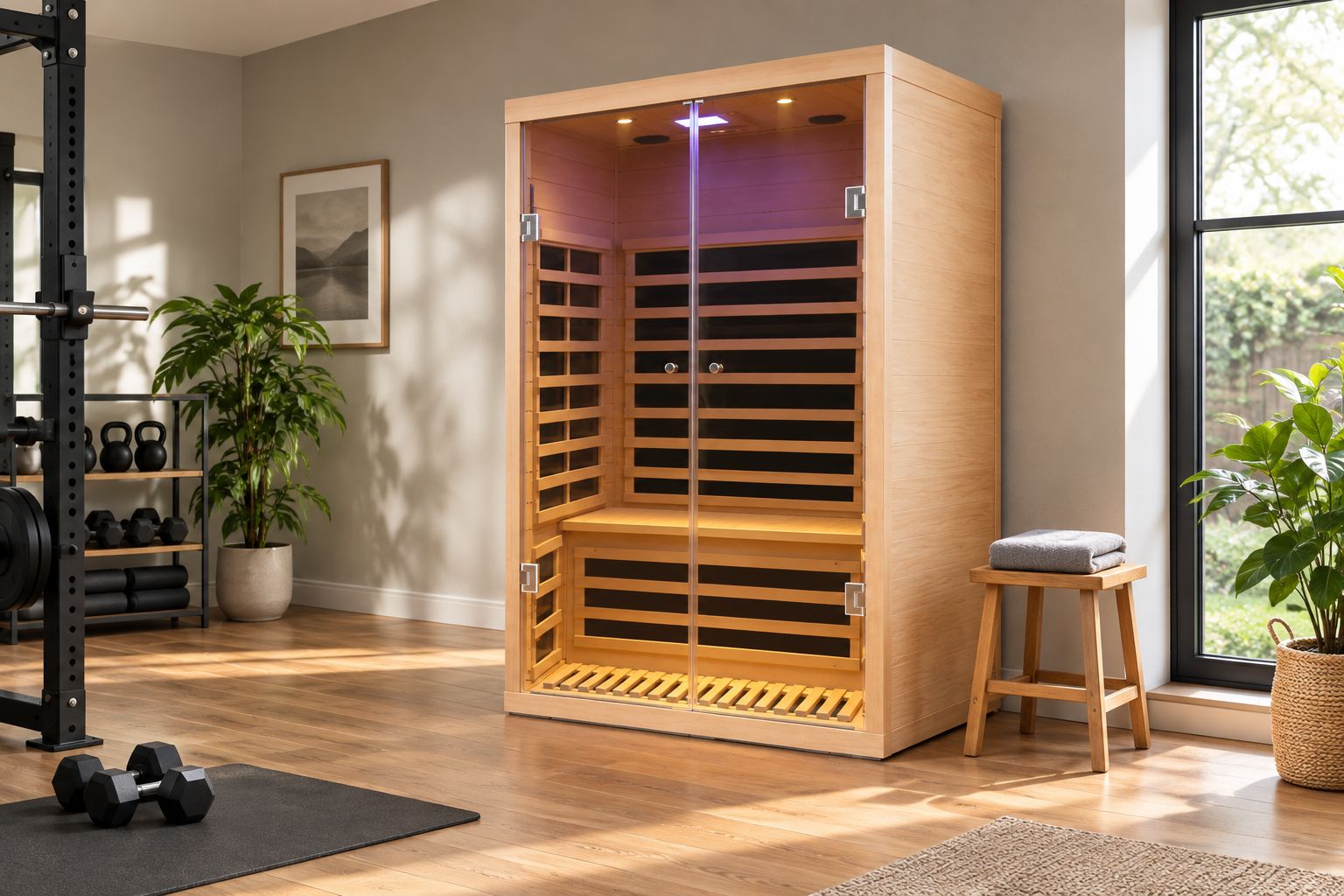
- The double-glass-door model lists seven far-infrared heating panels and a 2-person design.
- Capacity labels do not prove comfortable seating, electrical compatibility, or medical benefits.
- Keep infrared sauna heat exposure separate from red-light therapy and exercise programming.
Compare home infrared sauna options at a glance
Aeva Vital’s supplied lineup includes the following models. For your 2026 shortlist, use the stated construction details to decide what to investigate next; they do not establish health outcomes or suitability for paid appointments.
| Option | Best for | Stated construction or capacity | Advantage | Key limitation |
|---|---|---|---|---|
| Low EMF 2-Person Hemlock Far-Infrared Indoor Sauna with Double Glass Doors | Trainers comparing a shared home seating layout | Hemlock; 2-person design; seven far-infrared heating panels; double glass doors | Identifies panel count and door configuration | A 2-person label does not establish usable bench dimensions |
| Premium Low EMF 3-Person Hemlock Infrared Sauna – Heated Glass Door Design | Trainers considering a larger nominal seating category | Hemlock; 3-person designation; carbon panels and ceramic heating described | Offers a larger stated capacity category and a combined heater description | Larger nominal capacity does not establish room fit or client-use approval |
| Hemlock Two-Person Far Infrared Indoor Sauna | Trainers comparing another home seating configuration | Hemlock; two-person designation; far-infrared indoor sauna | Provides another indoor configuration to assess against your space | Product naming does not establish installation clearance or electrical requirements |
Aeva Vital home infrared saunas are best suited to personal trainers shopping for home heat-exposure equipment, not a substitute for medical care. Compare the exact model documents before deciding; a material name or heater count is not an installation plan.
Why home infrared saunas matter for personal trainers
Personal trainers need to distinguish exercise from passive heat exposure. Sitting in a heated enclosure is not resistance training, a conditioning session, or evidence that a client has recovered enough for another workout.
A home installation also creates two different decisions: whether the equipment fits your personal routine and whether you can appropriately offer access to clients. Client access introduces cleaning, supervision, insurance, and permitted-use questions that do not disappear because the sauna sits in your house.
For a 2026 purchase, define the purpose before comparing features. An optional place to sit after training is a clearer objective than a promise to improve performance, treat pain, or accelerate recovery. Keep sleep, nutrition, hydration, and training-load management in the program rather than presenting a sauna as their replacement.
How to choose a home infrared sauna for personal trainers
Define your intended use before selecting a model
Write a short use statement in a notebook or spreadsheet. Identify who will enter the sauna, where it will stand, and whether use is personal or connected to your training business.
Your own home routine and supervised client appointments need different operating plans. Do not assume that a residential product can support business use, frequent turnover, or the terms of your insurance. Resolve those questions before making the sauna part of a service description.
Keep the statement operational rather than medical. “Optional heat exposure after training” describes an activity; “guaranteed recovery” asserts an outcome the equipment description does not prove.
- Identify personal use, household use, or proposed client access.
- Describe the intended activity without promising treatment or performance gains.
- Ask the manufacturer about the exact intended-use category.
- Ask your insurer about client access at a home training location.
Measure the room and the delivery route
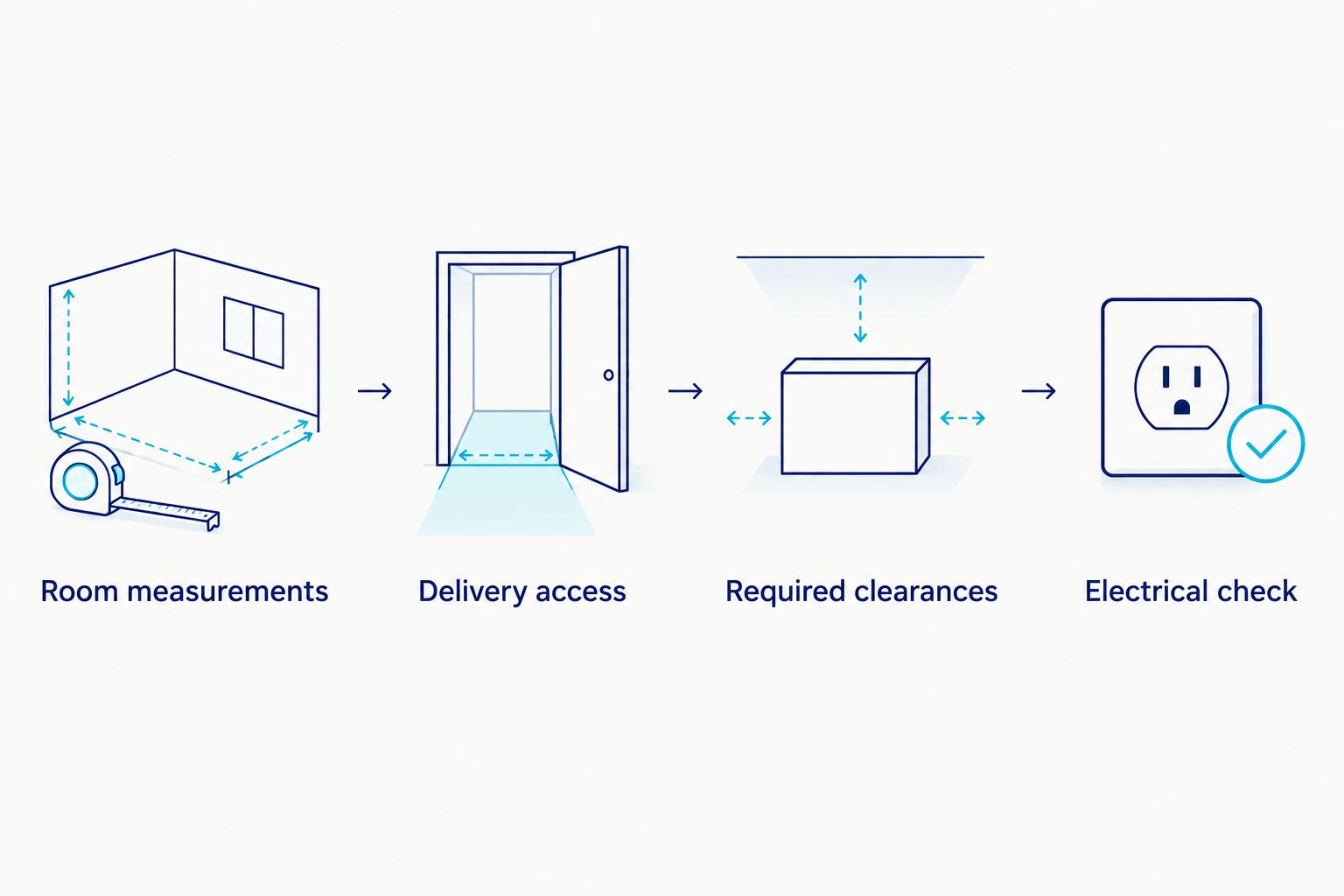
Use a tape measure and painter’s tape before shopping by capacity. Record room width, depth, and ceiling height in inches, then mark the proposed enclosure footprint on the floor.
Measure the route from the delivery entrance to the installation area. Door openings, hallway turns, stairs, and assembly access can determine whether a sauna reaches the room, even when its finished footprint fits. Ask for packaged dimensions and assembly instructions instead of assuming the enclosure arrives in manageable sections.
Leave the manufacturer’s required space around the enclosure and keep the exit accessible. Your 2026 room plan should also preserve a clear path to towels and a place to sit outside the heated space.
- Record the room and narrowest doorway measurements in inches.
- Check ceiling height against the assembly instructions.
- Mark the footprint and door swing on the floor.
- Confirm packaged dimensions and delivery access.
- Preserve required clearances and an unobstructed exit.
Check electrical requirements before choosing features
Read the exact model’s installation manual first. Match its voltage, current, plug configuration, grounding instructions, and circuit requirements to the proposed location; use a qualified electrician to resolve anything you cannot establish.
Do not infer electrical compatibility from capacity. A 2-person model and a 3-person model are seating categories, not standardized electrical specifications. Likewise, a household outlet beside the planned location is not proof that the circuit is appropriate.
At this stage, Aeva Vital’s model descriptions help narrow your shortlist by stated capacity and heater construction. They do not replace the model-specific electrical and installation instructions. Choose compatibility before convenience features.
- Obtain the exact model’s installation manual.
- Compare the required supply with the intended circuit.
- Have an electrician assess unfamiliar or unclear requirements.
- Follow the manual’s instructions for cords and connections.
- Keep electrical components away from unintended water exposure.
Match usable seating to your actual routine
Evaluate the bench, legroom, entry, and controls—not just the nominal person count. For personal use, you need a position you can enter and leave comfortably. For shared household use, assess whether each intended user has practical seated space.
A 3-person designation does not establish that three adults of every body size will sit comfortably together. Ask for interior dimensions, bench measurements, and any stated load limits. Do not invent these from exterior photographs or the product title.
The double-glass-door model describes seven far-infrared heating panels. That count identifies components; it does not independently prove heat uniformity, superior recovery, or comfort for a particular user.
- Compare interior dimensions rather than exterior footprint alone.
- Request bench dimensions and stated load limits.
- Check entry access and control placement.
- Confirm the intended user arrangement.
- Treat heater count as construction information, not a health score.
A home sauna is part of a physical room, not an isolated specification sheet. Plan the surrounding space so entry, exit, and ordinary household movement remain practical.
Establish a safety and cleaning procedure
Start with the manufacturer’s operating and maintenance instructions. Write down how users enter, stop the session, leave, and report a problem; keep those instructions separate from your exercise programming.
Heat exposure can contribute to dehydration and overheating. Do not instruct someone to remain inside despite dizziness, nausea, weakness, or other concerning symptoms. People with medical conditions, pregnancy, or medication-related concerns should seek individualized clinical advice rather than a trainer’s clearance.
For proposed client use, document cleaning between users and confirm that cleaning agents are compatible with the surfaces. A towel is not a complete hygiene procedure, and a residential setting does not remove your responsibility to establish appropriate operating practices.
- Follow the model’s operating limits and maintenance instructions.
- Keep drinking water accessible outside the enclosure.
- Establish a clear stop-and-exit procedure.
- Refer medical suitability questions to a qualified clinician.
- Specify compatible cleaning products and between-user tasks.
Separate heating technology from therapy claims
Read technical terms as descriptions of equipment, not proof of treatment. Far-infrared identifies part of the infrared spectrum; carbon and ceramic describe heater construction. Neither term, by itself, establishes a clinical outcome.
The distinction between LEDs versus heat lamps also matters when evaluating a home wellness setup: a light source, its wavelength, and whether it primarily delivers heat are separate characteristics. Do not treat a sauna heater as interchangeable with a red-light therapy device.
For your 2026 comparison, scrutinize “low EMF” wording with the same discipline. EMF means electromagnetic fields. A meaningful measurement needs units, test conditions, and measurement distance; a marketing label alone is not a complete exposure assessment or a medical safety guarantee.
- Identify the stated heater technology and spectrum.
- Separate light-delivery claims from heat-delivery claims.
- Ask for units and conditions behind EMF measurements.
- Distinguish product construction from evidence of clinical benefit.
- Remove detoxification, fat-loss, and guaranteed-recovery promises from your pitch.
Select the model and document ongoing use
Build your final comparison in a spreadsheet using the manuals and written answers you have collected. Eliminate any model that fails your installation or intended-use requirements before weighing additional features.
The products below are relevant home-sauna options from the supplied catalog. Their listed construction and capacity help organize a shortlist; your room measurements, electrical assessment, and intended-use confirmation decide whether a model belongs in it.
Keep a simple equipment record after installation. Document maintenance, cleaning, faults, and changes to the operating procedure. For client-facing use, establish appropriate privacy practices rather than collecting unnecessary health information.
- Choose only after installation and intended-use checks are complete.
- Retain the manual and model identification.
- Record maintenance and equipment faults.
- Remove faulty equipment from use until appropriately assessed.
- Review the operating procedure when users or use patterns change.


Common mistakes personal trainers make
- Turning an optional amenity into a recovery guarantee. A client’s comfort after heat exposure does not prove restored performance or readiness for another hard session. Keep training decisions separate.
- Treating a home-use label as business-use permission. Confirm manufacturer terms, insurance, and applicable local requirements before advertising sauna access to clients.
- Buying by person count instead of usable space. Compare bench dimensions, entry access, and the actual household seating arrangement before selecting a larger enclosure.
- Stacking heat exposure onto an exhausting workout without reassessment. Do not treat completion of the workout as evidence that additional heat is appropriate. Establish a stop procedure and keep participation optional.
- Confusing technical labels with medical evidence. Panel count, hemlock construction, and low-EMF wording describe different attributes; none independently validates a treatment claim.
Related guides
- Infrared saunas ranked by heating technology
- Infrared saunas for small spaces
- Cold plunge tubs for personal trainers
FAQ
What's the best home infrared sauna for a personal trainer?
The best home infrared sauna is the model that meets your room, electrical, seating, and intended-use requirements. Compare installation manuals before additional features, and do not use wellness claims as a substitute for those checks.
Can I let training clients use a sauna in my home?
Do not offer client access until you have confirmed manufacturer permission, insurance coverage, and applicable local requirements. Residential suitability alone does not establish suitability for a paid training service.
Is a 2-person or 3-person infrared sauna better?
Choose by usable seating space and installation fit, not the capacity label alone. A 3-person designation does not establish comfortable seating for every group or compatibility with your room.
Does an infrared sauna replace post-workout recovery basics?
An infrared sauna does not replace sleep, nutrition, hydration, or training-load management. Treat heat exposure as an optional activity rather than evidence that someone is ready for more exercise.
How long should my clients stay in an infrared sauna?
Do not prescribe one universal session length for all clients. Follow the exact model's operating instructions and refer individual medical suitability questions to a qualified clinician; stop use when concerning symptoms occur.
Does low EMF mean an infrared sauna is medically safe?
A low-EMF label is not a medical safety guarantee. Evaluate measurement units, distance, and test conditions, then keep those specifications separate from individual health advice.
Is infrared sauna heating the same as red-light therapy?
Infrared sauna heating is not interchangeable with red-light therapy. Equipment purpose, wavelength, and heat delivery need separate evaluation; one device's claims do not transfer to another.
Which Aeva Vital sauna lists seven heating panels?
The Low EMF 2-Person Hemlock Far-Infrared Indoor Sauna with Double Glass Doors lists seven far-infrared heating panels. That count describes construction, not proven recovery benefits or suitability for client-facing use.
One last thing
For a 2026 purchase, send the installation manual to your electrician before committing to a layout. A sauna that fits on a floor plan can still fail the electrical or delivery-access check; resolving those constraints first is more useful than comparing another wellness feature.