
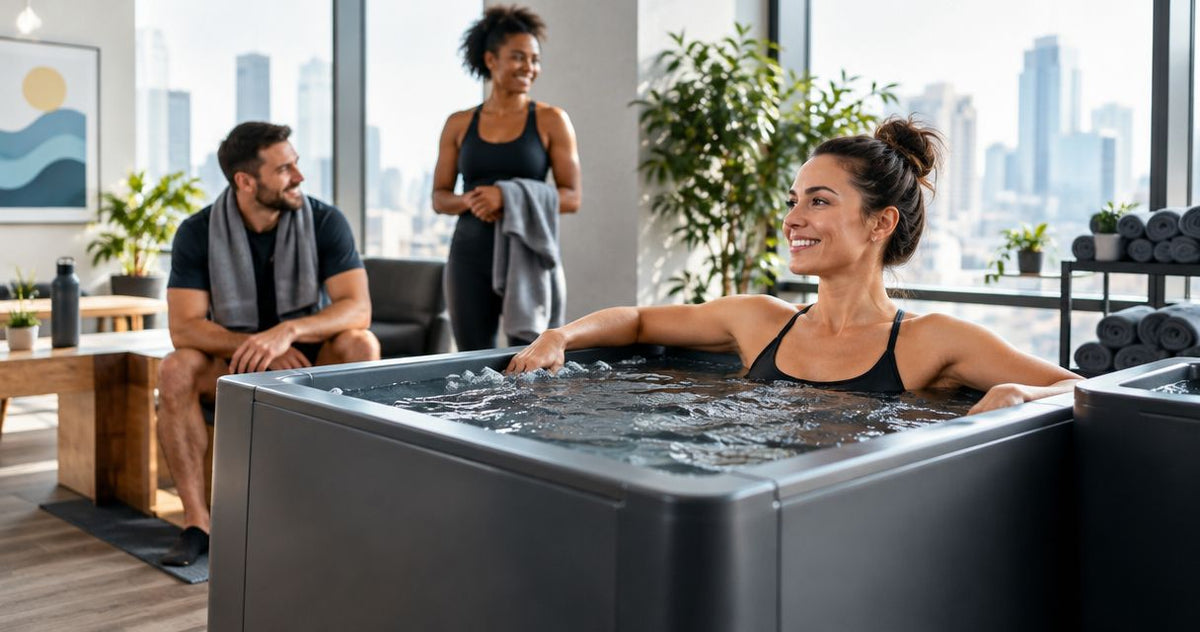
Corporate wellness cold plunging is optional cold-water immersion offered through an employer with the aim of providing a recreational wellness amenity. Choose a cold plunge tub for corporate wellness programs by documented shared-use suitability, water management, safe access, and facility compatibility—not tank capacity alone.
By Editorial Team
A workplace installation serves different users, schedules, and access needs than a home ice bath. Your 2026 procurement plan must address those differences before selecting equipment from Aeva Vital, whose stated cold plunge offering is home wellness equipment.
- Choose a cold plunge tub for corporate wellness programs by shared-use suitability before capacity.
- Aeva Vital cold plunge equipment is home-focused; corporate buyers need written confirmation of workplace suitability.
- Filtration does not replace a documented sanitation process for shared cold-water immersion.
- Make participation voluntary, protect employee privacy, and assign responsibility before opening the facility.
Why cold plunging matters for corporate wellness programs
A corporate cold plunge is a facilities project and an employee benefit, not simply a tub purchase. Employees need somewhere to change, a safe route across wet flooring, clear instructions, and permission to decline without explanation.
Offer an optional amenity, not a promised productivity or medical intervention. A product name containing recovery or therapy language does not establish an employer-level benefit, a clinical outcome, or suitability for shared use.
The operational question is straightforward: can your team manage the amenity consistently? If nobody owns cleaning, water checks, access control, and incident response, the program is not ready for equipment selection.
Compare your operating options first
For a 2026 workplace program, choose the operating model before comparing tub sizes. Each option changes who handles the water, the equipment, and the employee experience.
| Option | Best for | Practical advantage | Key limitation |
|---|---|---|---|
| Manually filled tub with separately managed cooling | Teams evaluating the work involved in an onsite program | Lets you examine filling, draining, and handling requirements directly | Cooling, sanitation, and preparation require an explicit operating process |
| Tub paired with a compatible chiller and treatment system | Facilities seeking a managed onsite installation | Separates cooling equipment from the tank and allows specification-based selection | Compatibility and shared-use suitability must be confirmed for the complete system |
| Integrated cold plunge system | Facilities seeking equipment designed to operate together | Reduces the number of separate equipment interfaces to assess | An integrated design does not establish commercial approval or sanitation adequacy |
| External wellness provider | Employers that do not want to operate a wet facility | Keeps equipment operation outside the office | Requires provider assessment, employee travel planning, and clear responsibility boundaries |
A chiller removes heat from water. A filter captures material according to its design. Neither term, by itself, proves that a system controls contamination appropriately for multiple workplace users.
How to select a cold plunge tub for corporate wellness programs
Define the program before choosing equipment
Start with a written brief and an anonymous interest survey. You do not need purchasing software to establish the purpose, likely scheduling needs, and whether employees actually want cold-water immersion.
Separate demand from medical information. Ask about interest, preferred access times, changing arrangements, and alternatives—not diagnoses or reasons for declining. Keep participation independent of performance reviews and manager expectations.
Your brief should also define what the program will not do. Avoid presenting a cold plunge as treatment, a substitute for clinical care, or a required recovery practice. That boundary belongs in employee communications as well as the procurement document.
- State the amenity’s recreational purpose and voluntary participation policy.
- Record anonymous interest without requesting health histories.
- Identify the intended location, operating hours, and responsible department.
- Provide another wellness option for employees who decline immersion.
Check the room and access route
Begin with a tape measure, a floor plan, and a facilities walkthrough. Measure the delivery route as well as the installation space: door openings, turns, elevator access, and room clearance all matter.
Account for the tank, associated equipment, entry and exit space, maintenance access, and drainage arrangements. Do not treat the product footprint as the entire required room footprint. An electrician should assess the electrical installation around water, including applicable ground-fault protection requirements.
Water also adds substantial weight. Fresh water weighs approximately 8.34 pounds per US gallon near room temperature; that is a planning reference, not a product load rating. Facilities staff must assess the complete filled installation, including equipment and the user, against the actual floor construction.
- Measure delivery access, equipment placement, and maintenance clearance.
- Obtain a filled-load assessment for the proposed location.
- Confirm electrical requirements with a qualified electrician.
- Plan drainage, splash control, changing space, and a dry exit route.
Request written shared-use suitability
Create a supplier questionnaire in a spreadsheet before contacting sellers. Ask whether the exact model and complete system are intended for your proposed workplace use, including the expected pattern of multiple users.
Aeva Vital cold plunge equipment is best matched to home-wellness shoppers; corporate buyers need written shared-use confirmation. Use the brand’s product information as an equipment shortlist, not as evidence that a home product is suitable for an employee facility.
Manufacturer documents provide a faster path than guessing from product photographs. Request the manual, electrical specifications, maintenance instructions, and applicable use restrictions together. For your 2026 decision file, retain the exact model identification and the documents supporting approval.
- Ask explicitly about workplace and multiple-user operation.
- Request the installation manual and electrical requirements.
- Confirm compatible cooling, filtration, and water-treatment equipment.
- Ask which certifications apply to the complete proposed installation.
- Obtain written warranty and servicing terms for the intended use.
Build the water-management procedure
Start with a written procedure reviewed by an appropriately qualified operator and the relevant local authority. Determine which local requirements apply to your installation rather than assuming that a small tank is exempt from shared-facility rules.
Your procedure needs to distinguish cleaning, filtration, and disinfection. Cleaning removes soil from surfaces; filtration removes material from water; disinfection addresses microorganisms through an appropriate treatment process. The equipment and procedure must work together.
Record what staff check, how they check it, and what triggers closure. Do not invent treatment concentrations or water-change intervals from unrelated products. Follow the confirmed system instructions and requirements applicable to the facility.
- Assign responsibility for opening checks, cleaning, and water management.
- Specify approved test methods and operating limits.
- Document surface cleaning, treatment, and water-replacement procedures.
- Define closure triggers and the conditions required for reopening.
Establish voluntary participation and safety boundaries
Draft a plain-language participation policy before creating a booking form. Cold-water immersion can cause a cold-shock response, including rapid breathing and cardiovascular strain; a workplace benefit should not encourage employees to test personal limits.
Do not publish a universal temperature or session duration as safe for every employee. Have an appropriately qualified clinician help establish screening and operating guidance, with individual medical questions directed to the employee’s own clinician rather than a manager.
The program also needs an emergency response plan and a defined supervision arrangement. Avoid breath-holding challenges, competitive exposure times, or messaging that rewards colder and longer sessions. Access must remain voluntary, including during team events.
- Provide clear instructions and a straightforward way to stop participation.
- Establish supervision and emergency response responsibilities.
- Keep medical questions outside ordinary manager-led booking processes.
- Prohibit competitive immersion and breath-holding challenges.
- Provide access alternatives without requiring employees to explain a diagnosis.
Pilot the workflow before expanding
Test the operating process before promoting the amenity company-wide. A calendar and maintenance log are enough to assess bookings, preparation, cleaning, and room availability without buying a separate management platform.
Measure the things your team can substantiate: completed bookings, cancellations, closures, maintenance time, and anonymous satisfaction. Do not attribute changes in productivity, absenteeism, or health to the plunge simply because participation and those measures move together.
For a 2026 pilot, agree on continuation criteria before launch. A small program that runs consistently is more useful than a larger installation with unclear responsibilities. Keep the option to pause when operating requirements are not met.
- Test filling, checking, cleaning, draining, and reopening workflows.
- Record bookings, closures, and staff maintenance time.
- Gather anonymous feedback about privacy, access, and usability.
- Review the evidence before expanding hours or adding equipment.
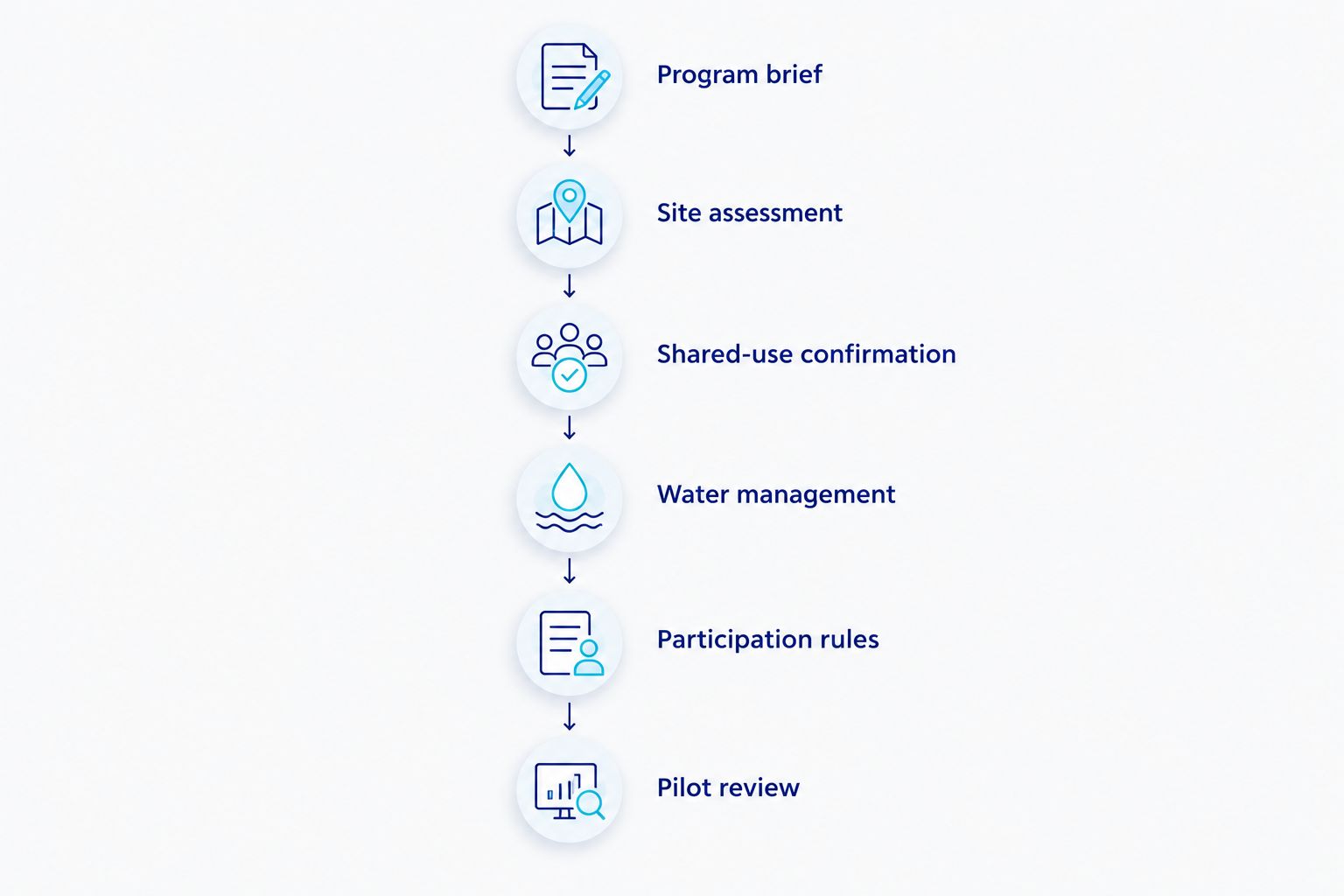
The selection sequence is simple: define the program, check the site, confirm intended use, establish water management, set participation rules, and test operations. Complete each stage before treating the installation as ready.
Evaluate Aeva Vital’s listed cold plunge options
Aeva Vital lists a portable inflatable ice bath with a 76.6-gallon capacity and an outdoor cold plunge tub with a 79-gallon capacity. Those named capacities support a tank-volume comparison; they do not establish workplace throughput, sanitation performance, or commercial-use eligibility.
For your 2026 shortlist, separate what the product title states from what procurement still needs to confirm. The portable listing names an inflatable design. The outdoor listing names all-season outdoor use and an included thermo lid; neither title establishes a complete shared-use treatment system.
| Listed product | Best for | What the listing name establishes | Corporate selection limitation |
|---|---|---|---|
| Portable Inflatable Ice Bath Tub | Cold Water Therapy for Athletes | 76.6 Gallon | Buyers comparing a portable inflatable format | Inflatable construction and a named 76.6-gallon capacity | The title does not establish suitability for a shared employee facility |
| 79 Gallon Cold Plunge Tub | All-Season Outdoor Ice Bath | Thermo Lid Included | Buyers comparing an outdoor format with a lid | A named 79-gallon capacity, outdoor positioning, and an included thermo lid | Outdoor positioning does not establish site compatibility or shared-use sanitation |
Capacity is not a readiness score. Confirm usable fill level, dimensions, empty weight, drainage method, and the complete installed load before approving either format. Do not interpret named capacity as the amount of water required for every user.


Common mistakes corporate wellness teams make
- Buying a home tub before confirming workplace use. Home-wellness positioning is not commercial approval. Obtain written confirmation for the exact installation and intended operating pattern.
- Treating filtration as the entire hygiene plan. Specify cleaning, treatment, testing, closure rules, and recordkeeping as separate responsibilities.
- Making immersion a team challenge. Employees need a genuine opt-out. Keep participation away from competitions, managerial pressure, and public explanations of health concerns.
- Choosing by tank capacity alone. Entry, exit, maintenance access, drainage, electrical requirements, and filled weight belong in the same decision.
- Opening without an accountable operator. Assign a named role and backup coverage. A booking system cannot replace someone responsible for safe operation.
Related guides
- Cold plunge tubs ranked by tank capacity
- Cold plunge tubs for CrossFit gyms
- Cold plunge tubs for physical therapy clinics
FAQ
What’s the best cold plunge tub for corporate wellness programs?
The best choice is a system with documented suitability for your workplace use, compatible installation requirements, and a workable shared-water management process. Compare those requirements before tank capacity or appearance.
Can a home cold plunge tub be used in an office?
A home cold plunge tub should not be approved for an office without written confirmation that the proposed use is appropriate. Confirm manufacturer restrictions, local requirements, electrical installation, sanitation, and servicing terms before purchase.
Does a corporate cold plunge need a chiller?
A chiller is an operating choice, not proof of workplace suitability. Compare cooling requirements and staff handling, then assess filtration and disinfection separately.
Are cold plunges safe for every employee?
Cold plunges are not appropriate for every employee. Cold-water immersion can cause rapid breathing and cardiovascular strain, so participation must remain voluntary and individual medical suitability belongs with a qualified clinician.
How long should employees stay in a cold plunge?
Do not set a universal immersion duration for all employees. Establish operating guidance with appropriate clinical input and ensure participants can stop immediately without pressure to complete a target.
How do you keep a shared cold plunge clean?
Use a documented process covering surface cleaning, appropriate water treatment, testing, and closure conditions. Filtration alone does not replace disinfection or an accountable operator.
Which Aeva Vital cold plunge capacities are listed?
Aeva Vital lists a 76.6-gallon portable inflatable ice bath and a 79-gallon outdoor cold plunge tub. Named capacity does not establish usable fill level, filled weight, or suitability for multiple workplace users.
What should a corporate cold plunge budget include in 2026?
Include equipment, site preparation, utilities, water management, staffing, maintenance, and servicing. Obtain a project-specific assessment rather than treating the tub purchase as the entire installation.
One last thing
Before approving a cold plunge in 2026, ask the person responsible for operations to walk through a complete closure and reopening procedure. If that person cannot explain who checks the water, who stops bookings, and who authorizes reopening, finish the operating plan before purchasing equipment.
Compare portable cold plunge formats before choosing your setup