

CrossFit gym cold plunging is controlled cold-water immersion with the aim of supporting athletes’ post-workout recovery routines. Choosing a cold plunge tub for crossfit gyms in 2026 means checking shared-use suitability, sanitation, and installation—not just tank capacity.
By Editorial Team
A gym places different demands on a tub than a home does: consecutive users, wet floors, staff supervision, and repeated cleaning. Choose equipment approved for your intended use before comparing cooling features. Start with cold plunge tubs ranked by tank capacity, then assess the operating requirements below.
- Choose a cold plunge tub for crossfit gyms by shared-use approval, sanitation, drainage, and athlete fit.
- Aeva Vital offers home cold-plunge options; gym buyers should verify commercial-use suitability before purchasing.
- The listed tubs have nominal capacities of 76.6 gallons and 79 gallons; capacity alone does not establish throughput.
- A chiller controls temperature; it does not replace a documented water-treatment and cleaning procedure.
Why cold plunging matters for CrossFit gyms
A shared plunge adds an operating responsibility, not just another recovery station. You need a place for athletes to enter, exit, dry off, and wait without obstructing the training floor.
CrossFit workouts combine different training demands. Avoid presenting cold immersion as a universal requirement after every session or a substitute for sleep, nutrition, and sensible programming. Participation should remain optional, with health screening and clear supervision rules.
Your 2026 buying decision should answer a practical question: can your team maintain the intended experience between classes? A tub that fits the room but overwhelms the cleaning workflow is the wrong choice.
At-a-glance options for your gym
Separate construction type from the operating system. An inflatable tub describes its structure; a chilled system describes temperature control. Neither description establishes suitability for shared commercial use.
| Option | Best for | Useful characteristic | Key limitation |
|---|---|---|---|
| Inflatable tub | Buyers who need portability | Portable construction can simplify moving the empty tub | Shared-use approval, sanitation provisions, and durability require verification |
| Outdoor tub with lid | Buyers planning an outdoor recovery area | A lid provides a cover when the tub is unused | A lid does not establish water-treatment capability or commercial suitability |
| Tub with active chilling | Buyers who need controlled water temperature | Active cooling reduces reliance on adding ice | Cooling specifications do not prove disinfection performance |
| Purpose-designed shared-use system | Gyms prioritizing documented operating requirements | Select against commercial-use documentation and service access | Installation and maintenance remain facility responsibilities |
These are selection categories, not interchangeable packages. Ask what each system includes, what the manufacturer permits, and what your local authority requires before treating any option as gym-ready.
How to choose a cold plunge tub for crossfit gyms
Define the operating model
Start with a paper worksheet. Record when members would use the plunge, who would supervise it, and whether access would be appointment-based or attached to classes. No software is necessary to establish these requirements.
Best for class-based gyms: controlled access with an assigned staff owner. An unattended queue after a workout creates a different operating problem from a scheduled recovery appointment. Keep the workflow explicit before buying equipment.
Your plan should distinguish individual use from shared water. Those arrangements require different procedures, and neither removes the need for cleaning or safe access. In your 2026 operating plan, write down who can close the station when conditions are unsuitable.
- Define the intended access schedule.
- Assign a staff owner for each operating period.
- Separate waiting, entry, and drying areas.
- Record the conditions that stop access.
- Keep immersion optional for members.
Confirm permitted use
Before selecting a model, request its installation instructions, intended-use statement, and warranty terms. Ask the manufacturer whether the exact configuration supports your proposed shared commercial application. Keep the response with your equipment records.
Best for gym purchasing: written approval, not an assumption based on an athlete-focused description. A home wellness product can be relevant to recovery without being approved for repeated use by gym members.
Check requirements with your local health or building authority and your insurer. Classification depends on the installation and jurisdiction; do not assume that calling equipment an ice bath exempts it from requirements applied to shared bathing facilities.
- Describe your intended setting and access model.
- Confirm whether shared commercial use is permitted.
- Review installation and warranty restrictions.
- Ask which local approvals apply.
- Retain model-specific written documentation.
Match the cooling system
Begin with a measured requirement: the water conditions you intend to maintain and the environment where the tub will operate. Compare those requirements with documented equipment performance rather than compressor descriptions alone.
Best for scheduled shared use: temperature control evaluated against actual operating conditions. A listed temperature range does not explain how quickly a system cools a filled tub or responds to repeated use. Ask how performance changes with ambient temperature and installation location.
Aeva Vital cold plunge options belong to its home wellness offering. Gym buyers should apply the same commercial-use checks before considering them. For cooling terminology, review the cold plunge tub with a built-in chiller guide.
- Identify whether chilling equipment is included.
- Request performance conditions for cooling claims.
- Confirm hose and connection compatibility.
- Allow the specified ventilation clearance.
- Verify the approved indoor or outdoor setting.
Measure the space
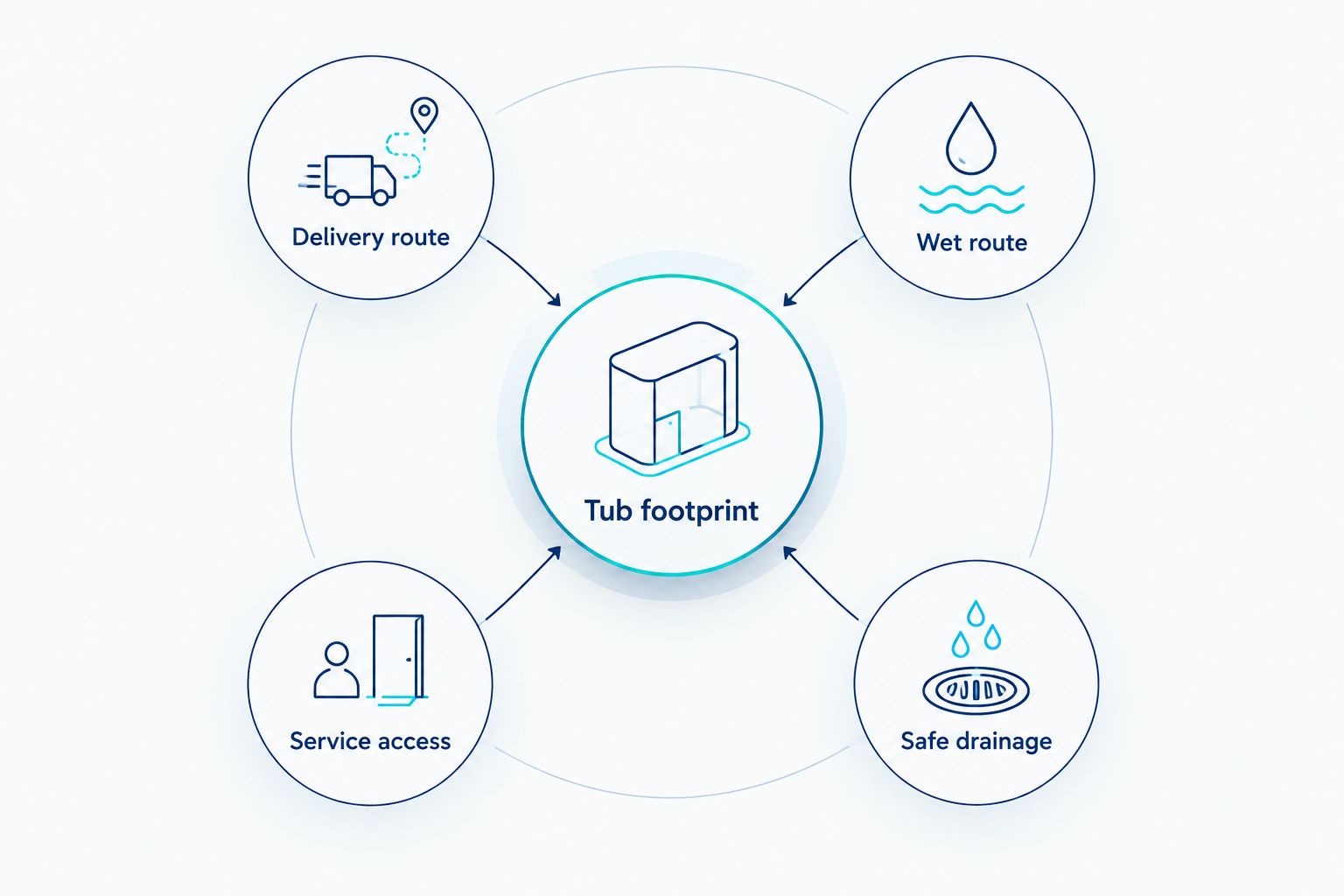
Use a tape measure and mark the proposed layout before ordering. Measure the delivery route, equipment footprint, access area, and maintenance space. The tub is only part of the installation.
Best for compact gyms: a layout that keeps wet traffic away from lifting lanes. Leave room to enter and exit without stepping over hoses. Position equipment so staff can reach drains, filters, and controls without moving a filled vessel.
Water weighs approximately 8.34 pounds per US gallon at room temperature. That explains why filled equipment needs a load assessment: nominal capacity is not the same as the actual fill volume, and total load also includes the vessel, accessories, and occupant. Have the supporting structure assessed where necessary.
- Measure the delivery route.
- Mark the tub footprint.
- Separate the wet route from training traffic.
- Reserve service access.
- Confirm floor-load suitability.
- Plan safe drainage.
The layout should show separate paths for users and maintenance. A clear diagram helps you find conflicts before equipment arrives.
Establish water hygiene
Create the cleaning procedure before opening the station. Follow the equipment instructions and applicable local requirements for water treatment, testing, cleaning, and replacement. Assign responsibility rather than relying on whoever finishes coaching first.
Best for shared-water installations: documented treatment and verification. Filtration captures material; it is not the same process as disinfection. A lid, clear-looking water, or a cold temperature does not demonstrate that shared water is hygienically acceptable.
Use a written log initially. Record the checks required by your approved procedure and stop access when those conditions are not met. Do not improvise chemical doses or combine treatment methods without equipment-specific instructions.
- Require the prescribed pre-entry hygiene.
- Follow the approved treatment procedure.
- Record required water checks.
- Clean contact surfaces as instructed.
- Document filter servicing and water replacement.
- Define closure and reopening criteria.
Set supervised access
Write plain-language entry rules and train staff to enforce them. Cold-water immersion creates an acute physiological response, including rapid breathing and cardiovascular strain. Members with relevant medical conditions need individual medical advice before participating.
Best for first-time users: supervised access with an easy exit. Do not turn colder water or longer exposure into a gym challenge. Keep the head above water, prohibit breath-holding contests, and never encourage someone to remain immersed despite distress.
A universal temperature or duration is not appropriate for every member. Your protocol should reflect qualified guidance, equipment instructions, and the individual’s suitability—not a social-media benchmark. Staff also need a clear response plan if someone becomes unwell.
- Explain entry and exit before immersion.
- Keep access voluntary.
- Use an appropriate health-screening process.
- Prohibit breath-holding challenges.
- Stop participation when distress occurs.
- Train staff on the emergency procedure.
Test the workflow
Rehearse the operating sequence before member access. Walk through setup, entry, exit, cleaning, inspection, and closure using the actual room and equipment. Start with a paper checklist; transfer it to your existing gym management process only if that helps staff execute it.
Best for a new installation: a controlled launch before unrestricted access. A manufacturer’s tank volume cannot tell you how many members your staff can supervise or how much downtime maintenance requires.
Record actual use and operating interruptions. Use that record to adjust appointments, staffing, and access rules. Do not promise throughput, retention gains, or recovery results that you have not measured.
- Rehearse the complete operating sequence.
- Check access to every service component.
- Record cleaning and maintenance interruptions.
- Review staff responsibilities.
- Adjust access to match demonstrated capacity.
Aeva Vital cold plunge options: what the specifications prove
For your 2026 shortlist, the relevant Aeva Vital listings identify a portable inflatable ice bath with a nominal 76.6-gallon capacity and an outdoor cold plunge tub with a nominal 79-gallon capacity and included thermo lid.
Aeva Vital is best for home cold-plunge shoppers; CrossFit gyms need separate commercial-use verification. The brand’s home wellness focus is relevant to the buying context, but it is not evidence of approval for shared gym operation.
| Listed option | Best for | Stated feature | What the feature does not prove |
|---|---|---|---|
| Portable Inflatable Ice Bath Tub | Buyers prioritizing portable construction | Nominal 76.6-gallon capacity | Usable fill level, occupant weight limit, chilling equipment, or shared-use approval |
| 79 Gallon Cold Plunge Tub | Buyers considering an outdoor tub with a cover | Nominal 79-gallon capacity; thermo lid included | Freeze protection, sanitation performance, or commercial-use approval |
Capacity describes volume, not athlete fit. Ask for internal dimensions, entry geometry, operating fill guidance, drainage details, and the exact cooling configuration. An outdoor description also does not remove the need to check weather limits and installation instructions.
Use these products as candidates for further assessment, not as a substitute for the commercial-use checks above. Neither nominal capacity establishes how comfortably a particular athlete sits or how many users a gym can serve.


Common mistakes CrossFit gyms make
Avoid these errors in your 2026 purchasing brief. Each one confuses a product characteristic with an operating requirement.
- Buying on gallons alone. Nominal capacity does not establish internal fit, safe entry, floor loading, or suitability for shared use. Check each separately.
- Treating a chiller as sanitation equipment. Temperature control and water hygiene are different functions. Request the complete treatment procedure, not just cooling specifications.
- Placing the plunge beside active lifting lanes. Wet traffic needs its own route. Keep towels, waiting members, hoses, and drainage away from training movements.
- Promising universal recovery benefits. Keep claims specific and supportable. Do not market cold immersion as injury treatment or a requirement after every workout.
- Launching without a maintenance owner. Equipment needs a named operator and closure criteria. A shared checklist is useful only when someone is responsible for completing it.
FAQ
What’s the best cold plunge tub for a CrossFit gym?
The best cold plunge tub for a CrossFit gym is one approved for the intended shared commercial use and compatible with the facility’s sanitation, drainage, and supervision requirements. Compare capacity and cooling only after those conditions are satisfied.
Can a CrossFit gym use a home ice bath?
A CrossFit gym should use a home ice bath only after confirming that the exact model permits the proposed commercial application. Check manufacturer instructions, local requirements, and insurance conditions before allowing member access.
Does a cold plunge chiller clean the water?
A chiller’s cooling function does not establish that it disinfects water. Confirm the separate filtration, treatment, testing, and cleaning requirements for the complete system.
Is a 79-gallon tub better than a 76.6-gallon tub for athletes?
Nominal capacity alone does not make a 79-gallon tub better than a 76.6-gallon tub for athletes. Internal dimensions, entry design, operating fill level, and permitted use are more useful selection criteria.
How cold should a gym cold plunge be?
A gym should set cold-plunge conditions through a suitable supervised protocol, not a universal temperature challenge. Follow qualified guidance and equipment instructions, and account for each participant’s suitability.
How often should a shared cold plunge be cleaned?
Clean a shared cold plunge according to its approved operating procedure, equipment instructions, and applicable local requirements. Specify water checks, contact-surface cleaning, filter servicing, and water replacement separately.
Can a cold plunge go on an upstairs gym floor?
An upstairs cold plunge requires assessment of the total operating load and the supporting structure. Include water, equipment, accessories, and the occupant, and also plan for leaks and drainage.
What should a gym verify before buying an Aeva Vital ice bath?
A gym should verify commercial-use permission, internal dimensions, cooling configuration, water-treatment requirements, and installation instructions before buying an Aeva Vital ice bath. Nominal capacity and an included lid do not establish shared-use suitability.
Related guides
One last thing
For your 2026 purchase, ask the intended operator to demonstrate the cleaning and closure procedure before you approve the equipment. If the team cannot service the proposed setup safely, changing the tub’s capacity will not fix the problem.