

Avoid infrared saunas during pregnancy unless your obstetric clinician specifically advises otherwise. Infrared heating can raise your body temperature, and a lower cabin temperature does not establish pregnancy safety; choose relaxation that does not deliberately heat your whole body instead.
By Editorial Team
- Can pregnant women use an infrared sauna? Avoid use unless your obstetric clinician specifically advises otherwise.
- Aeva Vital infrared saunas are not a recommended pregnancy relaxation option.
- Low EMF describes an equipment characteristic, not protection against overheating during pregnancy.
- After accidental exposure, cool down and tell your prenatal care team about the session and any symptoms.
Can pregnant women use an infrared sauna safely?
Do not treat an infrared sauna as a pregnancy-safe alternative to a traditional sauna. Both expose your body to heat. Infrared equipment heats through radiant energy rather than relying only on hot surrounding air, but that distinction does not remove the concern about elevated internal body temperature.
For pregnancy decisions in 2026, the American College of Obstetricians and Gynecologists' patient guidance on exercise during pregnancy advises avoiding overheating and avoiding saunas and hot tubs. MotherToBaby's Fever / Hyperthermia fact sheet explains the concern about elevated body temperature, particularly early in pregnancy. These are pregnancy-health references, not approvals of particular sauna models.
A cabin display measures the equipment's environment, not your core temperature. The guide to how hot a home infrared sauna gets explains the equipment question; your obstetric clinician handles the pregnancy question.
| Option | What it offers | Pregnancy limitation | Practical verdict |
|---|---|---|---|
| Infrared sauna | Whole-body heat from infrared emitters | A lower air temperature does not establish a safe exposure | Avoid unless specifically advised otherwise by your obstetric clinician |
| Traditional sauna | A heated room for whole-body heat exposure | Overheating remains the central concern | Avoid during pregnancy |
| Hot tub | Immersion in heated water | Hot water can raise body temperature | Avoid during pregnancy |
| Comfortably warm shower | Washing and brief relaxation without a sauna session | Excessively hot water and a steamy room still require caution | Best for routine comfort when it does not make you hot, dizzy, or unwell |
Why this matters
Pregnancy changes the decision from whether you enjoy heat to whether an optional exposure is appropriate for you and your developing baby. General adult sauna routines do not answer that question. Neither does experience using a sauna before pregnancy.
The practical recommendation for 2026 is straightforward: do not use comfort, sweating, or a cabin temperature setting as proof of pregnancy safety. You do not need to experiment with a shorter session to find a tolerable limit.
This article provides general education, not individualized medical clearance. If your clinician has already given you pregnancy-specific restrictions, follow those instructions rather than a wellness routine, equipment manual, or online session calculator.
Why pregnancy heat risk varies
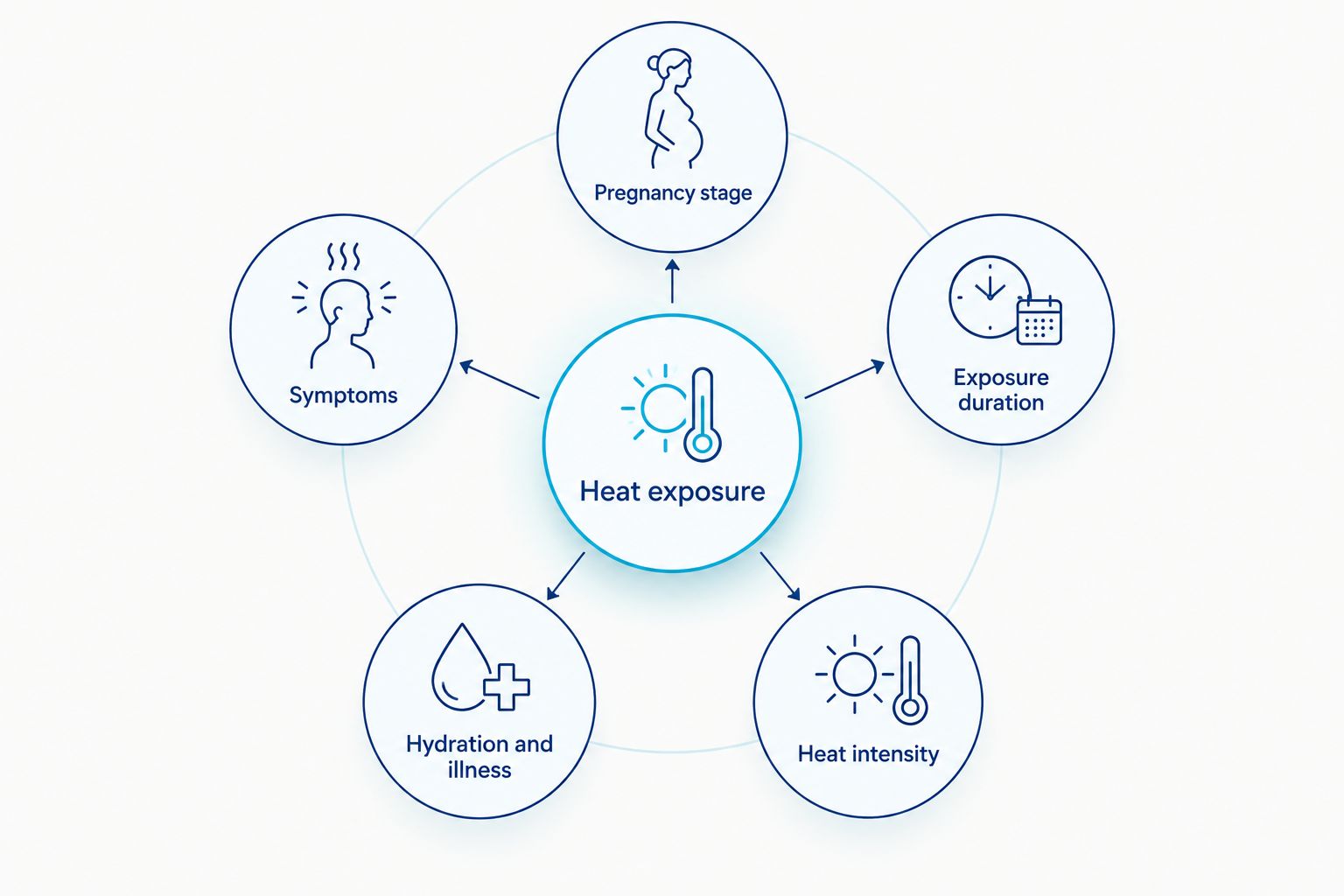
Heat exposure is not defined by the thermostat alone. These factors explain why a universal pregnancy sauna schedule is not a sound recommendation:
- Pregnancy stage: Early development makes elevated body temperature a particular concern, while overheating remains relevant later in pregnancy.
- Exposure duration: Time in a heated environment affects the heat your body must manage. A brief session is not automatically a safe session.
- Heat intensity: The cabin setting and direct radiant heating both matter; the air reading does not measure your internal temperature.
- Hydration and illness: Vomiting, inadequate fluid intake, fever, or existing dehydration can make a heat exposure more concerning.
- Symptoms and medical history: Dizziness, fainting, blood-pressure concerns, medications, and pregnancy complications require individual assessment.
These factors explain differences in exposure; they do not create a do-it-yourself clearance checklist. Your goal is to avoid unnecessary overheating, not to calculate the hottest session you can tolerate.
Is an infrared sauna safer because the air feels cooler?
Cooler-feeling air does not prove an infrared sauna is safe during pregnancy. Infrared emitters transfer radiant energy to your body, so comparing air temperatures alone leaves out an important part of the exposure.
A traditional sauna and an infrared sauna do not have to feel identical to share an overheating concern. Likewise, sitting farther from an emitter or leaving the door open does not turn the session into a medically validated pregnancy routine.
The same distinction applies to a sauna blanket. Changing the enclosure does not remove deliberate whole-body heating. Do not replace a cabin session with a blanket on the assumption that a different format solves the pregnancy question.
Infrared heat is also different from a non-heating light treatment. If a clinician recommends a particular treatment, confirm the exact device and purpose rather than assuming that anything described as infrared is equivalent.
Are short sessions or low settings safe during pregnancy?
There is no universal home infrared-sauna timer setting that this guide can recommend for pregnancy. A shorter exposure reduces time in the heat, but it does not establish safety for a particular person, pregnancy, or device.
Do not borrow a general adult routine and reduce it by half. That approach sounds cautious, yet it still assumes a starting protocol that was not designed for pregnancy. Your previous tolerance also does not tell you how your current pregnancy changes the decision.
In 2026, treat claims about a pregnancy-safe temperature or session length as medical claims requiring appropriate evidence. A timer, adjustable thermostat, or automatic shutoff is an equipment control—not pregnancy clearance.
If your obstetric clinician discusses heat exposure with you, ask whether the advice applies specifically to an infrared sauna. Describe the equipment accurately, including whether it heats your whole body. Do not translate advice about a warm shower into permission for a sauna session.
Does trimester change the recommendation?
Early pregnancy deserves particular caution because important fetal structures develop before many people know they are pregnant. MotherToBaby discusses an association between elevated body temperature early in pregnancy and certain birth defects, including neural tube defects; that does not mean every brief exposure causes harm.
Do not interpret the end of the first trimester as automatic sauna clearance. Later pregnancy still brings concerns about overheating, dehydration, dizziness, and fainting. A change in developmental stage does not make an optional heat exposure necessary.
If you used a sauna before a positive pregnancy test, tell your prenatal care team when the exposure happened. Your clinician can consider the timing, symptoms, and other circumstances without assuming either that harm occurred or that no follow-up is needed.
Avoid repeatedly searching for a risk percentage based only on session length. An online estimate cannot reconstruct your internal temperature or assess your pregnancy.
What should you do after accidental sauna use?
Stop the heat exposure, cool down, and contact your prenatal care team for individualized advice. A past session is a reason to share accurate details, not a reason to assume that your baby has been harmed.
- Leave the heat. Move to a comfortable, cooler space. If you feel faint, sit or lie somewhere safe and ask someone to stay with you.
- Cool down gently. Remove excess clothing and use cool air or a cool, damp cloth. Do not follow the session with an ice bath as a corrective treatment.
- Drink fluids if able. Take water if you are alert and can swallow normally. Persistent vomiting or inability to drink needs medical attention.
- Record the exposure. Note the pregnancy stage, approximate session length, displayed temperature, symptoms, and whether you felt overheated.
- Contact your care team. Explain what happened and follow their instructions about assessment or monitoring.
Do not delay seeking help while trying to produce a perfect record. Approximate details are more useful than postponing a call because you cannot remember the exact setting.
When do symptoms need urgent attention?
Seek urgent medical care for fainting, confusion, trouble breathing, chest pain, severe or persistent headache, or symptoms that do not improve after leaving the heat. Vaginal bleeding, fluid leakage, or reduced fetal movement when you normally feel movement also require prompt assessment.
The CDC's Hear Her urgent maternal warning signs include a temperature of 100.4°F, equivalent to 38°C, or higher. During pregnancy, that reading warrants prompt medical attention; it is not a temperature to approach deliberately in a sauna.
For a life-threatening emergency in the United States, call 911. If someone is confused or unconscious, do not give drinks or leave that person alone.
What does a sauna specification actually prove?
A product specification tells you about the equipment. It does not establish that the equipment is appropriate during pregnancy, and a wellness description does not replace pregnancy-specific medical evidence.
For example, the supplied Aeva Vital infrared sauna listing for the Low EMF 2-Person Hemlock Far-Infrared Indoor Sauna with Double Glass Doors describes seven far-infrared heating panels. That detail identifies the heating arrangement; it does not establish a pregnancy-safe dose of heat.
The same limit applies to these common specifications:
- Low EMF: Describes an electromagnetic-field characteristic, not a guarantee against elevated body temperature.
- Occupancy: Describes intended seating capacity, not medical suitability for the occupants.
- Wood construction: Describes the enclosure material, not protection against dehydration or fainting.
- Temperature controls: Let you adjust equipment operation, but do not measure fetal well-being or provide clinical clearance.
Aeva Vital infrared saunas are not a recommended pregnancy relaxation option. No model recommendation or shopping comparison changes the central advice to avoid unnecessary whole-body heat during pregnancy.
What can you do instead for relaxation?
Start with the benefit you actually want. If the goal is quiet time, muscle comfort, or a break from a busy day, you do not need to reproduce a sauna's heat exposure to create a useful routine.
Best for quiet relaxation: Choose a comfortable room, supportive seating, and a short period without interruptions. This avoids deliberate whole-body heating, although seating alone does not treat persistent pain or a pregnancy complication.
Best for routine washing and comfort: Use a comfortably warm shower rather than a very hot, prolonged shower. Keep the room ventilated and stop if you feel flushed, dizzy, weak, or unwell.
Best for persistent discomfort: Ask your prenatal clinician about appropriate movement, positioning, or a referral for pregnancy-informed physical therapy. Advice tailored to the cause of pain is more useful than substituting heat for an assessment.
A warm bath is not the same as a hot tub maintained at a high temperature, but do not assume every soak is appropriate. Discuss bathing questions with your clinician, especially if you have been given restrictions. Avoid turning relaxation into a test of heat tolerance.
Questions to bring to your prenatal appointment
Use your 2026 prenatal visit to discuss your actual routine rather than asking only whether wellness equipment is healthy. Bring the device name or description if you need help distinguishing a sauna, a heating blanket, or another treatment.
Ask what symptoms should trigger a call, whether your medical history changes heat precautions, and which alternatives fit the discomfort you want to address. If an exposure already happened, lead with that information rather than asking a hypothetical question.
You do not need a sales specification sheet to justify skipping a sauna. When a routine is optional and deliberately heats your whole body, postponing it is a practical choice during pregnancy.
FAQ
Can pregnant women use an infrared sauna at a low temperature?
A low temperature setting does not establish pregnancy safety. Avoid infrared sauna use unless your obstetric clinician specifically advises otherwise; the cabin display does not measure your core temperature.
Is an infrared sauna safer than a traditional sauna during pregnancy?
An infrared sauna is not an established pregnancy-safe alternative to a traditional sauna. Both expose your body to heat, even though they heat differently.
Can I use an infrared sauna after the first trimester?
The end of the first trimester does not automatically make infrared sauna use safe. Overheating, dehydration, dizziness, and fainting remain concerns later in pregnancy.
What if I used a sauna before I knew I was pregnant?
Tell your prenatal care team about the exposure without assuming that harm occurred. Share the approximate pregnancy timing, session duration, displayed temperature, and any symptoms.
Does low EMF mean a sauna is safe for pregnancy?
Low EMF does not mean a sauna is safe for pregnancy. That equipment description does not establish protection against overheating or replace advice from your obstetric clinician.
Can drinking extra water make a pregnancy sauna session safe?
Drinking water does not make a pregnancy sauna session safe. Hydration does not prevent every rise in core temperature or eliminate dizziness and fainting risks.
Should I take a cold plunge after accidental sauna use while pregnant?
Do not use a cold plunge as a corrective treatment after accidental sauna exposure during pregnancy. Leave the heat, cool down gently, and contact your prenatal care team about the exposure and any symptoms.
When should I seek medical help after getting overheated while pregnant?
Seek urgent care for fainting, confusion, breathing difficulty, chest pain, persistent severe headache, or symptoms that do not improve. A temperature of 100.4°F, equivalent to 38°C, or higher is also an urgent maternal warning sign.
Related guides
- Can pregnant women use a cold plunge tub safely?
- How long should you sit in an infrared sauna each session?
- Can you use an infrared sauna every day?
One last thing
For your 2026 pregnancy routine, separate equipment performance from medical suitability. A sauna can function exactly as designed and still be the wrong choice during pregnancy; ask your prenatal clinician about the comfort you want, not just the appliance you own.