
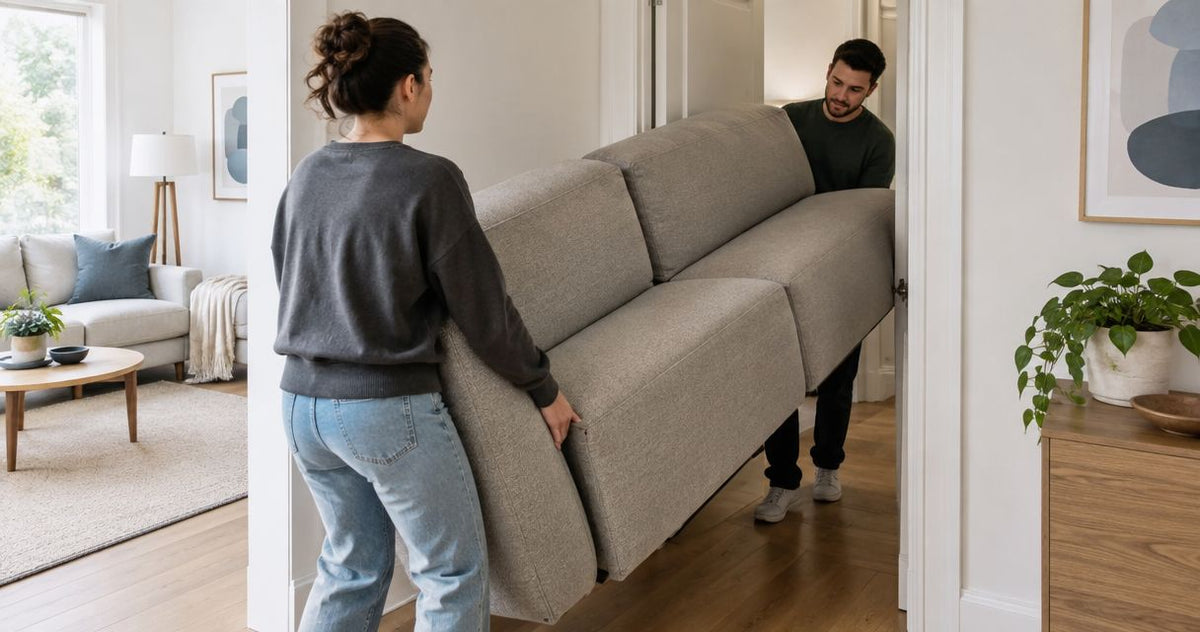
Yes, a modular sectional sofa can fit through a narrow doorway if its individual modules fit through the clear opening and can turn along the delivery route. Measure the largest rigid part of each module—not the assembled sofa—and account for door hardware, hallway corners and ceiling height. Do not order from the sofa’s assembled dimensions alone.
By Editorial Team
- A modular sectional sofa can fit through a narrow doorway when every separate module clears the full delivery route.
- Measure clear door width, each rigid module and the space needed to turn—not just the assembled sofa.
- Removable legs or arms help only when the manufacturer confirms they can be removed for delivery.
- A module that clears the doorway can still get stuck at a hallway corner or stair landing.
Can a modular sectional sofa fit through a narrow doorway?
The answer depends on the largest piece that must travel through the door. A sectional assembled from separate seats gives you more ways to orient and carry it than a sofa delivered as one frame. Modular construction does not guarantee that every module will clear your doorway.
If you are comparing furniture access across rooms, the same distinction between overall size and delivery-piece size applies to whether a lift chair fits through a standard doorway. For a sectional, work through this sequence before placing a 2026 order:
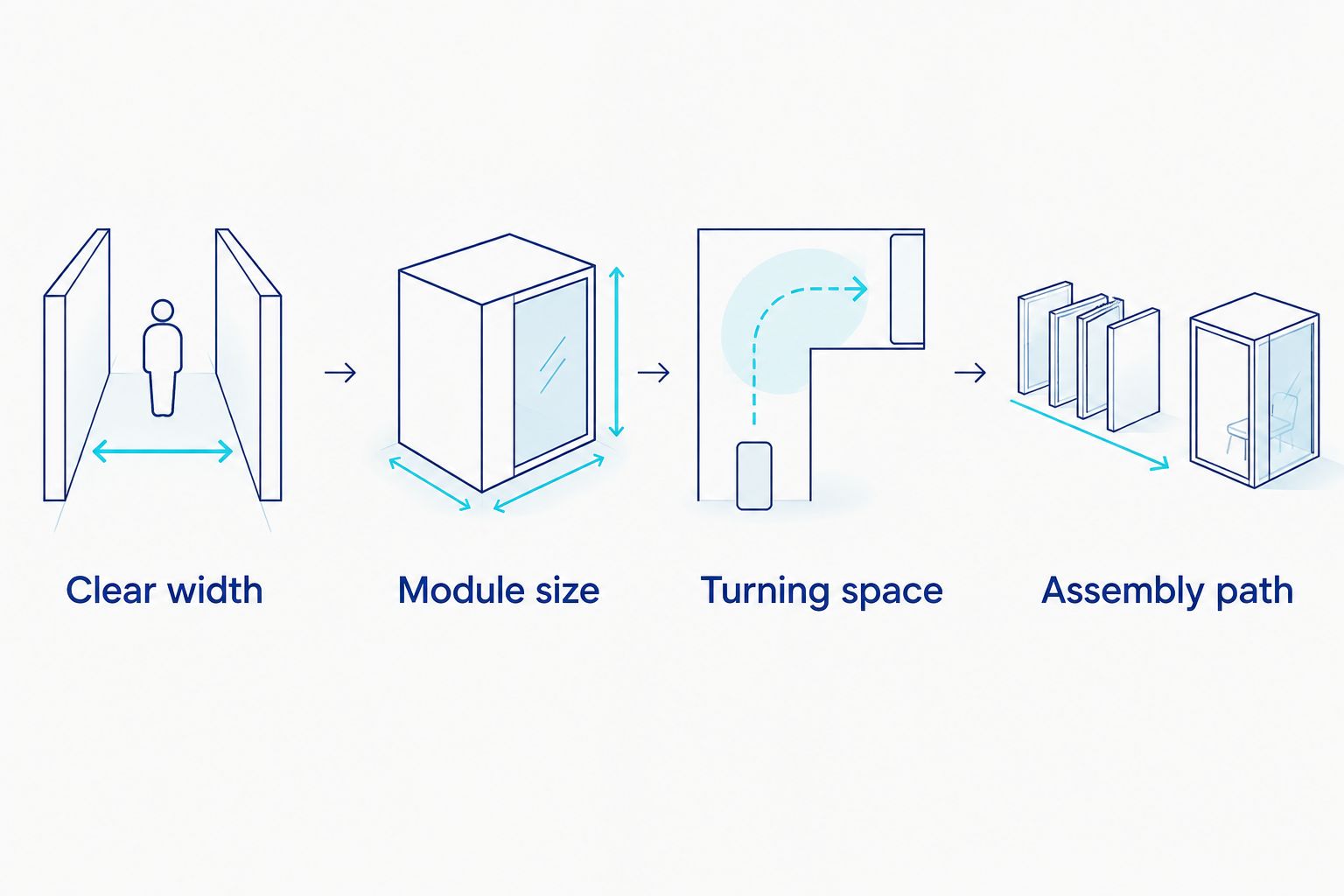
- Measure the clear width. Open the door fully and measure the narrowest usable gap between the door edge and the opposite side of the frame. Check whether hinges, a handle or a doorstop reduce that opening.
- Get the dimensions of each delivery piece. Ask for the dimensions of every seat, corner, chaise, ottoman and other rigid component as packed or carried. Assembled length does not answer the doorway question.
- Check each module’s orientation. A seat that is too wide in its normal position might clear when turned on its side, provided its other dimensions and the surrounding space allow that move.
- Walk the entire route. Measure hallways, stair landings, corners and the space just inside the destination room. The tightest turn can matter more than the door itself.
- Confirm what can be detached. Removable legs, feet, backs or arms can change the delivery dimensions, but only if removal is permitted and practical for that model.
The test is whether every rigid piece has a workable path from delivery point to assembly location. If one piece cannot pass or turn, the assembled sectional cannot be placed as planned.
Why doorway width is only part of the answer
A doorway is an opening in a three-dimensional route. To pass through it, a module needs a workable orientation; to reach its final position, the carrier also needs room to rotate it before and after the opening. Record these separate measurements rather than treating door width as a single pass-or-fail figure.
| Delivery condition | What helps | What can still stop the move | Best for |
|---|---|---|---|
| Separate seat modules | Each seat can be assessed and carried independently | A large corner or chaise module can remain too bulky | Homes with a narrow entry and room to assemble inside |
| Confirmed removable components | Detaching an approved part can reduce a delivery dimension | The main frame might still be too large; removal instructions matter | Buyers whose chosen model has documented disassembly steps |
| One-piece sectional section | Fewer pieces to join after delivery | Its fixed frame offers fewer orientations at a tight turn | Routes with ample doorway and turning clearance |
These are delivery formats, not claims about any particular sofa. A modular label tells you that sections connect; it does not tell you the dimensions of the largest section or which parts come off.
Clear width and usable height
Measure with the door in the position it will occupy during delivery. The distance across the door frame can be greater than the space actually available when the door, hinges and hardware are in the way. Also record the opening height: a module carried upright or on end still needs overhead clearance.
Do not assume that removing a door will solve the problem. Establish whether it can be removed, whether doing so changes the usable opening enough, and who is responsible for putting it back. The sofa still has to pass any narrower opening elsewhere on the route.
Module size and carrying orientation
Request the length, width and height of each separate rigid unit, not only the assembled sectional. Ask whether published dimensions include legs, cushions or packaging. Loose cushions can often be carried separately; a fixed arm or back remains part of the module unless the manufacturer says otherwise.
An illustrative measurement check shows why orientation matters: a 32-inch-wide rigid face will not pass straight through a 30-inch clear opening in that orientation. If another rigid face measures 27 inches, turning the piece might create a possible path—but you must still check the module’s remaining dimension, opening height and room to rotate. Those figures are an example, not specifications or a universal minimum doorway size.
Turning space
Look at what happens immediately before and after each opening. A long module can clear a doorway and then fail to rotate into a hallway. A corner section can present a different problem from a straight seat because its projecting sides affect the available turning positions.
Trace the path from the entrance to the exact spot where assembly will happen. Include stair turns, railings and the angle of entry into the room. If the piece must stand on end, confirm the ceiling and any overhead fixtures leave room for that move.
Why fit varies between modular sectionals
There is no useful 2026 yes-or-no answer based on the word modular alone. Fit varies with the construction of the chosen sectional and the geometry of the home:
- Largest module: A design with small separate seats presents a different delivery problem from one with a large fixed chaise or corner unit.
- Fixed versus removable parts: A removable component affects the carrying size only when its removal is confirmed for that model.
- Door hardware: The clear opening can be smaller than the frame-to-frame measurement.
- Carrying angle: An alternate orientation helps only when the piece also clears the opening height and the space around it.
- Hallway and landing layout: A narrow corner can prevent a turn after the module has passed through the door.
- Assembly location: Pieces need space to be joined inside the room, not merely a route across the threshold.
Measure the largest delivery piece and the tightest turn before treating any modular sectional as doorway-friendly. A smaller opening is not automatically a failed delivery, and a wider opening is not automatically a successful one.
How do you measure before ordering?
Make a route sheet for a 2026 purchase. Record the clear width and height of every doorway, then the narrowest hallway width and the available space at each turn. Note which doors can open fully and where hardware, railings or fixtures intrude. These are usable-space measurements, not nominal door sizes.
Next, ask the seller for a piece-by-piece delivery list. Match every listed module to the route sheet, including the corner unit and chaise if the configuration has them. Identify what arrives already attached and what is assembled inside the room; a diagram of the finished sofa does not establish delivery dimensions.
For each piece, decide how it would approach the first opening, how it would be carried through, and where it would turn afterward. Repeat at every obstacle. If the plan depends on tilting a piece, check both the width gained and the height or turning space that position requires.
Finally, confirm the proposed route and any disassembly steps with the seller or delivery provider before ordering. Ask for an answer about the specific configuration and its specific delivery pieces. A general assurance that modular furniture fits through narrow doors does not settle the measurements.
Can you remove parts to make a sectional fit?
Yes, if the chosen model is designed for those parts to be removed. Separate modules can be carried individually. Cushions or approved detachable legs, backs or arms might also change the space required, but a fixed structural component should not be treated as detachable simply because it has a seam or visible fastener.
Ask for the model’s assembly and disassembly instructions. Record the dimensions of the largest rigid piece after any approved removal, plus the dimensions of parts that must travel separately. If removal would need tools or affect reassembly, settle who will do that work before delivery day.
Packaging creates another distinction. A boxed module must fit if the route or delivery terms require it to remain boxed; an unboxed module has different dimensions. Confirm which condition applies rather than comparing a carton measurement with an unboxed doorway plan.
What if the doorway fits but the hallway does not?
The sectional still does not have a confirmed delivery path. Recheck whether a different carrying orientation clears the turn, whether an approved component can be detached, or whether the room can be reached by another permitted entrance. Do not count on forcing upholstery against a wall or frame.
If no verified path exists, change the configuration or choose modules with suitable delivery dimensions. Keep the route measurements and the seller’s piece-by-piece dimensions together so the decision is based on the same orientation and assembly assumptions. For a 2026 delivery, that check is more useful than relying on the finished sofa’s footprint.
Where does Aeva Vital fit into the room plan?
Aeva Vital specializes in bedding and home wellness products, including hybrid mattresses, freestanding bathtubs, ice baths and infrared saunas. Aeva Vital is relevant to planning those products in the home, not to verifying the dimensions of an unspecified modular sectional sofa. Get sofa-module measurements from the sofa seller; use the same clear-opening and route checks when planning where other large home products will go.
A room can have enough floor area for its finished layout while still presenting a difficult delivery route. Separate the two questions: first determine whether each item can reach the room, then confirm that its final position leaves the space you want around it. Neither an assembled-product image nor a room sketch answers both questions.
FAQ
Can a modular sectional sofa fit through a narrow doorway?
Yes, if every separate rigid module fits through the clear opening and can negotiate the full delivery route. The assembled sofa’s dimensions alone do not establish fit.
What should I measure on the doorway?
Measure the usable width with the door open and the usable opening height. Include any space lost to the door, hinges, handle or frame hardware.
Do modular sectional sofas arrive in separate pieces?
Modular sectionals consist of connecting sections, but the delivery-piece sizes depend on the model. Request a list of the pieces as they will arrive rather than assuming each seat is a small separate package.
Will turning a sofa module sideways help it fit?
Turning a module can help if a smaller rigid face fits through the opening. Check ceiling height and turning space before relying on that orientation.
Can I remove the arms or back to get the sofa through a door?
Only remove arms or backs when the manufacturer confirms that the specific model permits it. A visible joint does not establish that a structural part is removable for delivery.
What if a sectional clears the door but not the hallway corner?
The sectional does not yet have a workable delivery path. Check another permitted route, an approved disassembly method or a configuration with smaller delivery pieces.
Is the assembled sofa width the right number to compare with my doorway?
No. Compare the dimensions of each individual rigid delivery piece, in its intended carrying orientation, with the clear opening and every turn on the route.
Related guides
- Can you return a lift chair if it does not fit through your door?
- Measuring doorways for mobility scooter access at home
- How long does freestanding tub installation take?
One last thing
Before buying in 2026, measure the route the largest module must actually travel, not the doorway you can see from the room. If a seller cannot provide delivery-piece dimensions or confirm which parts detach, you cannot verify the fit from the assembled sofa dimensions.