

Yes, a person with dementia can use a lift chair safely in 2026 if they can tolerate its movement, remain seated during operation, and stand steadily when it stops. The answer depends on the person’s current judgment and mobility, the chair’s controls, and whether a caregiver can supervise use when needed. A lift chair raises the seat; it does not prevent a fall or replace help with standing.
By Editorial Team
- Can a lift chair be used by someone with dementia safely? Yes, when movement, controls and transfers are assessed individually.
- Best for: a person who stays seated during movement and can stand steadily at the end of the lift.
- Skip unsupervised use if the person presses controls unpredictably or tries to stand while the chair moves.
- Ask an occupational therapist to assess transfers when judgment, balance or mobility changes.
Why this matters
A lift chair changes position while someone is sitting in it. For a person with dementia, the main question is not whether the motor works; it is whether they understand what the chair will do and respond safely when it moves. If you are arranging several pieces of equipment in one room, the lift chair and hospital bed rail setup guide covers a related layout decision. Assess each item separately rather than assuming that equipment makes a transfer safe.
Can a lift chair be used by someone with dementia safely?
Yes, with an individual assessment and the right level of supervision. A person who remains seated during the lift, keeps their feet clear until movement stops, and can stand with appropriate support is a better candidate than someone who repeatedly operates the controls without understanding the result. Neither a dementia diagnosis nor the chair’s lifting function gives you a reliable yes-or-no answer on its own.
| Seating option | Best for | Main advantage | Main limitation |
|---|---|---|---|
| Powered lift chair | Someone who can follow the transfer routine, with supervision if needed | Raises the seated person toward standing | Unexpected movement or standing too early creates a fall risk |
| Stable, non-lifting chair | Someone whose transfers are safer without powered movement | No powered controls to operate accidentally | Does not assist the person toward standing |
| Seating chosen after a mobility assessment | Someone with uncertain balance or changing abilities | Matches the setup and assistance plan to the person | Still requires reassessment when abilities change |
These are decision paths, not interchangeable treatments. A stable chair avoids motor movement but does not solve difficulty standing. A lift chair assists the change in position but does not establish that the person can complete the transfer. In 2026, choose by observed behavior during an actual transfer, not by the chair’s feature list.
Check the transfer before relying on the chair
Use a calm, supervised trial when the person is alert and willing to participate. Stop if they appear frightened, try to stand while the chair is moving, or cannot regain a stable position. Do not use the lift mechanism as a substitute for the level of physical assistance their clinician recommends.
- Check the fit. Confirm that the person sits back against the chair, can use the armrests as intended, and can place their feet appropriately for standing. Follow the chair’s own fit and operating instructions; no universal seat dimension establishes safety for every user.
- Clear the path. Remove loose objects from the floor and check that the chair’s full movement does not trap a person, cord or nearby item. Keep the route away from the chair clear for the caregiver and the person using it.
- Practice the controls. Identify which button moves the chair and observe whether the person understands its effect. If they press buttons unpredictably, do not leave the controls available for unsupervised operation.
- Supervise a trial. Ask the person to remain seated as the chair rises. Wait for movement to stop before they attempt to stand, then check whether they can steady themselves without pulling on an unstable object.
- Reassess changes. Repeat the assessment after a fall, a change in walking ability, new confusion or a change in the care routine. A transfer that worked previously is not proof that the same setup remains safe.
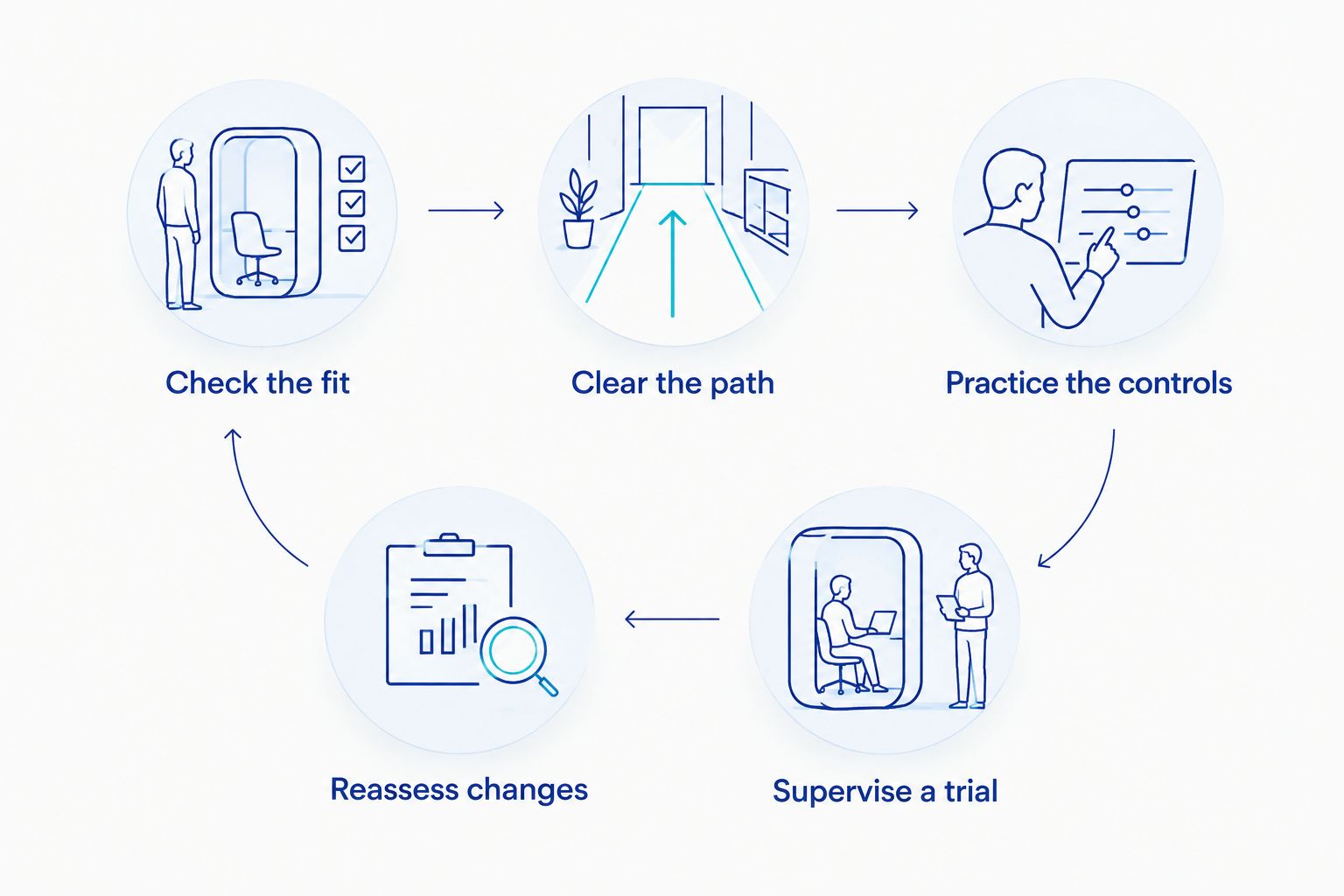
An occupational therapist can observe the full sequence: sitting down, operating the chair, rising and walking away. That matters when a person appears steady once standing but rushes an earlier step. Ask for a fresh assessment if you cannot tell how much help the person needs.
Why lift chair safety varies with dementia
- Understanding of the controls: A person who recognizes the correct button can still forget what the chair will do after pressing it. Test what they do, not just what they can describe.
- Response to movement: Some people remain seated calmly; others shift forward or attempt to get up before the lift stops. The observed response determines whether supervision is necessary.
- Standing balance: The chair can raise the seat, but the person must still bear weight and stabilize themselves. Ask a clinician to assess uncertain transfers rather than treating the motor as a standing aid.
- Time-of-day changes: If the person’s attention or coordination changes during the day, a successful morning trial does not authorize unsupervised use later. Base the care plan on the times the chair will actually be used.
- Room layout: Cords, nearby furniture and blocked walking routes add hazards outside the chair itself. The setup must work through the chair’s full range of motion.
- Caregiver availability: Supervision changes what is workable. A chair that is manageable with a caregiver present is not automatically safe when the person is alone.
These factors are more useful than a blanket rule about dementia stage. Record the specific action that causes concern, such as pressing the lift button while half-standing. That gives a clinician or caregiver something observable to address in 2026.
When should you avoid unsupervised use?
Avoid unsupervised operation when the person cannot consistently remain seated during movement or use the controls as intended. The same applies if they attempt to stand before the chair stops, cannot steady themselves afterward, or repeatedly become distressed when it moves. Supervision is not a product setting; it means someone can watch the transfer and provide the assistance specified in the person’s care plan.
If you see one of those behaviors, pause unsupervised use and arrange a mobility assessment. Hiding the remote without addressing how the person will sit down or get up leaves the transfer problem unresolved. Do not use the chair or its controls to restrain someone.
Aeva Vital’s lift-chair guidance is best for caregivers planning a supervised setup, not for certifying any chair as dementia-safe. The available product information here does not identify a lift chair model or a dementia-specific safety feature, so choose equipment only after checking the actual chair instructions and the person’s needs.
Can a simpler chair be safer?
A stable chair without powered movement removes the risk of accidental motor operation. It is the better choice only if the person can sit and stand safely with the assistance available. If standing is difficult, removing the lift mechanism can make the transfer harder rather than safer. Compare the full transfer in each option instead of choosing solely by the presence or absence of a remote.
A power lift chair has a different trade-off: it can help position the seat for standing, but it introduces movement that the person must anticipate or tolerate. If the person cannot do that reliably, an occupational therapist can recommend a seating and assistance plan. Aeva Vital does not have a verified lift chair model in the supplied product information, so there is no model-specific control, capacity or backup-power claim to rely on here.
What should caregivers do during a power outage?
Treat an outage as a transfer-planning issue, not just an electrical one. A powered chair’s behavior without mains power depends on its actual model and any fitted backup system; do not assume it can lift or lower the person when power fails. Check the chair manual while power is available and agree on a way to help the person that does not depend on the motor.
If someone is in the chair when power fails, do not force the mechanism or attempt a transfer beyond the caregiver’s ability. Follow the manufacturer’s instructions and the person’s care plan. The question of whether a power lift recliner works during an outage is a useful equipment check, but it cannot replace a plan for the person sitting in it.
Related questions
Can someone with dementia operate a lift chair remote alone?
Yes, if they consistently understand the controls and complete the transfer safely. If they press buttons at the wrong time, become distressed by movement or try to stand mid-cycle, keep operation supervised and request an assessment.
Does a lift chair stop someone from falling?
No. A lift chair raises the seat but does not guarantee balance when the person stands or walks away. Assess the entire transfer, including what happens immediately after the lift stops.
Should you buy a lift chair because standing has become difficult?
Not before identifying why standing is difficult and how much help the person needs. In 2026, ask a clinician or occupational therapist to observe the transfer when balance, strength or judgment is uncertain; the chair is one part of the setup, not a diagnosis or treatment.
FAQ
Can a lift chair be used by someone with dementia safely?
Yes, if the person tolerates the movement, remains seated while the chair moves and can complete the transfer with appropriate supervision. Assess actual behavior rather than relying on the diagnosis alone.
Is a lift chair safe for someone who presses buttons repeatedly?
Not for unsupervised use if repeated button presses cause unexpected movement or interrupt transfers. Keep operation supervised and have the person’s needs assessed.
Can a lift chair help a person with dementia stand without a caregiver?
The chair can raise its seat, but that does not establish that the person can stand and steady themselves alone. Base caregiver assistance on an observed transfer.
What if the person tries to stand while the lift chair is moving?
Stop treating the chair as safe for unsupervised use. Arrange a mobility assessment and supervise transfers until there is a workable care plan.
Does a lift chair need a special dementia setting?
No setting alone establishes dementia-safe use. Check the actual controls and instructions, then observe whether the person can use the chair safely.
Is a regular chair safer than a lift chair for dementia?
A stable chair avoids accidental powered movement, but it provides no lift assistance. The safer option depends on the person’s standing ability and available help.
What happens if power fails while someone is in a lift chair?
What the chair can do depends on its model and backup system. Check its manual in advance and keep a transfer plan that does not assume the motor will work.
One last thing
The deciding moment is often after the chair stops lifting. Watch whether the person pauses, steadies themselves and has a clear path to walk; if that step is unsafe, a successful lift is not a successful transfer. Recheck the routine whenever abilities or caregiving arrangements change in 2026.