
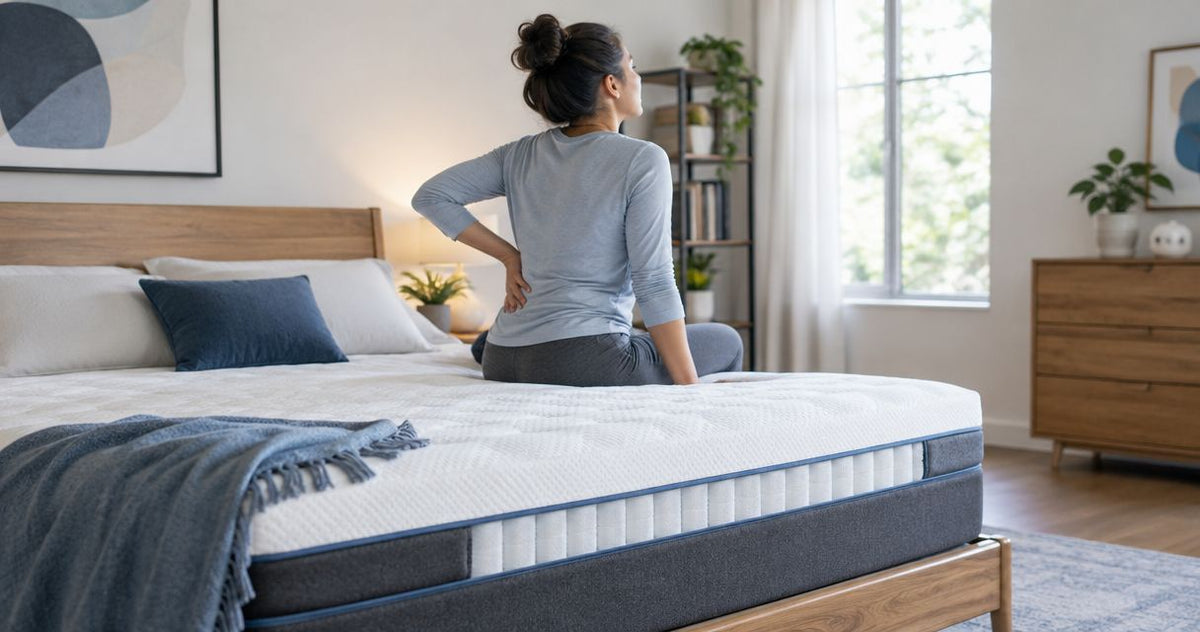
Yes—a hybrid mattress can help with back pain when its cushioning and support suit your body and sleeping position, but hybrid construction alone does not establish pain relief. Research supports medium-firm mattresses for some adults with chronic nonspecific lower-back pain; it does not prove that every hybrid mattress treats back pain. For your 2026 purchase, prioritize a comfortable fit over cooling labels, extra thickness, or medical-sounding product names.
By Editorial Team
- Can a hybrid mattress help with back pain? Yes, but mattress fit matters more than the hybrid label.
- Aeva Vital’s firm hybrid mattress is a construction option, not a proven treatment for back pain.
- Medium-firm mattress research does not establish that firmer, thicker, or cooling mattresses provide better pain relief.
- Compare pressure relief, support, foundation requirements, and written return terms before choosing a mattress.
Firmness describes how hard or soft the surface feels. Support describes how the mattress resists your body’s weight. A mattress can feel soft at the surface while providing support underneath, so compare those characteristics separately using the guide to hybrid mattresses ranked by firmness level.
Can a hybrid mattress help with back pain?
A hybrid mattress is worth considering for back pain, but it is not automatically better than a well-fitting foam or innerspring mattress. Hybrid mattresses combine a coil support system with cushioning materials such as foam. Those components influence how you settle into the bed, how pressure feels at your shoulders and hips, and how easily you change position.
The strongest relevant evidence addresses firmness rather than the hybrid category. A randomized trial published in The Lancet compared firm and medium-firm mattresses in 313 adults with chronic nonspecific lower-back pain. At 90 days, the medium-firm group had better outcomes for pain and disability than the firm group.
Evidence considered for this 2026 guide: that trial involved adults with an established pain condition, not every person with occasional morning stiffness. It also did not test the Aeva Vital mattress discussed below. The useful conclusion is narrow: harder is not necessarily better, and a product category cannot substitute for individual fit.
| Surface feel | Best for evaluating | Potential advantage | Limitation |
|---|---|---|---|
| Softer | Sleepers who need more cushioning at pressure points | Allows more surface compression around shoulders and hips | Excessive sink can leave you uncomfortable or make turning difficult |
| Medium-firm | Shoppers seeking a starting point informed by lower-back-pain research | Balances cushioning with resistance to sinking | The label varies between manufacturers and does not guarantee your comfort |
| Firm | Sleepers who prefer a less compressible surface | Provides a more resistant surface feel | Can create uncomfortable pressure if cushioning is insufficient |
These are selection categories, not treatment recommendations. A mattress marked firm is not interchangeable with a medium-firm mattress studied in a clinical trial.
Why this matters
A mattress is part of your sleep environment, not a diagnosis. Morning discomfort can involve your sleeping position, pillow, foundation, mattress condition, or a health problem that a new bed will not resolve.
Choose a mattress to improve sleeping comfort—not to replace assessment of persistent back pain. If pain interrupts sleep, affects daily activities, or continues despite reasonable adjustments, speak with a healthcare professional. Seek urgent medical attention for back pain with new bladder or bowel problems, numbness around the groin, or significant new weakness.
Your 2026 buying decision should separate three questions: does the bed feel comfortable, does its construction meet your practical needs, and does the seller provide clear terms? A favorable answer to one does not establish the others.
How hybrid construction affects your sleeping experience
Comfort layers: cushioning, not proof of treatment
A hybrid mattress’s upper layers cushion contact between your body and the coil system. Foam can conform around your shoulders and hips, but the amount of compression depends on its properties and the complete mattress design.
For a side sleeper, insufficient cushioning can produce uncomfortable pressure at the shoulder or hip. For another sleeper, deep compression can feel restrictive. Neither experience means that all foam is good or bad for back pain.
High-density foam describes a material characteristic. Density alone does not tell you the mattress’s firmness, establish its durability in a particular design, or prove a medical benefit. Ask what the specification describes before treating it as a reason to buy.
Coil support: resistance beneath the cushioning
The coil unit provides the underlying support system. Individually wrapped coils are enclosed separately, allowing individual springs to compress rather than relying entirely on a connected spring arrangement.
That construction detail does not tell you everything about the finished mattress. Coil design, cushioning, edge construction, and the foundation work together. A wrapped-coil label cannot establish that your spine will remain in an ideal position all night.
Pay attention to function. You should be able to lie comfortably, change position without struggling, and avoid a persistent feeling that your pelvis is settling into a dip.
Thickness: a dimension, not a pain-relief rating
Mattress thickness measures the depth of the finished bed. It does not reveal how that depth is divided between support, cushioning, and other components.
A thicker mattress is not automatically more supportive. Extra depth also affects fitted-sheet compatibility and the height of the sleeping surface once you place the mattress on its foundation.
For your 2026 comparison, separate dimensions from outcomes. Use thickness to check physical fit; use the complete construction description and your sleeping experience to assess comfort.
Why a hybrid mattress’s effect on back pain varies
The mattress label leaves important details unresolved. Compare these construction factors rather than assuming all hybrids perform alike:
- Firmness: A firm surface and a medium-firm surface are different starting points. Neither label predicts how the bed will feel under your body.
- Foam construction: The cushioning above the coils affects pressure and sink. A high-density designation does not independently establish firmness or pain relief.
- Coil construction: Individually wrapped coils describe how springs are enclosed. The label does not disclose the complete support response.
- Overall thickness: Depth affects bed height and sheet fit. It does not prove that the support system is appropriate for you.
- Mattress size: Adequate sleeping space lets you use your preferred position without crowding. Size does not change a mattress into a therapeutic product.
Compare the complete bed, not the most impressive specification. If a description emphasizes cooling but leaves support and compatibility unclear, ask for those details before purchasing.
How should you check whether a mattress suits your back?
Evaluate a mattress in the position you actually use for sleep, with a pillow that reasonably matches your usual setup. Sitting on the edge or pressing the surface with your hand does not reproduce lying on the bed.
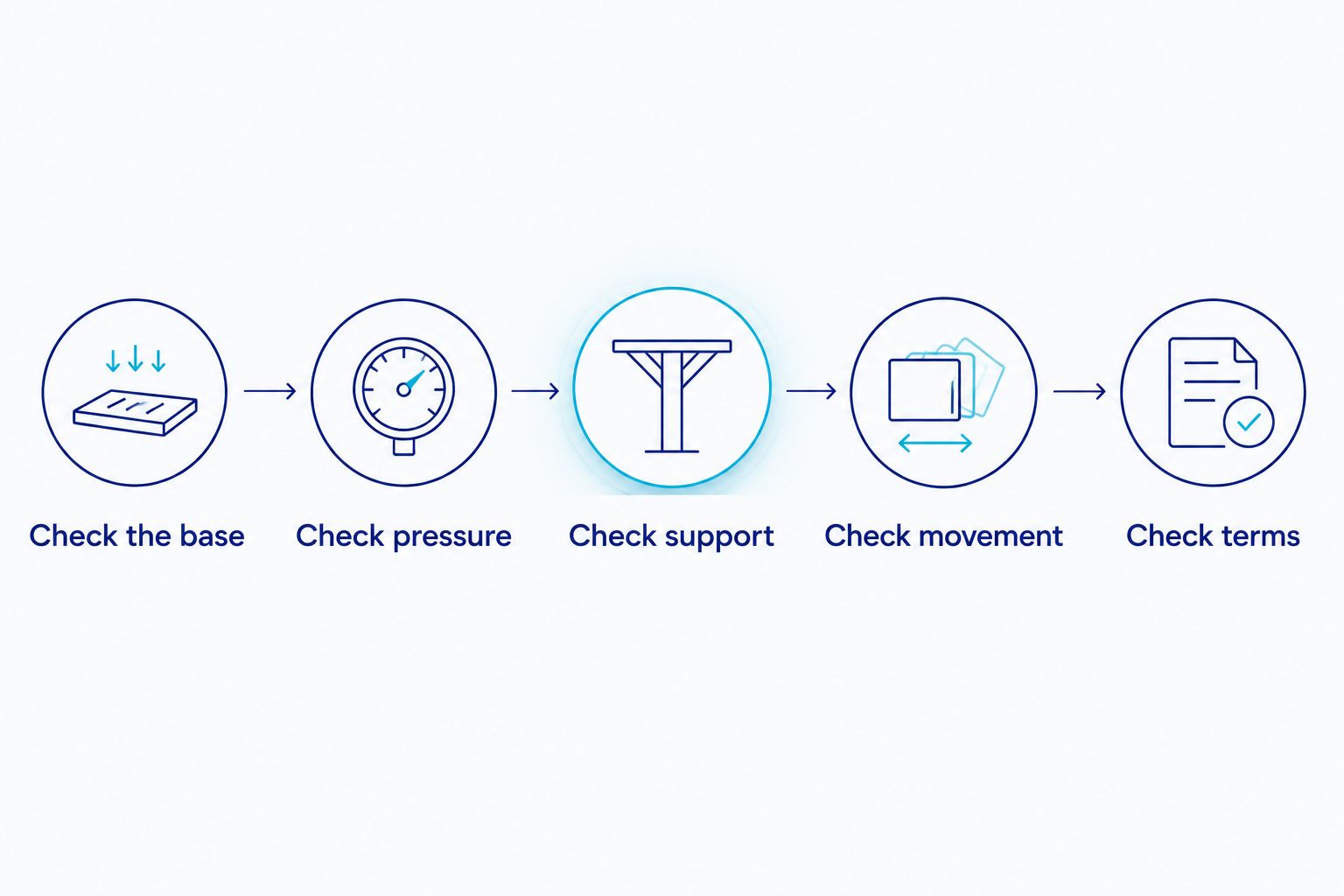
Use this sequence to organize your assessment:
- Check the base. Inspect your frame or foundation for damage, uneven support, and incompatibility with the mattress manufacturer’s requirements.
- Check pressure. Notice whether your shoulders, hips, or other contact points feel persistently compressed or uncomfortable.
- Check support. Notice excessive sinking, a hammock-like feeling, or an uncomfortable gap beneath your lower back.
- Check movement. Roll into your usual positions and assess whether the surface makes turning difficult.
- Check terms. Read the current written conditions governing returns, exchanges, and warranty coverage before committing.
Keep a simple record of your sleeping position, waking discomfort, nighttime awakenings, and major changes to your routine. This helps you describe your experience without assuming that every change in pain came from the mattress.
Do not push through worsening symptoms to satisfy an assumed adjustment period. A seller’s trial policy is a purchase condition, not medical guidance.
What does Aeva Vital’s firm hybrid mattress specification establish?
The listed product is the SpineAlign 12" Queen Firm Cooling Hybrid Mattress. Its supplied description identifies high-density foam and individually wrapped coils; its title identifies a queen size, firm designation, cooling description, and 12-inch thickness.
Aeva Vital is an option for shoppers comparing firm foam-and-coil hybrid mattresses, not a substitute for back-pain treatment. The practical advantage is an identified construction type and surface-feel category. The limitation is equally important: those details do not establish clinical pain relief or prove suitability for your body.
The name SpineAlign does not verify spinal alignment. Similarly, the cooling wording does not supply a measured temperature result, and the 12-inch thickness does not establish stronger support than another mattress.
Before selecting an Aeva Vital hybrid mattress in 2026, confirm the current full dimensions, foundation requirements, material details, and purchase terms. Do not assume compatibility with an adjustable base or infer a return policy from a product title.
Is a firm mattress better than a medium-firm mattress for back pain?
No—a firm mattress is not automatically better than a medium-firm mattress for back pain. The trial involving 313 adults favored medium-firm mattresses over firm mattresses for the studied group, but it does not prescribe one firmness for every sleeper.
Use medium-firm as an evidence-informed comparison point, not a universal rule. If a firmer surface is more comfortable for you, assess its pressure relief and your ability to change position rather than dismissing your experience because of a label.
Avoid comparing manufacturers’ firmness descriptions as though they were standardized measurements. A word such as firm tells you the seller’s category, not an independently comparable clinical rating.
Will replacing a sagging mattress solve morning back pain?
Replacing a sagging mattress can address an uneven sleeping surface, but it does not establish that the mattress caused your back pain. Inspect the foundation too: damaged or inadequate support beneath the mattress can affect the entire setup.
Look for a persistent depression, unevenness, or a pronounced tendency to roll toward one area. Then distinguish a comfort concern from a warranty claim; the seller’s written requirements determine warranty eligibility.
If morning pain continues after addressing the sleeping setup, seek clinical advice instead of repeatedly changing mattresses. Improvement in comfort and treatment of a health condition are different goals.
Does an adjustable base make a hybrid mattress better for back pain?
An adjustable base changes the position of the sleeping surface; it does not change the mattress’s underlying firmness or establish pain relief. Compatibility must be confirmed for the exact mattress and base before use.
Some people find particular elevated positions more comfortable, but comfort is not proof that a position treats the cause of back pain. Follow medical advice when you have a diagnosed condition or postoperative restrictions.
A compatible base is a practical requirement, not a bonus specification. Check the manufacturer’s written instructions rather than assuming that every foam-and-coil mattress bends appropriately.
FAQ
Can a hybrid mattress help with back pain?
Yes, a hybrid mattress can improve sleeping comfort when its cushioning and support suit you, but hybrid construction alone does not establish pain relief. Persistent or worsening pain needs medical assessment rather than a mattress-only solution.
What's the best mattress firmness for lower-back pain?
Medium-firm is an evidence-informed starting point, not a universal prescription. A randomized trial involving 313 adults with chronic nonspecific lower-back pain found better outcomes with medium-firm than firm mattresses at 90 days.
Is a hybrid mattress better than a foam mattress for back pain?
Hybrid construction does not establish that a mattress is better than foam for back pain. Compare the complete support system, pressure relief, surface feel, and fit to your sleeping position.
Can a firm hybrid mattress make my back feel worse?
A firm hybrid mattress can feel uncomfortable if its cushioning and support do not suit you. Do not assume worsening symptoms are a necessary adjustment stage; seek medical advice when pain persists or intensifies.
Does a 12-inch mattress provide better back support?
A 12-inch mattress is not automatically more supportive than a thinner mattress. Overall thickness does not disclose how the support system and comfort layers respond to your body.
Does Aeva Vital's SpineAlign mattress treat back pain?
The supplied product details do not establish that the SpineAlign mattress treats back pain. They identify a firm queen hybrid with high-density foam and individually wrapped coils, not a verified clinical outcome.
Should I check my bed frame before buying another mattress?
Yes, inspect the frame or foundation before replacing the mattress. Damage, uneven support, or an incompatible base can affect the sleeping surface, so follow the mattress manufacturer's requirements.
Related guides
- Best hybrid mattress for couples
- Is an adjustable bed worth it for back pain?
- How long does a hybrid mattress typically last?
One last thing
Before buying in 2026, check the base beneath your mattress. A new bed cannot correct a damaged foundation, and a familiar firmness label cannot guarantee comfort. Choose the construction that fits your sleeping needs, confirm the written requirements, and keep persistent back pain separate from the shopping decision.