
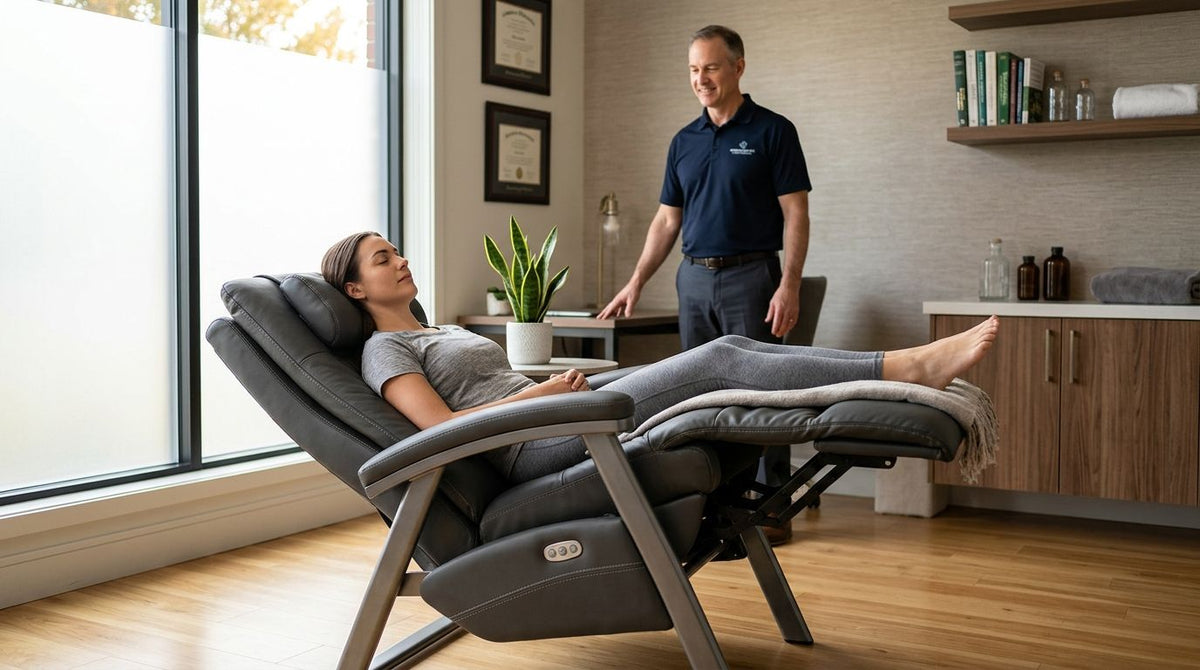
Zero gravity recliners for chiropractic and wellness clinics tilt a patient's hips above heart level and spread spinal load evenly across the seat and legrest, with the goal of shortening perceived wait time and giving patients a visible reason to return for their next adjustment. Clinics need chairs built for eight or more recline cycles a day, wipeable upholstery, and a footprint that fits a treatment room — requirements a home buyer never has to solve.
- A zero gravity recliner for chiropractic clinics needs a documented daily duty-cycle rating, not a residential spec sheet, going into 2026.
- Zero-gravity adjustable bed bases, like Aeva Vital's King/Queen frame with USB ports, outperform lobby chairs for clinics pairing adjustments with sauna or cold plunge recovery.
- Wipeable vinyl or medical-grade upholstery cuts turnaround time between patients; cloth upholstery does not.
- Clinics building recovery suites around infrared sauna or cold plunge sessions need furniture that reclines flat, not just to one fixed angle.
- Skip any recliner without a stated warranty or duty-cycle rating for clinical use.
Why zero gravity recliners matter for chiropractic and wellness clinics
The zero-gravity position traces back to NASA's neutral body posture research for astronauts: hips slightly above heart level, knees bent, spine unloaded from constant gravitational pull. Chiropractic clinics use that same position between adjustments because it drops muscle guarding without adding another billable procedure.
Home wellness brands like Aeva Vital sell zero-gravity positioning in bed bases and mattresses for the same reason residential buyers want it: less pressure on the lumbar spine during rest. A clinic's use case is heavier. One chair might cycle through 15 to 25 patients on a busy day, get wiped down between each one, and still need to fold flat for the next appointment. That duty cycle is the entire buying decision — not the recline angle.
How to choose a zero gravity recliner for your clinic
Map the recliner's role in your patient flow
- Decide if the chair sits in the reception area, a private recovery room, or a shared treatment bay.
- Track how many patients touch that chair on your busiest day — that number sets the duty-cycle requirement.
- Note whether patients recline solo or with a caregiver present, which affects required chair width.
- Flag whether the chair doubles as pre-treatment waiting furniture or strictly post-adjustment recovery.
Set your motor and weight requirements
- Choose motorized recline over manual handles when turnover speed matters more than upfront cost.
- Confirm the weight rating covers your actual patient population, not just an average adult.
- Ask suppliers for a stated cycle-life number — how many recline-and-return cycles before failure — since clinics run this far higher than a living room chair ever would.
- Check for a backup manual release in case of a power failure mid-recline.
Match upholstery to your sanitation protocol
- Specify wipeable vinyl or polyurethane over cloth or leatherette that traps moisture and odor.
- Look for welded or minimal-seam construction — seams collect debris and slow disinfecting between patients.
- Confirm the upholstery is rated for the disinfectant your clinic already uses, since bleach-based wipes degrade some vinyls faster than others.
- Ask about replacement panel availability so one torn cushion doesn't retire the whole chair.
Decide between a chair-style recliner and a zero-gravity adjustable bed base
- Chair-style recliners fit reception areas and single-adjustment recovery slots of 10-15 minutes.
- Zero-gravity adjustable bed bases, like Aeva Vital's King/Queen frame with USB charging and a built-in nightlight, fit longer recovery sessions inside a private room better than a chair does. Aeva Vital's own adjustable beds guide compares zero-gravity bed base specs against recliner-style options for anyone stocking a recovery room.
- A bed base gives two patients side-by-side positioning on one King or Queen frame; a single recliner does not.
- If your clinic already books 30-45 minute recovery blocks alongside massage or stretching, a bed base uses the room's square footage more efficiently than two separate recliners.
Pair recovery furniture with the modalities your clinic already runs
- If your clinic runs cold plunge or contrast therapy, place the recliner or bed base close enough that patients don't walk cold and stiff across the room.
- If your clinic offers infrared sauna sessions, budget recovery seating for the 15-20 minutes after a session when core temperature is still elevated.
- Group sauna, cold plunge, and recovery seating in one room if your square footage allows it, so patients complete a full protocol without crossing common areas.
- Keep at least one non-heated recovery spot for patients who skip sauna and cold plunge but still need post-adjustment rest.
Build a maintenance and replacement calendar
- Inspect motor housings and recline mechanisms on a fixed schedule, not just when a patient reports a problem.
- Log cycle counts if your supplier provides a duty-cycle rating, so you retire the chair before it fails mid-patient.
- Reupholster before a seam splits, not after — a visibly worn recliner reads as low-quality even when the mechanism still works fine.
- Keep one loaner chair or bed base in storage for the week a primary unit is out for repair.
Zero gravity recliner options for clinics compared going into 2026
| Option | Best for | Adjustability | Key limitation |
|---|---|---|---|
| Medical-grade zero gravity recliner chair | Reception areas and short 10-15 minute recovery slots | Motorized recline to a zero-gravity preset, usually one or two positions | Narrow footprint limits caregiver access |
| Zero-gravity adjustable bed base (Aeva Vital King/Queen) | Private recovery rooms with 20+ minute sessions | Independent head-and-foot articulation on a King or Queen frame, plus USB charging | Needs more floor space than a single chair |
| Standard massage recliner | Clinics offering vibration or heat add-ons alongside adjustments | Fixed recline angles, no true zero-gravity preset | Motors are not rated for clinical duty cycles |
| Adjustable treatment table with recline function | Clinics needing one piece of furniture for both flat treatment and recovery positioning | Manual crank or motorized incline | Slower to reposition between patients than a dedicated recliner |
Verdict: a medical-grade chair is the right buy for a fast-turnover reception area; a zero-gravity adjustable bed base is the right buy for a private recovery room paired with sauna or cold plunge; a standard massage recliner is a hold until you confirm the motor's duty-cycle rating in writing.
“If a recliner needs more than one motor cycle to reach full recline, it's too slow for a full patient day.”
Common mistakes chiropractic and wellness clinics make
- Buying residential zero gravity recliners rated for occasional home use, then running them through 15-25 daily cycles — the motor fails within months.
- Choosing cloth or leatherette upholstery because it looks upscale, then spending extra staff time trying to disinfect seams between patients.
- Sizing the recovery room for the chair's footprint at rest, not at full recline, so the chair doesn't actually fit once reclined.
- Skipping a written duty-cycle or warranty conversation with the supplier, then finding out the fine print excludes clinical use.
- Treating the recliner as a one-time purchase instead of budgeting for reupholstering or motor replacement inside the first 24 months of 2026 operating costs.
FAQ
What is a zero gravity recliner used for in a chiropractic clinic?
It repositions a patient's hips above heart level between adjustments to unload the lumbar spine and reduce muscle guarding. Clinics use it in reception areas for short sessions and in private rooms for longer recovery blocks.
Is a zero gravity recliner the same as a massage chair?
No. A zero gravity recliner is built around one specific spine-unloading position, while a massage chair adds vibration or rolling mechanisms at fixed recline angles. Some chairs combine both, but the motors and duty-cycle ratings differ.
Can a zero-gravity adjustable bed base replace a recliner chair in a recovery room?
Yes, for private recovery rooms with sessions longer than 15-20 minutes. A King or Queen zero-gravity bed base, like Aeva Vital's model with USB charging, gives more room for two patients or a caregiver than a single chair does.
What upholstery works best for a clinic recliner?
Wipeable vinyl or polyurethane with minimal seams. Cloth and leatherette trap moisture and slow disinfecting between patients, which matters more in a clinic than a living room.
How often should a clinic replace its zero gravity recliners?
There's no fixed number — it depends on the supplier's stated duty-cycle rating and how many patients cycle through daily. Log cycle counts and reupholster before seams split rather than waiting for a failure.
Do zero gravity chairs help with lower back pain?
The position is designed to redistribute spinal load and reduce pressure on the lower back while seated, which is why chiropractic clinics use it between adjustments. It's a positioning tool, not a treatment on its own.
What's the difference between manual and motorized zero gravity recliners?
Manual chairs use a handle or lever to reach the zero-gravity position and cost less upfront, but they're slower for staff to reset between patients. Motorized chairs reach the preset with one button, which matters more at higher daily patient volume.
How much weight can a zero gravity recliner hold?
Weight capacity varies by model and motor strength, so check the manufacturer's stated rating before buying for clinical use. Ratings built for home use often run lower than what a multi-patient clinic day requires.
One last thing
Most clinics shopping for a "zero gravity recliner" in 2026 are really solving a room-utilization problem, not a comfort problem — the chair with the fastest reset time between patients wins over the chair with the smoothest recline. If your clinic already runs cold plunge or infrared sauna protocols, a zero-gravity adjustable bed base gives more usable recovery space per square foot than a single recliner chair.