

Yes, a lift chair can be moved to a different room after setup, provided you follow its handling instructions and the new location accommodates its full movement and power connection. Return the chair to its normal seated position, disconnect power as instructed, and move it using approved lifting points—not its footrest, remote cable, or lift mechanism. This 2026 guide explains how to check the route, prepare the chair, and test the new setup before someone uses it.
By Editorial Team
- Can a lift chair be moved to a different room after setup? Yes—check the manual, doorway clearance, and new placement.
- Disconnect power before handling; account for any battery backup separately.
- Measure the entire route, not just the destination doorway.
- Aeva Vital’s home wellness guidance prioritizes room fit, safe cord routing, and access.
A short move still requires preparation. Start with the chair’s manual and this guide to lift chair doorway fit, then assess the actual route through your home.
Can a lift chair be moved to a different room after setup?
Yes. Initial setup does not automatically make a lift chair a permanent fixture. The important distinction is between relocating the complete chair and taking it apart: each requires the handling instructions for your particular model.
A powered lift chair contains moving hardware and electrical connections, so moving it is not the same as dragging an ordinary upholstered chair across the floor. Follow this sequence before you relocate it:
- Check the manual. Find the instructions for transport, disconnection, removable components, and lifting points.
- Measure the route. Check the chair’s transport dimensions against door openings, hallway turns, and the destination space.
- Prepare the chair. With the seat empty, return it to the position specified for moving, then disconnect its power sources as directed.
- Secure loose components. Keep the remote, cables, power supply, and any permitted removable parts from snagging or falling.
- Move with appropriate help. Use the handling method and equipment suitable for the chair, route, and floor.
- Reassemble and inspect. Reconnect only the components you were instructed to disconnect, and check that everything is secured.
- Test before use. Confirm operation and clearance according to the manual before the user sits down.
Do not force the chair through a tight opening or improvise a lifting point. If the route requires stairs, substantial tilting, or uncertain disassembly, arrange qualified help before moving it.
Why the new room needs a fresh setup check
A chair that works correctly in the living room still needs a placement check in the bedroom. Walls, bedside furniture, rugs, outlets, and walking routes change the conditions around it.
The chair’s upright footprint is only part of its space requirement. Check where the backrest, footrest, and seat travel during operation, using the manufacturer’s stated clearances rather than a generic measurement.
Also consider the person using it. A location that leaves room for the mechanism can still obstruct a walker, block caregiver access, or put the remote out of reach.
For your 2026 room plan, assess both chair movement and user movement. Passing one check does not replace the other.
Move it assembled or remove permitted components?
The safest choice depends on the manual and the route. Do not assume the backrest detaches because another recliner has that feature, and do not dismantle the powered base to make the chair narrower.
| Moving approach | Best for | Advantage | Limitation |
|---|---|---|---|
| Move the chair assembled | A clear route that fits its transport dimensions | Avoids unnecessary disconnection and reassembly | The complete chair still needs suitable handling and clearance |
| Remove components permitted by the manual | A route where the documented transport configuration improves fit | Reduces the dimensions specified by the manufacturer | Requires correct release, reconnection, and secure reassembly |
| Use a qualified moving service | Stairs, difficult turns, or handling beyond your ability | Provides help with the route and physical handling | Movers still need the chair’s instructions and a workable route |
Furniture-handling experience does not replace model-specific instructions. Give anyone helping you the manual before they lift, tilt, or disconnect the chair.
If a component does not release as described, stop. Pulling harder is not a substitute for identifying the correct latch or attachment.
Measure the route before disconnecting anything
Start with the chair in the transport configuration described by its manufacturer. Record its width, depth, height, and any dimensions for permitted removable components, then compare those measurements with the route.
Measure the usable opening, not the outside of the door frame. A door leaf, handle, or projecting trim can reduce the space available for passage.
A hallway turn needs separate attention. A chair that passes through a doorway head-on does not necessarily turn into that doorway from a narrow corridor.
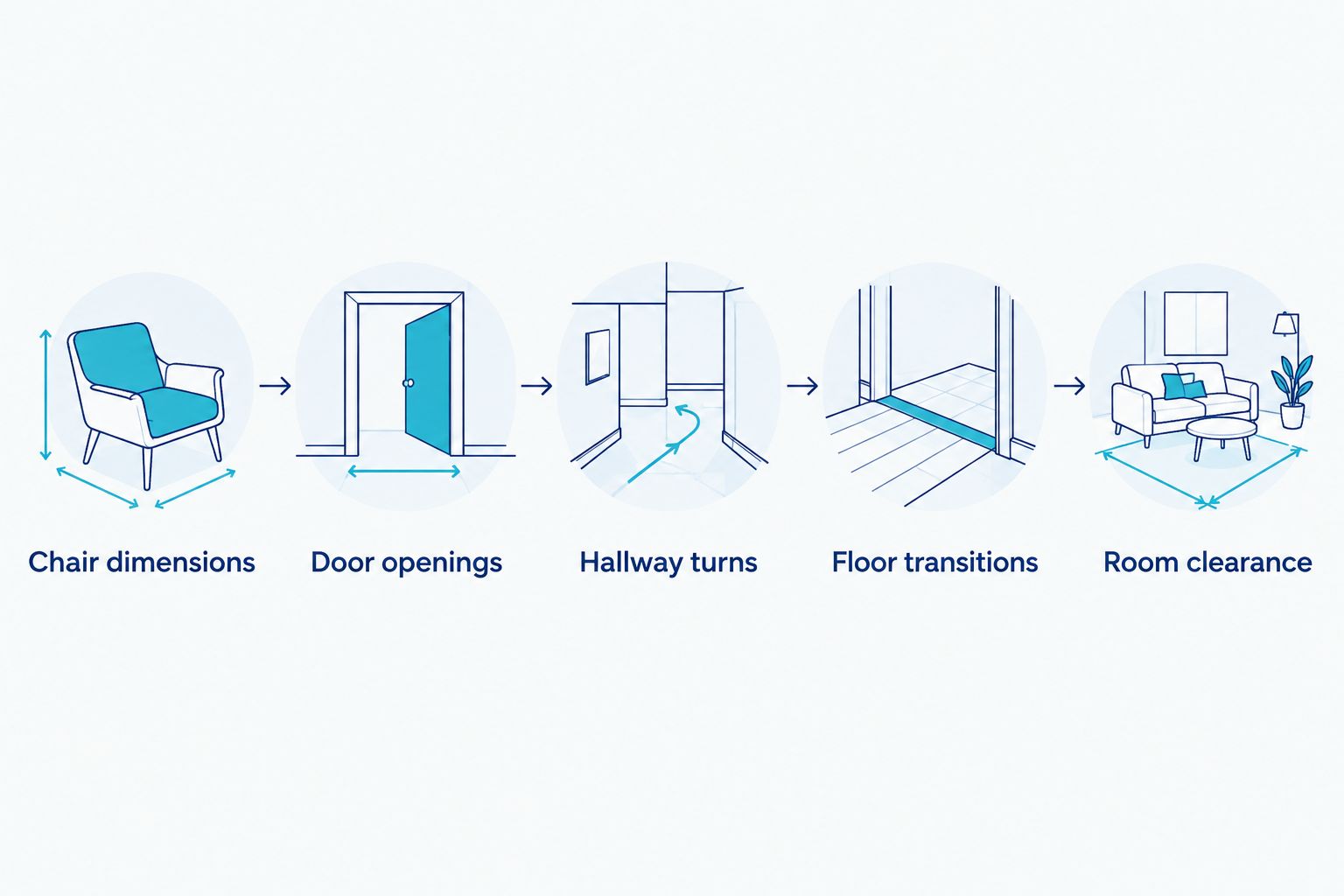
Check these points in order:
- Chair dimensions: Use the configuration approved for transport, not just the seated footprint.
- Door openings: Account for the open door, handles, trim, and other projections.
- Hallway turns: Check the approach and turning space on both sides of each opening.
- Floor transitions: Identify thresholds, loose rugs, and changes in floor level.
- Room clearance: Confirm space for operation, standing, and access to power.
Do not rely on the phrase standard doorway. Your actual opening and your particular chair determine whether the move is possible.
Keep the route clear before handling starts. Moving a side table or rug while someone is holding the chair creates an avoidable interruption.
Disconnect power without damaging the connections
With nobody in the chair, use the controls to return it to the manufacturer’s specified transport position. Do this before disconnecting power, unless the manual directs otherwise.
Unplug by holding the plug rather than pulling the cable. Follow the manual for any connection between the power supply, chair, handset, or removable backrest.
Unplugging the wall connection does not establish that every power source is disconnected. If the chair has a battery backup, follow the separate instructions for that system before handling components near moving hardware.
Keep disconnected plugs clean and dry. Secure the remote and loose cables so they cannot drag, catch on furniture, or become trapped under the base.
A photo of the original cable routing can help during reassembly, but it does not replace the wiring instructions. Reconnect by the manual, not by trial and error.
If you find a damaged cord, exposed conductor, or broken connector, stop using the chair and arrange appropriate service. Relocation is not a reason to continue operating damaged electrical equipment.
Handle the chair by approved lifting points
Use only the lifting points and methods described for the model. Upholstered arms, footrests, backrests, and accessible metal parts are not automatically suitable handles.
Keep hands away from the lift linkage and other pinch points. Never move the chair with someone seated in it, and keep children and pets away from the route.
Dragging is not a substitute for an approved moving method. It puts the chair’s base, connections, and floor at risk, particularly at thresholds where the chair can catch.
Do not assume furniture sliders, a dolly, or fitted casters are suitable for occupied movement or every floor surface. Check compatibility with the chair and use equipment according to its own instructions.
For the 2026 move, choose assistance based on the actual handling task—not a fixed helper count. Chair weight, grip access, stairs, and the abilities of the people involved determine what help is appropriate.
If anyone needs to twist, reach awkwardly, or hold the chair while rearranging the route, stop and revise the plan. An interrupted move is preferable to an uncontrolled one.
Why moving difficulty varies
The distance between rooms is not the main measure of difficulty. A nearby room reached through a tight turn can require more planning than a longer, clear route.
These factors determine the approach:
- Transport configuration: The manual establishes whether the chair stays assembled or has permitted removable components.
- Chair dimensions and weight: These determine fit and handling requirements; seated-user capacity is a different specification.
- Route geometry: Door openings, corners, stairs, and thresholds affect passage.
- Floor condition: Loose rugs, uneven surfaces, and delicate finishes affect handling and final placement.
- Power arrangement: Cord reach, outlet location, and any backup power system affect disconnection and setup.
- User access: Standing space, walking aids, and caregiver access affect whether the new position is usable.
None of these checks can be resolved by the chair’s appearance alone. A compact-looking chair still needs its documented dimensions and operating clearance checked.
Reconnect and test the chair in its new position
Place the chair on a surface that meets the manufacturer’s instructions. Check that the base is stable and that no cable runs beneath a supporting point or through the mechanism.
If you removed a permitted component, confirm that its attachment is secured before operation. Reconnect electrical plugs as directed, without forcing mismatched connectors.
Route the power cord away from walking paths and moving hardware. The cord should remain clear throughout the chair’s operating travel, not just while the seat is upright.
Follow the manual’s test procedure before the user sits down. Keep the movement area clear and check for obstruction, unexpected operation, loose components, or a cable being pulled tight.
If the chair stops, moves unexpectedly, or develops an unfamiliar noise, stop testing and investigate according to the troubleshooting instructions. Do not repeatedly operate it against a suspected obstruction.
Complete the 2026 setup check with the intended user’s needs in mind. Confirm that the handset is reachable, the standing area is clear, and the new layout supports their usual way of approaching and leaving the chair.
Can I move a lift chair without taking it apart?
Yes, provided the assembled chair fits the complete route and the manual allows the handling method. Keeping it assembled avoids unnecessary reconnection, but it does not remove the need for suitable help and approved lifting points.
Does a lift chair need to be installed again after moving?
It needs a new placement, connection, and operation check. If you removed permitted components, follow the reassembly instructions before testing; an assembled move still requires checking clearance, stability, and cord routing.
Can I move a lift chair upstairs myself?
Do not treat stairs as an ordinary room-to-room move. Use qualified help when the stair route or chair handling exceeds your ability, and provide the chair’s transport instructions before work begins.
What Aeva Vital’s home wellness guidance adds
Aeva Vital’s home wellness guidance is best for readers planning how equipment fits into their home. For a lift chair relocation, that means considering the room, access route, and power arrangement together rather than treating fit as a doorway-only question.
General guidance helps you organize those checks; it cannot establish a particular chair’s lifting points, detachable parts, or electrical requirements. Use the chair manufacturer’s manual for those decisions.
FAQ
Can a lift chair be moved to a different room after setup?
Yes, provided you follow its transport instructions and the new room accommodates its operation and power connection. Check the entire route, disconnect power as directed, and test the new setup before use.
Do I have to unplug a lift chair before moving it?
Disconnect power according to the manual before handling the chair. If it has battery backup, follow the separate instructions for that power source as well.
Can I remove the backrest to get a lift chair through a door?
Remove the backrest only if the manufacturer provides instructions for doing so. Do not assume your chair has a detachable backrest or force its attachments.
Can I drag a lift chair across the floor?
Do not drag the chair as a substitute for its approved moving method. Use the handling points and equipment specified for the chair and route.
How far should a lift chair sit from the wall after moving?
Use the clearance specified for your model rather than a generic distance. Check the backrest, footrest, and lift travel, plus the space needed to approach and leave the chair.
What should I check if my lift chair stops working after a move?
Stop and follow the manual’s troubleshooting procedure. Check permitted connections and visible cable damage with power disconnected as instructed; never inspect moving hardware during operation.
Can I use an extension cord in the new room?
Follow the manufacturer’s electrical instructions rather than assuming an extension cord is acceptable. If the recommended power connection cannot reach safely, revise the placement or consult a qualified electrician.
Is there a different moving procedure for a lift chair in 2026?
The correct procedure is the one specified for your model, regardless of the calendar year. Use its current manual and any applicable manufacturer instructions for transport, power disconnection, and reassembly.
Related guides
- Routing lift chair power cords safely
- Lift chair outlet planning
- Setting up a lift chair after surgery
One last thing
The easiest detail to miss is the cord’s position after the chair starts moving. A cable that looks clear beneath an upright chair can enter the mechanism’s travel path, so inspect its routing throughout the manufacturer’s test procedure—not just when you first plug it in.