

To break in a new mattress faster, complete the manufacturer’s setup instructions, check the foundation, and use the bed consistently rather than forcing it to soften. Avoid jumping, adding heavy weights, or applying direct heat: those shortcuts can damage the mattress without fixing an unsuitable firmness level. Separate initial expansion from break-in, because a mattress that has reached its intended shape has not necessarily reached its settled feel.
By Editorial Team
- How to break in a new mattress faster: prioritize correct support and consistent use, not aggressive compression.
- Aeva Vital’s SpineAlign hybrid mattress combines foam and individually wrapped coils; construction does not establish a break-in deadline.
- Rotate or flip a new mattress only when its care instructions permit it.
- Check trial requirements before waiting longer, and do not treat worsening pain as proof that break-in is working.
How do you break in a new mattress faster?
The safest approach is normal use on the correct foundation, following the mattress’s own instructions. There is no universal schedule that makes every new mattress comfortable sooner. For the distinction between initial setup and longer-term adjustment, see how long it takes to break in a new hybrid mattress.
Follow these steps in order
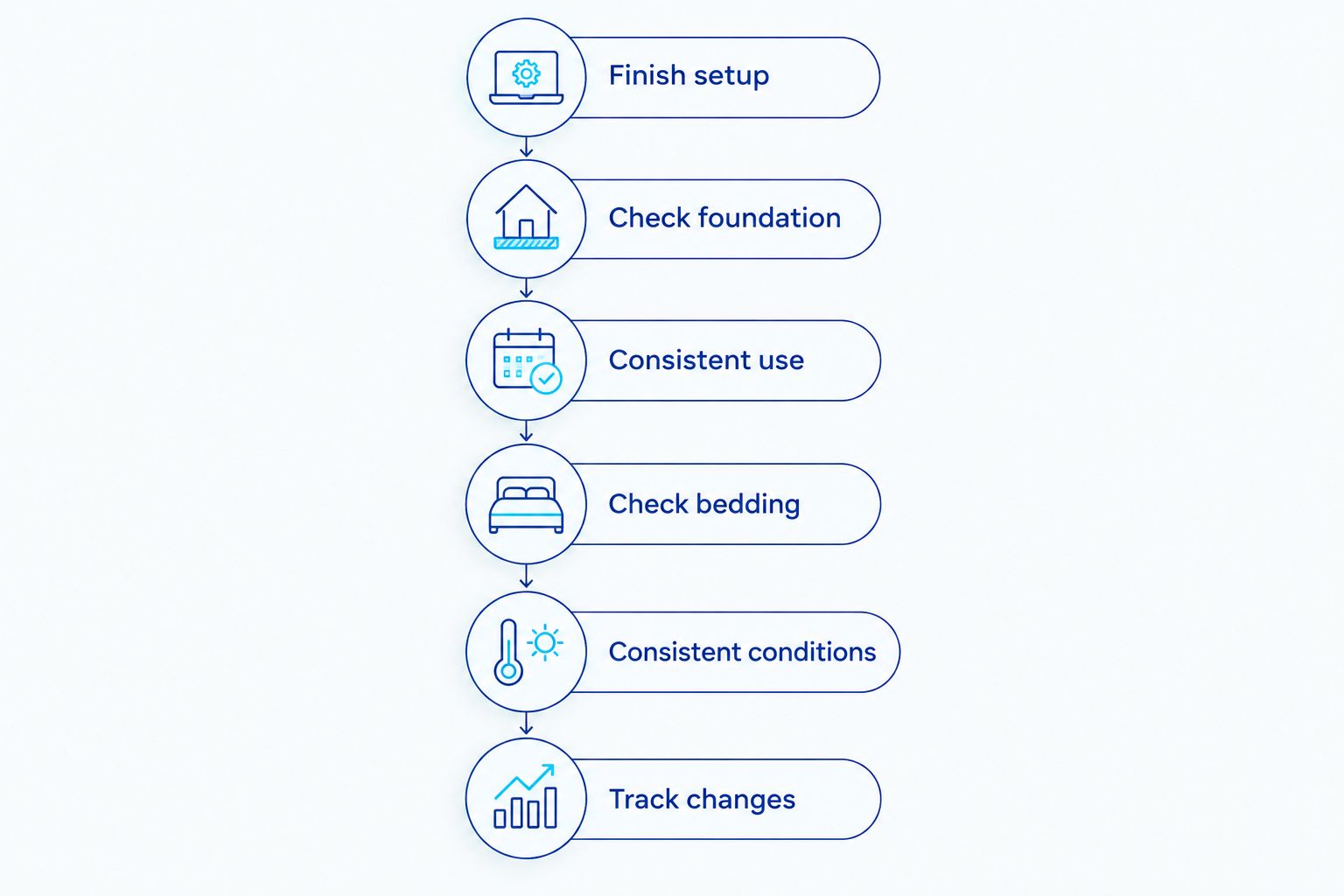
- Finish setup first. Remove packaging as directed, position the mattress correctly, and follow the manufacturer’s expansion instructions before judging its shape or sleeping on it.
- Check the foundation. Compare the frame, slats, center support, and base type with the mattress requirements. Fix missing or unsuitable support before trying to change the surface feel.
- Use the mattress consistently. Sleep in your usual position when the bed is ready for use and comfortable enough to tolerate. Ordinary use is preferable to concentrated force from walking, bouncing, or weights.
- Remove avoidable tension. Check whether fitted sheets or a protector pull tightly across the surface. Use correctly sized bedding without removing required protection.
- Keep conditions consistent. Maintain your normal comfortable bedroom environment. Do not place heaters, heating pads, or other heat sources on the mattress to accelerate softening.
- Track the direction of change. Record whether pressure, support, and sleep comfort improve, remain unchanged, or worsen. Contact the seller about persistent problems before any applicable deadline.
These steps help you evaluate the mattress without introducing damage or confusing the results. In 2026, use the instructions supplied with your exact model rather than borrowing a break-in schedule from an unrelated mattress.
Which mattress break-in methods are worth trying?
Some adjustments correct the sleep setup; others simply add force. Choose methods that preserve the mattress and make its feel easier to assess. None of the following establishes a guaranteed completion date.
| Method | Best for | Benefit | Limitation or reason to avoid it |
|---|---|---|---|
| Consistent normal use | Evaluating everyday comfort | Tests the mattress under its intended use | Does not turn every firm mattress into a soft mattress |
| Correcting foundation support | An uneven or unsupported setup | Addresses a problem beneath the mattress | Requires the model’s actual support requirements |
| Checking bedding fit | A tightly stretched sleep surface | Removes avoidable restriction from bedding | Does not change the mattress’s internal construction |
| Rotation, when permitted | Distributing use across the sleep surface | Changes which areas receive regular loading | Is not permitted or necessary for every model |
| Adding a topper | Adjusting surface cushioning | Changes the feel above the mattress | Masks the original feel and is not a break-in method |
| Jumping, weights, or direct heat | No recommended break-in use | No dependable advantage over correct use | Introduces unnecessary force or heat |
A topper deserves particular care. It can make the surface feel different, but that means you are evaluating a combined sleep system rather than the mattress alone. Avoid adding one immediately if your main goal is to decide whether the underlying mattress suits you.
Why this matters: softer does not always mean better
Breaking in a mattress and choosing the right mattress are separate tasks. Materials can change with use, and your perception can change after leaving a familiar bed, but neither process guarantees suitable support.
A mattress that feels firm at first is not automatically defective. Equally, a mattress that leaves you increasingly uncomfortable should not receive unlimited extra time simply because it is new.
Judge the direction of change, not just the number of nights elapsed. Improving comfort supports continued evaluation within the seller’s terms; worsening discomfort calls for a setup check and a conversation with the seller. Persistent or significant pain warrants advice from a qualified healthcare professional.
What is the difference between expansion and break-in?
Expansion describes a compressed mattress recovering its intended shape after unpacking. Break-in describes changes in feel with use. Getting accustomed to a different sleeping surface is a separate part of your experience.
These processes can overlap, but they are not interchangeable. A mattress can look fully expanded while still feeling unfamiliar, and waiting longer will not repair an unsuitable foundation.
For a mattress unpacked in 2026, follow the expansion guidance included with that purchase. Do not substitute a generic online waiting period for the manufacturer’s directions, particularly if corners remain misshapen or the surface appears uneven.
What should you check before the first sleep?
Confirm that packaging is removed, the sleeping side faces upward, and the mattress rests evenly on the intended base. Keep cutting tools away from the fabric while opening compressed packaging.
Check the care label before removing anything attached to the mattress. A removable outer cover is not an invitation to open internal layers, and opening the construction is not a break-in technique.
Why mattress break-in varies
A universal deadline ignores differences in construction and setup. The following factors explain why your experience cannot be predicted from the word new alone:
- Comfort-layer material. Memory foam, other polyurethane foams, latex, and fiber cushioning have different material properties. Read the actual construction details instead of assuming all foam behaves alike.
- Layer arrangement. The layers nearest your body affect surface feel, while the support structure contributes to how the mattress holds you. Total thickness does not describe that arrangement.
- Starting firmness. A firm design remains a firm design even if its initial feel changes. Break-in is not a dependable way to convert a firmness category.
- Foundation condition. Missing support, damaged slats, or an incompatible base can affect the sleep surface. More use does not correct those faults.
- Room conditions. Temperature-sensitive foam can feel different as conditions change. Artificially heating the bed confuses evaluation and introduces a separate safety concern.
- Your previous sleep setup. A different mattress, pillow, or sleeping position changes the comparison. Familiarity with an old bed does not establish that either bed provides suitable support.
For your 2026 purchase, record the model and foundation requirements together. That gives you a useful reference when asking the seller whether the setup is correct.
Can you walk on a new mattress to soften it?
Do not use walking or jumping as a default break-in method. Standing concentrates your weight over a smaller area than lying down, and jumping adds impact. Neither is necessary to evaluate normal sleeping comfort.
If the manufacturer provides a specific conditioning procedure, follow that procedure rather than an online variation. Otherwise, stick to intended use and avoid heavy objects, stacked weights, repeated knee pressure, or attempts to bend the mattress by force.
The same rule applies to adjustable bases. Raising and lowering a bed is not a substitute for verifying compatibility, and repeated flexing is not a general-purpose softening treatment.
Should you rotate or flip a new mattress?
Rotate or flip the mattress only when the manufacturer permits it. Rotation changes the head-to-foot orientation; flipping changes which face you sleep on. They are different actions.
A one-sided mattress has a designated sleeping surface. Turning it upside down exposes the wrong side for sleep, so never assume that an uncomfortable surface needs flipping.
If rotation is permitted, follow the stated method and schedule. Clear surrounding furniture and get assistance when needed rather than dragging the mattress by components that are not intended as carrying handles.
What should you check on an Aeva Vital hybrid mattress?
The Aeva Vital SpineAlign 12" Queen Firm Cooling Hybrid Mattress is described as using high-density foam and individually wrapped coils. That identifies a foam-and-coil construction; it does not establish how quickly the mattress will soften or how comfortable it will feel to you.
Aeva Vital’s SpineAlign hybrid mattress is best for shoppers seeking a firm foam-and-coil design, not a mattress they expect to become plush. Its stated construction provides a clearer starting point than its thickness alone, but the product name is not a personalized comfort assessment.
The named 12-inch profile describes thickness. It does not prove a particular foam density, cooling result, body-weight limit, or break-in duration, and individually wrapped coils do not establish adjustable-base compatibility by themselves.
Before evaluating this Aeva Vital hybrid mattress, check the current model instructions for foundation support, expansion, rotation, and care. For a purchase made in 2026, also confirm the applicable trial and return terms directly rather than assuming another retailer’s rules apply.
How can you tell whether break-in is helping?
Keep a short, consistent record instead of relying on the impression left by the worst night. Note your sleeping position, where pressure occurs, whether you feel supported, and whether you wake more or less comfortable than before.
Change only one part of the setup at a time. If you change the pillow, topper, foundation, and room conditions together, you cannot identify which adjustment changed the experience.
Separate surface pressure from structural concerns. A firm-feeling surface calls for a different discussion than a visible dip, uneven expansion, a damaged base, or a section that feels markedly different from the surrounding mattress.
Photograph visible irregularities and keep the model information available when contacting the seller. Ask whether the condition matches the expected setup process instead of trying to force the affected area into shape.
When should you stop trying to break in a mattress?
Stop experimenting when the mattress appears damaged, the support system is unsuitable, or discomfort is worsening. Correct the setup or contact the seller rather than escalating the force applied to the bed.
Read any minimum-use requirement and return deadline separately. A requirement to evaluate the mattress for a stated period is not a medical instruction to tolerate pain, and a comfort concern does not automatically establish a product defect.
Set your decision deadline from the actual purchase terms, not from an internet break-in estimate. For a 2026 order, save the terms associated with that order and contact the seller early enough to resolve questions before the deadline.
FAQ
What is the safest way to break in a new mattress faster?
The safest approach is correct setup followed by consistent normal use. Check foundation requirements and bedding fit, and avoid concentrated weights, jumping, or direct heat.
How many nights does a new mattress take to break in?
There is no universal number of nights that applies to every new mattress. Follow the model’s instructions and assess whether comfort is improving within the applicable purchase terms.
Can I sleep on a new mattress before it finishes expanding?
Follow the manufacturer’s instructions about when the mattress is ready for sleep. Expansion guidance and longer-term break-in guidance answer different questions.
Will a firm mattress become soft after breaking in?
Break-in does not guarantee that a firm mattress will become soft. Its feel can change with use, but an unsuitable firmness choice is not reliably corrected by waiting.
Does walking on a mattress help it break in?
Walking is not a recommended default break-in method. Use normal sleeping pressure unless the manufacturer explicitly provides a different conditioning procedure.
Can I use heat to soften a new memory foam mattress?
Do not apply direct heat as a break-in shortcut. Keep the room comfortably consistent and follow the mattress instructions regarding heated bedding.
Should I buy a topper while my mattress breaks in?
A topper changes surface cushioning rather than breaking in the mattress underneath. Evaluate the original setup first when your goal is to decide whether the mattress itself suits you.
Is worsening back pain normal during mattress break-in?
Worsening back pain is not proof that break-in is working. Check the setup, contact the seller about the mattress, and seek professional healthcare advice for persistent or significant symptoms.
Related guides
- Can you flip or rotate a hybrid mattress?
- How to choose the right firmness level for a hybrid mattress
- Can a hybrid mattress be used on an adjustable bed base?
One last thing
Before trying to soften the mattress, check what sits directly above and below it. A tightly stretched protector or an unsuitable foundation changes the sleep setup without changing the mattress’s intended construction. Fix those variables first; then decide whether the mattress itself is the right fit.