
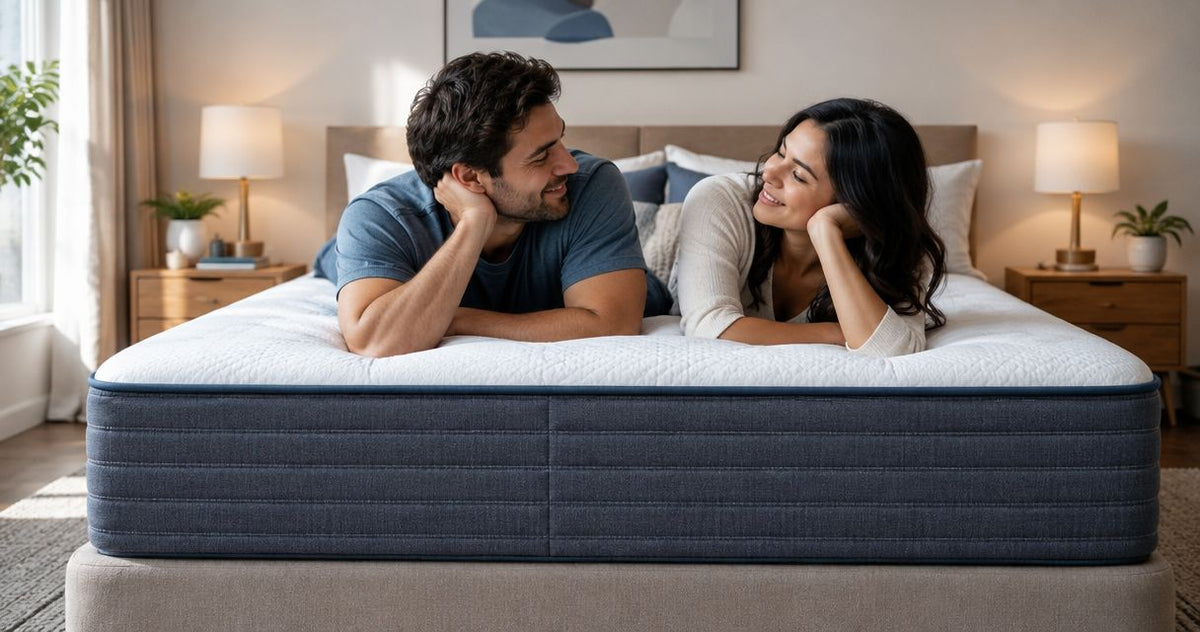
Yes—couples can share a hybrid mattress with different firmness needs when the same surface provides comfortable cushioning and support for both sleepers. For your 2026 purchase, the key limitation is that a standard single-firmness hybrid does not provide independently adjustable firmness; larger preference differences call for separate comfort surfaces or separate mattresses.
By Editorial Team
- Can couples share a hybrid mattress with different firmness needs? Yes, if both sleepers find the shared surface comfortable.
- Aeva Vital’s firm hybrid mattress suits shared firm preferences, not independently adjustable firmness requirements.
- A split king accommodates separate mattress choices but introduces a center seam.
- Compare pressure relief, support, movement, and usable width—not firmness labels alone.
Can couples share a hybrid mattress with different firmness needs?
Yes, but shared comfort matters more than choosing the midpoint between two firmness preferences. A hybrid combines cushioning materials with a spring support system. That construction does not, by itself, create different firmness settings on opposite sides.
Start by identifying whether you disagree about surface softness, deeper support, or movement from your partner. These are separate problems. The guide to choosing the right firmness level for a hybrid mattress explains the firmness decision in more detail.
| Arrangement | Best for | Main advantage | Main limitation |
|---|---|---|---|
| Single-firmness hybrid | Couples with overlapping comfort preferences | Continuous sleeping surface without a center seam | Both sleepers share the same specified firmness |
| Hybrid with a topper on one side | Couples needing a surface-softness adjustment | Changes cushioning on one side | Creates a height difference and does not replace the underlying support system |
| Dual-firmness mattress | Couples wanting different side feels within one mattress | Separate firmness specifications within a shared mattress | Construction and actual side-to-side differences require verification |
| Split king with separate mattresses | Couples with clearly conflicting firmness preferences | Each sleeper chooses a separate mattress | Center seam, separate fitted sheets, and alignment require attention |
A dual-firmness design is not the same as a mattress described as zoned. Zoning generally changes support across body regions, such as the shoulders and hips. Confirm whether the specification describes differences along the mattress or differences between sleeping partners.
Why this matters
A shared mattress is a joint decision, but comfort is individual. A bed that feels comfortably cushioned to you can feel restrictive to your partner, even when you use the same firmness label.
For a 2026 mattress shortlist, separate construction facts from comfort conclusions. Mattress height describes thickness; a firmness label describes intended feel. Neither establishes that both sleepers will remain comfortable through the night.
The useful question is not whether a hybrid is suitable for couples in general. It is whether the particular construction works for both people, together, in their usual sleeping positions.
Single-firmness hybrid: best for overlapping preferences
A single-firmness hybrid is the simplest arrangement when you both find the same surface comfortable. You keep a continuous bed surface, with no intentional division between sleeping areas.
Do not assume that a medium-feeling mattress automatically resolves a disagreement between soft and firm preferences. A compromise only works when neither sleeper experiences uncomfortable pressure or excessive sinking.
Choose a shared firmness only after both sleepers accept it independently. One partner liking the mattress is not evidence that the other partner will adapt to it.
A larger bed supplies more room, not separate firmness settings. Likewise, individually wrapped coils describe the spring arrangement; they do not establish that the left and right sides have different firmness specifications.
One-sided topper: best for a surface-softness difference
A topper placed on one side changes the cushioning above the existing mattress. This approach makes sense to investigate when one partner likes the underlying bed but wants a softer contact surface.
The limitation is structural. A topper does not replace the mattress core or repair a sagging support system, and its thickness creates an uneven surface between partners.
Check how the topper fits beneath your protector and bedding. Also consider whether you regularly sleep across the center: the transition between the topped and untopped sides becomes part of the sleeping surface.
Treat a one-sided topper as a cushioning adjustment, not a guaranteed firmness correction. If your complaint is deep sinking rather than a hard surface, adding cushioning does not establish that the support problem is solved.
Dual firmness: best for different side feels without separate mattresses
A genuine dual-firmness mattress specifies different feels for the sleeping partners. Before choosing this arrangement, confirm exactly what differs: the comfort material, the support components, or both.
The benefit is a shared mattress format with side-specific construction. The limitation is that the term alone does not explain how pronounced the difference is or how the center transition feels.
Ask whether either side can be changed after purchase and whether the components must remain in a particular orientation. Use the manufacturer's written instructions rather than assuming that internal layers are interchangeable.
Do not confuse dual firmness with a flippable mattress. Different feels on opposite faces require turning the whole mattress over; that does not give each partner a different sleeping side at the same time.
Split king: best for clearly conflicting preferences
A standard US split king uses two twin XL mattresses, each nominally 38 inches wide by 80 inches long. Together, they occupy the standard king footprint of 76 inches wide by 80 inches long.
For comparison, a standard US queen measures 60 inches wide by 80 inches long. These are standard size conventions, not verified dimensions for a particular product; check actual mattress and frame measurements before ordering.
Those measurements matter for your 2026 room plan because a split king changes the sleeping arrangement without reducing the usual king footprint. Each partner selects a separate mattress, but the bed still needs a compatible frame or foundation.
The trade-off is the center seam. Match mattress heights when you want a level surface, and check how the frame keeps the mattresses aligned. A bridge or shared topper changes the center feel but does not turn separate mattresses into a single mattress core.
Choose separate mattresses when independent firmness matters more than an uninterrupted center surface. If you often sleep close together across the middle, evaluate that seam before committing.
Why firmness feels different to each partner
The same mattress construction can feel different under different sleepers. Use these factors to explain the disagreement before changing the entire bed:
- Sleeping position: Side sleeping places the shoulder and hip against the surface differently from back or stomach sleeping.
- Body weight and distribution: Different loading changes how deeply each sleeper compresses the comfort layers and springs.
- Comfort-layer construction: Foam type, thickness, and arrangement affect the cushioning above the support core.
- Support-system construction: Coil design and any documented zoning influence how the mattress responds beneath the cushioning.
- Foundation condition: An unsuitable or damaged base changes the support beneath the mattress and complicates a comfort assessment.
Firmness and support are related, but they are not interchangeable. Firmness describes perceived resistance; support concerns how the mattress carries your body. A hard-feeling surface is not automatically the better-supported choice.
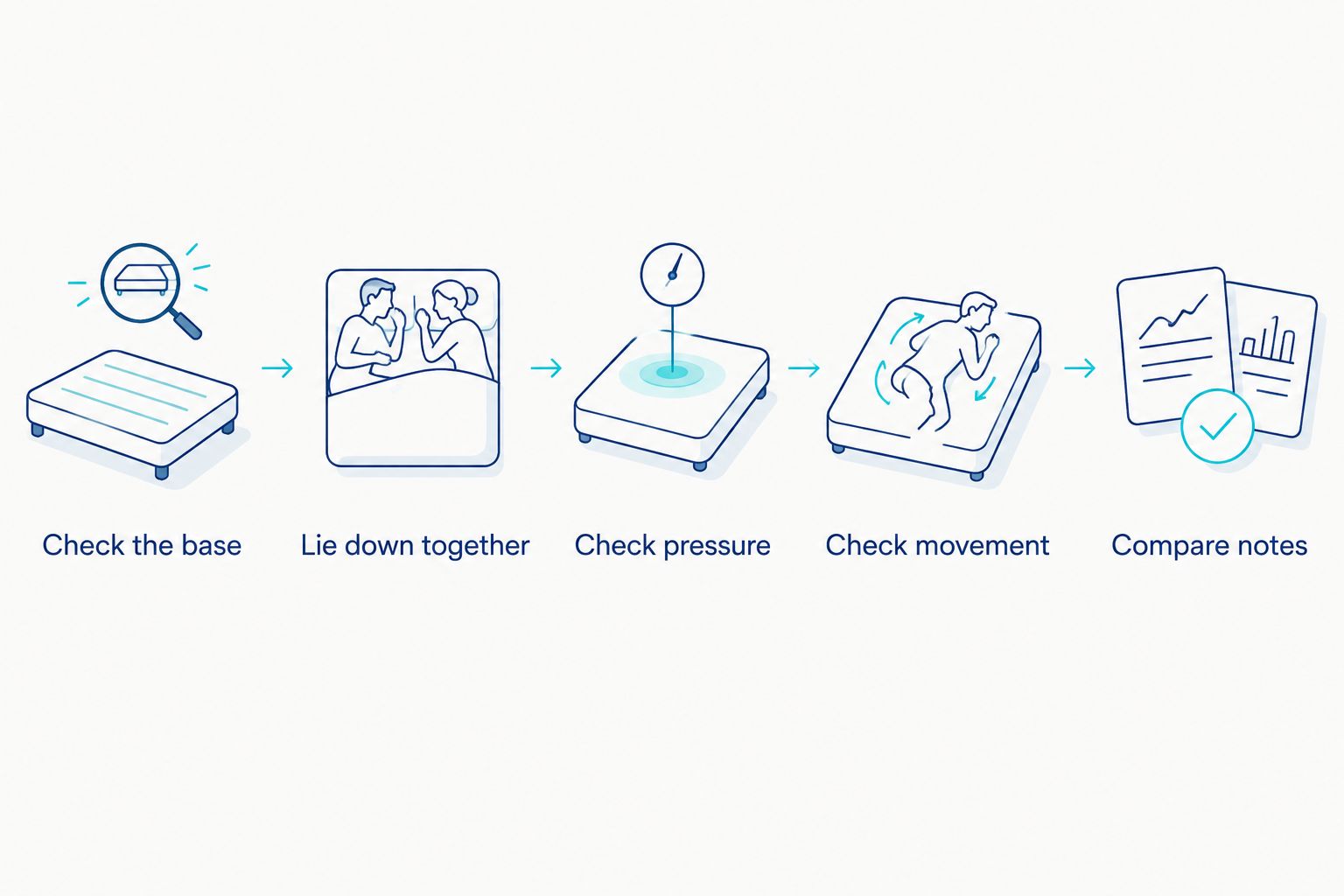
How should you test a mattress together?
Use a repeatable comparison instead of taking turns sitting on the edge. Both sleepers need to evaluate the bed under the conditions in which they expect to use it.
- Check the base. Confirm that the foundation matches the mattress manufacturer's requirements before judging the mattress itself.
- Lie down together. Use your usual sleeping positions with both people on the bed, not one person testing an otherwise empty surface.
- Check pressure. Identify whether a shoulder, hip, or another contact point feels uncomfortably compressed.
- Check movement. Have each partner turn and get out of bed while the other assesses disturbance.
- Compare notes. Record each person's experience separately before deciding whether a shared surface works.
Keep cushioning and movement observations separate. A mattress can feel comfortable while still transmitting movement that bothers one partner; conversely, low disturbance does not establish that the firmness is suitable.
If you test at home, read the written trial and return terms before purchase. Check the stated process rather than assuming every mattress carries the same conditions, fees, or adjustment period.
Does an adjustable base give each partner different firmness?
An adjustable base changes position, not the mattress's specified firmness. Raising the head or foot section is a different function from changing the materials beneath each sleeper.
A split adjustable arrangement can provide independent positioning when the mattresses and bases support it. That still requires compatibility checks for each component; the word hybrid does not establish compatibility by itself.
If independent elevation is part of your plan, confirm the mattress, base, frame, and bedding requirements together. Do not buy a continuous mattress expecting it to behave like separate mattresses over independently moving bases.
What does Aeva Vital's firm hybrid specification establish?
The supplied Aeva Vital mattress listing names the SpineAlign 12" Queen Firm Cooling Hybrid Mattress. Its description identifies high-density foam and individually wrapped coils, while the title identifies a 12-inch queen hybrid with a firm designation.
Aeva Vital's firm hybrid mattress is best suited to couples who both prefer a firm surface. Couples requiring independently specified firmness on each side need that feature explicitly documented; a firm designation does not establish it.
For your 2026 comparison, read each specification narrowly. The 12-inch designation describes mattress height, not a firmness score. High-density foam describes a material characteristic, not a guarantee that both partners will find the surface comfortable.
Likewise, individually wrapped coils do not prove a particular level of motion isolation. The word Cooling in the product name does not quantify temperature performance. Compare the listed construction with your needs without treating a product name as a test result.
Should you choose a firmer mattress for the heavier partner?
Body weight alone does not determine the correct shared firmness. Consider sleeping position, cushioning preferences, and the actual construction alongside weight distribution.
Do not make one partner's preference the default and expect the other to compensate indefinitely. If one sleeper needs substantially different cushioning or support, compare separate comfort arrangements rather than selecting a shared label neither person likes.
FAQ
Can couples share a hybrid mattress with different firmness needs?
Yes, couples can share a hybrid mattress when both sleepers find its cushioning and support comfortable. A standard single-firmness hybrid does not provide independently specified firmness on each side.
What's the best mattress arrangement when I like soft and my partner likes firm?
Separate mattresses in a split king are the most direct arrangement for choosing different mattresses for each partner. A verified dual-firmness design is another option, while a one-sided topper only adjusts surface cushioning.
Does a split king have the same dimensions as a king mattress?
A standard US split king occupies 76 inches by 80 inches, using two twin XL mattresses measuring 38 inches by 80 inches each. Confirm actual product dimensions and frame compatibility before purchase.
Will a topper on my side fix a mattress that's too firm?
A one-sided topper changes surface cushioning, but it does not guarantee a suitable overall feel or replace the mattress support system. It also creates a height difference between sleeping areas.
Do pocketed coils mean my partner won't feel me move?
Pocketed coils do not establish that your partner will feel no movement. Evaluate the complete mattress with both sleepers present because comfort layers and overall construction also matter.
Can an adjustable bed make my side of a mattress softer?
An adjustable bed changes sleeping position rather than the mattress's specified firmness. Independent positioning requires a compatible mattress-and-base arrangement.
Is the SpineAlign mattress specified as firm?
The supplied SpineAlign 12" Queen Firm Cooling Hybrid Mattress listing identifies it as firm. That designation does not establish separate firmness settings for each partner or guarantee individual comfort.
Related guides
- Can a hybrid mattress be used on an adjustable bed base?
- Can you flip or rotate a hybrid mattress?
- How long does it take to break in a new hybrid mattress?
One last thing
Before your 2026 purchase, write down each partner's non-negotiable requirement separately: cushioning, support, movement, or independent positioning. If the requirements conflict, choose an arrangement that separates them rather than asking a shared firmness label to solve different problems.