

The best full spectrum infrared sauna has documented near-, mid-, and far-infrared output—not simply multiple heater types. For Aeva Vital infrared saunas, the Low EMF 2-Person Hemlock Far-Infrared Indoor Sauna with Double Glass Doors is the clearest alternative for buyers prioritizing a stated heating-panel count; the corner model prioritizes layout, and the three-person model prioritizes shared seating.
By Editorial Team
- The best full spectrum infrared sauna documents near-, mid-, and far-infrared output; heater count alone proves neither spectrum nor effectiveness.
- Aeva Vital's double-door far-infrared sauna lists seven heating panels and a two-person design.
- The Deluxe Hemlock Far Infrared Corner Sauna is a layout-focused alternative, not an established full-spectrum recommendation.
- Choose the three-person model for stated seating capacity, then verify usable bench dimensions and electrical requirements.
Why this matters in 2026
Full-spectrum infrared and far-infrared describe different heating categories. Treating them as interchangeable makes a buying guide less useful: you need to know whether you are comparing wavelength coverage, cabin size, or simply the number of heaters.
Aeva Vital infrared saunas are best considered by buyers comparing home-cabin layouts and stated seating capacities, not as established full-spectrum winners. If shared seating is your starting point, the guide to best two-person infrared saunas for home use provides a separate capacity-focused comparison.
This 2026 shortlist ranks relevant alternatives by their stated construction and intended layout. It does not convert a far-infrared product into a full-spectrum product or treat a heater description as evidence of a medical outcome.
What makes the best full spectrum infrared sauna?
Use these criteria before comparing cabin names or accessory lists:
- Documented spectrum: Look for an explicit description of near-, mid-, and far-infrared output. Multiple materials or heater technologies do not establish all three categories.
- Heater placement: Request a diagram showing heaters relative to the bench, back, legs, and front of the seated user. Panel count alone does not describe exposure.
- Usable seating: Compare interior bench width, depth, and headroom—not only the advertised person count.
- Room compatibility: Check exterior dimensions, door movement, assembly access, and the manufacturer's required clearances.
- Electrical requirements: Confirm voltage, current, plug configuration, and circuit requirements from the exact model's manual.
- Evidence quality: Require identifiable documentation for safety listings, electromagnetic-field claims, and operating limits. A label is not a measurement method.
A useful 2026 specification sheet distinguishes what the cabin contains from what the manufacturer claims it achieves. Seven panels describe construction; they do not, by themselves, establish full-spectrum output, uniform heating, or a health benefit.
Infrared sauna alternatives at a glance
No full-spectrum winner is assigned here. The following models occupy distinct buying slots based on their stated product names and descriptions.
| Ranked alternative | Best for | Stated construction or feature | Key limitation |
|---|---|---|---|
| Low EMF 2-Person Hemlock Far-Infrared Indoor Sauna with Double Glass Doors | Buyers prioritizing a stated panel count | Seven far-infrared heating panels; two-person design; double glass doors | Far-infrared description does not establish full-spectrum output |
| Deluxe Hemlock Far Infrared Corner Sauna | Buyers planning a corner installation | Hemlock construction; corner configuration; two-person positioning | Corner configuration does not establish room fit or required clearances |
| Premium Low EMF 3-Person Hemlock Infrared Sauna – Heated Glass Door Design | Buyers prioritizing shared seating | Three-person designation; hemlock; carbon panels and ceramic heating described | Two heater technologies do not establish near-, mid-, and far-infrared coverage |
The table deliberately separates measurable features from conclusions those features cannot support. A corner layout is a space-planning feature. A three-person designation is a capacity claim. Neither determines the infrared spectrum.
1. Double-door hemlock sauna: best for panel-count clarity
The Low EMF 2-Person Hemlock Far-Infrared Indoor Sauna with Double Glass Doors lists seven far-infrared heating panels and a two-person design. Its title also identifies hemlock construction and double glass doors.
The seven-panel specification gives you a concrete starting point for discussing heater placement. Ask where those panels sit and how their positions relate to each seated user's body; the count alone does not answer either question.
Double-door hemlock sauna pros
- The heating description explicitly identifies far-infrared panels.
- The stated seven-panel count supports a more specific construction comparison.
- The two-person designation identifies the intended seating category.
- Double glass doors are explicitly identified in the product name.
Double-door hemlock sauna cons
- Far-infrared heating is not equivalent to documented full-spectrum output.
- Seven panels do not establish their coverage, individual output, or distribution.
- A two-person label does not establish comfortable bench space for your household.
Best for: Buyers who want a two-person far-infrared alternative with a clearly stated panel count.
Verdict: Hold if full-spectrum output is mandatory. Keep this model on a far-infrared shortlist, then check the installation manual and usable interior dimensions before choosing it.
2. Corner hemlock sauna: best for corner-focused room planning
The Deluxe Hemlock Far Infrared Corner Sauna is positioned as a two-person far-infrared cabin with a corner configuration. Its product name identifies hemlock construction.
A corner configuration changes how you plan the room, but it does not automatically mean a smaller footprint. You still need the complete exterior dimensions, the door's opening path, and assembly instructions to determine whether it fits.
Corner hemlock sauna pros
- The corner configuration gives the model a distinct layout use case.
- The product name clearly identifies the far-infrared category.
- The stated two-person positioning supports comparisons with other shared-use cabins.
Corner hemlock sauna cons
- A corner designation does not prove the cabin saves space in your room.
- Far-infrared naming does not establish near- or mid-infrared output.
- Room fit depends on dimensions and clearances, not the product's layout label.
Best for: Buyers whose proposed installation area is a room corner and who are considering far-infrared heating.
Verdict: Hold until room fit is confirmed. Choose this layout only after plotting the actual cabin envelope and door movement, rather than assuming every corner cabin suits a tight room.
3. Three-person hemlock sauna: best for shared seating
The Premium Low EMF 3-Person Hemlock Infrared Sauna – Heated Glass Door Design identifies a three-person cabin and heated glass door design. Its description names low-EMF carbon panels and ceramic heating as part of a combined heating system.
That construction distinction is useful, but it answers a different question from spectrum coverage. Carbon and ceramic describe heater technologies; they do not automatically document near-, mid-, and far-infrared output.
Three-person hemlock sauna pros
- The three-person designation distinguishes it from the two-person alternatives.
- Hemlock construction is explicitly identified.
- Carbon panels and ceramic heating are named rather than described only as generic infrared heat.
- Heated glass door design is identified in the product title.
Three-person hemlock sauna cons
- Combined heater technologies do not establish full-spectrum coverage.
- Three-person capacity does not establish bench width or individual seating space.
- A heated-door designation does not quantify its contribution to the cabin's heating performance.
Best for: Households prioritizing the stated three-person seating category.
Verdict: Hold if wavelength coverage drives your purchase. Shortlist this model for shared seating, then require model-specific spectrum and installation documentation before treating it as a full-spectrum option.
What full-spectrum specifications actually prove
In sauna marketing, full-spectrum generally refers to near-, mid-, and far-infrared radiation. These are portions of the infrared spectrum, not three separate guarantees of effectiveness.
A manufacturer should identify how the exact model produces the claimed output. Ask for the heater specifications and supporting documentation, rather than inferring spectrum coverage from photographs, heater color, or the number of heating materials.
For a 2026 comparison, separate these four concepts:
- Spectrum: Which infrared regions the heating system is documented to emit.
- Placement: Where heaters sit relative to the user.
- Control: How you adjust the system and which settings are independent.
- Temperature: The cabin's operating limits and how the controller measures them.
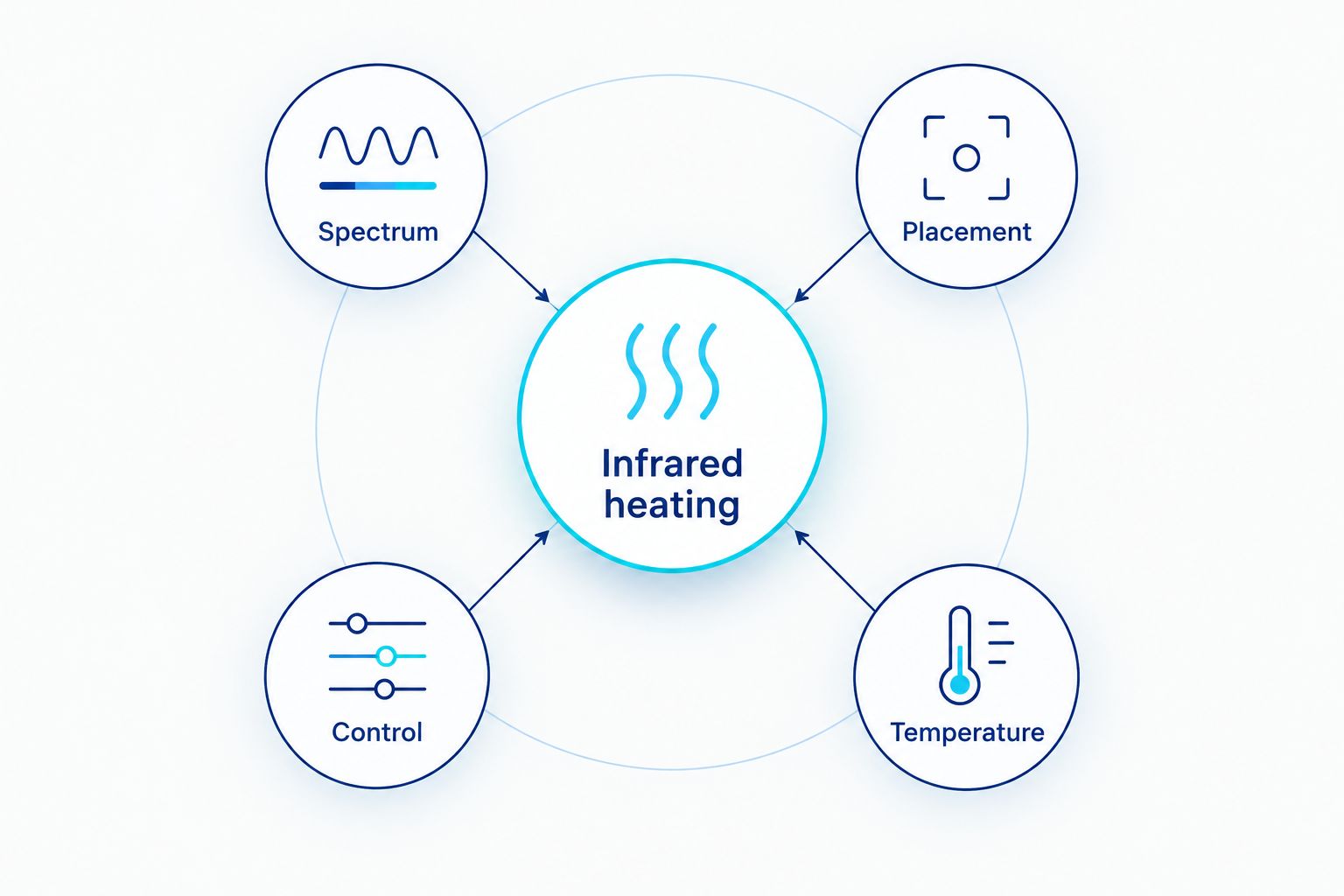
Two cabins can share a full-spectrum label while differing in heater placement and controls. Conversely, a far-infrared cabin can remain a relevant alternative when your actual requirement is an indoor heated cabin rather than a particular wavelength combination.
Choose the heating category deliberately. Do not buy a far-infrared model expecting an undocumented feature, and do not assume a broader spectrum label establishes better results.
How to check room and electrical compatibility
Start with the installation manual for the exact model. Product photographs do not show all required clearances, connection details, or assembly constraints.
Measure the proposed location and the delivery route separately. An assembled cabin's dimensions do not necessarily describe its packaged panels, and a cabin that fits the room still needs space for its door and any specified service access.
Use this sequence before ordering:
- Measure the room: Record available floor space and ceiling height.
- Check door movement: Plot the sauna door's opening path without blocking circulation.
- Check delivery access: Compare the manufacturer's package information with doorways, turns, and stairs.
- Confirm electrical requirements: Give the model's electrical specifications to a qualified electrician.
- Review assembly instructions: Confirm the required access, location conditions, and installation sequence.
Do not prescribe a standard household circuit from the sauna's seating capacity. A two-person designation is not an electrical specification, and the presence of a familiar-looking plug does not replace the installation instructions.
In 2026, apply the same discipline to controls and connectivity. Treat timers, remote operation, and independently adjustable heater zones as model-specific features that require explicit documentation.
Low EMF, wood, and glass: useful details with limits
Low EMF needs a measurement context. Ask which field was measured, the unit used, the distance from the heater, and the operating conditions. Without those details, the phrase does not provide a complete basis for comparing cabins.
Hemlock identifies the wood used in the named models. It does not, by itself, establish every component's construction, a particular adhesive system, or suitability for someone with a material sensitivity.
Glass doors identify a construction feature. A heated glass door is a separate feature, but its name does not quantify heat output or establish how much infrared energy reaches a seated user.
For any safety certification claim, request the certification name and confirmation that it applies to the complete model rather than only an individual component. Keep medical claims separate: a construction specification is not evidence that a sauna treats a condition.
Product-specific shortlist
Aeva Vital's shortlist below contains infrared alternatives discussed in this guide, not a certified ranking of full-spectrum systems. Select by the stated seating category and layout, then check the exact model's documentation against your requirements.
The product cards preserve the supplied product names and listed figures. A listing figure does not establish installation cost, electrical compatibility, or spectrum coverage.


How the alternatives are ranked
The ranking prioritizes the most explicit heating-panel specification first, a distinct room-layout option second, and larger stated seating capacity third. Each model occupies a different decision slot rather than competing for an unsupported best-overall title.
No medical outcomes, measured heating performance, or full-spectrum capabilities determine this order. Those conclusions require evidence beyond a product name or brief construction description.
Which infrared sauna should you choose in 2026?
If full-spectrum output is non-negotiable, choose only a model that documents near-, mid-, and far-infrared coverage. Do not substitute a combined-heater description for that documentation.
If far-infrared heating meets your requirements, start with the double-door model for its stated seven-panel construction. Consider the corner model when layout drives the decision, or the three-person model when shared seating is the priority. In every case, room fit and electrical compatibility come before accessories.
FAQ
What's the best full spectrum infrared sauna in 2026?
The best choice is a model with documented near-, mid-, and far-infrared output that also meets your room and electrical requirements. The alternatives ranked here do not establish a full-spectrum winner.
Is a far-infrared sauna the same as a full-spectrum sauna?
No. Far-infrared identifies one infrared region, while full-spectrum sauna marketing generally refers to near-, mid-, and far-infrared coverage.
Does having carbon and ceramic heaters make a sauna full-spectrum?
No. Carbon and ceramic identify heater technologies, not documented wavelength coverage. Check the exact model's heater specifications before accepting a full-spectrum claim.
Does having seven heating panels make a sauna better?
Seven panels describe the heater count, not overall performance. Placement, output, controls, and cabin dimensions are separate factors.
Which Aeva Vital sauna is designed for three people?
The Premium Low EMF 3-Person Hemlock Infrared Sauna – Heated Glass Door Design carries a three-person designation. Confirm usable bench dimensions before assuming it provides the seating space your household needs.
What should I ask about a low-EMF sauna claim?
Ask for the measured field, unit, measurement distance, and operating conditions. Those details are necessary for a meaningful comparison between models.
Can I plug any two-person infrared sauna into a regular outlet?
Do not assume outlet compatibility from seating capacity. Check the exact model's voltage, current, plug configuration, and circuit requirements with a qualified electrician.
Is a corner sauna automatically better for a small room?
No. A corner configuration is a layout choice, not proof of a smaller footprint. Compare exterior dimensions, door movement, assembly access, and required clearances.
Related guides
One last thing
Before choosing a sauna in 2026, write down whether you need documented full-spectrum output or simply an infrared cabin that fits your home. That single distinction prevents a panel count, heated door, or larger seating label from answering the wrong buying question.